
iPad mini (2026) Geekbench 7 Hardware Check: A20 Pro Five-Core CPU Trails iPhone 18 Pro Max, Leads Some iPads
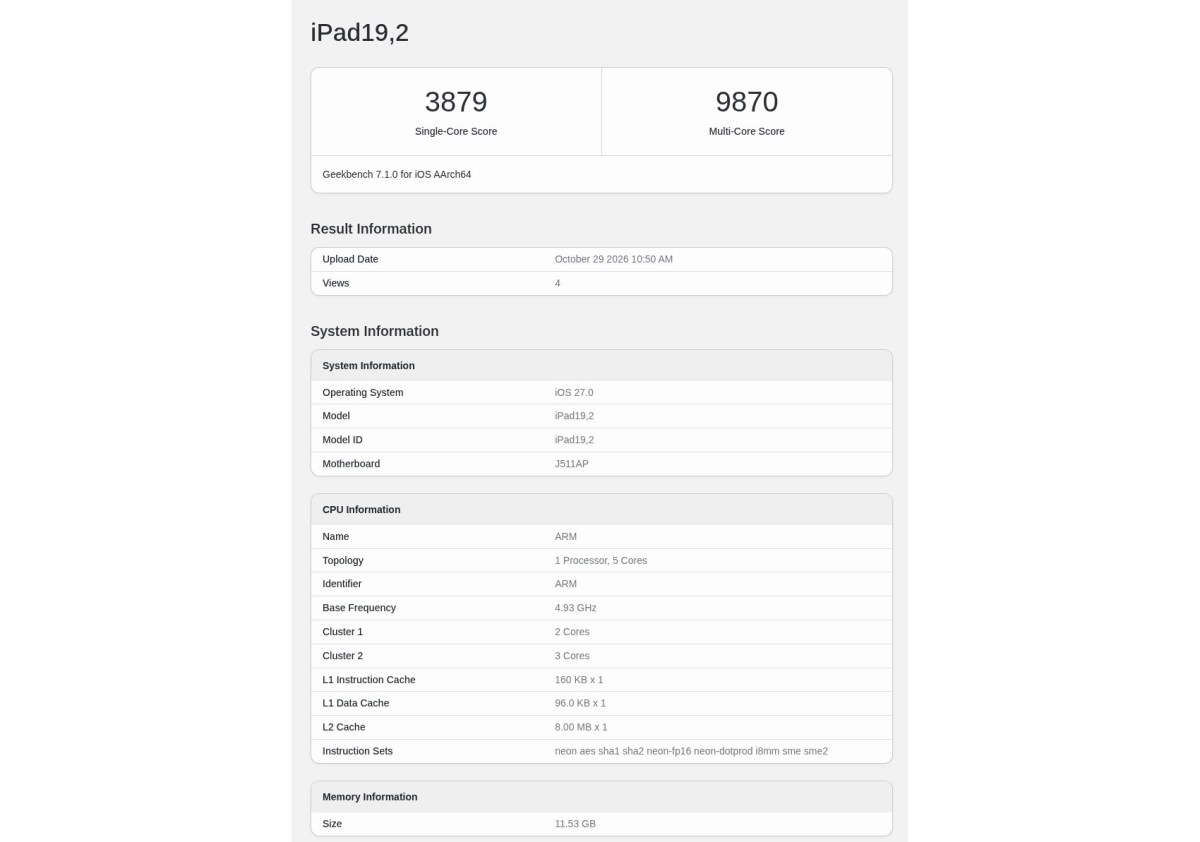
Apple's next-generation compact tablet has appeared in the Geekbench 7 database, and the published results give hardware buyers a more precise way to position iPad mini (2026) against phones, the older mini, and larger Apple tablets. The headline figures are 3879 points in the single-core test and 9870 points in the multi-core test. Those numbers are not simply "faster" or "slower" in one direction: they show a device whose single-thread result is close to the six-core A20 Pro chip in iPhone 18 Pro Max, while the multi-thread result exposes the cost of using a five-core CPU instead of a six-core CPU.
For MyTechDailyNews Hardware readers, the more useful detail is the core layout behind the score. The model entry listed as iPad19,2 in the Wi‑Fi + Cellular configuration uses five CPU cores: two performance cores and three power-efficient cores. The performance cores reach 4.93GHz. This is a trimmed A20 Pro variant, and that trimming appears tied to the storage option rather than to a different brand of silicon. The tested profile points to the 128GB or 256GB version, where one power-efficient core is disabled; the full six-core A20 Pro processor is reserved for the 512GB model.
Geekbench 7 score summary: compact tablet, phone baseline, and iPad comparisons
The table below summarizes the Geekbench 7 data points cited in the benchmark entry and comparison set. The purpose is not to declare one device universally better, but to separate two different performance questions: how responsive a single task can be, and how much parallel throughput the silicon provides.
| Device | CPU configuration in the cited data | Geekbench 7 single-core | Geekbench 7 multi-core | Reading of the gap |
|---|---|---|---|---|
| iPad mini (2026) | five-core CPU, two performance cores, three power-efficient cores, 4.93GHz | 3879 | 9870 | Strong single-thread result for a five-core layout |
| iPhone 18 Pro Max | six-core A20 Pro chip | 4024 | 11424 | The tablet trails by about 4% in single-core and about 14% in multi-core |
| Previous iPad mini | A17 Pro, trimmed version | 2638 | 7103 | The new model is about 47% higher in single-core and about 39% higher in multi-core |
| 13-inch iPad Pro | M5 chip | 3580 | 15126 | iPad mini (2026) is about 8% ahead in single-core; iPad Pro is about 53% ahead in multi-core |
| 13-inch iPad Air | M4 chip | 3206 | 12686 | iPad mini (2026) is about 21% ahead in single-core; iPad Air is about 29% ahead in multi-core |
Why the five-core CPU changes the comparison
The most important hardware detail is not only that Apple uses an A20 Pro family chip, but that it uses a five-core CPU in this configuration. The core split is explicit: two performance cores handle latency-sensitive work, while three power-efficient cores carry additional parallel work. In the Geekbench 7 comparison, the gap to iPhone 18 Pro Max is modest in the single-core test, about 4%, because the single-thread result is often shaped by the performance core behavior rather than by the total core count. The multi-core gap is larger, about 14%, which aligns with the fact that the tested iPad mini has one CPU core fewer than the six-core A20 Pro chip referenced for iPhone 18 Pro Max.
Storage configuration is also central here. The 128GB and 256GB versions are described as using a reduced A20 Pro layout with one power-efficient core masked, leaving five cores total. That means a buyer comparing only the chip name can miss a real difference. The 512GB model is where the six-core A20 Pro processor appears in the cited data. This is not a new pattern for Apple: the previous iPad mini also used a trimmed A17 Pro version, so the current model continues a product-line practice rather than presenting a one-off exception.
The memory line is another point worth separating from marketing claims. The benchmark information shows 12GB memory on the new iPad mini, but, as noted in the source comparison, Apple's official marketing materials did not mention this specification. For hardware readers, that means the 12GB memory figure should be treated as part of the Geekbench-derived configuration data, not as a headline feature confirmed by the product marketing page.
Generational jump and cross-device context
- Compact-tablet upgrade: Against the previous iPad mini, iPad mini (2026) scores 2638 to 7103 versus 3879 and 9870, meaning the cited uplift is about 47% in single-core and about 39% in multi-core.
- Phone comparison: Against iPhone 18 Pro Max, the tablet is not in a different performance class in the single-core result; the difference is about 4%.
- Core-count effect: Against the same A20 Pro family, the tablet's five-core layout creates a larger multi-core gap, about 14%.
- Big-screen tradeoff: The 13-inch iPad Pro with M5 chip still wins the multi-core conversation by about 53%, while the smaller iPad mini (2026) can be ahead in single-core by about 8%.
- Air comparison: The 13-inch iPad Air with M4 chip is about 29% ahead in multi-core, but the new mini leads by about 21% in single-core.
These comparisons show a clear pattern: a smaller Apple tablet using an A20 Pro five-core CPU can compete surprisingly well in the Geekbench 7 single-core dimension, while a larger iPad using an M-series processor still maintains a multi-core advantage. That is not a contradiction; it is the direct consequence of core count and parallel scaling. If a workload benefits from many execution threads, the M-series devices have more headroom. If the workload is dominated by responsiveness on a single thread, the compact iPad mini (2026) looks much closer to premium silicon than its size alone might suggest.
Common misconceptions before judging the score
- A five-core CPU does not mean the device is uniformly about five-sixths as fast as a six-core CPU. The about 4% single-core difference and about 14% multi-core difference are different measurements, and they answer different usage questions.
- The A20 Pro name alone does not guarantee the six-core layout. The cited data ties the trimmed five-core A20 Pro variant to 128GB or 256GB configurations, while the 512GB model is where the full six-core A20 Pro processor appears.
- 12GB memory should not be read as an advertised feature if the marketing material did not state it. Here, it is a benchmark-recorded specification, not a confirmed promotional claim.
- A single benchmark is not a complete verdict. The Geekbench 7 numbers are useful for CPU comparison, but the article data does not provide display, battery, thermals, GPU, or real-app performance, so the conclusions should stay limited to the cited processor results.
Action advice for hardware readers and buyers
If the purchasing question is "is the new mini a meaningful performance upgrade over the old mini?", the cited Geekbench 7 numbers point clearly yes: 3879 and 9870 versus 2638 and 7103 translate to about 47% and about 39% improvement. If the question is "can it sit close to iPhone 18 Pro Max in single-thread responsiveness?", the answer supported by the data is also yes, because the gap is only about 4%. If the question is "can a five-core iPad mini beat the multi-core scaling of a full six-core A20 Pro chip or an M-series iPad?", the data says no: it trails iPhone 18 Pro Max by about 14%, and the 13-inch iPad Pro and 13-inch iPad Air remain ahead in multi-core by about 53% and about 29%, respectively.
For readers comparing storage variants, the practical advice is to check which A20 Pro configuration matters for the intended workload. The benchmark result of 3879 / 9870 belongs to the five-core CPU version with two performance cores and three power-efficient cores, and the configuration points to 128GB or 256GB with one power-efficient core disabled. If the decision is based on the six-core A20 Pro processor, the 512GB version is the cited placement for that full layout. Price and availability, as stated in the article, are from $699, €749, or £699, and iPad mini (2026) is currently open for pre-orders.
Final take: what the benchmark data supports
The Geekbench 7 result positions iPad mini (2026) as a compact tablet with unusually strong single-core reference numbers inside the compared iPad set. The five-core A20 Pro CPU is close to the iPhone 18 Pro Max's six-core A20 Pro chip in single-core performance, but the missing one CPU core becomes more visible in multi-core, where the tablet trails by about 14%. At the same time, the generational move over the previous iPad mini is substantial: about 47% higher single-core and about 39% higher multi-core. The broader conclusion is that Apple's M-series processors still dominate the multi-core side in the larger iPad Pro and iPad Air comparisons, while the iPad mini (2026) can exceed some of them in single-core, a result that gives hardware-focused buyers a clearer reason to weigh core count, storage variant, and workload type together rather than relying only on the chip name.