
MyTechDailyNews Hardware Lab: Intel Moon Lake and Wildcat Lake Refresh Leak Spec Breakdown
How to Read This Leak: A Segmentation Story for Intel Entry Hardware
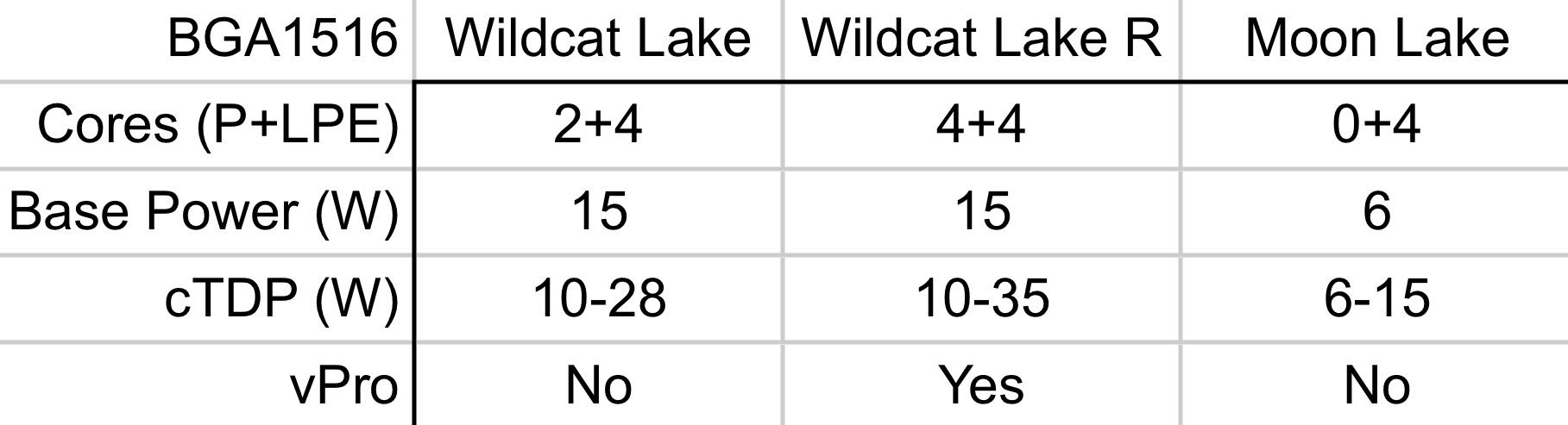
For MyTechDailyNews Hardware readers, the most useful part of the information attributed to Jaykihn on October 29 is not a single benchmark number, but the way it separates three entry-level Intel processor targets. Moon Lake appears as an efficiency-first part that may keep the same BGA 1516 package as Wildcat Lake, use a compute chip based on the Intel 18A process, and rely on a chiplet layout rather than a traditional monolithic design. The stated core mix is up to 4 Darkmont low-power efficiency cores, with no traditional performance cores. Its base power is described as about 6 W, while configurable power can reach up to 15 W. If confirmed, that would make Moon Lake one of the more unusual products Intel has brought forward for ultra-low-power devices in recent years, because it leans toward small silicon area, lower power and lower system cost instead of balancing performance cores with efficiency cores.
Wildcat Lake Refresh points in a different direction. The leaked core configuration is up to 4 Cougar Cove performance cores plus 4 Darkmont low-power efficiency cores, compared with the existing Wildcat Lake baseline of up to 2 performance cores and 4 low-power efficiency cores. That single difference turns the refresh into a core-count upgrade story, not just a minor naming change. vPro support is also expected, which broadens the discussion beyond consumer notebooks. Because Intel has not announced final naming, prices or availability, the practical value of this leak is to help readers understand where each product would fit before a purchase.
Spec Matrix: Core Counts, Power Envelopes and Package Signals
Data citation: the table below summarizes the leak attributed to Jaykihn on October 29. It is an editorial comparison, not an official product sheet, and any missing or unconfirmed field should be treated as pending Intel confirmation.
| Hardware signal | Existing Wildcat Lake | Wildcat Lake Refresh leak | Moon Lake leak |
|---|---|---|---|
| Package and layout | Wildcat Lake is the reference part using the BGA 1516 package and already uses a separate chip design. | Not separately confirmed, but it is positioned as an upgrade branch of Wildcat Lake. | Same BGA 1516 package as Wildcat Lake, with separate chip design. |
| Compute silicon | Existing Wildcat Lake combines a compute chip based on Intel 18A with I/O silicon made on another process. | Process details are not fully restated in the leak. | Compute chip based on Intel 18A process. |
| Core configuration | Up to 2 performance cores and 4 low-power efficiency cores. | Up to 4 Cougar Cove performance cores and 4 Darkmont low-power efficiency cores. | Up to 4 Darkmont low-power efficiency cores, with no traditional performance cores. |
| Power profile | 10 to 28 watts. | 10 to 35 watts. | About 6 W base power, up to 15 W configurable power. |
| Graphics expectation | Graphics configuration is not restated in the leak. | Expected to continue Xe3 integrated graphics; core count may not change much. | May use Xe3 architecture integrated graphics, but GPU core count is unclear. |
| Enterprise platform | Not described in the leak. | Expected to add vPro platform support. | Not described in the leak. |
Wildcat Lake Refresh: More Performance Cores Are the Main Upgrade
The clearest hardware change in Wildcat Lake Refresh is the jump in performance core count. The existing Wildcat Lake family is described as having up to 2 performance cores and 4 low-power efficiency cores; the leaked refresh moves that ceiling to up to 4 Cougar Cove performance cores while still carrying 4 Darkmont low-power efficiency cores. For a budget notebook, that matters because the performance cores carry the heavier foreground workload, while the efficiency cores handle background and lighter tasks. The main upgrade direction is adding performance cores rather than replacing the entire processor design.
In everyday use, that extra performance-core capacity could make complex office work, several programs at once, and light creation tasks feel more comfortable. The leak also gives a higher power ceiling: Wildcat Lake Refresh is expected to cover a base power range of 10 to 35 watts, compared with 10 to 28 watts for current Wildcat Lake. That higher window lets notebook makers release more CPU headroom when the cooling system can support it. The trade-off is thermal design pressure: a wider power range can mean higher heat output and a stronger demand on chassis cooling and battery endurance.
Moon Lake: Low-Power First, With Clear Use-Case Boundaries
Moon Lake is the opposite profile. The leaked description says it may stop at up to 4 Darkmont low-power efficiency cores, remove traditional performance cores, run with a base power of about 6 W, and offer configurable power up to 15 W. That makes it fit the type of hardware where efficiency and cost control dominate: Chromebook, entry notebook, lightweight devices, and general online tasks. Web browsing, document editing, online video and basic office work are the kinds of workloads that can be served by low-power cores without needing the sustained high-load capability of a performance-core part.
The boundary is just as important. Without traditional performance cores, Moon Lake may struggle with sustained high-load jobs such as complex software compilation, heavy image processing, busy multitasking, or applications where strong single-threaded performance is decisive. The actual experience will still depend on factors that the leak does not fully specify, including core frequency, cache capacity, memory bandwidth and operating system scheduling. Graphics also remains an open question. Xe3 architecture integrated graphics are mentioned as a possibility, but the number of graphics cores is not confirmed. If Moon Lake is positioned below existing Wildcat Lake, its graphics and media capability may be more limited as well.
vPro and Chiplets: Why the Leak Has Procurement Consequences
For IT procurement staff, the vPro note is one of the most operationally relevant details. Wildcat Lake Refresh is expected to add vPro platform support. vPro is Intel platform technology for enterprise computing devices, covering remote management, security functions and fleet-level device administration. If that support arrives in an entry-level refresh, the product line may no longer be limited to ordinary consumer notebooks; it could appear in more business laptops and managed commercial endpoints.
The chiplet or separate-chip design also matters. Both processors are expected to use this approach, dividing compute and I/O functions into different chips and linking them through inter-chip technology. Existing Wildcat Lake already uses a split where the compute chip is based on Intel 18A and the I/O chip uses another process. That combination lets Intel avoid making every function with the most advanced node, which can help control the cost of lower-priced parts. For hardware buyers, the same idea may influence how OEMs tune different notebook models even when the processor family name looks similar.
18A, RibbonFET and PowerVia: Advanced Process Does Not Guarantee Entry-Level Performance
The leak mentions Intel 18A and 18A advanced process in the context of entry-level products. Intel 18A is an advanced manufacturing node and part of the broader push toward advanced domestic semiconductor production. It introduces RibbonFET gate-all-around transistors and PowerVia backside power delivery, with the goal of improving transistor density, power delivery efficiency and performance behavior. Applying that node to lower-tier silicon is a signal that Intel wants to push advanced manufacturing into cheaper products.
But the hardware point needs nuance: an advanced node does not automatically produce a faster laptop in real use. Entry-level results are still shaped by product cost, core count, cache capacity, memory bandwidth, package design and chassis cooling. Moon Lake could use the Intel 18A process and still deliver lower absolute performance than a higher-tier processor because it has fewer effective cores and tighter power limits. For readers comparing notebooks, the process name is a background signal, while the workload fit, cooling behavior and sustained power matter more.
Market Pressure: Apple MacBook Neo, Qualcomm Windows Notebooks and the Low-Price Segment
The product segmentation is easier to see when placed against low-cost PC competition. The leak suggests Intel is trying to divide budget computing into clearer layers: Wildcat Lake targets budget notebooks, student machines and lightweight business systems; Wildcat Lake Refresh moves toward parts that need stronger CPU capacity; Moon Lake points to very low power and low-cost devices, including Chromebook and other entry products.
This also reflects pressure from Apple MacBook Neo, Qualcomm-powered Windows notebooks and other low-cost computing devices. In that environment, a traditional entry laptop can no longer rely only on old processor silicon and a low-cost manufacturing story. Intel appears to be using the 18A advanced process, separate chip design and different core combinations to keep cost under control while still presenting a competitive hardware value. For MyTechDailyNews Hardware readers, the result is likely a market where the same price band contains parts with very different performance priorities.
Hardware Checklist: What Still Needs Confirmation Before a Purchase
- Final names, prices and official launch dates are still not confirmed by Intel.
- Moon Lake and Wildcat Lake Refresh specifications come from the Jaykihn leak dated October 29 and need official validation.
- Core frequency, cache capacity, memory bandwidth and OS scheduling are not fully specified, but they determine whether low-power cores feel adequate.
- Xe3 graphics core counts remain unclear, especially for Moon Lake.
- The actual power limits set by each notebook model matter as much as the processor stated configurable power range.
- Wildcat Lake Refresh may arrive in the first half of 2027, but this timing is still unconfirmed.
Action Guide: Which Entry-Level Laptop Buyer Should Pay Attention
- For Chromebook, light online work and basic office use, Moon Lake efficiency-first layout is the most relevant leak. Watch for whether OEMs pair it with adequate memory and cooling rather than pushing it into heavier workloads.
- For users who multitask across office applications, browser tabs and light creation tools, Wildcat Lake Refresh is the more useful upgrade path because the leaked core mix adds Cougar Cove performance cores while still keeping Darkmont low-power efficiency cores.
- For small and medium business buyers, vPro support in Wildcat Lake Refresh is the key procurement signal. If that support arrives as expected, buyers managing fleets should watch whether the model includes the required enterprise platform features.
- For thermal-sensitive thin-and-light notebooks, do not assume the higher 10 to 35 watts range is automatically better. A smaller power window can be preferable if the chassis cannot sustain heat.
- For buyers comparing low-price systems, track performance core count, actual power limits, integrated GPU configuration and thermal design, not just the processor family name.
Common Misconceptions: Where Readers Should Not Overread the Leak
- Do not treat Moon Lake as a full replacement for mainstream entry laptops. It is described as efficiency-only or performance-core-free in the leak, which changes its workload ceiling.
- Do not equate Intel 18A with guaranteed faster performance in cheap machines. The node is advanced, but core mix, cache, memory bandwidth and cooling remain decisive.
- Do not assume Wildcat Lake Refresh is a new architecture. The leaked description emphasizes more performance cores, especially up to 4 Cougar Cove performance cores, rather than a complete architectural change.
- Do not treat vPro as a marketing term for consumers. For enterprise buyers, it changes manageability and security relevance, but for casual home users it may have little impact.
- Do not compare Xe3 graphics between these parts without GPU core counts. The leak says core numbers are unclear, and the lower tier may have limited graphics capability.
Final Takeaway for Hardware Buyers
MyTechDailyNews Hardware sees the Jaykihn October 29 leak as a product-line split: Moon Lake would chase lower power and lower cost, while Wildcat Lake Refresh would chase stronger entry-level CPU handling through a higher performance-core count and vPro support. The useful conclusion is not to choose the most advanced-sounding name, but to match the core mix, power ceiling, graphics expectation and thermal design to the workloads that will actually run on the machine. Until Intel confirms final parameters, names, pricing and launch date, readers should treat this as a planning signal rather than a confirmed hardware review, especially with a possible Wildcat Lake Refresh window in the first half of 2027 still pending verification.