
Hardware Kit Check: Innodisk GMSL2 camera starter kit for four 3-Mpixel edge AI vision workflows
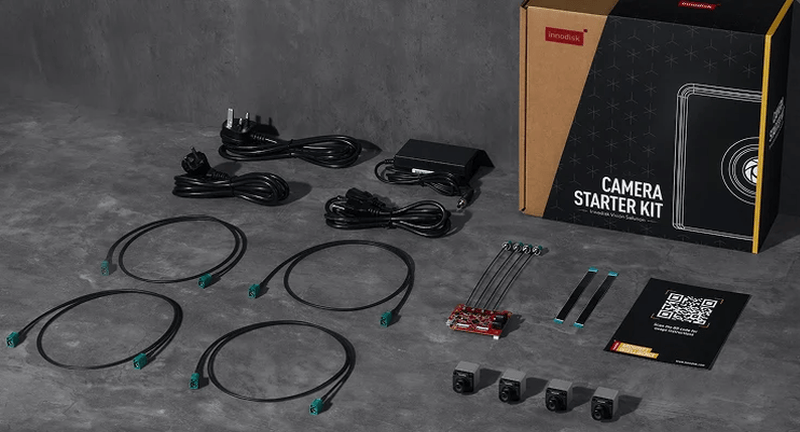
MyTechDailyNews Hardware treats this product as a bring-up bundle, not a simple camera purchase. The listed GMSL2 camera starter kit from Innodisk is aimed at teams that need to prove a multi-camera edge AI vision concept before deciding how far development, validation, or later customization should go.
The bundle centers on several inputs rather than one sensor path: four 3-Mpixel modules, the named MIPI CSI-2-to-GMSL2 capture card, cables, power items, and software support tied to the NVIDIA Jetson Orin Nano Super Developer Kit. The procurement question is therefore not only whether the listed parts exist, but whether the package is the right starting point for a perception workload that may eventually require a production-ready deployment.
Kit contents and decision relevance
| Listed item | Role in the kit | What a hardware buyer should verify |
|---|---|---|
| four 3-Mpixel GMSL2 camera modules | Forms the multi-camera input base for initial edge vision work. | The modules are described as fixed-focus, so the intended field of view and mount geometry should be reviewed against that constraint. |
| MIPI CSI-2-to-GMSL2 capture card | Named interface hardware included with the four cameras. | Confirm that the capture path fits the chosen evaluation host workflow instead of treating it as an unrelated camera accessory. |
| four 1-meter GMSL2 FAKRA cables | Bundled physical links between the camera modules and the capture environment. | The supplied reach is explicitly 1-meter, so bench spacing should be checked before assuming other distances are included. |
| power adapter and power cords | Power accessories that complete the listed starter package. | Check that the included power items match the evaluation setting and that the team plans its bench connections clearly. |
| camera source code | Software reference provided for the NVIDIA Jetson Orin Nano Super Developer Kit. | Use the named NVIDIA platform as the documented reference point rather than an unspecified host assumption. |
Interface data and evaluation numbers
For this kind of hardware kit, the most useful data points are short and verifiable. GMSL2 is described here as a serial video link intended for real-time transmission. The bandwidth figure given for the forward channel is up to 6 Gbps. That value is an interface-data reference, not a claim about overall application performance.
- Pixel class: four 3-Mpixel camera modules are bundled.
- Focus behavior: the camera modules are described as fixed-focus.
- Link type: GMSL2 is presented as a serial video-transport technology.
- Forward-channel rate: the listed figure is up to 6 Gbps.
- Reference host: NVIDIA Jetson Orin Nano Super Developer Kit.
- Reference software: camera source code for the named NVIDIA platform.
Why the pre-integrated angle matters
The kit presents itself as a shortened bring-up route. Hardware parts, capture hardware, and Jetson-oriented software are assembled together, so a team need not spend as much early effort sourcing components, stitching the stack together, debugging drivers, or manually tuning the first camera path. That makes the product most relevant to teams that want to test a multi-camera perception path before committing to a longer development cycle.
Still, the product description positions the bundle at an early stage. It is not presented as the end of the engineering process. After a first validation pass, the described path leads to customization support from Innodisk, covering hardware adjustment up to edge deployment. In other words, the kit can shorten the first bring-up phase, but the final production fit remains a separate decision.
Named application targets
The target domains are specific enough to help screening. The named scenarios are heavy-duty vehicle blind-spot detection and ADAS, as well as object recognition and environmental perception for humanoid robots and autonomous mobile robots. These are perception-heavy use cases, which matches the kit’s multi-camera framing. The description does not imply a universal mounting plan or a single cable route; it points to edge vision tasks for which the starter kit can be evaluated.
The fixed-focus modules and 1-meter FAKRA cabling should be read as practical hardware constraints within those target domains. They help set expectations for early prototyping, especially when the layout, viewing geometry, or physical distance differs from a simple bench setup.
Common misconceptions
- “It is only a camera pack.” The listed GMSL2 camera starter kit includes more than the four 3-Mpixel modules: the named capture card, cables, power items, and platform-specific camera source code.
- “The starter kit is already a production deployment.” The description emphasizes initial validation, followed by customization when needed.
- “up to 6 Gbps is the whole system’s visible performance.” The figure describes a forward-channel interface rate, while application behavior also depends on the camera chain, capture card, software, host, and target task.
- “Any NVIDIA Jetson target is equally covered.” The listed platform is specifically the NVIDIA Jetson Orin Nano Super Developer Kit.
- “The supplied cable reach solves every layout.” The bundle lists four 1-meter GMSL2 FAKRA cables, so installation geometry should be checked against that reach.
Action checklist for integration teams
Before purchasing the offering identified as EKIT-B14-001, a hardware team can use this short checklist to keep the evaluation aligned with the listed scope:
- Decide whether the evaluation really requires four camera inputs rather than a simpler single-camera test.
- Check that the NVIDIA Jetson Orin Nano Super Developer Kit is acceptable as the reference platform for the supplied camera source code.
- Map the planned task to one of the named domains: heavy-duty vehicle surround awareness, or robot object recognition and environment perception work.
- Compare the actual cable path with the included four 1-meter GMSL2 FAKRA cables.
- Treat the purchase as a validation platform, then define what would trigger hardware fine-tuning or application-deployment customization.
- Record the key cited parameters in the test plan: four 3-Mpixel modules, fixed-focus, GMSL2, up to 6 Gbps, 1-meter FAKRA, and the NVIDIA reference platform.
Data citations
All technical references in this kit check come from the product description itself. They include the bundle composition, the 3-Mpixel camera count, the named MIPI CSI-2-to-GMSL2 capture card, the GMSL2 link definition, the up to 6 Gbps forward-channel figure, the four 1-meter GMSL2 FAKRA cables, the NVIDIA Jetson Orin Nano Super Developer Kit reference, the customization path after validation, and the product code EKIT-B14-001.
Hardware take
The practical conclusion for MyTechDailyNews readers is that this is a hardware bring-up bundle for multi-camera edge AI vision experiments. It makes the most sense when the team values reduced sourcing and integration effort, has the named NVIDIA reference platform as the starting point, and can accept the listed fixed-focus, 3-Mpixel, 1-meter FAKRA, and validation-stage scope. If those conditions match the evaluation plan, the GMSL2 camera starter kit can serve as a compact platform for proving a concept before moving toward deeper customization.