
Hardware Buyer Case Read: Surviving 2026 Parts Risk in Europe and the US | MyTechDailyNews
In 2026, the real question for hardware buyers in Europe and the US is no longer simply can I get the part? It is whether the part arrives on schedule, matches the datasheet, and still works after integration. A single chip stretching from 8 weeks to 20 can stop a line, so the practical answer is to read supply risk as a hardware specification: lead time, traceability, and test evidence all matter.
What happened in the parts market?
The market passed through a full downcycle over the past three years. Demand contracted, inventory piled up, and prices fell. Many buyers thought the squeeze was over. The reality is uneven: mainstream part numbers can be easy, while allocation, end-of-life, or hard-to-find parts move from weeks to months overnight. Chang Ming draws this lesson from twelve years in the supply chain: poor-quality components cost more than money; they cost time. Public sourcing reports reinforce the case. iBS Electronics said in July 2026 that average component lead times had increased from 16.7 weeks in February 2026 to 20.6 weeks, with seven categories severely constrained. That is a supply-chain problem, but it becomes a hardware problem the moment a substitute part changes timing, thermal margin, or certification status.
Which scarce parts hurt hardware teams most?
In this case, three categories matter most. ADI and TI part numbers remain under chronic shortage or end-of-life pressure in Western markets; lead times can stretch to dozens of weeks, so a board cannot be planned around datasheet availability alone. NVIDIA allocation is another pressure point: AI compute demand has made allocation cycles decisive, and the practical benchmark in the Chang Ming case is holding lead times under three months rather than guessing a slot.
Memory is the third stress test. Chang Ming covers DDR5 and DDR4 support from Micron, Samsung, and SK Hynix, described as three major manufacturers. For buyers, the point is not to chase the lowest spot quote; it is to compare memory capacity risk, allocation stability, and lifetime cost across modules. NetworkWorld reported that Samsung raised prices for 32GB DDR5 modules to $239 from $149 in September, a 60% increase, while warning of an industry-wide 2026 price surge.
Lead-time checklist for a 2026 BOM
| Component class | Risk signal | Hardware decision | What to ask a supplier |
|---|---|---|---|
| ADI and TI | Scarce or EOL part stuck at dozens of weeks | Freeze alternate plan before PCB spin | Date code, lot traceability, EOL notice, authorized route |
| NVIDIA | AI allocation longer than planning cycle | Use under three months as a planning red line | Allocation proof, ship date, firmware compatibility |
| DDR5 and DDR4 | Price and supply swing by module | Compare three major manufacturers: Micron, Samsung, SK Hynix | Contract price basis, mixed-lot policy, test report |
| Power and legacy parts | Lead time can stretch from 8 weeks to 20 | Validate thermal, isolation, certification | Second source, reliability data, counterfeit screening |
How does the Chang Ming case turn supply risk into checks?
Chang Ming International Technology Co., Ltd. was founded in 2013 and works as a global hybrid distributor, combining authorized distribution with independent distribution. Headquartered in Shenzhen, it lists logistics centers in Hong Kong, Malaysia, and Japan, and serves over 3,000 customers across more than 60 countries. Its use cases include telecommunications, industrial control, power systems, automotive electronics, medical equipment, industrial IoT, and smart wearables.
For a hardware buyer, the useful part of this case is not the size of the catalogue. It is whether the distributor can separate design-in, shortage, and obsolescence problems. Authorized brand lines include ZLG (Zhiyuan Electronics), MORNSUN, Hi-Link, Wuxi MEMS, AVIA Semiconductor, and Amass. Advantage brand coverage includes TI, ADI, Infineon, NXP, ST, Microchip, Xilinx, Intel, Renesas, Toshiba, Broadcom, Marvell, Qorvo, NDK, Hamamatsu, and 24 other mainstream brands.
The service model is built in six categories, each with a hardware-specific risk lever:
- Authorized brand selection and design-in help, which shortens development cycles and reduces trial-and-error costs.
- One-stop BOM kitting, with kit-completion rates up to 90%.
- Multi-category, low-volume supply with virtually no minimum order quantity or value, useful for R&D and pilot runs.
- Scarce, allocation-constrained, end-of-life, and hard-to-find parts, sourced across Europe, North America, and Asia with over 3,000 qualified global suppliers and on-hand inventory.
- Consignment and clearance of surplus inventory to unlock tied-up capital.
- Value-added services such as Kitting and NET Terms to turn dead stock into working capital.
In other words, the six things buyers care about most map to the same list: avoiding production line shutdowns, avoiding reputational damage, avoiding breach-of-contract penalties, reducing procurement costs, improving cash flow, and accessing better value-added services.
Why quality checks matter more than price promises?
For European and US buyers, counterfeit risk is often the deciding fear. A fake part does not look like a risk on a quote. GetLEO notes that a counterfeit electronic part may be sanded, relabeled, or pulled from a scrapped board and resold as new. That is why quality should be treated as a testable workflow, not a marketing claim.
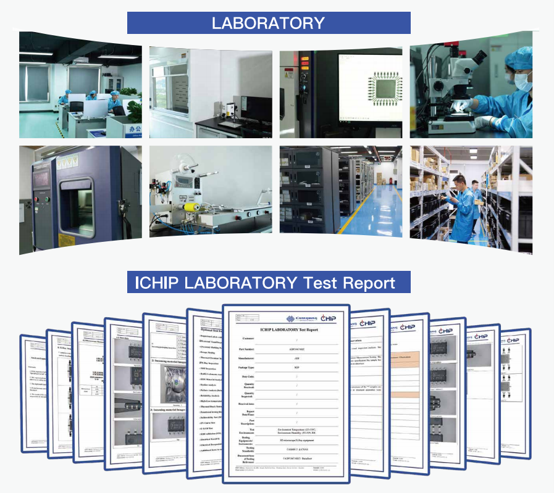
Chang Ming's answer is a nine-step quality inspection process: outer packaging inspection, documentation verification, original label validation, visual inspection, dimensional measurement, non-destructive X-ray inspection, chip decapsulation, chemical testing, and issuance of an internal inspection report. Every step is photographed, documented, and uploaded to the system, making it traceable. Chip decapsulation is performed by a third party, and chemical testing is aimed at detecting refurbished chips.
Third-party testing partners include CNAS, White Horse, which was founded in 2004 and is described as compliant with IPC and JEDEC standards, and CECC. Together they offer ten inspection services, including appearance inspection, X-ray fluoroscopy, decapsulation, cross-sectioning, solderability testing, reliability testing, and failure analysis.
Supplier grading is the quiet part of reliability
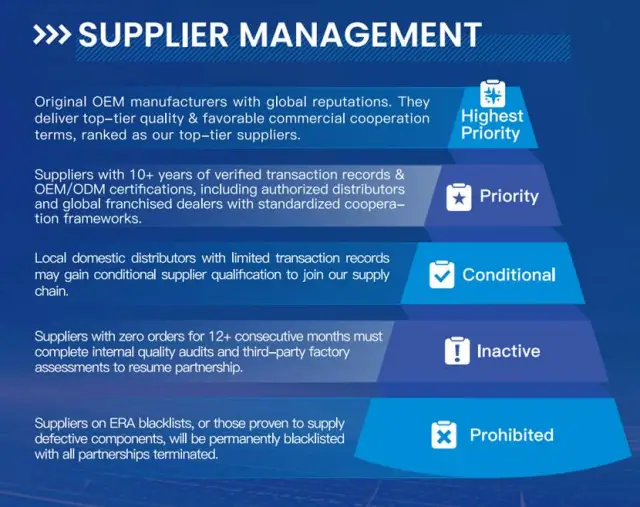
Chang Ming uses a five-tier supplier grading system, from 'Highest Priority' to 'Prohibited', supervised through SAP. Internationally renowned original manufacturers are Highest Priority; suppliers with over 10 successful transactions and QC approval are Priority; suppliers with transaction history or traceability are Conditional; suppliers with no transactions for over a year are Inactive and must pass re-inspection; suppliers on the ERAI blacklist or with poor reputations are permanently prohibited.
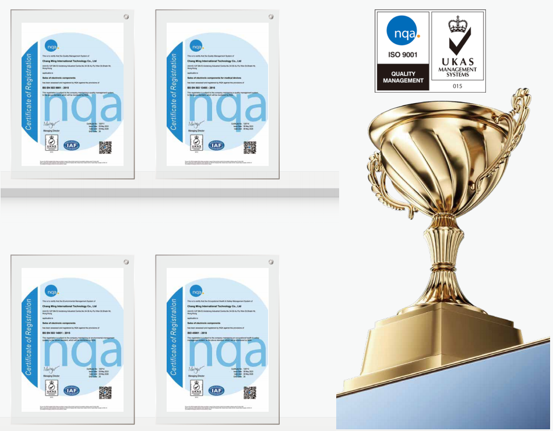
The company also lists ISO9001, ISO14001, ISO13485, and ISO45001 certifications, along with Dun & Bradstreet enterprise certification. The 365-day warranty is only as good as the screening behind it: the most rigorous supplier screening, testing methods, and inspection workflows.
Common mistakes buyers still make
- Reading price as lead time. A low quote that cannot be held is not savings.
- Assuming all standard parts are safe. iBS's 2026 data shows even normal categories can move into constrained status.
- Testing only one batch. If a supplier can mix lots, buyers need date-code and lot-level rules before first build.
- Forgetting the system penalty. If a part near a power stage or an FPGA with millions of logic gates fails, one component failure can cost both time and money.
What should hardware teams do next?
- Split the BOM into commodity, allocation, legacy, and memory tiers before asking for quotes.
- Ask for test evidence in the order of the nine-step workflow: documents, visual, dimensional, X-ray, decapsulation, chemical report.
- Treat memory as a contract item: compare three major manufacturers - Micron, Samsung, SK Hynix - and document the assumption behind the price.
- For NVIDIA, ask whether the allocation can hold under three months; if not, re-plan the line schedule instead of absorbing risk.
- For ADI and TI, request EOL or shortage notices and check whether dozens of weeks are quoted or confirmed.
FAQ: what readers ask
Is 2026 a shortage year or a verification year?
Both, but verification is more useful. The problem is not that everything is missing; it is that scarce, allocated, and end-of-life parts fail in ways that look like normal supply until a line stops.
Why can poor parts cost time, not only money?
Because a failed part can stop testing, trigger rework, delay certification, and damage customer trust. The Chang Ming case sums this in twelve years of supply-chain lessons.
What is the first thing to check in a quote?
Check whether the lead time is firm, whether the date code and lot traceability are provided, and whether counterfeit screening can be inspected. If those are absent, price is incomplete.
Final read: what to watch next
Whether it is a tiny capacitor or an FPGA with millions of logic gates, the failure of any single component on a board brings both time and economic losses to the manufacturer. The open question for teams in Europe and the US is not who will promise the fastest delivery, but who can show the smallest uncertainty: confirmed dates, traceable lots, and reports that survive a surprise audit.
As a next step, watch two signals through 2026: whether NVIDIA allocation can remain under three months at the order level, and whether memory prices from Micron, Samsung, and SK Hynix stabilize long enough for budgeting. The case is simple: a hardware purchase is not done when the part ships; it is done when the line still runs after it arrives.
References
- iBS Electronics: Component Supply Tightens in 2026 as Inventory Falls and Lead Times Extend
- NetworkWorld: Samsung warns of memory shortages driving industry-wide price surge in 2026
- GetLEO: Counterfeit Electronic Components Detection, Traceability, and DFARS
- NextPCB: Shortage of Electronic Components in 2026
- MyTechDailyNews Hardware: EUV Slot or Real Capacity?