
MyTechDailyNews Hardware Analysis: BrainChip Sequora and Akida Edge IP for Local Generative AI
When an edge hardware design needs to keep generative model execution close to the endpoint, the processor IP pairing described by BrainChip becomes relevant. The central pieces are Sequora and Akida: one is positioned for generative and sequential AI tasks, the other for continuously arriving sensor streams. For device makers evaluating earbuds, sensor nodes, and similar constrained systems, the key question is not simply whether an AI block exists, but how workload boundaries, memory behavior, signal handling, and licensing deliverables fit the silicon plan.
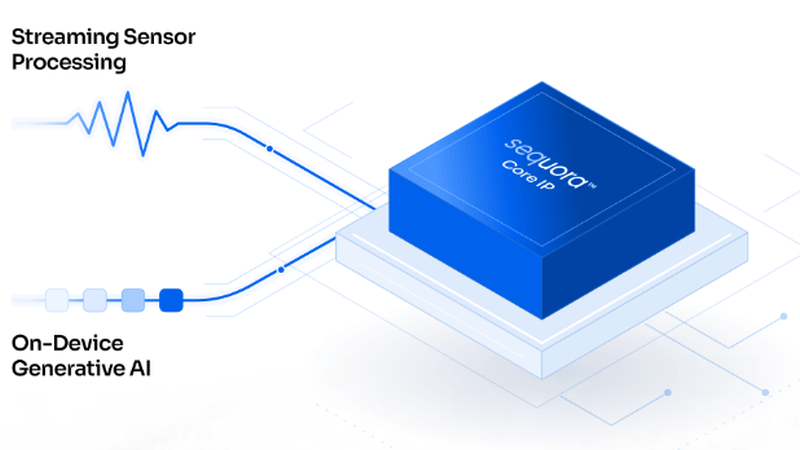
Workload separation: Akida for streams, Sequora for generation and sequence tasks
The supplied material describes a division of responsibilities rather than a single universal accelerator. In that division, Akida is associated with streaming sensor data, while Sequora is associated with generative and sequential AI execution. For hardware evaluation, this distinction is important because the inputs, timing behavior, and integration effort can differ substantially when data is continuously arriving versus when a model is producing or updating a sequence.
The streaming examples listed for Akida include vibration, audio, radar, raw RF IQ data, and biological signals. Those are all sensor-centric data classes, and they fit a front-end processing narrative. The examples listed for Sequora are on-device LLM inference, voice-to-voice interaction, and AI agents. Those are higher-level functions that consume or produce sequential information, and they align with the described role of Sequora.
From a board and SoC planning standpoint, the description therefore suggests that a design may need to evaluate two blocks as one system. Akida is presented as the workload owner for continuous sensor streams; Sequora is presented as the workload owner for generative and sequential processing. The pairing is described as complementary, so teams should review the boundaries rather than assume one block can replace the other across all functions.
Architecture review: state-space models, fixed-size state, and the unified MAC array
The core hardware points provided for Sequora are its optimization for state-space models (SSMs), its use of a unified multiply-accumulate (MAC) array, and its ISA-level support for algorithm updates through software. Each of these items maps to a different integration question.
First, SSM optimization is relevant because the supplied explanation states that these models maintain a fixed-size state to represent input history. That means memory demand does not grow with sequence length in the described model class. For constrained edge hardware, this is not a minor implementation detail; it is a direct check point against on-chip memory sizing, external memory pressure, and worst-case sequence handling.
Second, the unified MAC array is described as covering both signal processing and neural-network computation. The stated effect is that a separate DSP preprocessing stage is not required. In hardware planning terms, this can reduce one assumed subsystem dependency in the described architecture. Whether that simplification produces measurable benefits in a specific product depends on integration, but the removal of a distinct preprocessing block is the claim to validate against the RTL and verification flow.
Third, the instruction-set architecture (ISA) is described as permitting new algorithms to be deployed through software updates. For semiconductor IP procurement, this matters because algorithm life cycles can change after tape-out. The provided framing positions Sequora not only as a compute block, but as a programmable block where updates are expected to be possible at the instruction-set level.
Comparison table: what is known from the supplied description
| Hardware decision area | Akida in the supplied description | Sequora in the supplied description |
|---|---|---|
| Workload focus | Streaming sensor data | Generative and sequential AI tasks |
| Examples listed | Vibration, audio, radar, raw RF IQ data, biological signals | On-device LLM inference, voice-to-voice interaction, AI agents |
| Architecture note | Presented as complementary sensor processing | Optimized for state-space models (SSMs) |
| Memory-related description | Not separately detailed in the supplied text | Fixed-size state representing input history |
| Compute path | Not separately detailed in the supplied text | Unified MAC array for signal processing and neural-network computation |
| Update path | Not separately detailed in the supplied text | ISA supports new algorithms through software updates |
| Procurement framing | Paired with Sequora in the described approach | Licensable semiconductor IP from Brainchip Holdings |
Evaluation checklist for hardware and procurement teams
- Separate the workload map before estimating integration. Confirm which functions are sensor-stream handling and which functions are generative or sequential output generation.
- Verify each sensor type against the Akida framing: audio, vibration, radar, raw RF IQ data, and biological signals are the examples supplied in the source text.
- Verify each model-facing function against the Sequora framing: on-device LLM inference, voice-to-voice interaction, and AI agents are the examples supplied in the source text.
- Test the memory claim in your own sequence scenarios. If the design uses sequences with changing lengths, the fixed-size state described for SSMs is a specific evaluation point rather than a generic marketing statement.
- Review whether the unified MAC array description changes your block diagram. If the supplied architecture removes a separate DSP preprocessing stage, RTL, verification IP, synthesis scripts, and SDK integration should be checked against that simpler flow.
- Inspect the license deliverables. The supplied availability section identifies RTL characterized as fully synthesizable and portable across processes, plus verification IP, synthesis scripts, and an SDK containing a compiler, a C++ runtime library, and a model zoo.
Common misconceptions about this edge IP description
- Misconception: one accelerator can naturally cover both raw sensor stream processing and generative AI without architecture trade-offs. The supplied framing explicitly separates Akida and Sequora roles.
- Misconception: state-space model support is purely a software concern. The provided description ties Sequora's optimization to SSMs and fixed-size state behavior, which directly affects hardware memory sizing.
- Misconception: fixed-size state equals unlimited context for a product. It describes the model's state representation, but system behavior still depends on implementation, memory configuration, and workload integration.
- Misconception: a unified MAC array eliminates all signal conditioning concerns. The statement supplied is that separate DSP preprocessing is not required in the described architecture; real system validation still needs to test the complete input chain.
- Misconception: software-updatable ISA means all future models are automatically compatible. The claim is that new algorithms can be deployed through software updates, not that every algorithm will map without effort.
Action recommendations for a hardware purchase decision
- Write a one-page workload matrix. Divide the product's AI needs into streaming sensor handling and generative or sequential execution. Place Akida and Sequora in the appropriate columns and note every function that does not fit cleanly.
- Use the SSM memory behavior as a validation target. Build a test plan around changing sequence lengths and observe whether the fixed-size state described in the source material matches your memory constraints.
- Use the unified MAC array statement as an integration review item. Check whether the supplied RTL and verification flow actually allow the absence of a separate DSP preprocessing stage in your use case.
- Use the availability details as procurement due diligence. Because the IP is described as licensable semiconductor IP from Brainchip Holdings, ask for exact license terms, synthesis targets, verification coverage, and SDK package scope before committing silicon.
Closing perspective
For MyTechDailyNews Hardware readers, the notable point is not broad generative AI terminology alone, but the concrete ownership boundaries in the supplied description. Akida is mapped to streaming sensor data, Sequora to generative and sequential tasks, and the SSM, unified MAC, and ISA-update details are the technical hooks that make the pairing worth evaluating for constrained edge products.
When teams assess this offering, the most reliable approach is to treat the supplied facts as a checklist: workload boundaries, fixed-size state behavior, removal of separate DSP preprocessing, software algorithm updates, and the listed RTL and SDK deliverables from Brainchip Holdings. Those points define the verification and integration path more clearly than general marketing language.