
MyTechDailyNews Hardware Brief: Altech STH5 Brings 85A and 13 mm Width to Terminal Block Selection
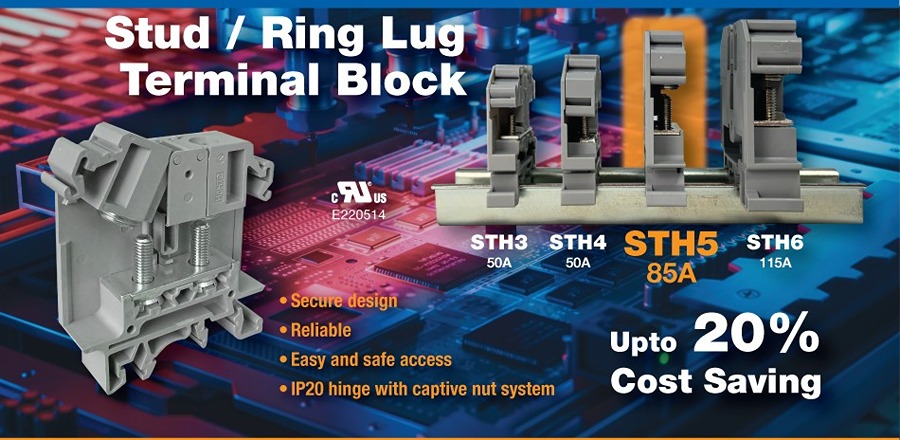
Connection density, ampacity, wire range, and service access often compete for the same panel budget. The newest named terminal block in the Altech lineup is presented against that trade-off: the STH5 is described as a narrow-body option with 85A, 600V, and 13 mm width, paired with a value case that includes easy access, secure termination, and up to 20% cost savings.
Hardware angle: why the numbers are grouped this way
For hardware evaluation, the interesting point is not that a single specification exists, but that several constraints are being published together. The source ties the model to 22–4 AWG conductors, an IP20 hinged cover, a captive nut system, and two-lug connectivity. It also places the product against uses involving vibration, machinery, transportation, and semiconductor equipment. In practical terms, those attributes answer the usual first questions for a builder: what wire can it hold, how is the connection retained, and how much module space does the part consume.
Spec sheet at a glance
| Specification field | Published value | Evaluation note |
|---|---|---|
| Model | STH5 | Named compact terminal block in the Altech lineup. |
| Current rating | 85A | Core ampacity figure for selection. |
| Voltage rating | 600V | Published voltage class. |
| Body width | 13 mm | Physical module size for density checks. |
| Wire range | 22–4 AWG | Supported conductor size window. |
| Cover and nut | IP20 hinged cover; captive nut system | Published access and retention features. |
| Connection style | two-lug | Stated connectivity arrangement. |
| Jumpers | 2, 3, and 4-pole fork and ring lug jumpers | Accessory families to confirm. |
| Material availability | UL94 V-0 | Optional material grade listed. |
| Cost position | up to 20% | Savings claim, conditional wording. |
Series map: STH5 next to STH3, STH4, and STH6
The same STH Series framing includes lower and higher current entries. The named 50A options are STH3 and STH4; the named higher option is 115A STH6. For buyers, that creates a simple current-class cross-check: stay with STH5 when the application is anchored around 85A, look toward STH3 or STH4 if 50A is the target, and evaluate STH6 if the circuit class is 115A.
| STH Series entry | Current rating | Use in comparison |
|---|---|---|
| STH3 | 50A | Lower-current model named in the family. |
| STH4 | 50A | Lower-current model named in the family. |
| STH5 | 85A | Compact model detailed in this brief. |
| STH6 | 115A | Higher-current model named in the family. |
Checklist before selecting the compact model
- Confirm whether the required current is aligned with 85A rather than a 50A or 115A class.
- Confirm that the planned conductor sizes fall within the stated 22–4 AWG window.
- Confirm that a 13 mm module width fits the available rail or enclosure spacing plan.
- Verify that the wiring approach matches the published two-lug connectivity.
- Log the IP20 hinged cover and captive nut system as separate access and retention features.
- Identify whether the design needs 2, 3, and 4-pole fork and ring lug jumpers.
- Record whether the UL94 V-0 material option must appear in the bill of materials.
- Preserve the “up to 20%” language as a conditional value claim.
Common misconceptions to avoid
- A body width of 13 mm should be read as the listed module dimension, not as a proxy for installation-level thermal behavior.
- two-lug should be read as the stated connection format, not as an implied compatibility claim for every conductor type outside 22–4 AWG.
- IP20 should be logged as the stated protection descriptor tied to the hinged cover, not rewritten into a different rating.
- UL94 V-0 should be logged as an available material option, not an automatic configuration attribute for every SKU.
- 2, 3, and 4-pole fork and ring lug jumpers should be checked as accessory pole counts and lug styles, not as universal jumper variants.
- The “up to 20%” savings wording should remain conditional in a quote record.
Actionable procurement notes
- Record 85A, 600V, 13 mm, and 22–4 AWG as first-pass spec fields.
- Log IP20 hinged cover and captive nut system separately from wire and lug data.
- Verify that the termination plan uses two-lug connectivity.
- If jumpering is expected, identify whether 2, 3, and 4-pole fork and ring lug jumpers are needed.
- If material grade is part of the bill of materials, confirm whether the UL94 V-0 option applies.
- Keep the up to 20% cost-savings wording as an optional value claim until quote-level comparison is available.
Editorial take
At MyTechDailyNews, the STH5 is most useful as a compact data point rather than a complete solution story: the published package gives hardware editors a clear set of numbers to test against a design brief. The important editorial move is to preserve the exact ratings and accessories—85A, 600V, 13 mm, 22–4 AWG, IP20, two-lug, 2, 3, and 4-pole jumpers, and UL94 V-0—while treating the up to 20% savings as a manufacturer-stated opportunity, not a guaranteed outcome. Within the STH Series, the adjacent STH3 and STH4 models at 50A, plus the STH6 model at 115A, give enough range context to make the compact model easier to place.