
MyTechDailyNews Hardware: Managing DDR3 and DDR4 Lifecycle Risk as AI Memory Demand Shifts
Long-lived hardware programs often depend on parts whose commercial future is not decided by their usefulness inside the product. For teams maintaining aerospace, defense, transportation, industrial and medical systems, the memory question is becoming more specific: AI-oriented manufacturing priorities can influence whether DDR3 and DDR4 components remain available, and whether an end-of-life notice arrives sooner than a project timeline assumes.
What the memory supply shift means for hardware selection
When a hardware designer chooses a memory device, the electrical and mechanical fit is only part of the decision. The supply decision also reflects whether the device belongs to a generation receiving capacity and investment. In the current reporting, DDR5, GDDR6, HBM3 and LPDDR5 are presented as AI-driven product priorities, while DDR3 and DDR4 remain embedded in systems expected to stay in service for years.
That creates a mismatch for procurement and engineering: a part can still satisfy the installed design, but the production ecosystem around it may be moving toward other nodes and product families. The result is not a technical failure of the component, but a lifecycle risk that can affect production, service and redesign decisions.
Quick reference: where lifecycle risk concentrates
| Planning area | Device or sector mentioned | Hardware decision relevance |
|---|---|---|
| Memory generations receiving AI investment | DDR5, GDDR6, HBM3, LPDDR5 | Capacity and investment direction can influence availability economics for older devices. |
| Legacy memory in long-life systems | DDR3, DDR4 | May face tighter supply and earlier end-of-life notices than some designers expect. |
| High-impact component categories | Processors, microcontrollers, FPGAs, memory, supporting devices | Lifecycle planning should not focus only on processors, microcontrollers and FPGAs. |
| Memory substitution parameters | Data width, speed, temperature range, package, die configuration | A capacity match alone does not prove interchangeability. |
| Support horizon examples | 10, 15, 20 years | Last-time buy quantities and inventory burdens grow with program lifetime. |
The hardware lifecycle gap, restated for product teams
The central point is that semiconductor technology cycles can be shorter than the operating lives of systems built around them. A device may remain appropriate for a board, enclosure, certification file or field service requirement long after its maker sees little commercial reason to continue it.
For validated hardware, changing a part is not a simple supplier swap. A modified design may require testing, requalification and recertification, which increases cost and program risk. Teams therefore need to separate “technically still works” from “still obtainable, traceable and supportable.”
Rank parts by what their loss would do to the product
Lifecycle reviews start by weighting each component. If a device can be replaced with little impact, an EOL notice is primarily a sourcing task. If the device is highly integrated or difficult to qualify, losing it can spread across the whole program.
The review should cover the component’s system role, whether technically suitable alternatives exist, what qualification will require, how long the program needs support and how the board, firmware or software would need to change if the hardware is altered.
Why “same memory size” is not the whole spec
Memory shows why a replacement cannot be selected by capacity alone. Compatibility can depend on data width, speed, temperature range, package, die configuration and other traits. Moving across generations can also introduce architecture and qualification questions. Even a larger capacity may need evaluation if the original system was qualified around a specific configuration.
For hardware documentation, these attributes should be captured during design and kept in the product lifecycle record. That makes future substitution analysis less subjective.
Build the plan around the program, not the notice
An EOL notice often triggers talk of last-time buy. This may not be practical for programs needing another 10, 15, or 20 years. The quantity may lock up capital, while storage, inventory management and demand changes create additional burdens.
A program-centered review should start from expected production volumes, service-life requirements, installed-base support and component criticality. Depending on that picture, the right answer could be inventory planning, continued authorized manufacturing, redesign or a mix. The important operational point is to evaluate those options before schedule pressure makes them narrower.
Common misconceptions the article addresses
- Obsolescence means the part stops working. A component can remain technically ideal long after it is no longer commercially attractive to its manufacturer.
- Only processors and FPGAs need lifecycle planning. Memory and supporting devices matter just as much to long-term availability.
- A replacement with the same capacity is a safe swap. Compatibility can depend on data width, speed, temperature range, package and die configuration, among other characteristics.
- Last-time buy always solves a long-life program. A 10-, 15- or 20-year support need can make the required inventory expensive and difficult to manage.
- Gray-market supply is equivalent to authorized supply. Discontinued parts can attract counterfeit, recycled or poorly stored devices when independent and gray-market sellers fill the gap.
Action checklist for hardware and procurement teams
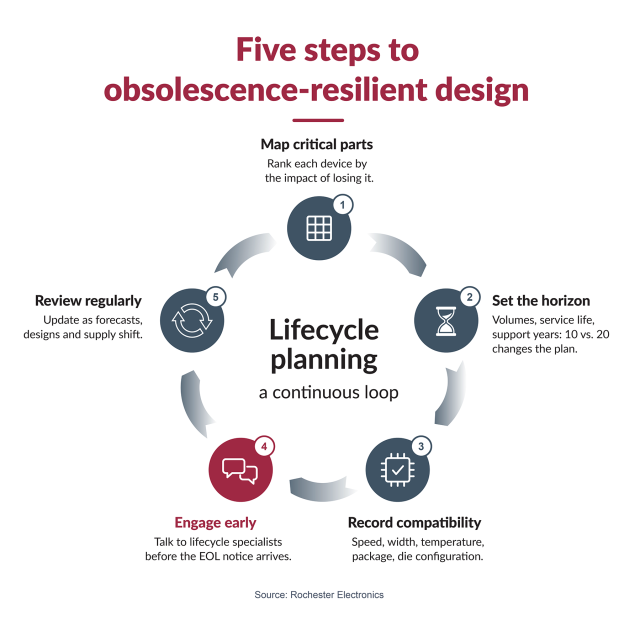
- Create a critical-parts matrix. Record why each device matters and what a replacement or redesign would affect.
- Document program lifetime. Capture production volumes, service expectations and support horizon; a 10-year plan and a 20-year plan are not the same.
- Store interchangeability parameters. For memory and similar devices, list speed, width, temperature range, package, die configuration and other compatibility factors.
- Start supplier dialogue before EOL arrives. Early information gives time to compare inventory, authorized manufacturing, redesign and support options.
- Keep lifecycle records current. Forecasts, design changes and supply-chain changes can alter the strategy, so review it regularly.
- Use traceable purchasing routes. For safety-critical or high-reliability hardware, prefer sources with traceability to the original manufacturer; the article cites Rochester Electronics as a fully authorized distributor meeting SAE AS6496.
- Review bills of materials early. Technical teams can review component lists, program timelines and component lifetimes, from one device to hundreds of line items.
Lifecycle specialists as an information layer
Engineering teams usually hold the system architecture and program requirements. Semiconductor and lifecycle specialists can provide availability, manufacturing capability and technology-change information. The useful bridge is a documented review of both sides.
Rochester Electronics operates across authorized distribution and licensed manufacturing. Where authorized finished devices remain available, they can support continued use. Where finished devices are no longer available, licensed manufacturing from authorized wafer and die can provide another way to keep selected legacy devices in supply.
Procurement guardrails: traceability matters
After discontinuation, independent and gray-market sellers can create short-term availability while introducing counterfeit, recycled or poorly stored devices. For high-reliability and safety-critical systems, the source recommends authorized sources with full traceability to the original manufacturer.
It specifically identifies fully authorized distributors like Rochester Electronics that meet SAE AS6496 as able to provide that traceability.
Data reference points cited in the article
- AI-oriented memory families: DDR5, GDDR6, HBM3 and LPDDR5 are described as product priorities drawing capacity and investment.
- Legacy families exposed in long-life systems: DDR3 and DDR4 remain present in industrial, medical, aerospace and other extended programs.
- Sectors named: aerospace, defense, transportation, industrial and medical.
- Memory compatibility factors: data width, speed, temperature range, package, die configuration and other characteristics.
- Program horizons used as examples: another 10, 15, or 20 years.
- Distribution standard named: SAE AS6496.
Longevity is a design requirement
For hardware owners, the conclusion is less about fear of discontinuation and more about making availability part of the specification. Obsolescence is expected in semiconductor technology cycles, but disruption is not automatic if a team understands which parts are critical, documents what makes them interchangeable and keeps a structured review tied to program lifetime.
MyTechDailyNews Hardware readers with long-lived equipment should treat an EOL notice as a prompt to compare inventory, authorized manufacturing, redesign and traceable procurement before the set of practical choices shrinks.