MyTechDailyNews Hardware Analysis: 48V vs. 12V, Zonal Architecture, and the 13 Connector Interfaces Enabling Smarter Vehicles
MyTechDailyNews Hardware is treating the automotive electrical transition as a component-level decision rather than a broad trend story. The move from 12V to 48V affects current paths, conductor sizing, connector ratings, assembly tolerances, and the amount of electronic function a platform can absorb. For readers evaluating vehicle platforms, the useful question is whether a zonal electrical design can support sensors, automated steering, advanced driver assistance, and electrified features while keeping mass, safety risk, cost, and complexity under control. The evidence reviewed here points to 48V as a practical bridge between legacy vehicle electronics and software-defined mobility, with TE Connectivity’s LVCS standardization serving as the enabling hardware layer.
That framing matters because the transition is not only a specification label. Lower current for a given power level can make thinner wiring and smaller connector housings feasible, while a zone-based layout can reduce long cross-vehicle runs and the manufacturing friction they create. Those changes ripple through energy efficiency, packaging, assembly automation, and how easily new loads can be added later.
Zonal architecture as a hardware response to growing electrical load
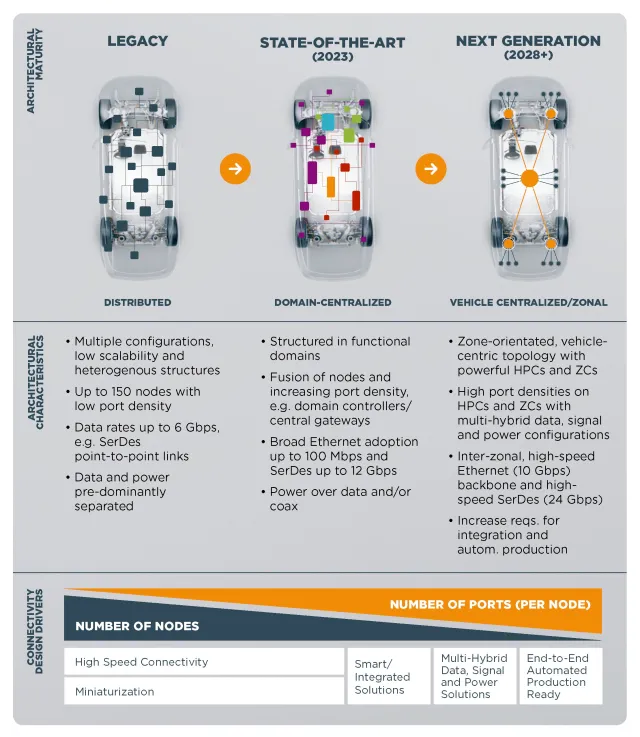
Modern vehicles behave less like mechanical machines with a few circuits and more like mobile electronic systems. In domain-based layouts, electronic control units are distributed around the body in patterns that can resemble a web. Every added camera, lamp, steering sensor, or driver-assist feature may require additional conductor routes. The result is rising harness complexity, more assembly difficulty, and less efficient production.
A zonal architecture groups hardware by physical areas—front section, rear section, left door area, right door area—around local controllers, then uses a central vehicle computer to coordinate them. This topology can shorten electrical pathways, simplify installation, and make feature additions less disruptive. Because fewer connections cross the whole vehicle, wiring mass can fall and production planning can become more predictable.
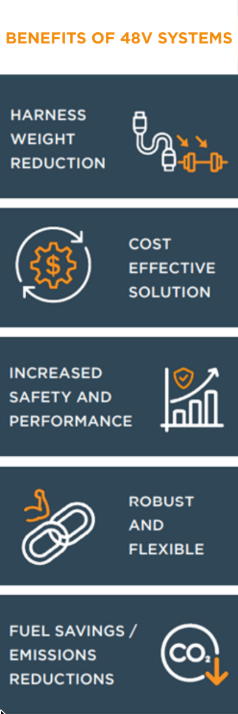
Architecture alone does not raise available electrical headroom. 48V matters because the same power can be delivered with lower current. Depending on the design and use case, that can support thinner wires and smaller connectors, with weight savings reaching up to 75 percent. Less loss and less mass can improve efficiency and range. In hybrid and electrified platforms, those gains can also reduce power and fuel consumption, lower emissions, and improve responsiveness.
Hardware implications to watch
- Efficiency: lower electrical losses contribute to stronger overall vehicle efficiency.
- Mass: conductor and connector downsizing can enable weight reduction up to 75 percent in suitable designs.
- Function support: electric compressors, active chassis, steering, and energy-recovery functions are easier to carry than on constrained 12V systems.
- Manufacturing: predictable connector guidance and retention support automated and manual assembly.
- Platform scaling: reduced connector variation supports broader reuse across models.
Specification comparison for procurement and engineering readers
The following table summarizes the hardware differences described in the source material. It is a directional comparison, not a guarantee that every vehicle using the concept will match the same values.
| Hardware factor | Legacy 12V approach | 48V zonal approach |
|---|---|---|
| Electrical topology | Domain-based ECUs distributed across the vehicle | Zone controllers linked through a central vehicle computer |
| Current for same power | Higher | Lower |
| Conductor impact | Conventional wiring emphasis | Thinner wires and smaller connectors possible |
| Weight reference | Limited by legacy harness and connector volume | Up to 75 percent savings depending on design and use case |
| Connector variation | More than 150 distinct connector types cited | LVCS consolidates interfaces to 13 standardized 48V-compatible options |
| Safety margins | Legacy connectors were not designed around 48V conditions | LVCS built for 48V creepage, clearance, voltage rating consistency, and risk reduction |
| Automation readiness | Traditional connectors support assembly, but automation was not a core premise | Gripping, retention, guidance, and optional electronic mating confirmation aid robots and operators |
Data citations used in this hardware assessment
- Weight reduction reference: up to 75 percent, depending on vehicle design and use case.
- Connector variation reference: more than 150 different connector types in modern vehicles.
- Standardization target: LVCS consolidates interfaces to 13 options for 48V compatibility.
- Engineering reference: TE Connectivity is described as the only engineering partner with a production-ready LVCS solution.
Connector design becomes the risk-control layer
Higher voltage changes what has to be controlled first. Arcing can become a design concern when connectors mate or separate while carrying load. If creepage and clearance are insufficient—especially where moisture, dust, or debris appear—sparks or short-circuit paths become more credible. A 48V connector therefore needs environmental protection, consistent voltage ratings, and assembly margins that prevent field degradation.
Low Voltage Connection Standard, or LVCS, is presented as the targeted answer for 48V work. The source describes TE Connectivity as the only engineering partner with a production-ready solution in this area, setting a reliability benchmark for harsh environments. The practical importance is not abstract: these systems are designed around 48V safety expectations from the outset, rather than as retrofitted 12V parts.
The manufacturing angle is equally important. Many legacy 12V connectors were not developed with automated assembly as a central requirement. LVCS addresses this through positive gripping, horizontal and vertical retention, and guiding elements, allowing robots or operators to seat connectors predictably. Where available, electronic confirmation can send a signal to vehicle software if a connection is not fully sealed, converting a mechanical quality step into a verifiable system event.
Interface count is a procurement metric, not trivia
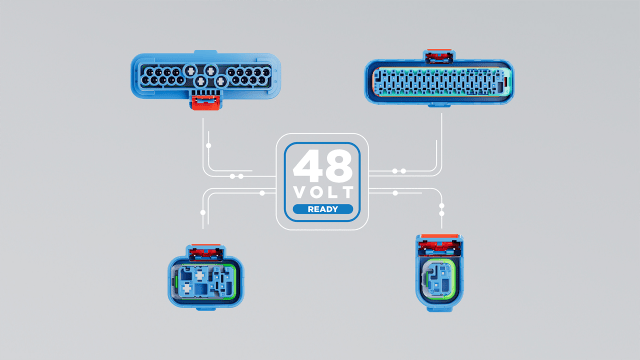
A vehicle catalog with more than 150 connector types creates avoidable complexity for original equipment manufacturers, suppliers, assembly planners, and service teams. More part numbers mean more inventory decisions, more mating variants, more validation paths, and more chances for confusion during line changes. LVCS is described as reducing that spread to 13 fully standardized options for 48V compatibility.
For platform teams, the benefit is architectural consistency. A smaller interface set aligns the electrical system with the zonal vehicle design and makes new functions easier to introduce without reworking connectors every time a feature appears. Fewer potential failure points and reduced connector variety can also make scaling a design across vehicle lines more practical.
Future-load flexibility depends on early collaboration
The industry is still moving toward unknown future loads: more sensors, higher-power functions, and new software-controlled actuation. Rather than overdesigning for every worst-case scenario, 48V systems are described as flexible enough to let requirements evolve while the platform matures. For hardware buyers, that means the architecture should be judged by its ability to absorb future electrical functions, not just by today’s measured load.
Early involvement between vehicle makers and component suppliers is central to that flexibility. When suppliers join development before needs are fully fixed, connector systems and architecture choices can be tuned for expected loads while leaving room for future functions. This feedback loop matters because the same electrical boundary that supports steer-by-wire, brake-by-wire, or electric compressors today may need to support yet-undefined loads in later vehicle generations.
Software becomes part of the power hardware story
As more functions ride on 48V, load management becomes as important as the wiring itself. The source material notes that software increasingly decides how power is shared between 48V subsystems and the main traction battery. That dynamic balancing helps keep performance consistent and avoids placing unnecessary strain on any single power source.
Factory and road efficiency are linked
The hardware benefits do not stop at the assembly plant. Lighter wiring and fewer connector part numbers can reduce material use and simplify manufacturing, while standardized interfaces support higher levels of automation, including automated wiring-harness assembly. Robots can perform repetitive connection tasks with fewer errors, improving production speed and commercial viability.
For drivers and operators, the result is a vehicle that is easier to build, easier to maintain, and more efficient to use. Each wire, connector, and zone controller contributes to a system where rising capability does not automatically mean rising weight or rising production friction.
Common misconceptions in hardware discussions
- 48V is only a higher number on the spec sheet. It changes the relationship between voltage, current, conductor size, loss, safety margins, and connector design.
- Zonal architecture alone will solve electrical growth. Zoning helps routing and scaling, but 48V is what creates more usable power headroom at lower current.
- Standardized connectors must mean fewer choices only, not better safety. The described LVCS work keeps 48V safety margins and environmental expectations as the design basis.
- Automation-ready connectors are only a factory convenience. They can improve reliability and give software visibility into connection quality, which matters throughout the vehicle’s life.
Action checklist for technical readers
- Treat 12V versus 48V as a current-and-loss question, not a branding question.
- Inspect whether zone controllers and a central computer are genuinely reducing cross-vehicle harness complexity.
- Use connector variation as a practical metric: more than 150 types versus 13 standardized options is a meaningful reduction.
- Ask whether mass savings near 75 percent apply to the intended design, not just a marketing figure.
- Confirm that connector design includes creepage, clearance, retention, guidance, and—when relevant—electronic sealing confirmation.
- Evaluate software load balancing between 48V systems and the traction battery as part of the electrical architecture, not as separate software marketing.
Conclusion: what MyTechDailyNews takes from the 48V transition
The strongest hardware signal is that 48V power and zonal architecture are interdependent. One makes the electrical layout more organized; the other makes that layout capable enough for demanding automotive functions. The transition may happen incrementally across established manufacturers and EV-native companies, but the endpoint is clear: a lighter, safer, more scalable, and more software-manageable vehicle electrical system.
For MyTechDailyNews Hardware, the important takeaway is measurable. Lower current supports lighter wiring, standardized interfaces reduce connector sprawl, and production-ready low-voltage connectivity from TE Connectivity helps bring safety and automation into the same specification conversation. That is what turns an architectural idea into a practical route toward smarter, more efficient vehicles.