
2026 Hurun Rich List Explained: A Record 670 Billion Yuan Fortune, AI Money and Three Newcomers in the Top Ten
By Sarah Chen · Tech Daily · MyTechDailyNews
In short: On October 27 the Hurun Research Institute published the 2026 Hurun Rich List. ByteDance founder Zhang Yiming, 43, became China's richest person for the second time with 670 billion yuan after a 200 billion yuan jump, while artificial intelligence and robotics supplied most of the upward movement and Shenzhen took first place by headcount. Below is the plain-language version: what changed, who benefited, who moved backwards, and how to read the list without a finance background.
Wealth rankings are usually treated as gossip, but they work better as a mood indicator for the technology sector — a yearly photograph of which businesses the market currently rewards. This edition gives an unusually readable answer. The names climbing the table are tied to large-scale AI, robots and chips, while several long-established consumer and internet fortunes moved down. You do not need to track share prices to notice the shift: much of the growth sits behind products and services ordinary readers already meet in daily life.
The top three, side by side
| Position | Person and company | Wealth on the list | Change versus last year |
|---|---|---|---|
| First | Zhang Yiming, ByteDance (43 years old) | 670 billion yuan | Up 200 billion yuan |
| Second | Zhong Shanshan, Nongfu Spring (72 years old) | 410 billion yuan | Down 120 billion yuan |
| Third | Zeng Yuqun, CATL | 385 billion yuan | Up 55 billion yuan |
Two details behind the headline matter more than the order of the names. ByteDance's valuation is now placed at 3.3 trillion yuan, and the institute links that step-up to progress in the company's AI business rather than to its older products. And Zhang's win is a repeat, not a debut: it is his second time at the top, and the 670 billion yuan figure refreshes the record for China's richest person.
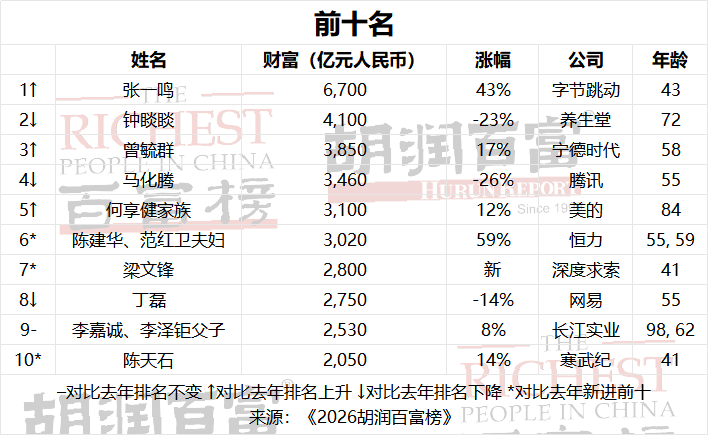
Three newcomers push into the top ten
- Chen Jianhua and Fan Hongwei (Hengli) — a couple counted together at 302 billion yuan.
- Liang Wenfeng (DeepSeek) — 280 billion yuan, landing straight into seventh place.
- Chen Tianshi (Cambricon) — 205 billion yuan.
With those three arrivals, entrepreneurs from the new-productivity side of the economy now hold half of the top ten seats. That is the clearest sign in the document that the list's centre of gravity has shifted away from the sectors that used to fill its upper rows.
A bigger, richer and more concentrated list
- 1529 entrepreneurs made the cut this year, 95 more than last year and the highest total ever recorded.
- Their combined wealth reached 32 trillion yuan, a 7% year-on-year increase.
- The number of names in the 100-billion-yuan league rose by 2, to 43.
- The ten biggest gainers, counting first-time entries, added more than 900 billion yuan between them — 56% of the list's entire 2.1 trillion yuan increment.
That last point is the one to keep in mind whenever the 7% average is quoted. The growth is real, but it is not spread evenly, and a handful of AI-linked and technology-linked fortunes supplied most of it.
AI and robotics: where the new money came from
AI is the single largest engine in this edition. More than 160 listed entrepreneurs owe their wealth to the AI track, which works out to roughly one person in every ten on the list. Besides DeepSeek's Liang Wenfeng, aged 41 and appearing for the first time, several other AI founders are debutants: Liu Debing and Tang Jie of Zhipu, Chen Weiliang of Muxi, and Yan Junjie of MiniMax.
Robotics is the second current. Nearly 80 entrepreneurs on the list are connected to it. Wang Xingxing of Unitree Robotics, 36, enters for the first time with 69.5 billion yuan, the second-largest fortune among the newcomers, while Wang Tao of DJI remains the best-funded name in that field at 110 billion yuan.
Which industries and cities are moving up
| Industry | Share of the list | Position this year |
|---|---|---|
| Industrial products | 18.5% | Largest by headcount |
| Consumer goods | 9.7% | Second |
| Healthcare | 8.3% | Third |
| Semiconductors | 6.9% | One of the fastest-growing sectors |
The city map changed as sharply as the industry map. Shenzhen put forward 177 names and rose to first place for the first time, pushing Shanghai (161) and Beijing (140) into second and third. The institute attributes the city's advance mainly to the clustering of semiconductor, AI and robotics companies there. One other milestone came from the same table: Zhou Qunfei of Lens Technology, with 127 billion yuan, is listed as China's richest woman.
The names that moved down
- Lei Jun, Xiaomi — down 157 billion yuan.
- Zhong Shanshan, Nongfu Spring — down 120 billion yuan.
- Ma Huateng, Tencent — down 119 billion yuan.
- The Wang Ning family, Pop Mart — down 94.5 billion yuan.
Hurun's own reading of these figures is worth quoting in substance rather than headline: the changes are not a genuine fall to a low level, but a rational correction after last year's very steep rise.
Five common misconceptions
- "A wealth drop means the business is shrinking." Not according to the institute's explanation of this year's declines, which it frames as a pullback from an unusually high base.
- "AI money sits with only one or two companies." More than 160 listed fortunes are attached to the AI track, and several of them are first-time entrants.
- "This is a ranking of companies." It counts individuals and, in some cases, couples and families, such as the Hengli pair or the Wang Ning family at Pop Mart.
- "A 7% total increase means most people gained." High-profile names lost money in the same year the aggregate rose.
- "City rankings measure lifestyle or population." The ranking here tracks where specific technology industries happen to cluster.
Frequently asked questions
Who is China's richest person this year, and why did the number change?
Zhang Yiming, 43, founder of ByteDance, at 670 billion yuan. His wealth grew by 200 billion yuan after AI business progress lifted the company's valuation to 3.3 trillion yuan. It is his second time taking the top spot, and the figure sets a new record.
When and by whom was the list published?
The Hurun Research Institute released the 2026 Hurun Rich List on October 27.
How large is this year's list?
1529 entrepreneurs, up 95 from last year — a record number. Their combined wealth is 32 trillion yuan, 7% higher year on year, and 43 names now sit in the 100-billion-yuan league.
Which sector contributed most, and which city leads?
AI contributed the most: over 160 names, one in ten on the list, with nearly 80 more tied to robotics. By city, Shenzhen leads with 177 names, ahead of Shanghai's 161 and Beijing's 140.
Who are the richest woman and the biggest movers?
Zhou Qunfei of Lens Technology, at 127 billion yuan, is the richest woman. Among the biggest single declines are Xiaomi's Lei Jun, down 157 billion yuan, and Tencent's Ma Huateng, down 119 billion yuan.
Why should an ordinary tech reader care?
Because the same sectors driving the wealth gains — AI, robotics, semiconductors — are the ones behind the products and services readers use, and the list is a quick way to see where the industry is putting its money and people.
What to do with this information
- Treat the ranking as a signal about which technology tracks are being funded and staffed, not as a verdict on any single product.
- For product and marketing teams: watch the first-time entrants. Three newcomers entered the top ten this round, and debutants in AI and robotics are the names most likely to appear in consumer-facing announcements next.
- For job seekers and suppliers: the growth side of the list is concentrated in AI, robotics and semiconductors, with Shenzhen hosting the largest group of listed founders.
- For investors and cautious readers: discount one-year swings. Corrections after steep rises are the institute's own explanation for several high-profile drops.
- For everyday users: expect more consumer devices and services from the AI and robotics companies named above, and use that expectation to decide which new tools you actually try.
Bottom line
Strip away the numbers and one pattern survives: the growth, the newcomers and the city rankings all point in the same direction this year, toward AI, robotics and the chip-and-hardware ecosystem around them. The list is still only a snapshot of individuals' estimated holdings on one day in October, not a scoreboard of product quality or long-term prospects. Read as a map of where attention and capital are flowing right now, though, it is one of the fastest ways to understand which corners of consumer technology are likely to dominate the next few product cycles.