
MyTechDailyNews General: XPeng MONA L05 Launch Backlash and the Youth-Marketing Misstep
MyTechDailyNews — A short customer complaint has turned the XPeng MONA L05 launch into a broad case about audience fit, public risk and the limits of youth-first branding. The line, “You want my money, call me an old geezer, and who are you anyway?”, captured why the post-95 and post-00 product team’s approach felt dismissive to many buyers. The controversy now involves not only the XPeng MONA L05 reveal, but also Etta’s apology video and the forceful response from XPeng vice president Yu Tao, making the event a lesson for every consumer-technology brand that talks to young people.
Why a youth-oriented launch failed to feel young
XPeng presented the MONA L05 with the slogan “young people’s car, defined by young people”. The staging leaned on the young-oriented idea and repeatedly used youth-friendly language. But the vehicle’s position complicates the pitch: SUV purchases are often family decisions, especially among multi-child households, and buyers aged 35 and over represent a high share. The XPeng MONA L05 starts at 170,000 yuan, while the commonly discussed youth-friendly car segment, or youth-friendly automobile range, usually sits between 50,000 and 150,000 yuan. For all but a minority of premium young buyers, a purchase at that level still depends on a parents’ lift—financial support from the family.
In that context, the line “You want my money, call me an old geezer, and who are you anyway?” was not a random overreaction. It pointed to a mismatch between the product’s price, the actual audience, and the tone used on stage. Marketing does not have to flatter every customer, but offending a customer without reason is a professional-manager failure.
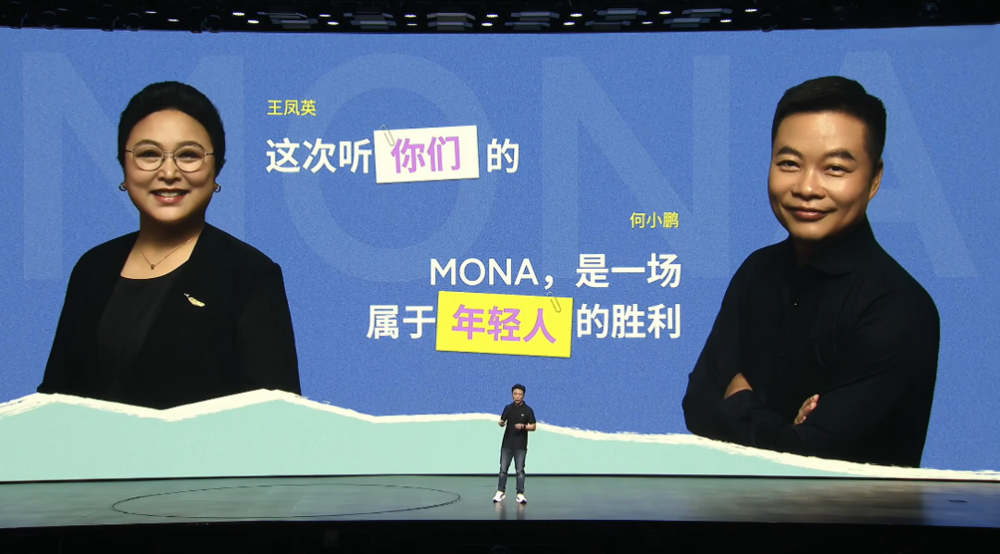
The event itself was longer than its energy. For more than one hour, the PPT looked plain, guest speeches lacked standout moments, and the only exchange that gained attention came from a Q&A segment. Etta asked whether elements suggested by the boss—the wood grain, baked-paint color and chrome strips—should be included, and said, “(the boss’s suggested wood grain, baked paint color and chrome strips) put in, we young people would not want them, right?” The audience response was sparse and the atmosphere awkward. She then said, “putting those in would finish the car; this L05 would become a mediocre traditional luxury car.” With a pre-sale price of 169,800 yuan, that half-cooked exchange did not establish the car as a luxury car.
That was the uncomfortable point: young buyers may not want to be defined by an old geezer, but they also do not have to accept being defined by a peer who treats one taste as universal. Some young people enjoy string beads and hanfu-style aesthetics. Disliking the traditional three-piece set should not revoke someone’s youth membership, and a car company sells vehicles, not a youth-aesthetic certification. The boss-style, domineering-CEO-style question carried an old vibe that, to many observers, felt heavier than the very old-geezer label it mocked.
The car’s design language also did not fully support the rebellion narrative. A low-slung wide body, streamlined exterior, starlight lamps and 256-color waterfall ambient lighting are common elements in recent mainstream models. Using the three-piece set as a foil did not make the XPeng MONA L05 look innovative. The deeper disappointment was not only the age-discrimination accusation, but the gap between a youth-oriented promise and a plain, dull, long, one-way output that felt closer to a failed middle-school open class than a 2026 product launch.
The contrast sharpened the critique. Lei Jun, a person born in the 1960s, still became known for the playful line “Are you OK”, while a post-00 presenter appeared to offer dry banter and rigid judgment. XPeng Motors is not a newcomer in the new-energy industry, yet the scene seemed more like 1996 than 2026, even as the launch took place in 2026 and the format looked back to the 1990s. Only after Yu Tao published a forceful response on October 24 did the episode begin to feel like the old saying: “dragons beget dragons, phoenixes beget phoenixes”.
From apology to reversal: the response created a second story
On October 22, Etta released an apology video. Judged only by tone, it seemed sincere. For many commentators, even if some people still did not buy it, such a slip-up controversy usually fades when it is not a hard product-quality defect. Two days later, the story reversed.

Yu Tao’s reply opened by saying that the “old geezer” label was “from start to finish a product-team joke about internal core leaders, with completely no reference to any external user”. That sentence sounded less like an explanation than an attempt to remove external liability. But a product launch is not an internal meeting. Once words are spoken publicly, they have public effects. Even the old pattern “the speaker meant nothing, but the hearer took it to heart” does not erase the cost of an unguarded expression.
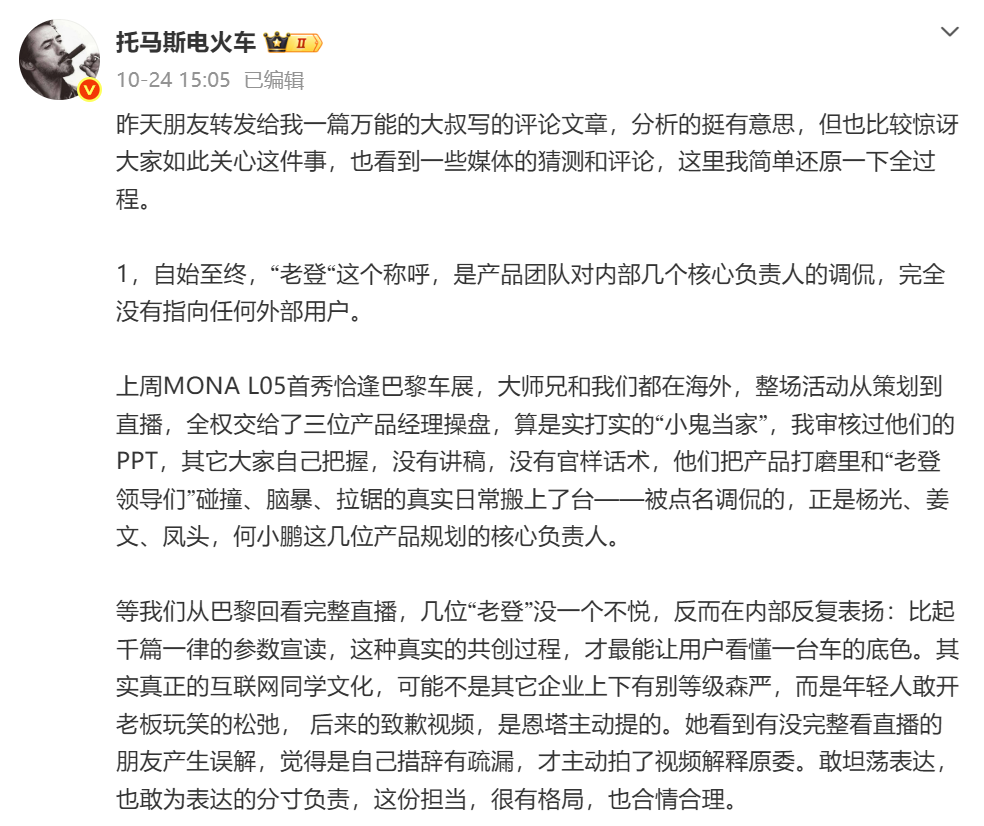
The more difficult part was that Yu Tao then treated the event as if it had occurred inside internal boundaries and judged it by internal standards. He said several leaders called “old geezers” were “not one of them displeased; rather, they repeatedly praised it internally”. The public, however, had already formed negative opinions from a scene that looked monotonous, dull and cold for more than one hour. What could justify repeated praise?
The stated reason was: “Compared with the cookie-cutter parameter recitation, that authentic co-creation process is what most helps users understand the underlying character of a car.” Critics found that logic odd. Few serious car launches still rely on a plain parameter recitation. Does a small argument about interior trim count as an authentic co-creation process, and how does that connect to the character of a vehicle? The article also pointed to a painful parallel: in August, XPeng X9 had just been recalled over a stalling problem, long before this launch. The audience could ask whether a stalling recall was caused by a lack of co-creation storytelling, or by a real reliability issue that buyers cannot see from a clever on-site story.
Inserting internal jokes into a launch has a long history. From the old-old geezers Steve Jobs and Bill Gates onward, such bits have often been backstage color, not a product manual. If a public event became a collection of internal jokes, the line with “does this have any relation to the public worth a single dime?” became hard to answer. Then Yu Tao argued that a true internet peer culture “is perhaps not other companies’ strict hierarchy, but the relaxed confidence of young people daring to joke about the boss”. The word “perhaps” could be removed, because many internet companies have flattened hierarchy; but the issue was not internal culture. It was a commercial relationship that requires respect for customers.
The sequence “inside versus outside” followed by “internal standards take precedence” left critics confused. The response then moved toward what observers called a counterattack and reckoning. Yu Tao said the apology video was initiated by En Ta, and described her action as “she saw that friends who had not watched the full livestream formed misunderstandings, and felt her own wording had omissions, so she proactively filmed a video to explain the original context.” In that framing, the word “apology” was replaced by “explain the original context”.
Finally, Yu Tao wrote: “Old geezers are not what people dislike; some people’s old vibe is what is hateful; please reduce the denunciation of the post-00 generation.” For many, this turned criticism of a public slip into an overreach against post-00 people, an attempt to escalate the dispute. The controversy thus came to represent a no-principle youth pandering, in which the company’s young front-line staff appeared protected without being corrected.
Relaxed culture is not an excuse for sloppy process
“Young people daring to joke about the boss” can be a healthy team climate. It does not mean business management can be relaxed in the wrong places. A public launch is not an internal brainstorm. Yu Tao’s forceful response, and the related forceful reply, actually revealed a loose preparation: he said the event was a real “Home Alone”, in which he reviewed the PPT but left the rest to the team, without a full script or official wording. In a company meeting, that can be openness. In a public setting, it is risk.
Many veteran professionals, or old hands, have stumbled in such venues. A manager’s job is to review what should be reviewed, guide what should be guided, and reduce the cost of trial and error. Etta may have talent, but talent requires growth, and growth requires learning from mistakes. The problem was that the slip and the broader problems at the XPeng MONA L05 launch were supposed to be managed before they became public.
After the slip-up controversy, the strong defense changed very little. Public perception of Etta did not become positive because of a forceful response, and industry evaluation did not reverse because internal leaders repeatedly praised the event. A company can declare victory internally, and it can conclude that no blame attaches to Yu Tao or his department, but the negative reaction to the new product launch remains visible. In such a scene, the company can choose not to see it, but outsiders are not obliged to cooperate.
What everyday tech readers should take away
Key takeaways
- The controversy moved from a “old geezer” joke to a larger trust question about who the brand was speaking to and who was supposed to pay.
- The price story mattered: a youth-friendly message, a 170,000-yuan starting point, and a 50,000 to 150,000 yuan youth-friendly expectation are hard to reconcile.
- The apology and reversal created a second narrative: internal humor, public effects, and leadership review all became part of the story.
- For brands, a launch setting is a commercial stage, not a team-building room.
Common misconceptions
- “A youth-oriented car must be bought only by young people.” The article’s point is that SUV audiences often include family buyers, especially multi-child households and people aged 35 and over.
- “An inside joke is harmless when spoken publicly.” Once said on a product launch stage, it can carry external effects, even if the speaker meant no offense.
- “A strong defense protects a young employee.” The piece argues that failing to review a public script can harm both the employee and the brand.
- “Youth-friendly means trendy words.” The piece suggests young buyers also need practical affordability, not only aesthetic labels and youth-aesthetic certification.
FAQ
Was the core issue only age discrimination?
Not only. The initial public irritation centered on the “old geezer” phrase, but the broader disappointment involved a more-than-one-hour plain launch, one-way output, weak stage interaction, and a response that reframed the issue as an internal matter.
Did XPeng say it insulted customers?
No. Yu Tao said the “old geezer” label was an internal joke about core internal leaders, “from start to finish”, with “completely no reference to any external user”. The controversy was about whether that framing was appropriate after a public stage.
Why did the apology not end the debate?
Because two days later the reversal arrived: the apology was described as En Ta’s voluntary explanation, the criticism was cast as “old vibe” dislike, and the event was evaluated by internal praise instead of public reaction.
What does the October 24 response add?
It shows the dispute shifted from a single slip-up to management culture: relaxed culture, review responsibility, and the boundary between internal humor and a public product launch.
Action checklist for consumer-technology brands
- Check audience-price fit before calling a product youth-friendly. If the starting price is 170,000 yuan while the expected youth-friendly band is 50,000 to 150,000 yuan, say what value justifies the gap.
- Separate internal humor from public script. A joke about “old geezers” in an internal meeting is not automatically safe on a launch stage.
- Have a senior editor or legal/PR reviewer scan the PPT, host lines and Q&A prompts before the event, not after the public reaction.
- Do not turn an apology into a lesson for critics. If a phrase causes misunderstanding, address the public effect first, then clarify the internal context.
- Train young staff without exposing them as unprotected front-line performers. Growth needs feedback, review, and a process that prevents a public event from becoming a failed classroom scene.
For MyTechDailyNews readers, the XPeng MONA L05 case is not just car-company drama. It is a reminder that young branding is easiest when it listens, hardest when it judges, and most dangerous when a public stage is run as if it were an internal room. The most useful lesson is simple: be relaxed with people, but rigorous with process.