
A Totaled Car and Airbags That Stayed Flat: Inside the XPeng Trigger-Condition Argument
By Sarah Chen, Tech Daily
Airbags are the piece of car technology most of us are asked to believe in blind: they either appear at the worst second of your life or they do not appear at all, and there is no middle setting you can inspect in advance. Not long ago, that invisible line between "deployed" and "did not deploy" turned into a very public argument. A front-seat passenger, Mr. Liu, walked away from a collision that left his vehicle scrapped, while every airbag on board — including the passenger bag and the side head curtain — stayed shut. The dispute that followed with XPeng is less about bent metal than about three things ordinary tech users deal with every day: a standard written in cautious language, an explanation delivered verbally, and data that only one side can read.
What happened, in the passenger's telling
Mr. Liu was riding in the front passenger seat while a friend drove. According to his account, the pair were trying to get around a concrete mixer truck ahead when the car struck a roadside green belt, then a tree, a utility pole and a stone, before rolling onto its side.
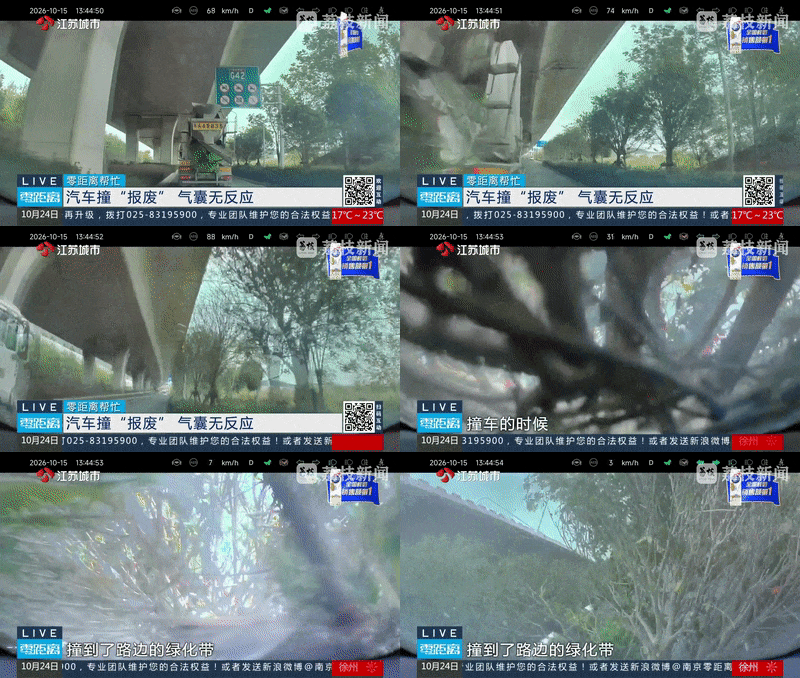
Mr. Liu puts the speed at the moment of impact at 87 km/h. Both occupants, he says, were briefly unconscious and then woke up; neither of them was injured. That outcome is the reason this story became a fight about documentation rather than a hospital story.

"Not enough force" and "wrong collision point": the two answers he received
The vehicle ended up written off, yet not one bag fired. Mr. Liu contacted after-sales to ask why, and says he was told two things: the impact force was not enough, and the collision hit the wrong point.

His reaction explains why the answer felt circular to him: "I don't know what speed would have been fast enough for the force to count. When an accident happens, am I supposed to aim for a spot to hit?" It is the frustration of being handed a rule that only seems to work backwards, after the crash has already chosen its own shape.
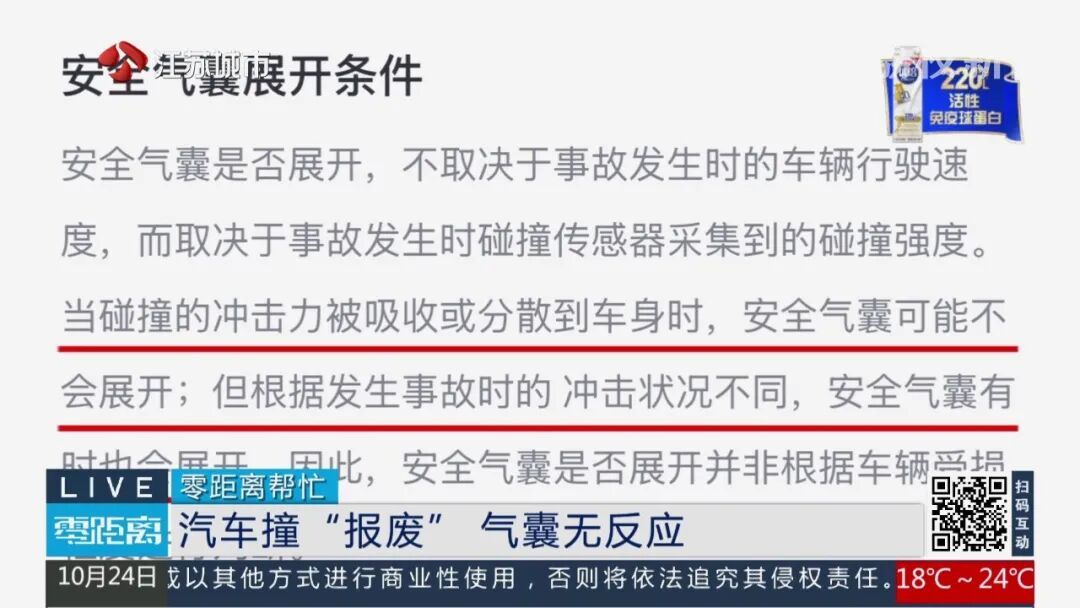
The wording problem: a manual built on "may"
There is a reason the exchange stalled. In the owner's manual, the passages describing when airbags come out lean heavily on the word "may", and they do not offer a clear, checkable threshold that a non-engineer could measure a real accident against. A reader of that section gets a description of possibility, not a set of conditions — which means that when something goes wrong, the owner and the manufacturer are not holding the same document in the same way.
The dealership stayed out of it; the maker named a trigger condition
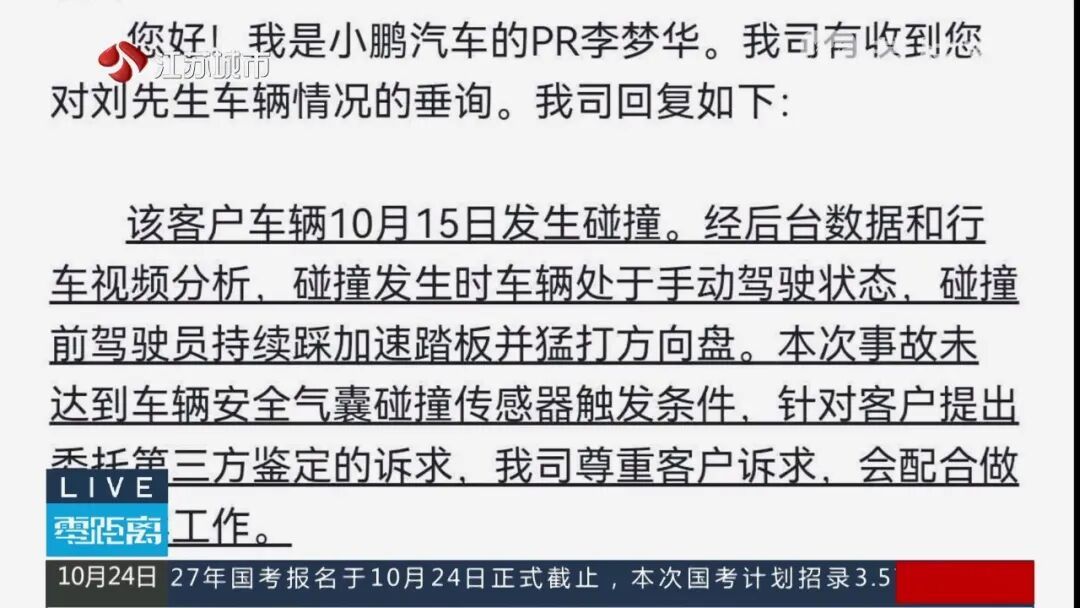
Reached about this incident, the 4S dealership said it was not in a position to accept an interview. XPeng's reply, sent by email, was more specific about the logic: this accident did not meet the trigger conditions of the airbag crash sensors. The company also stated that it respects the customer's decision to commission a third party for appraisal.
The real battleground: whatever the car's own data can still show
After that exchange, the manufacturer contacted Mr. Liu and proposed removing the car's computer module for testing. Here his objection turned procedural rather than emotional: almost all of the data on a car's systems lives inside that module, and he asked what would stop it from being modified or deleted once it was out of his hands. His own alternative is to pay out of pocket for a qualified third-party institution to run the check — an attempt to keep the evidence outside the control of the party whose design is being questioned.

What a lawyer suggests as the order of operations
The legal guidance attached to this case is short but pointed. Before any part is sent for testing, both sides should seal the physical evidence together. Where necessary, a party can apply for evidence preservation or a judicial appraisal. And there is a shift in the argument that owners rarely hear about: once the car owner has completed a preliminary round of proof, the burden of proof moves to the producer.
Who said what, at a glance
| Party | Position on the record |
|---|---|
| Mr. Liu, front-seat passenger | Car scrapped, no airbag deployed including the passenger bag and head curtain; willing to self-fund a qualified third-party test |
| After-sales | Impact force was not enough; the collision point was wrong |
| 4S dealership | Said it was not available for interview |
| XPeng | This accident did not meet the trigger conditions of the airbag crash sensors; respects a customer-commissioned third-party appraisal |
| Lawyer's guidance | Jointly seal evidence before testing; consider evidence preservation or judicial appraisal; burden shifts to the producer after preliminary proof |
Common misconceptions this kind of case clears up
- "A destroyed body means the airbags must have come out." The two are decided by different logic. In this incident the vehicle was scrapped and the bags stayed closed, while XPeng's stated position was that the sensor trigger conditions were not met.
- "The owner's manual will give me the exact number." Here its deployment wording repeatedly relies on "may" and provides no explicit standard to compare an accident against.
- "'Not enough force' and 'wrong point' are final technical findings." They were the explanations he says he received from after-sales. The written version from the maker talks about crash-sensor trigger conditions, and an independent third-party appraisal remains the unresolved step.
- "Handing a part over for inspection is a neutral favor." It is also a transfer of evidence custody — exactly the concern the owner raises about the computer module and the data stored in it.
- "Owners must prove a defect before anyone is obliged to listen." Under the lawyer's guidance, only a preliminary round of proof sits with the owner; after that, the responsibility to prove passes to the producer.
Checklist: do these before the car leaves your sight
- Write down the numbers you personally know: the speed you believe you were at, what you were trying to avoid, every object the car touched, and how many people were aboard.
- Photograph the damage and the surrounding scene before anything is towed, repaired or cleaned up.
- Ask after-sales for the explanation in writing, not only verbally, and preserve the exact wording you were given.
- Read the safety section of the owner's manual now rather than after a crash, and mark the sentences that say "may" instead of "will".
- If a component or module is proposed for inspection, insist that both sides seal the evidence together first.
- Consider evidence preservation or judicial appraisal when the data itself is the entire argument.
- Remember that a qualified third-party institution is an option open to you even if you have to pay for it yourself.
FAQ
Was anyone hurt in this accident?
According to Mr. Liu, both occupants were briefly unconscious and woke up afterwards, with no injuries reported.
Which airbags stayed closed?
He describes not a single bag on the vehicle deploying, calling out the front-passenger airbag and the side head curtain specifically.
What is the manufacturer's official line?
An email reply stating that this accident did not meet the trigger conditions of the airbag crash sensors, together with a statement that the company respects the customer's third-party appraisal.
Why does the manual matter so much here?
Because it is the first place an owner looks for a rule, and in this case its wording uses "may" rather than a clear threshold, leaving both sides without a shared measuring stick.
What is the next contested step?
Custody of the car's data. The manufacturer wants to take the computer module for testing; the owner wants a qualified third party working at his own cost; the lawyer's advice points to joint sealing, evidence preservation or judicial appraisal before anything moves.
Why this belongs in your technology feed, not only the accident pages
Strip out the brand name and a familiar pattern appears across consumer technology: a safety feature whose behavior is defined by internal thresholds, a document that describes that behavior in probabilities, and a log file that only the manufacturer can initially read. The lesson for readers is dull but powerful. The moment you suspect a system failed to act, treat the paperwork as part of the product — keep the scene, keep the explanations in writing, do not surrender custody of the data, and let the trigger conditions be examined somewhere other than the place that set them.