
X.com Gets a Ground-Up Web Rebuild: A MyTechDailyNews Checklist for Getting the Faster Version
By Sarah Chen · MyTechDailyNews, General desk
Short answer: X has finished rebuilding its web app and is now handing the faster version to signed-in users in stages, in a rollout the company describes as moving country by country. Visitors who browse while logged out, and the page versions search engines crawl, are already running on the new system. If your X.com still drags, nothing is broken on your side — you are most likely still on the older build, and browser housekeeping plus a little patience are the only practical levers today.
What actually changed on X.com?
Start with the headline: this is an infrastructure swap, not a feature launch. The social platform X has completed a full rebuild of its web application, and the new version is beginning to reach people who are already signed in. The company's own description of the schedule is phased — access opens country by country rather than all at once.
Two audiences are already on the new rails, and that matters if you want a preview without waiting for your account to be flipped: pages opened while you are logged out, and the pages search engines crawl for indexing, have been switched over to the new architecture. The rebuild is also the biggest single piece so far of a longer effort by X to lift efficiency while cutting what it costs to keep the platform running.
X chief engineer Yagiz Nizipli framed the change in a post describing the update, stressing that the performance jump is most visible where connections are weakest — exactly the situation of mobile readers on trains, in crowded venues or on rural data plans, rather than people on office fibre.
How much faster is it? The numbers, and how to read them
Direct answer: on a slow connection, X reports that the first post on a profile page now appears in about 2.7 seconds, down from more than 22 seconds on the old web app — an improvement of several times, and roughly an 88 per cent cut in wait time by our own arithmetic on those two figures.
Two pieces of context make that number mean something to a non-engineer. First, Google's Core Web Vitals guidance treats a Largest Contentful Paint of 2.5 seconds or less as "good", so 2.7 seconds under throttled conditions is now within touching distance of the benchmark most publishers and product teams are graded against. Second, the industry-standard way to measure a "slow connection" is the simulated slow-4G profile used by Google's Lighthouse tooling — about 150 ms of latency and 1.6 Mbps down / 750 Kbps up. That profile is deliberately harsh, and it explains why the gap between the old and new builds is so wide: the previous design made a browser download a shell and scripts first, then request data, then paint, so every weak-network step added its own delay.
| Point of comparison | Old web app | Rebuilt web app |
|---|---|---|
| First post on a profile page, slow connection | more than 22 seconds | about 2.7 seconds |
| Back-end serving one URL | three separate server systems (people, crawlers, link previews) | one unified architecture |
| Who sees it now | still the fallback for signed-in accounts not yet migrated | logged-out visitors and search-engine-crawled pages; signed-in users country by country |
| New consumer features shipped with the switch | — | none announced; the stated gains are speed, reliability and lower maintenance cost |
How to reproduce the speed test on your own machine
- Open X.com in Chrome or Edge and press F12 (or Ctrl+Shift+I / Cmd+Option+I on a Mac) to bring up DevTools.
- Switch to the Network tab and set throttling to a slow profile; if "Slow 4G" is not listed, choose Custom and copy the Lighthouse figures: 150 ms latency, 1.6 Mbps download, 750 Kbps upload.
- Tick "Disable cache", keep DevTools open, then reload the page.
- Load a profile page and watch when the first post actually appears — that moment is what X's headline timing refers to, not the whole feed.
- Repeat on the same device over a phone hotspot, and again on the mobile app, so you can tell a network problem apart from an app problem.
Treat the result as directional rather than official: a DIY throttle on your laptop will not match a lab run exactly, but it is a fast way to see whether your own complaint is about the site, your connection or your extensions.
Why collapsing three server stacks matters to ordinary readers
The conclusion: one plumbing system means fewer mismatched versions of the same page. Before the rebuild, X ran three separate server systems — one serving ordinary visitors, one serving search-engine crawlers, and one serving link previews. The practical upside the company cites is lower complexity and better resource efficiency, which also trims the long-tail maintenance burden that accumulates when the same code has to be fixed in several places.
For everyday readers there is a second, less obvious consequence: the pages that show up as previews when you paste an X link into a chat app, and the pages search engines index, now come from the same rebuilt base. If a linked post looks wrong in a preview card or in search results today, it will usually look wrong in fewer places after the migration completes. For content and marketing teams, that is a concrete reason to re-check the links you distribute once the rollout reaches your region.
What early users report
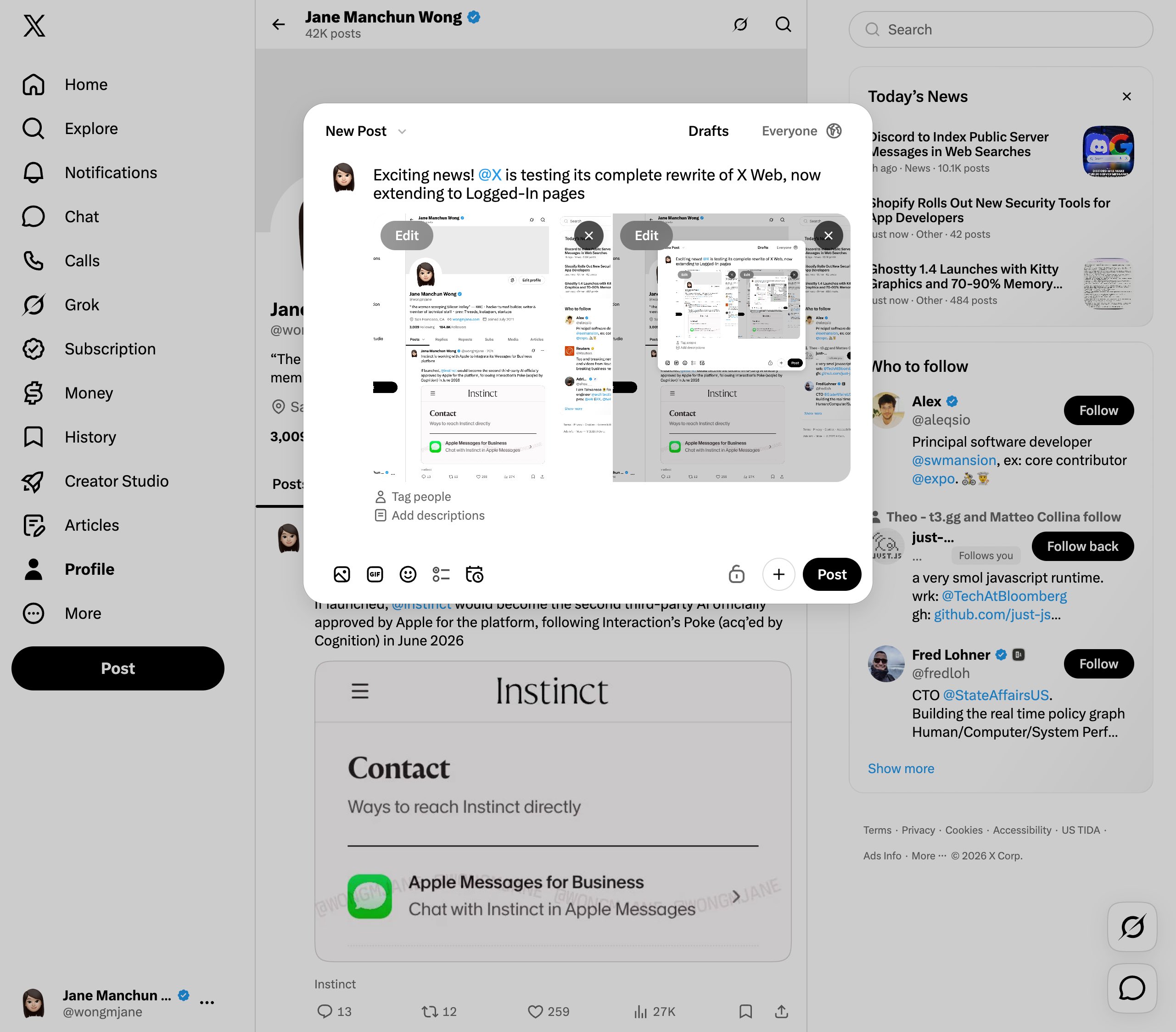
Cybersecurity researcher Jane Manchun Wong says she has already gained access to the rebuilt web app. Her feedback is experiential rather than measured: overall responses feel smoother, loading speed is visibly better, and a lot of interface details have been tidied up along the way.
Worth flagging as our own analysis: so far this is a vendor-published benchmark plus informed anecdote. No independent lab has re-run the 22-second versus 2.7-second comparison across many regions and devices, and X has not yet published the migration timetable per country, so early impressions and measured reality may diverge.
Checklist: six things to try if X.com still feels slow
- Force a fresh copy of the page. A normal reload can serve files from cache. Press Ctrl+Shift+R (Windows/Linux) or Cmd+Shift+R (Mac), or right-click the reload button and choose "Empty cache and hard reload". MDN documents cache-bypassing reloads as the standard way to skip locally stored assets.
- Check the logged-out view. Open an X.com profile in a private window while signed out. That path is already on the new architecture, so it gives you a fair impression of the target speed.
- Clear site data for x.com once. Browser settings → site permissions or cookies and site data → clear for x.com. Then sign in again; this resets stored session assets rather than your account.
- Rule out extensions. Load the same page with ad blockers, translation tools and AI assistants disabled. Weak-network complaints very often come from scripts injecting into the page, not from the site itself.
- Update the browser and test the real network. Older engines penalise streaming responses. Run the DevTools throttle above, then repeat on mobile data before blaming X.
- Log what you see. Note whether it is the feed, a profile page or a single post that stalls, plus the device and connection. If you spot a pattern, send the details and a screenshot to hello@techdaily.com and the MyTechDailyNews tech desk will test it and fold it into follow-up coverage.
Common misconceptions about the rebuild
- "The new X web app is a redesign with new features." It is not. The changes announced are architectural: faster loading, smoother interaction, fewer moving parts behind the scenes.
- "If I still see the old layout, my browser is broken." Nothing is broken. Access for signed-in accounts is opening country by country, so being on the older build is expected behaviour during the rollout.
- "Everything will now load in 2.7 seconds." That figure describes the first post on a profile page under a deliberately slow simulated connection. Video, image-heavy threads and peak-hour feeds will still be bound by your own network.
- "The web rebuild and the app rebuild are the same project." They are separate efforts. X also shipped a from-scratch Android rebuild announced by product lead Nikita Bier on 20 July 2026, which he described as one of the largest engineering projects in the company's history.
- "Performance work never changes business outcomes." For platforms, load speed is tied to how long people stay, how many posts get seen and how reliably links shared into chat apps render — so the migration is worth watching beyond the aesthetics.
What happens next — and what to do about it
X's roadmap for this change is deliberately modest: the rollout stays in phased mode, with signed-in accounts gaining access in batches by country and region, while the logged-out and search-crawled paths run on the new architecture right away. As coverage widens, more people are expected to touch the rebuilt web app within the coming weeks.
For readers, the useful action is a quick baseline test now — time how long a profile page takes on your daily connection, then repeat after your account switches over. For publishers, marketers and product teams, the practical to-do list is: re-check embedded previews of your shared links, monitor your own analytics for shifts in bounce rate and pages per session once the new build reaches your region, and treat page-speed claims as something to verify on real devices rather than accept from a press post. The central question for the wider audience is simpler still: whether the speed X is advertising holds up once everyone is migrated.
FAQ: quick answers on the rebuilt X web app
When will the new X web app reach my account?
There is no published date per country. X says the rollout proceeds country by country for signed-in users, and more people should be served by the new version within the coming weeks. Nothing you do inside settings accelerates it.
Can I see the new version before my account migrates?
Yes, partially. Open a profile while logged out — for example in a private browsing window. Logged-out pages and search-engine-crawled pages are already on the new architecture, so you get a genuine preview, just without your own feed.
Is 2.7 seconds the real-world loading time?
It is a benchmarked figure: the time for the first post to appear on a profile page under slow-network conditions, down from more than 22 seconds on the old build. Your own result depends on signal strength, device, page type and browser extensions.
Do I lose posts, follows or settings during the migration?
The announcement describes a technical rebuild of the web app only. Nothing in it indicates changes to accounts, content or subscription status, and the older build remains available as a fallback while accounts migrate.
How is this different from the new Android app?
Different codebase, same ambition. The Android rebuild was announced as complete in July 2026 and was pitched mainly at loading, scrolling and notification problems; the web rebuild targets first-post load time, crawling and link-preview serving by unifying what used to be three separate server systems.
Reference sources
- X Engineering, "Rebuilding the global town square from scratch" by Yagiz Nizipli — https://blog.x.com/en/engineering/rebuilding-the-global-town-square-from-scratch
- Google, web.dev, Largest Contentful Paint (LCP) thresholds — https://web.dev/articles/lcp
- Google Chrome Lighthouse, simulated throttling settings (150 ms latency, 1.6 Mbps / 750 Kbps) — https://github.com/GoogleChrome/lighthouse/blob/main/docs/throttling.md
- MDN, Location.reload() and cache-bypassing reloads — https://developer.mozilla.org/en-US/docs/Web/API/Location/reload
- Tencent News / ZAKER report on X's from-scratch Android app, 21 July 2026 — https://new.qq.com/rain/a/20260721A097TB00