
Volkswagen Parallel Tech Paths: NXP S32K5, China VEGA and the Software-Defined Car
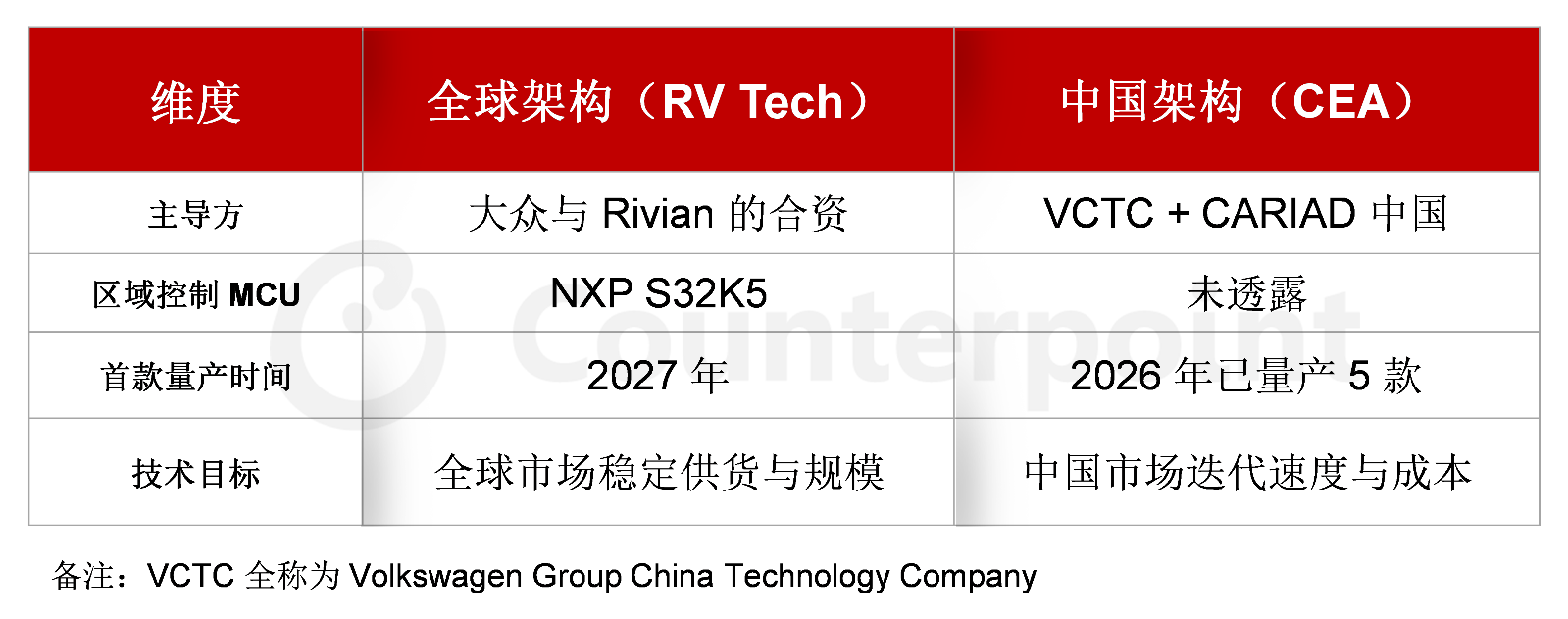
On October 26, NXP and Volkswagen said they had reached a strategic cooperation: the S32K5 series microcontroller was chosen for zone-control modules, the plan will serve brands and models across the group, and the first vehicles carrying the related technology are scheduled for 2027. Two days later, Volkswagen opened its first Tech Day in China and introduced VEGA, a homegrown framework spanning vehicle platform, electronic architecture and ADAS in three domains. For readers who follow technology from a consumer angle, the headline is not merely a chip order. It is evidence that Volkswagen is now managing its future as two development tracks at once, while keeping brand continuity in mind.
Counterpoint Research reads the two decisions as a re-splitting of technical authority. The global track is built around scale, consistency and validated processes; the China track is tuned for speed, local ecosystem response and quicker product cycles. That approach can create advantage, but it also raises the bill for verification, supply chain coordination and software upkeep. Whether the two systems later merge, and which one eventually sets the tone, remains open.
Background: A Global Car Group Facing Two Different Clocks
Software-defined cars are less like fixed machines and more like long-lived platforms. A vehicle architecture decides how sensors, controllers, safety systems and update services interact. For a large group, the central tension is familiar: global platforms protect reliability and economies of scale, but regional markets increasingly reward rapid change. Volkswagen China sits at the center of that tension, because the Chinese market pushes fast digital features, local supplier integration and frequent software iteration. VEGA was therefore presented not as an isolated product, but as a way to shorten the distance between local market needs and engineering decisions.
Why S32K5 Matters More Than a Supplier Headline
The core of the October 26 agreement is S32K5, a microcontroller family positioned for zone-control modules. In simple terms, a zone architecture groups many electronic functions by physical or logical area instead of giving each task a separate box. That can simplify wiring, reduce component sprawl and make over-the-air maintenance more practical. It also concentrates risk, because one powerful controller must handle functions that once lived apart.
NXP's official S32K5 launch materials from March 11, 2025 describe a software-defined, hardware-enforced isolation architecture for zone control, and the product family is tied to the CoreRide platform for scalable software-defined vehicles. The practical relevance for Volkswagen is not just silicon capability; it is governance. If zone controllers can keep safety-critical and connectivity-heavy functions separated, the carmaker can consolidate more features without letting a single software fault spread across the vehicle.
VEGA and C-Brain: The Efficiency Story Behind the Launch
The China Tech Day presentation emphasized a different kind of bottleneck: test cycles. Volkswagen said the C-Brain toolchain built around CEA had shortened software functional testing from 3 days to 2 to 3 hours, while software problem diagnosis dropped from 2 weeks to 20 minutes. These figures do not prove that every vehicle program will advance at the same pace. Counterpoint Research cautions that they are process signals, not a direct measure of total product-development efficiency.
What the numbers do show is that Volkswagen is trying to rebuild habits that were once dominated by German-led global workflows. CEA is part of that effort, but it is not a purely local invention. In April 2024, Volkswagen and XPeng signed an electronic architecture cooperation framework, choosing to develop jointly on the basis of XPeng's latest generation EEA 3.0 architecture. Volkswagen has emphasized that CEA is co-developed by Volkswagen (China) Technology Co., Ltd. (VCTC), CARIAD China and XPeng. In Counterpoint Research's reading, CEA blends XPeng architecture know-how with Volkswagen safety and validation practice, while local engineering handles adaptation.
The next question is generational alignment. As XPeng moves to EEA 4.0 in 2026, CEA 1.0 will need to close the technology gap and keep evolving. Counterpoint Research argues that the more important change is not which version a car uses, but the fact that architecture definition and technology selection have moved partly away from Germany and into the hands of teams inside China.
The Chip Layer: Three ADAS Routes and the Carizon C7H Plan
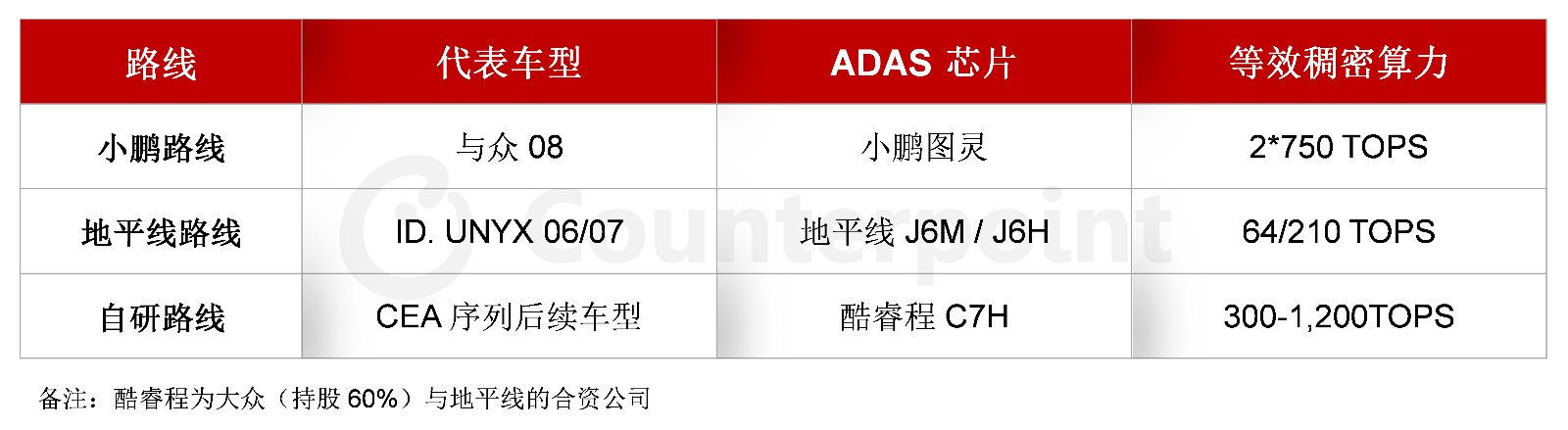
Volkswagen is not trying to solve intelligent driving with one chip pathway. Counterpoint Research says there are three parallel ADAS chip routes in China. One involves Carizon, the joint venture linked with Horizon. The company's C7H system-on-chip, associated with the Nash Architecture effort, is planned for production in 2028. Counterpoint Research notes that C7H is not simply a Horizon IP-licensed product; Horizon's role is broader, covering joint-venture shareholder, AI foundation model supplier and chip supply-chain partner.
Volkswagen Group China materials also describe C7H as a proprietary SoC meant to support cost-efficient and scalable automated driving, which helps explain why the company is willing to carry more in-house burden. For the industry, this points to a wider trend: carmakers no longer accept a supplier's standard chip as the end of the story. They want influence over compute design, because intelligent driving is tied to both vehicle differentiation and long-term cost control.
L3 in 2027: Readiness Is Not the Same as Ownership
Volkswagen has said it plans to reach L3-level autonomous driving technology readiness in 2027. That phrase is easy to misread. Counterpoint Research distinguishes technical readiness, road testing permission and consumer market access. These are separate gates, and they do not automatically open in sequence. Even if a system is technically prepared, regulatory approval and liability framing can lag. Based on China's autonomous driving rules and approval pace, Counterpoint Research estimates that personal-user L3 commercialization may not arrive earlier than 2029.
Public reporting around the October 26 period also suggests that testing is active, but those milestones are not equivalent to a customer-facing rollout. For ordinary buyers, the useful watchpoints are product approval, named market programs, and service conditions rather than readiness language in a launch event.
Export Potential: CMP, CEA and the South America, Africa, Southeast Asia Bet
Volkswagen's China system is not meant to stay only inside China. The company has talked about extending CMP, a platform integrated with CEA, to South America, Africa and Southeast Asia. Counterpoint Research interprets this as an attempt to use China's cost-control and development-speed advantages for products aimed at price-sensitive or fast-growing markets. The export ambition makes the supply question more important. Volkswagen has not made public which zone-control microcontroller supplier CEA uses, so the final chip choice will influence how deeply Chinese electronics suppliers can participate in the group's global vehicle programs.
What Readers Should Track Next
- Look for the first vehicles built around the 2027 plan, not only partnership press releases.
- Compare test-speed claims with customer-visible update frequency, stability and safety ratings.
- Watch whether CEA's chip sourcing becomes public, especially for zone-control hardware.
- Treat 2027 as readiness language for L3, while 2029 is the more realistic earliest consumer window according to Counterpoint Research.
- Use 2028 for the C7H mass-production marker, but do not assume a single chip path will define Volkswagen's entire ADAS future.
Common Misconceptions
| Misconception | More useful reading |
|---|---|
| One partnership means one unified global architecture | Two systems are still in play, each serving a different speed and market logic |
| Faster testing means safer cars automatically | Speed can improve iteration, but validation quality still depends on real-world deployment |
| A China stack is only for China | CMP plus CEA may later travel to South America, Africa and Southeast Asia |
| L3 readiness means buyers can use it right away | Testing permission, legal liability and sales approval remain separate stages |
FAQ
Why did Volkswagen pick NXP S32K5 for zone control?
Zone control is a consolidation problem. S32K5 is described in NXP launch materials as an architecture designed to keep multiple functions isolated and secure while serving software-defined vehicles. That makes it useful for a carmaker trying to reduce controller fragmentation without weakening safety boundaries.
What does VEGA add beyond CEA?
VEGA is broader than a single architecture. It groups vehicle platform, electronic architecture and ADAS, giving Volkswagen China a portfolio that can be judged as a complete stack rather than a set of isolated projects.
Is C7H meant to replace Horizon?
No. Counterpoint Research says the routes are parallel and roles overlap. Horizon supplies AI foundation models and chip ecosystem support, while C7H gives Volkswagen another path toward in-house silicon control.
Will Chinese engineering become the center of gravity?
Not immediately. The shift is real because architecture and chip choices have local input, but the final test is whether the China stack can deliver cost, reliability and export scale at the same time.
Action Advice for Following This Story
- Separate announcements from product reality. A chip selection and a platform reveal are not enough until a public vehicle program confirms them.
- Watch regulatory and liability milestones for L3, especially if you care about consumer use in China.
- Follow supplier disclosure, because a local chip ecosystem may change pricing, software maintenance and regional availability.
- Read export plans as a cost question, not only a geography question. South America, Africa and Southeast Asia often demand different price points and validation assumptions.
The real takeaway is not that Volkswagen announced a deal and a stack in the same week. It is that the company is now operating as if one carmaker can keep two technical clocks running at different speeds while still preserving the safety, compliance and brand expectations attached to a global name. That makes the story less about one supplier and more about whether distributed technical authority can become a durable competitive method.