
Hanoi Chip Plant Status Check: Viettel’s 2027 Timeline, Satellite Images and ASML Talks
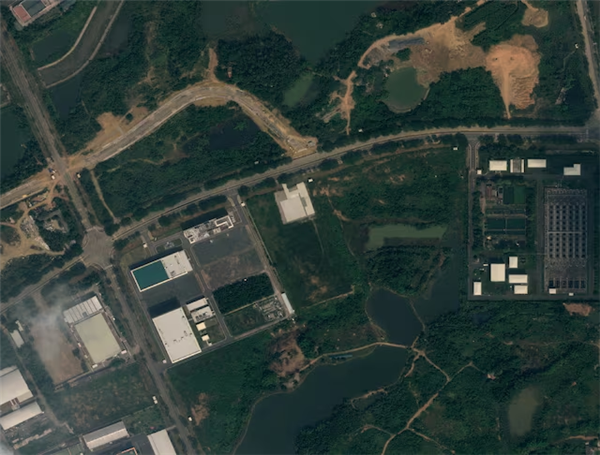
A semiconductor factory project in suburban Hanoi that had been publicly linked to a 2027 milestone is now facing fresh doubt. A reporter visited the site last week and found the land still covered with weeds. Satellite images from Planet Labs taken this January, along with images from Airbus taken in October, showed no completed buildings at the location. The project is developed by Viettel, a telecom and defense group operated by the Vietnamese military, and it has become a clear example of how stated industrial goals, construction progress and equipment supply negotiations can move at different speeds.
What the reporting actually shows
- Reporter visited the suburban Hanoi site last week and observed no completed buildings.
- Planet Labs imagery from this January and Airbus imagery from October supported the same observation: the factory site had not yet been built out.
- A person with direct knowledge of the project said the 2027 target is very likely not achievable.
- That person pointed to two practical constraints: Viettel lacks experience in building chip factories, and the project faces administrative obstacles in quickly obtaining government funds.
- The reporting also noted that the government-led project is still moving, but the timeline has become unclear.
- Three people familiar with the matter said negotiations between Viettel and ASML have continued for months and involve equipment procurement, but no agreement has been reached so far.
- ASML declined to comment on the talks, while Vietnam Ministry of Finance did not respond to a request for comment.
- Viettel’s public statement was stronger: it said the project “is proceeding according to the established plan and schedule” and that work is being carried out in phases according to technical requirements, with further updates to come at the appropriate time.
- The project broke ground this January. At that time, Viettel said it hoped the factory would be fully operational in 2030, with chips intended for aerospace, telecommunications and automotive applications.
A plain-language status table
| Topic | What the reporting states | Why readers should pay attention |
|---|---|---|
| Location | Suburban Hanoi, Vietnam | The site visit is one of the few direct checks on physical progress. |
| Visible construction | Reporter saw weeds on site last week; Planet Labs images from this January and Airbus images from October showed no completed buildings | Satellite and on-the-ground views do not yet match the image of an operating factory. |
| 2027 target | A person with direct knowledge said the 2027 target is very likely not achievable | The original schedule is now the central public question. |
| Stated reasons | Viettel lacks chip factory building experience; administrative obstacles to quickly obtaining government funds | It shows the issue is not only equipment buying, but also execution capability and funding workflow. |
| Official project status | The project is still progressing, but the timeline is unclear | Readers should separate “not stopped” from “on time.” |
| Viettel’s position | Viettel said the project “is proceeding according to the established plan and schedule” and that activities are being carried out in phases according to technical requirements | Viettel’s statement and the reported timeline concern coexist in the same update. |
| ASML negotiations | Talks have lasted months, cover equipment procurement, and have not resulted in an agreement; ASML declined to comment | Chip factories depend on equipment supply, so unresolved talks matter to the project’s feasibility. |
| Government comment | Vietnam Ministry of Finance did not respond to a request for comment | It leaves funding questions unanswered for now. |
| Longer-term goal | Groundbreaking took place this January; Viettel had hoped for full operation in 2030 | The 2030 goal remains the stated aspiration, while near-term construction status is the more immediate question. |
| Target sectors | Chips were intended to serve aerospace, telecommunications and automotive fields | These sectors make the project relevant beyond Vietnam’s domestic technology market. |
Why this update matters to general tech readers
For many readers, the most important part is not whether chips are difficult to make in a technical sense, but whether a announced schedule survives contact with real-world construction. In this case, the public picture has two layers. One layer is the developer’s statement that the project is following its plan. The other is the reported observation that the site remains unbuilt and that a person close to the project sees the 2027 target as unlikely. Both cannot be simplified away: they point to a project that has not necessarily ended, but whose public timeline now needs clearer verification.
The Hanoi chip plant story also shows how a semiconductor project is rarely just one single action. It involves land, buildings, financing, permits, equipment orders, supply negotiations and operating plans. A groundbreaking can start a project, but it does not by itself prove that the factory will reach production on schedule. For readers, that distinction is useful: “planned,” “under negotiation,” “under construction” and “operational” are different stages, and the latest reporting suggests the Hanoi project is still being tested at the construction and procurement stages.
What has been confirmed, what has not
Confirmed in the reporting
- There was a site visit last week.
- The site appeared weed-covered and had no completed buildings in the reporter’s observation.
- Planet Labs and Airbus imagery provided an additional view of the site from this January and October, respectively.
- Viettel has said the project “is proceeding according to the established plan and schedule.”
- Three people described months-long equipment procurement discussions with ASML without an agreement.
- ASML declined to comment, and Vietnam Ministry of Finance did not respond.
- The project broke ground this January, with a stated hope of full operation in 2030.
Not confirmed by the reporting
- Whether the project has been formally canceled or officially rescheduled.
- Whether ASML and Viettel have reached any private agreement beyond the reported lack of public agreement.
- Whether the Vietnamese military’s telecom and defense group Viettel has solved all funding and construction obstacles.
- Whether the 2027 milestone will be officially abandoned or quietly replaced.
Common misconceptions
- Misconception 1: “No buildings in satellite images means the project is dead.” The reporting says the site has not yet been built and that the 2027 target is very likely not achievable, but it also says the government-led project is still progressing and Viettel maintains it is following its plan.
- Misconception 2: “If the company says it is on schedule, that settles the question.” Viettel’s statement is one part of the update; the site observation, the source close to the project, and the lack of a confirmed equipment agreement are other parts that readers should weigh together.
- Misconception 3: “If ASML talks are underway, the factory can start soon.” The reporting says talks involve equipment procurement and have lasted months, but no agreement has been reached.
- Misconception 4: “A 2030 goal means there is no problem now.” The 2030 hope was stated when the project broke ground, but the more immediate question raised by reporting is whether the earlier 2027 target can still be met.
- Misconception 5: “Only the builder’s own statement matters.” For this story, satellite images, a reporter’s site visit, unnamed sources, ASML’s non-comment and Vietnam Ministry of Finance’s non-response all shape the public picture.
FAQ
What is the Hanoi chip plant project?
It is a semiconductor factory project developed by Viettel, a telecom and defense group operated by the Vietnamese military. The project is located in suburban Hanoi, Vietnam, and was linked to chip supply for aerospace, telecommunications and automotive fields.
When did construction planning start publicly?
The reporting says the project broke ground this January. At that time, Viettel said it hoped the factory would be fully operational in 2030.
What has changed in the latest reporting?
The latest reporting includes a site visit last week, satellite views from Planet Labs this January and Airbus in October, and statements from Viettel, ASML and sources close to the project. Together, they suggest the 2027 target is very likely not achievable, while the project is described as still progressing with an unclear timeline.
Has the site actually been built?
The reporting says the site still had weeds during the visit last week and that Planet Labs and Airbus imagery showed no completed buildings. The project had broken ground this January, but the visible building status remains a key concern.
Why is the 2027 target at risk?
A person with direct knowledge cited two reasons: Viettel lacks experience in building chip factories, and there are administrative obstacles to quickly obtaining government funds. The same reporting also noted that the government-led project has not stopped, but its timeline is now unclear.
What does Viettel say?
Viettel told media that the project “is proceeding according to the established plan and schedule” and that activities are being carried out in phases according to technical requirements. It said further updates would be provided at the appropriate time.
What about ASML?
Three people familiar with the matter said Viettel and ASML have negotiated for months on equipment procurement, but no agreement has been reached. ASML declined to comment on the negotiations.
What about government funding?
The reporting says there are administrative obstacles to quickly obtaining government funds, and it notes that Vietnam Ministry of Finance did not respond to a request for comment.
Is the 2030 full-operation goal still mentioned?
Yes. The reporting says that when the project broke ground this January, Viettel stated its hope for full operation in 2030. The immediate public question, however, is the earlier 2027 target and whether the project can move from planning and negotiation to visible construction.
Checklist: how to read the next update
- Check whether the site has visible buildings, not just a groundbreaking announcement.
- Separate Viettel’s statement of “proceeding according to the established plan and schedule” from independent observations such as reporter visits and satellite images.
- Look for an official update on whether the 2027 target is being revised, delayed or retained.
- Watch whether any agreement with ASML is confirmed publicly; the current reporting says there is no agreement yet.
- Follow whether Vietnam Ministry of Finance or another government body gives a clearer statement about funding timing.
- Read the 2030 goal as a long-term aspiration unless newer reporting confirms how the factory will reach construction and operation milestones.
Action suggestions
- For readers following Vietnam technology projects, treat the Hanoi chip plant as a case where physical construction status should be checked separately from company statements.
- For industry watchers, pay attention to the three people’s account of months-long equipment procurement talks with ASML; unresolved supply negotiations can be as important as the construction site itself.
- For policy and business readers, the reported administrative funding obstacles are worth watching because the project is described as government-led and still progressing despite an unclear timeline.
- For general audiences, avoid jumping from “no buildings yet” to “project canceled” or from “company says on plan” to “everything is normal.” The reporting supports a more careful conclusion: the public timeline is doubtful, but the stated project activity has not been withdrawn.
Bottom line
The Hanoi chip plant story is now less about the excitement of a groundbreaking and more about the gap between stated plans and observable progress. The reporting gives several concrete pieces: a site visit last week, weed-covered land, Planet Labs imagery from this January, Airbus imagery from October, a direct-knowledge view that the 2027 target is very likely not achievable, months of ASML equipment talks with three people saying no agreement has been reached, Viettel’s insistence that the project “is proceeding according to the established plan and schedule,” no comment from ASML, no response from Vietnam Ministry of Finance, and an earlier 2030 full-operation hope tied to the project’s start this January. The result is a project that may still be moving, but whose next credible sign of progress will need to be visible construction, clearer funding status and a confirmed path through equipment negotiations.