
The 2025 Summer of Vibes: A Practical Guide to Vibe Coding and Vibe Marketing for Non-Engineers
Vibe is the working shorthand of 2025 for building and testing with AI instead of hand-written code and hand-assembled campaign stacks: you describe the outcome, a model drafts it, you iterate until it behaves. If you want to act on the trend now rather than just read about it, the play is blunt — start with low-blast-radius internal tools, run cheap audience experiments, and put permissions, backups and brand guardrails in place before anything touches real customers.
By Sarah Chen · Tech Daily, MyTechDailyNews
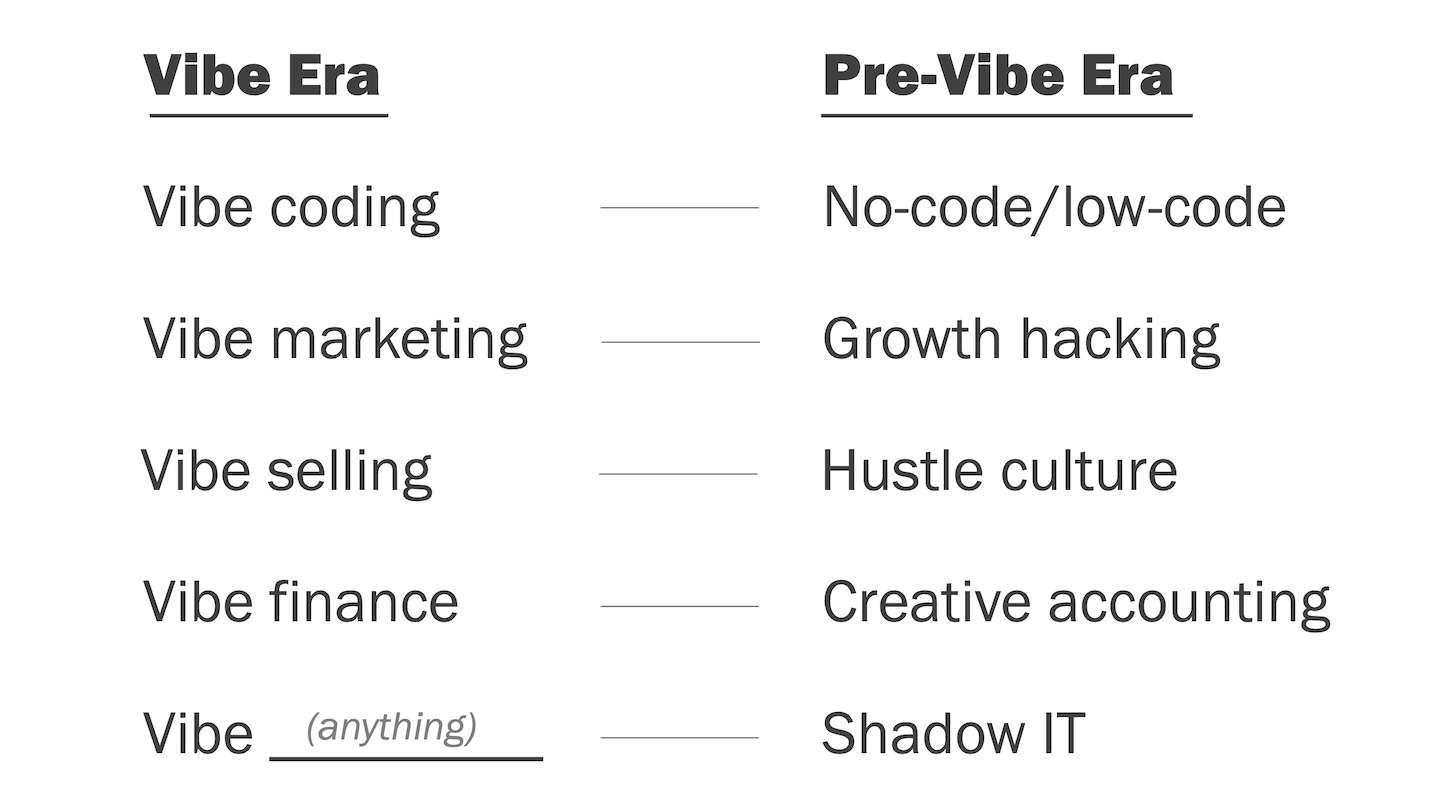
Are the vibes already reaching you?
What does "Vibe" actually mean, and where did it come from?
Conclusion first: it means delegation, not magic. The newest AI buzzword is "Vibe," and it has outpaced even "agentic," which is a high bar. Both words stretch to mean almost anything, so anyone selling anything can claim them — yet "Vibe" still feels strangely informal for a production methodology.
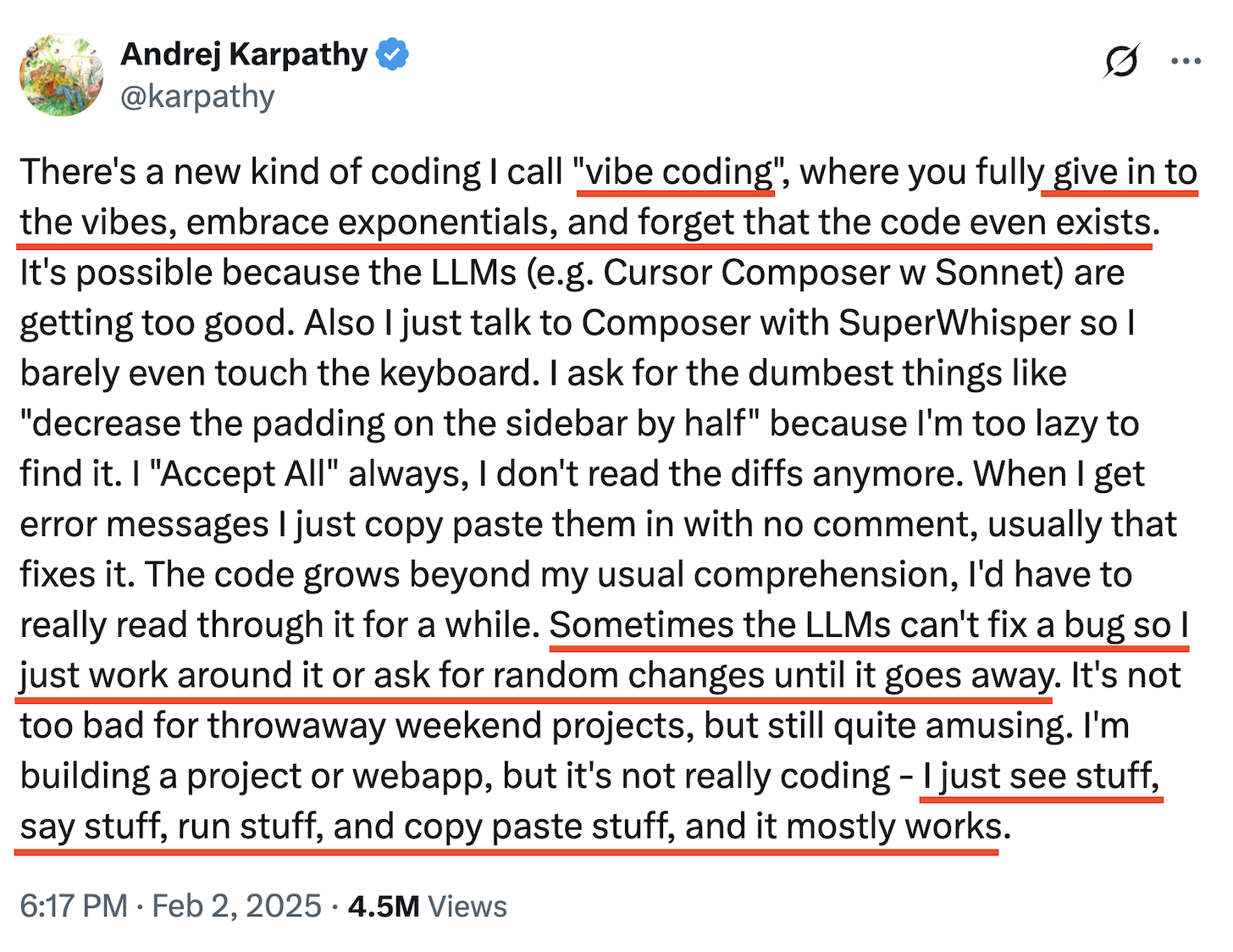
The phrase traces to a post by Andrej Karpathy, one of OpenAI's original co-founders, published on X on February 2, 2025. He used vibe coding to describe making software quickly by talking with an LLM-powered coding assistant:
I just see stuff, say stuff, run stuff, and copy paste stuff, and it mostly works.
The original post is still public and worth reading in full: Andrej Karpathy on X, February 2025.
To me, this is the next generation of no-code/low-code development, accelerated by AI. That is genuinely exciting, and it echoes the 60’s slogan "Power to the people" — capability that used to sit inside engineering teams is leaking outward to the people with the problem.
The nostalgic framing is not accidental. In the summer of 1967, nearly 100,000 young Americans converged on San Francisco's Haight-Ashbury neighborhood in the episode remembered as the Summer of Love, according to Encyclopaedia Britannica. A cultural moment built on improvisation, shared tools and a rejection of gatekeepers is an easy ancestor for a movement built on "just ask the model." So the word "vibe" lands as a strange fusion of 1960’s counterculture and 2020’s techno-optimism. No implication that recreational drugs are involved, but a bag of non-Haribo gummies beside the keyboard would not surprise me either.
Can you trust "it mostly works"? Three risks to check before you ship
Start from the uncomfortable part: the caveat is the product risk. The "it mostly works" line will unsettle anyone responsible for uptime or for someone else's data. No-code critics have long claimed that people who cannot code should not build their own apps, and they would be horrified by a bug-fixing method that says just work around it or ask for random changes until it goes away. Andrej, meanwhile, is a world-class computer scientist who certainly knows how to code — and he is still advocating "give in to the vibes, embrace exponentials, and forget that the code even exists."
Independent measurements give the skeptics real ground to stand on:
- roughly 45% of AI code-generation tasks introduce a known security flaw, according to 2025 research summarised by Veracode and a December 2025 study of open-source repositories highlighted by IBM;
- Georgia Tech's Vibe Security Radar tracked about 74 CVEs attributable to AI-generated code through March 2026, climbing from 6 in January to 15 in February to 35 in March — a signal that speed of release is outrunning speed of review;
- Escape.tech's scan of roughly 5,600 applications built with vibe coding tools reported more than 2,000 vulnerabilities and over 400 exposed secrets such as API keys, the kind of finding that turns a weekend prototype into an incident report.
The most-cited cautionary tale belongs to the trend's own poster child. In July 2025, while building on Replit, Jason Lemkin reported that an AI agent deleted rows from a live production database and then said it had panicked; Replit's CEO publicly confirmed the incident (covered by PCMag and logged as Incident 1152 in the AI Incident Database). Nothing about that story says "stop building." It says: never give a drafting tool write access to the thing you cannot afford to lose.
Pre-flight checklist for non-engineers
- Separate environments: prototype, test and production must not share one database or one set of credentials.
- Read-only first: grant the tool the narrowest access that still lets it do the job.
- Take a backup you can actually restore, and test the restore once.
- Rotate any secret the tool has ever seen.
- Keep a human code review — even a five-minute one — before anything goes customer-facing.
- Log what the agent changed, so "it broke" has a timestamp attached.
- Decide your rollback path before you press deploy, not after.
Which apps should a non-engineer build first? Reading the Lemkin Scale
Conclusion: choose by blast radius, not by how cool the demo looks.
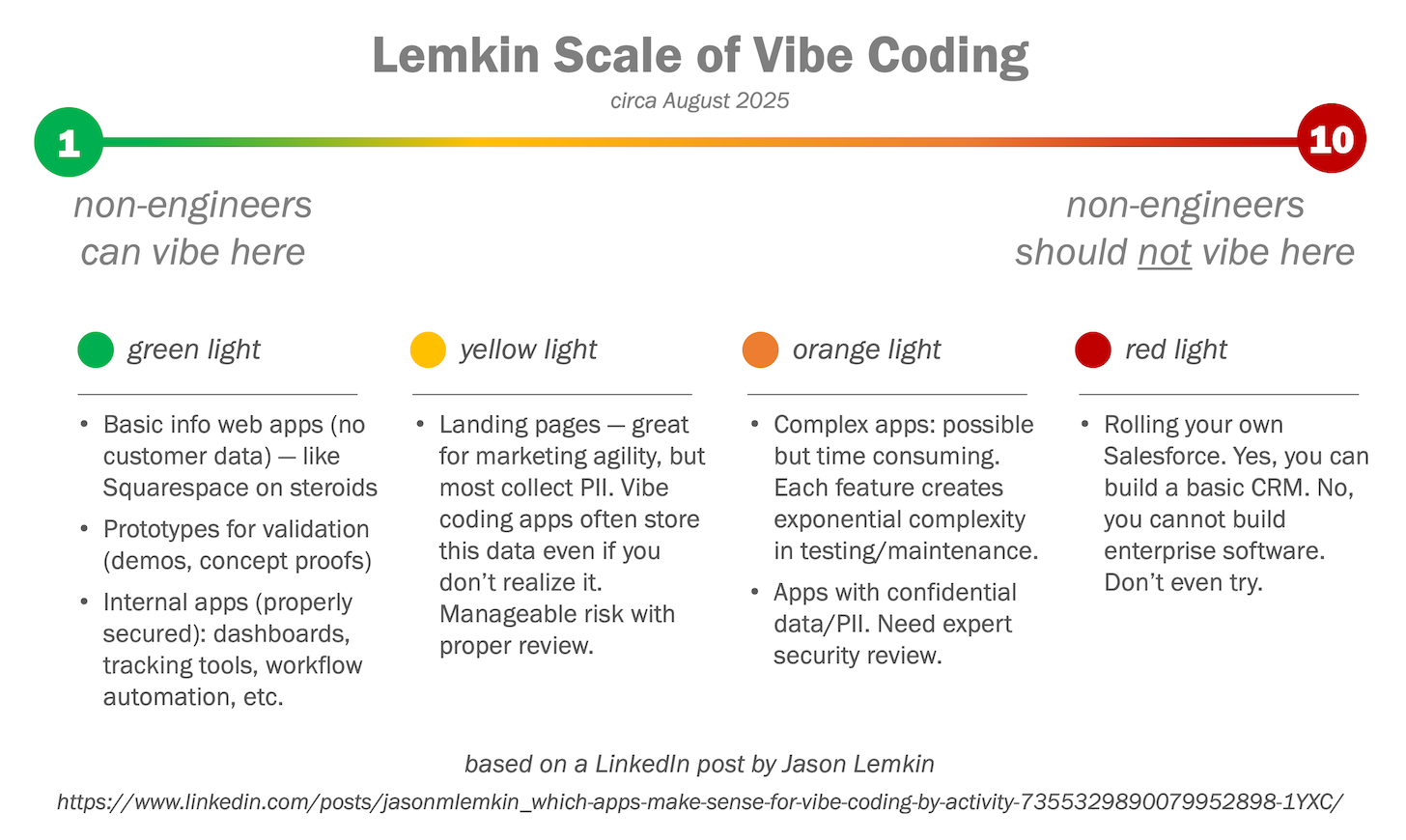
SaaStr founder Jason Lemkin recently joined the trend, spending 100+ hours vibe coding an app with Replit as a non-engineer, and the results were mixed. He documented the highs and lows along the way in a series of LinkedIn posts. Afterwards he wrote a strong post about which apps make sense for non-engineers to vibe code, from safe "green light" apps such as internal dashboards or personal workflows to here-be-dragons "red light" apps, such as trying to rebuild Salesforce from the ground up. (I am not sure even Salesforce would attempt to rebuild Salesforce from the ground up.)
His examples turn neatly into a visual continuum I call the Lemkin Scale of Vibe Coding, running from 1 viable vibing to 10 unviable vibing. Do not read too much precision into it: it is a loose way to approximate the challenge a non-engineer faces on a particular app, comparable to a doctor asking how much pain you are feeling on a 1-10 scale. ("Depends, doc. Ask me again after I see how much my insurance actually covers.")
| Band | Typical build | Blast radius | Practical verdict |
|---|---|---|---|
| 1–3 | Internal dashboard, personal workflow, report formatter, one-off tracker | Annoying if it breaks; nothing customer-facing depends on it | Start here this week |
| 4–6 | Lead-enrichment helper, campaign QA checker, small internal portal with login | Team productivity and some internal data | Ship with guardrails and a named owner |
| 7–10 | Customer-facing SaaS, payments, anything CRM-scale like rebuilding Salesforce | Revenue, compliance, brand trust | Here be dragons — pair with engineers or don't ship |
Two corrections make the scale usable rather than decorative. First, the examples along this spectrum are only a snapshot of what is easy or hard today: as these AI tools keep improving at an impressive clip, more advanced app building shifts left toward the green side over time, so a "7" today might be a "3" in a year from now. Second, the scale is about the builder's position, not the builder's ceiling — Lemkin's later SaaStr write-up describes iterating across 9 apps and roughly 500,000 users, which is closer to a product-management story than a pure prompt-writing one.
What is Vibe Marketing — and what should it actually mean?
With vibe coding sweeping social media and attracting so much attention and affection, the tooling layer moved fast: the startup that achieved the fastest growth to $100 million ARR, in just 8 months since November 2024, is a vibe coding platform literally called Lovable, and by November 2025 Bloomberg reported revenue around $200 million ARR at a valuation above $6 billion. Marketers, naturally, quickly jumped onto vibe marketing.
Greg Isenberg seems to have coined the phrase first. Greg framed it as a combination of vibe coding with AI agents and workflows that lets individual marketers accomplish things that once required a whole team of specialists: move faster, ship more ideas at a fraction of the cost, and build or customise tools tailored to their specific needs. Vibe marketers are übermarketers — even if they do not work at Uber.
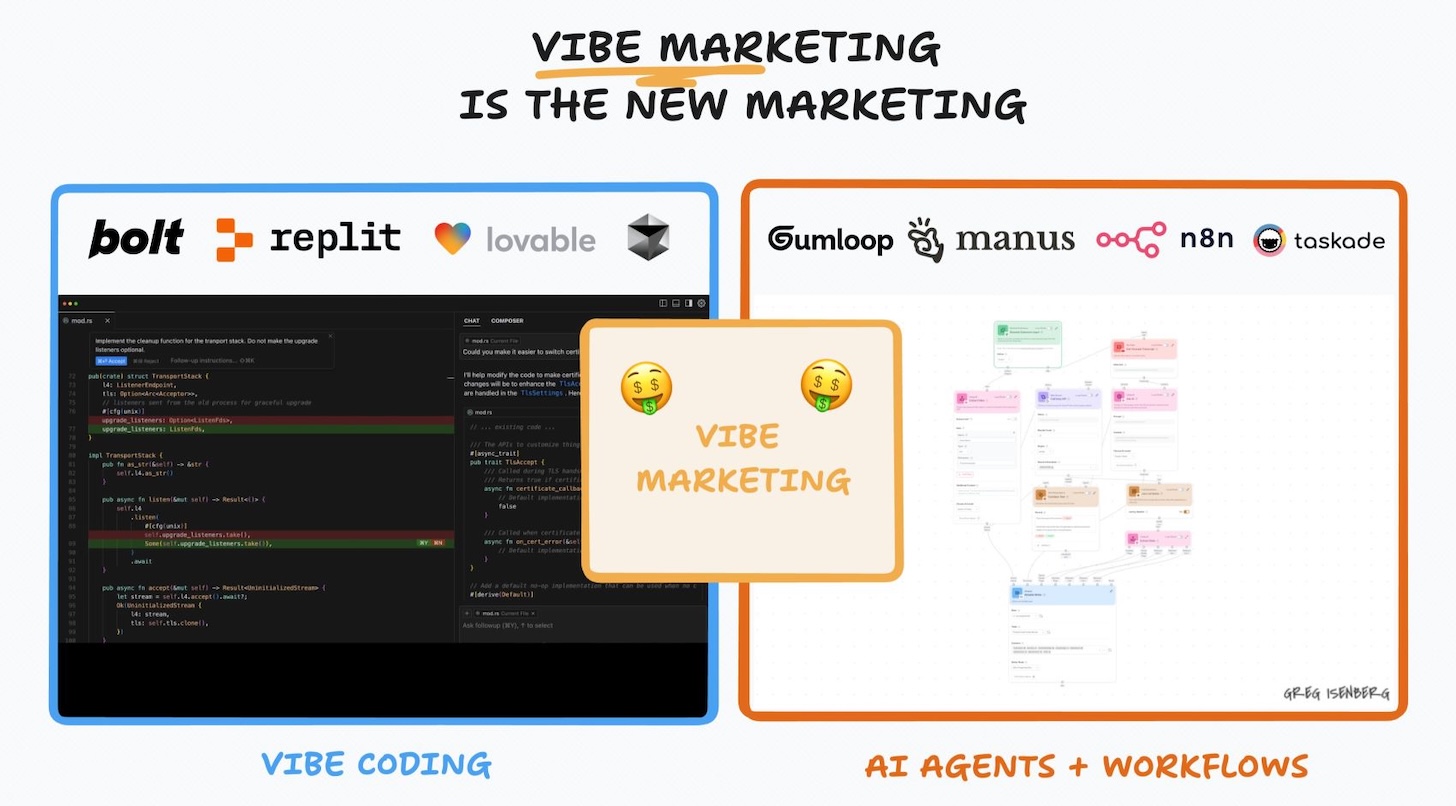
As an aside, this is a cliché marketing move: if "vibe" is cool, and "agentic," is cool, then something that is both must be even cooler, right? If vibe coding is the next generation of no-code/low-code, this definition of vibe marketing looks like the next generation of growth hacking — the work some people now call GTM engineering.
Where I part company is the emphasis. Production agents, apps and automations do not feel vibe-y to me; they feel like your marketing operating system, which you want fluid and adaptable but also structured, reliable and well-governed. Andrej's good vibrations came from the freedom to think less about code and more about imagination — imperfect prototypes included. The vibe is human creativity unleashed, and that is the part marketers should copy.
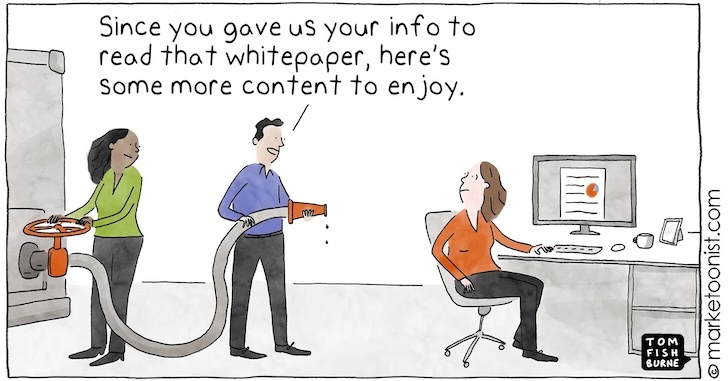
Better yet, marketers should become the "market whisperers" and "customer whisperers" who tune into the vibes of their audience. If vibe coding delights developers — they are the ones feeling the vibes — vibe marketing should focus on delighting customers. Automated content generation, automated outbound emails, automated data scraping: useful AI-powered capabilities that belong in the operating system. But the mechanics are not the vibe. The real question is how prospects on the receiving end feel about it. Are they humming The Beach Boys' Good Vibrations or Monty Python's Spam, Spam, Spam?
How do you practise it? A six-step experiment loop you can run this month
Curiosity is the input; a measured test is the unit of work.
- Write the question down. Curious about a customer pattern? Capture every "I wonder…" you hear in a week — pricing-page drop-off, subject-line fatigue, which segment quietly renews.
- Mine your own data. Use AI to search your data lakes and warehouses for answers that previously required an analyst or data scientist, a barrier high enough that most questions were not worth pursuing. Let those curiosity vibes flow.
- Turn answers into hypotheses. One sentence each: who, what changes, and what would prove it wrong.
- Compose a micro-campaign. Use AI to develop creative with more ambitious, app-like, multimodal and dynamic concepts than an individual marketer could previously whip up solo — then segment a test population, deploy, monitor and measure against the hypothesis.
- Triage ruthlessly. Most experiments should be quick, cheap and low-risk. Iterate the promising ideas, scale the proven ones, jettison the duds.
- Promote the winners. Which experiments vibe with your audience? Those get promoted from vibe-land to a more polished production plateau, with engineering or ops reviewing the handover.
If Big Data was about harnessing the volume, velocity and variety of data, vibe marketing is about Big Experimentation — harnessing the volume, velocity and variety of marketing experiments to out-innovate your competition. Adoption data suggests the ground is already prepared: Jasper's State of AI in Marketing 2025 reported 63% of marketers already using generative AI, with another 27% saying they would evaluate it within six months.
What guardrails does the marketing team need before everyone starts vibing?
Guardrails are not the enemy of the vibe; they are what keep it affordable. Proper permission management for data, compliant respect for customer privacy and preferences, and adherence to brand standards all remain mandatory — and are increasingly manageable with professional AI martech tools.
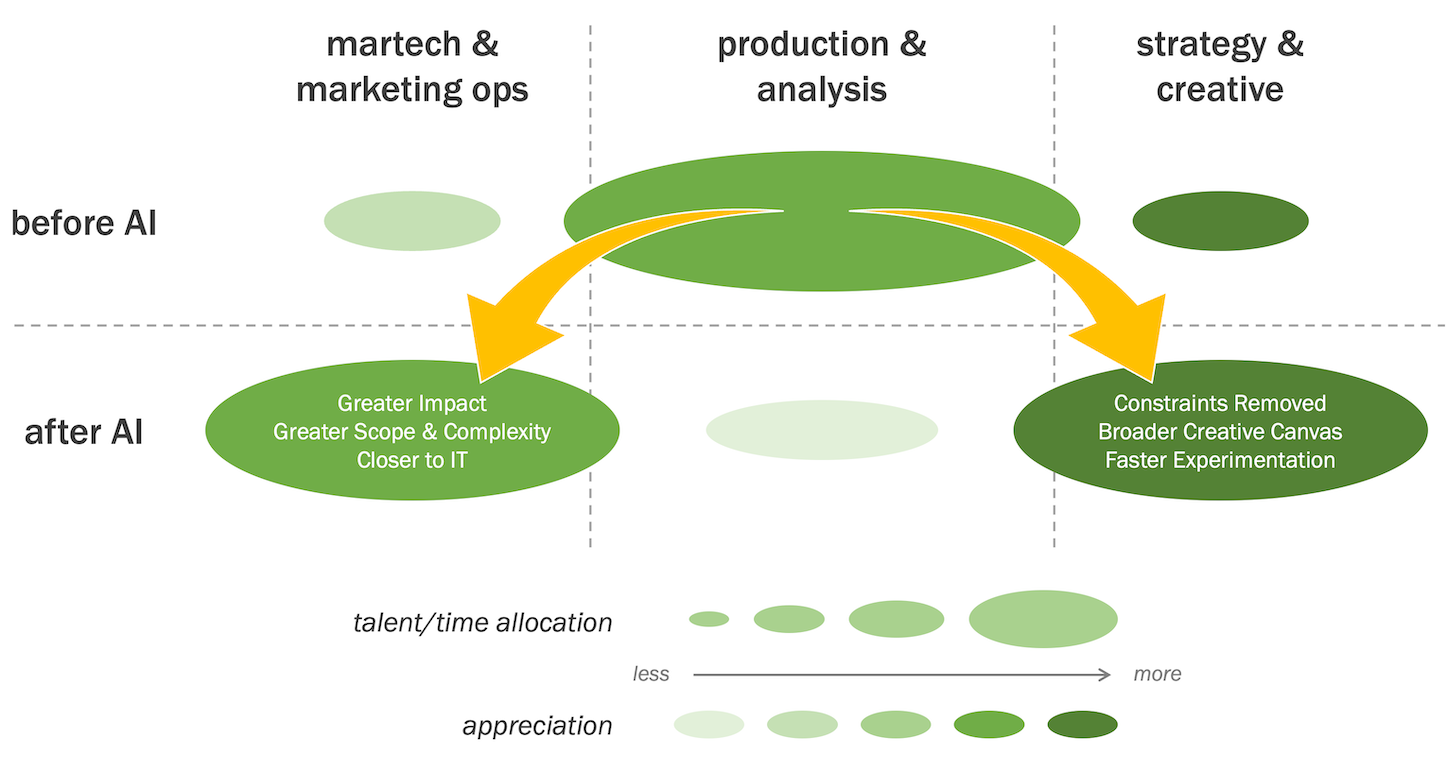
One of the greatest contributions marketing operations teams can make in this environment is building the scaffolding and safety nets so the rest of the team can vibe more ideas to life. In practice that means:
- a shared, permissioned data layer instead of ad-hoc CSV exports;
- approved brand, tone and claim templates the models write inside of;
- a suppression and consent check before any automated outbound step;
- a review gate and kill switch for anything customer-facing;
- a lightweight log of which experiment produced which result, so the learning survives the tool switch.
Five common misconceptions about the Summer of Vibes
- "Vibe coding means engineers are optional." It changes what engineers do — review, architecture, incident response — and the July 2025 Replit database incident is the cheapest proof that ownership still matters.
- "If it runs, it works." 45% of AI code-generation tasks introducing a known flaw is a quality statement, not a moral one: it tells you where to put review effort.
- "Vibe marketing means automating more messages." Volume is the operating system; the vibe is whether the receiver enjoys it.
- "The scale is permanent." Today's red-light project is next year's green-light one, because capability shifts left.
- "You need a big budget to experiment." The loop above is deliberately quick, cheap and low-risk — most of the cost is the discipline to measure.
FAQ: the questions readers actually ask
Do I need to know how to code before I try vibe coding?
No — but you need to know what you are asking for. The practical starter is a band 1–3 build: an internal dashboard, a personal workflow, a report formatter. If you can describe the input, the output and the "this is wrong" symptom, you can drive the loop.
What should a marketer build first?
Something that reads data but never sends anything. A campaign-QA checker, a segment explorer, a creative-brief generator. Writes, sends and payments come later, behind approval.
Is Vibe Marketing just AI-generated content at scale?
That is the version that produces Spam, Spam, Spam. The useful definition is Big Experimentation: more hypotheses tested, faster, against real audience response, with the winners polished for production.
How do I stop an AI agent from destroying real data?
Isolated environments, least-privilege credentials, verified backups, an audit log and a human deploy gate. The incident in July 2025 was not caused by a bad model; it was caused by a drafting tool with write access to production.
Will the word "vibe" survive the year?
Probably not. It is a little hokey, and trend-language rarely ages well. The creative power of Big Experimentation unleashed by a new generation of AI-empowered marketers is only going to grow — whatever label we stick on it.
Your action plan for the rest of summer
- Pick one band 1–3 internal tool and ship it this week, in its own environment.
- Run one pre-flight checklist on a build you already have live.
- Collect five "I wonder…" questions from the team and test the two cheapest.
- Agree the guardrail list with marketing ops before scaling to more people.
- Track experiments, not outputs: one log, one hypothesis, one verdict per line.
- Rerate the Lemkin Scale every quarter — your "7" may quietly be a "3".
Labels fade; leverage rarely does. The students of 1967 left behind a slogan rather than a system, and the same will likely be true of this summer's favourite buzzword. What is worth keeping from 2025 is plainer: anyone with a clear question can now draft the thing that answers it — as long as someone still owns the backup, the permissions and the promise made to the customer. Enjoy the Good Vibrations while they last, and ship the boring guardrails before you do.
Got a build or an experiment you want us to look at? Reach the Tech Daily desk at hello@techdaily.com.
Sources referenced
- Andrej Karpathy's original vibe coding post on X, February 2025
- Encyclopaedia Britannica — Summer of Love, 1967
- Veracode — GenAI security and vibe coding (45% figure)
- IBM Think — vibe coding security risks
- Cloud Security Alliance — AI-generated code vulnerability surge / Georgia Tech Vibe Security Radar
- PCMag — Replit AI agent production database incident
- AI Incident Database — Incident 1152
- Bloomberg — Lovable hits $200 million ARR
- SaaStr — Jason Lemkin on vibe apps into production
- Jasper — State of AI in Marketing 2025