
Why AI Automation Feels Efficient to Companies but Annoying to Customers: Two Real Journeys Decoded
Because unattended automation is almost always tuned to protect the company's cost line rather than the customer's outcome. It answers instantly, it fires on schedule, it closes tickets quietly — and when it breaks, it rarely raises an error anyone has to answer. That single design gap turns a stack built for throughput into an obstacle course for the person on the other end of the thread. Here is what happened in two real journeys, why the failures are structural, what the survey data says, and what vendors and customers should each do next.
By Sarah Chen · MyTechDailyNews General desk
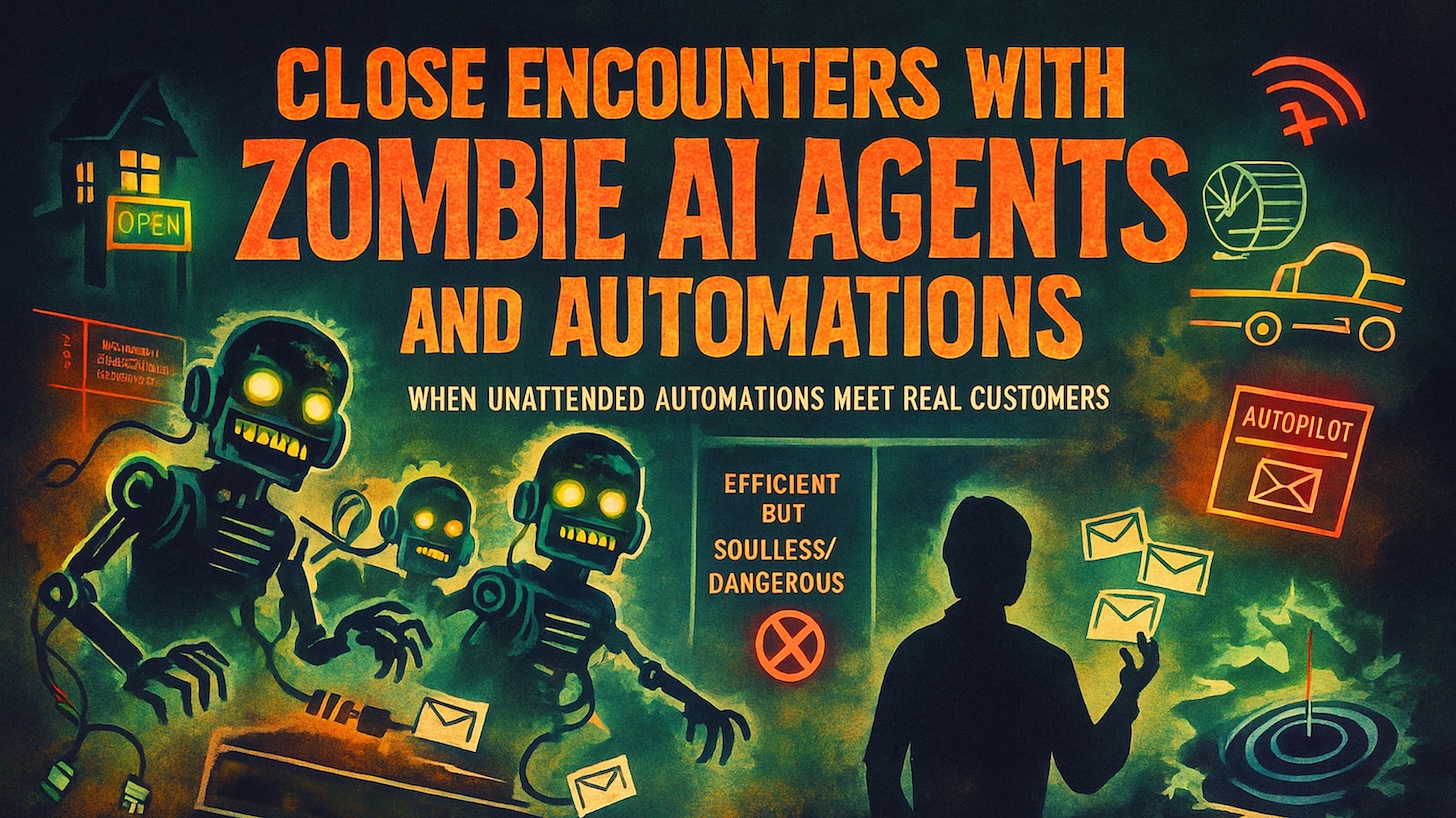
Every generation of runaway automation earns its own idiom: the lights are on but nobody is home, the engine is running but nobody is driving. The current one is more precise — The Wi-Fi’s on, but there’s no Internet. Everything appears connected; nothing is actually reachable.
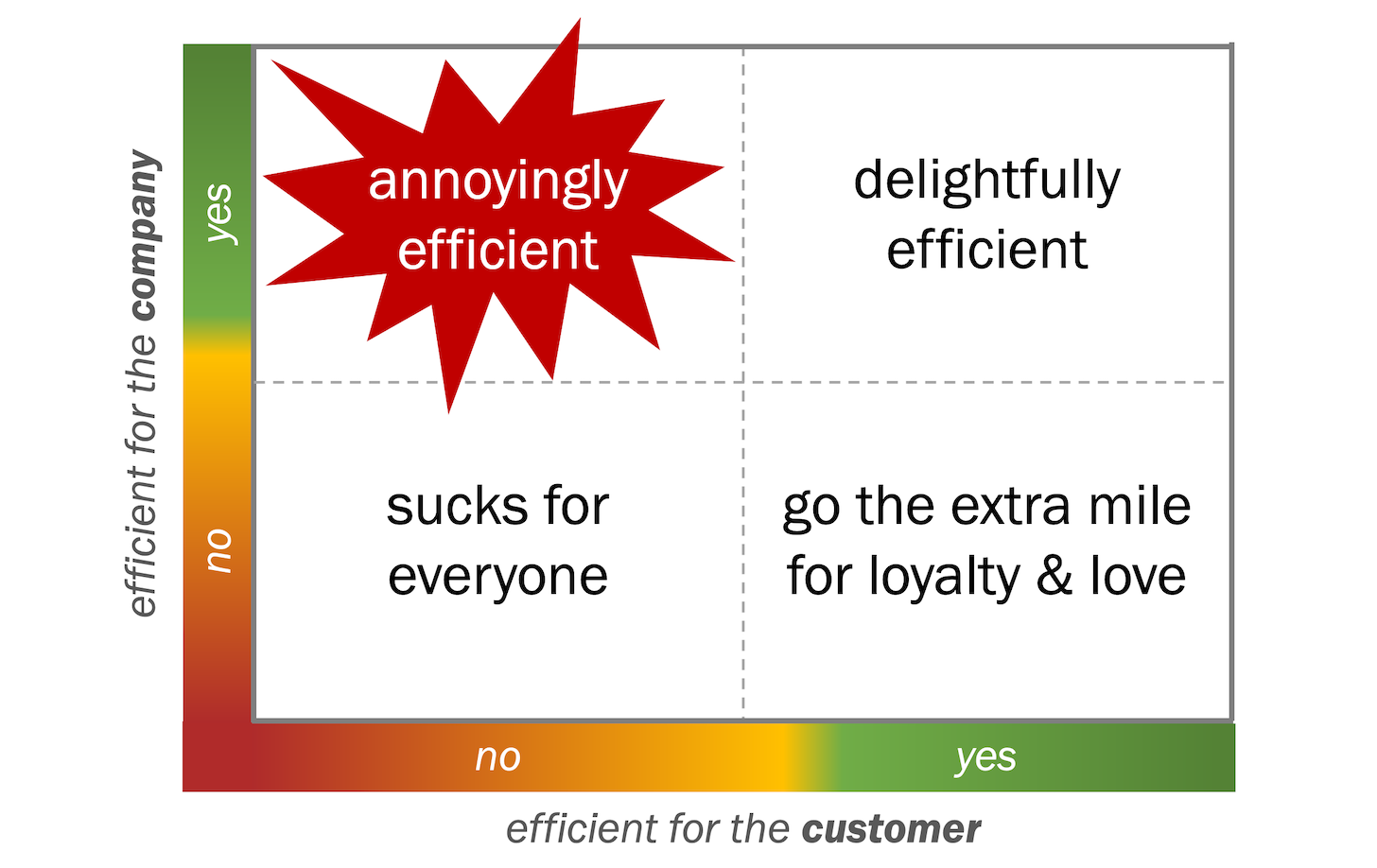
Over the past weeks, a marketing-technology practitioner documented first-hand how AI agents and automation behaved at two separate martech vendors — once as a paying customer, once as a near-prospect. Both episodes sat in the annoyingly efficient upper-left quadrant of the matrix below: efficient for the company, costly for the human. The original account spared the two companies' names, and this article is a diagnosis, not a hit piece.
What actually went wrong in the two customer journeys?
Journey one: the support address that goes nowhere. Useful, well-paced onboarding emails had been arriving for weeks from a shared address. Then last week a billing question came up, every help path in the product pointed to that same mailbox, and the question was sent there. No reply — not even an automated acknowledgement of receipt. After waiting a day, a polite follow-up went out. Silence again. A couple of days later, the same address delivered a cheerful onboarding message, apparently unaware of three unanswered attempts. A third reply, this time volunteering that a different address might be needed, also died in the void. FAQs, account screens and help documentation were searched; all still pointed to the same inbox.
The fault cannot be debugged from outside, but the candidate causes are familiar to anyone who runs a stack: a routing rule that mis-files the message, a destination queue nobody is assigned to work, an LLM that errors out while interpreting intent, or a failed lookup of the account record. Complex automations are fragile. The revealing detail is not that something broke — it is that nothing in the system was built to notice.
Journey two: the AI SDR that forgot the conversation ever happened. A gated report was downloaded out of plain interest, and Within a couple of minutes a note arrived from a named rep. This was not a mail-merge template: the opening paragraph was written about the nature of that practitioner's work on chiefmartec, it raised an AI concern genuinely relevant to the writing, and it asked what had sparked the download. The only tell was velocity — no human researches and drafts that fast, and a fast, thoughtful reply is not a sin. The response complimented the turnaround, explained the interest, and explicitly self-disqualified as a buyer. Nothing came back. Fair enough.
Then, a couple hours later, the same sender delivered a completely different template: an old-school Hello, $FIRST-NAME opener, a reference to something unrelated to the report, and calendar slots for a demo — a non sequitur to the exchange that had just taken place. A week later another message arrived in that same automated format, now with a $COMPANY-NAME merge tag in the first paragraph and the wrong company pasted into it. Two systems had taken the same person and never compared notes: an AI SDR agent wrote the first email, intercepted the reply without knowing what to do with it, and enrolled the contact in a drip sequence in a different product with no memory of the thread, while a data-enrichment service wrote flat-out wrong fields onto the record.
Why does company-side efficiency turn into customer-side friction?
Because the failure is born at the seams, and seams are exactly where nobody's dashboard points. Four mechanisms explain almost all of it.
- Silent failure. An agent that errors out loudly is a ticket; an agent that completes every step and still never reaches a human is a ghost. Platform engineering teams now treat this as an observability problem: Salesforce's engineering blog argued in September 2026 that AI agent telemetry has to make "silent production failures visible and actionable", because conventional monitoring watches uptime, not whether the customer got an answer. The unanswered billing inbox is textbook — zero exceptions, one angry customer.
- Integration density. The 2026 martech landscape catalogued by chiefmartec holds 15,505 products, up just 0.79% year over year, with 1,488 added and 1,367 dropped. Net change is flat; churn underneath is not. Every product swap adds a new handoff between systems that each keep their own idea of who the customer is, and no vendor can test the full matrix.
- Context loss on handoff. Five9's 2026 customer-experience research puts the blind spot in numbers: 96% of business leaders believe AI-to-human handoffs preserve context, while 83% of consumers say they still have to repeat themselves. That gap is not a modelling problem; it is a state-sharing problem between two tools that were bought separately.
- Metric design. Automation rate and deflection are monitored daily. Time-to-human, steps-to-human and post-handoff satisfaction usually are not, so the organisation optimises for the number it can see.
| Signal | What the dashboard reports | What the customer experiences |
|---|---|---|
| Inbound message | Routed successfully, no error logged | Three emails, zero acknowledgement, no answer |
| First sales reply | Sub-two-minute response, high relevance score | Impressive — until the thread is silently dropped |
| Nurture sequence | On schedule, personalised tokens populated | Wrong company name, wrong topic, wrong moment |
| Escalation | Not measured | No visible door to a person |
| Cost per contact | Down | Effort per problem unchanged or up |
Is this an anecdote or a pattern?
It is a pattern with a growing paper trail. A Morning Consult survey conducted for the 2026 Yale CEO Summit and reported by Fortune found that 82% of US adults say it has become harder to reach a human in customer service; 44% said they would be less willing to deal with a company that puts AI in charge of support, and 51% believed AI takes longer or never resolves the issue, against 26% who thought it was faster.
Gartner's August 2026 survey of 3,566 B2B and B2C customers went further: 87% said companies using generative AI for customer service must provide a way to reach a human agent. A separate Gartner survey published in July 2026 found customers are roughly three times more likely to bring a third-party GenAI assistant to resolve a support issue than to use the company's own chatbot — the clearest possible signal about whom people trust to navigate a vendor's systems.
On the supply side, Gartner predicted in June 2025 that more than 40% of agentic AI projects will be cancelled by the end of 2027, citing escalating costs, unclear business value or inadequate risk controls. Read alongside the two journeys above, that forecast looks less like a technology verdict than an operations verdict: the projects that die are the ones nobody was watching.
What is the root cause behind all of this?
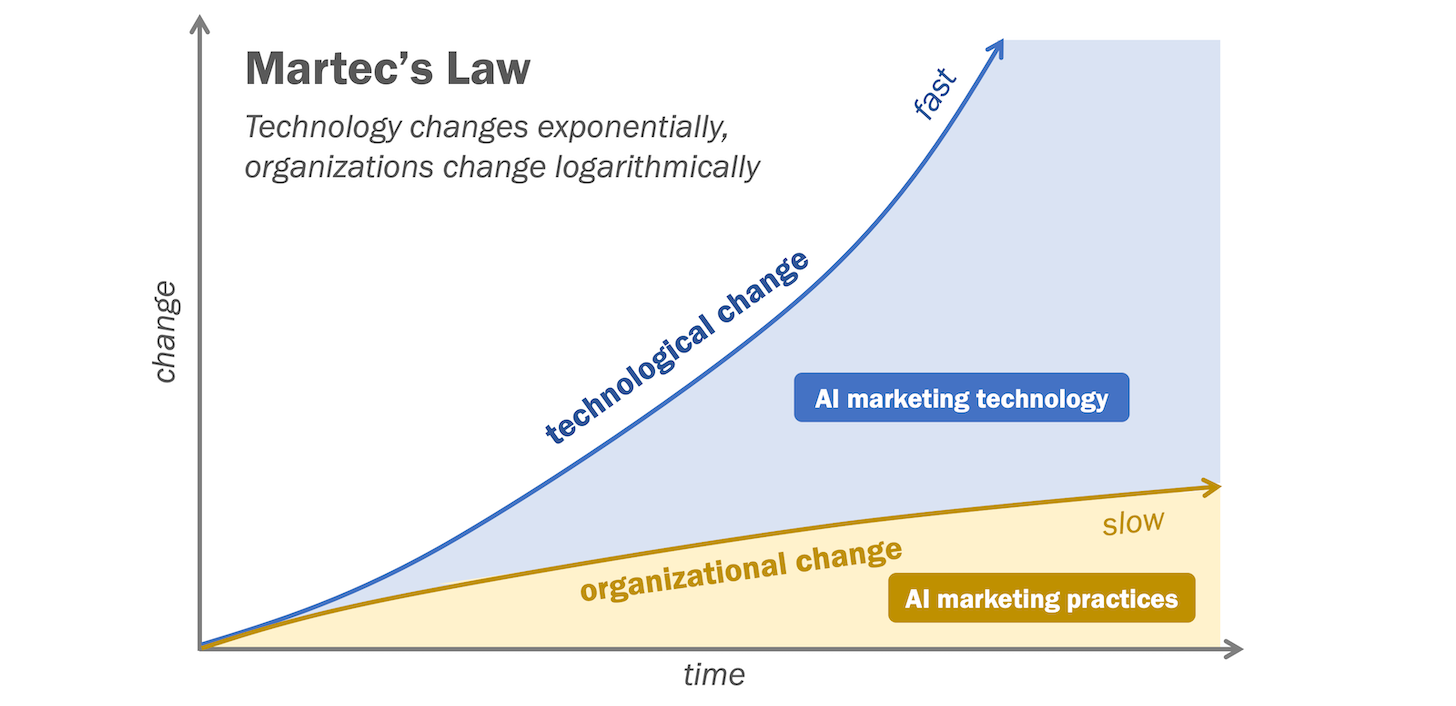
Martec’s Law: technology changes quickly, organisations change slowly. Anyone who has tracked this market for 17 years has watched the same cycle replay under a new name each time, and the corollary is unforgiving — we systematically underestimate the people and process changes required to absorb fast-moving technology.
Top-down AI edicts that are vague but urgent push teams to ship capabilities straight into production, borrowing the move-fast-and-break-things reflex from consumer software. For real AI transformation the better posture is go-slow-to-go-fast. That is not sloth — it is high intensity in first gear. Stages cannot be skipped: you learn what a technology can and cannot do, map its dependencies and ripple effects, and decide which legacy processes need patching versus which need retiring gracefully. Pilots should move fast but stay tightly contained, with a human in the loop, even if only as a post-hoc reviewer of what the agent did. Premature scaling converts tech debt into customer-facing incident.
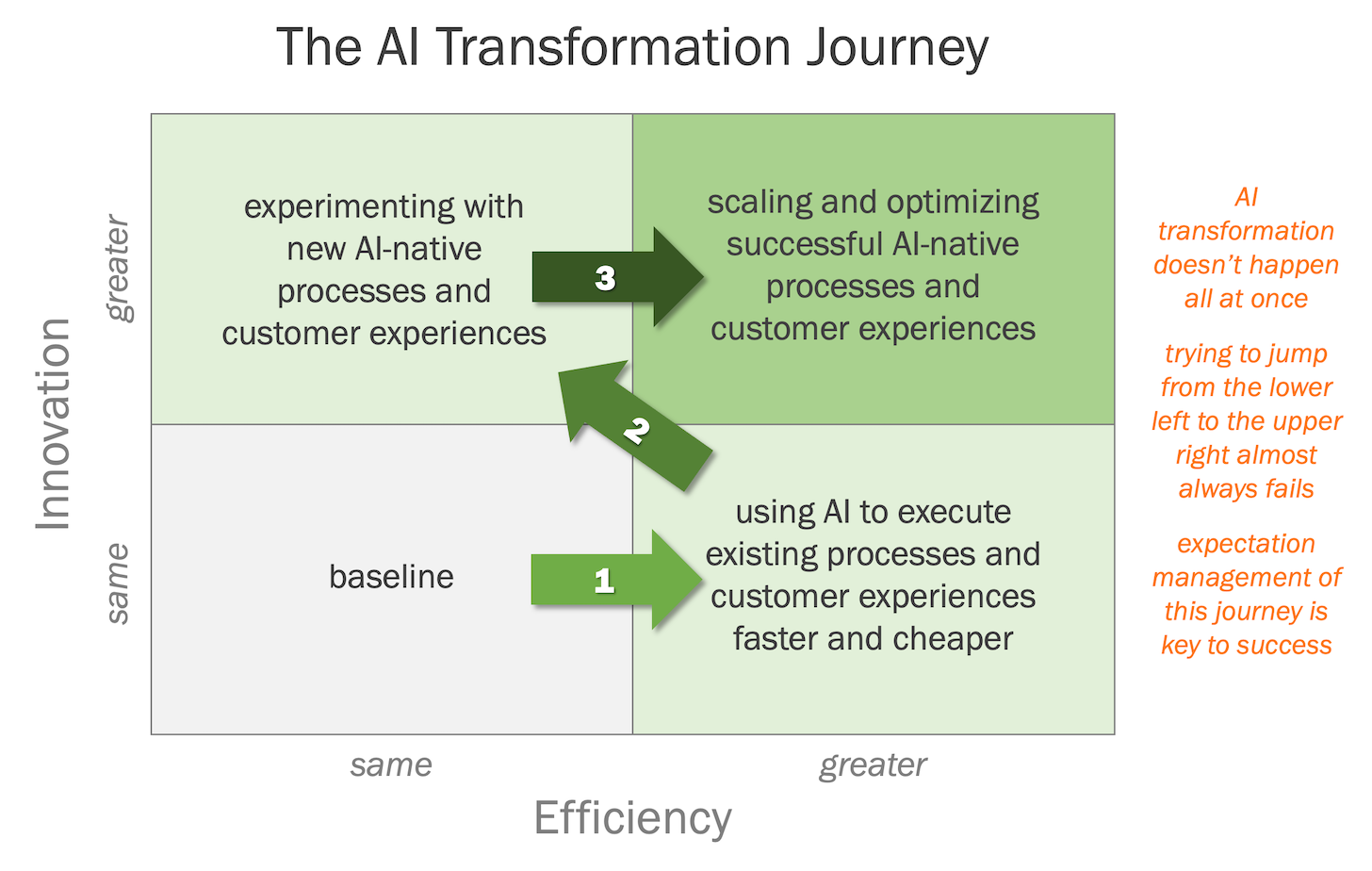
Frans Riemersma, a frequent collaborator in this space, frames it as two different missions inside one stack: a laboratory that runs experiments on new or adapted use cases, and a steady, reliable factory. Confusing the two is how test logic ends up emailing real customers with a wrong company name in the first line.
What should companies actually do? A practical checklist
- Always leave a door to a real person. Automation will never reach 100% coverage, and edge cases are infinite; some of them are loyal customers you cannot afford to lose. Deliberately going the extra mile for loyalty and love is the bottom-right quadrant the matrix points at, and it is also what 87% of surveyed customers say they require.
- Staff and alarm the inboxes you publish. New, as MyTechDailyNews analysis: any shared address that appears in product help paths deserves an auto-acknowledgement with a ticket number and a stale-mail alert that fires on elapsed time since last human reply — the same heartbeat monitoring used for queues and cron jobs. A mailbox that never errors is the failure mode that no existing dashboard catches.
- Run secret shopper journeys. Have someone walk the funnel as a prospect or new customer and record everything. Internal employees are a start; external fresh eyes are better. This is harder in B2B, where the data-enrichment industry builds a very confident, frequently incorrect picture of who you are.
- Inspect every live agent and automation on a calendar. Elevators get periodic inspection; anything that carries prospects and customers through a journey should too. Are the rules and data definitions still valid? Is the content and branding still current? What could have happened before this message, and what happens next? Timestamp and sign each review, and pair repeatable test harnesses with human judgement.
- If a message carries a rep's name, loop the rep in. Inbox rules can suppress the noise until the recipient responds, but at least a peek is worth it, because the automation is spending that person's reputation.
- Track the handoff, not just the deflection. Measure average time and number of steps from "customer asks for a human" to "a human answers", plus satisfaction after the transfer, and report it beside automation rate.
- Keep laboratory and production workloads apart. Separate data, separate send permissions, separate review, and a named owner for every agent that can touch a customer.
What can you do if you are stuck in an automation loop?
- Say the escalation words. Reporting from Scripps News in March 2026 collected practitioner tips for reaching a person: phrasing such as "representative", "agent", "escalate" or "file a complaint" tends to trigger transfer logic that plain problem descriptions do not.
- Change channel, not wording. Voice lines, web forms and in-app account screens often have different routing than the chat widget; the billing question that died in a marketing mailbox may have a staffed destination elsewhere.
- Money and legal requests go to regulated addresses. Billing disputes, cancellations, privacy and data requests usually have a dedicated contact in a site footer or account settings, staffed because it must be. That is where these questions belong, not in an onboarding inbox.
- Keep the paper trail. Reply within the same thread so context is attached, and screenshot any promise an automated agent makes about refunds, credits or timelines.
- Time-box your patience. After three unanswered attempts, stop repeating and escalate — supervisor request, public review channel, or a consumer-protection filing. Repeating into a broken router costs you time and teaches the vendor nothing.
- Use your own assistant. The Gartner finding that customers are three times likelier to use a third-party GenAI tool than the company chatbot is effectively consumers voting with their behaviour.
Common misconceptions about AI customer automation
- "The model just isn't good enough yet." Wrong diagnosis. Put an agent in an interception position and every capability gain sharpens its ability to keep a customer busy. The problem is placement, not intelligence.
- "A fast reply is good service." Speed only counts when it moves the problem. An impressive two-minute first email followed by silence is a worse experience than a slower thread that stays answered.
- "Personalisation means someone is paying attention." Production-quality generative personalisation and a wrong $COMPANY-NAME merge tag can both come from the same unattended pipeline. Relevance in the first line is not attention across the journey.
- "Silence means nothing went wrong." Automations rarely throw errors when they fail a person; they simply stop. Unanswered inbox, unhandled reply, unreviewed queue — all green lights.
- "Higher automation rate is the goal." It is one of several. Without time-to-human and post-handoff satisfaction next to it, the number is decorative.
FAQ: the questions readers actually search
Are AI agents replacing human customer service?
They are replacing the first touch, not the last. The dominant production pattern is triage plus assisted agents, and demand for the human end is rising rather than falling: 82% of US adults surveyed by Morning Consult say reaching a real person has become harder, which is a supply problem, not a preference shift.
What is a "silent failure" in automation?
A workflow that executes every step without throwing an error while still never delivering the outcome — for example, a message routed into a mailbox nobody reads. Because nothing crashes, nothing alerts, and the damage shows up later as churn, complaints or a bad review.
Why does an AI sales email ignore my reply?
Usually because the agent that wrote to you and the sequence that later emailed you are different products with a weak integration, and no memory of the conversation. The reply either was never surfaced to a human or arrived in a form the agent had no rule for, so the contact was silently enrolled in whatever was next in line.
How long should it take to reach a human?
There is no universal standard yet, which is the problem. Gartner's survey shows 87% of customers consider a human option essential, so the practical benchmark any buyer should demand from a vendor is a stated, measured time-to-human and a visible escalation path in the product itself.
What to watch next
Three moves are already visible. First, governance and monitoring for autonomous customer-facing agents is becoming its own product category, which is what orchestration in the AI age of marketing actually requires — orchestration without observability is just scheduling. Second, buyers are starting to ask for handoff metrics in vendor evaluations, the same way uptime SLAs migrated from marketing claims to contracts. Third, consolidation is quietly underway: 1,367 products were removed from the 2026 martech landscape, and stacks that shrink by integration rather than by count will produce fewer of these seams.
Deploying an agent has become trivially easy. Keeping a dozen of them pointing at the same customer truth is operations work — unglamorous, inspectable, and now the real differentiator between vendors that feel modern and vendors that merely announce they are.
Sources
- Gartner newsroom, 4 August 2026 — survey of 3,566 B2B and B2C customers on GenAI in customer service: https://www.gartner.com/en/newsroom/press-releases/2026-08-04-gartner-survey-finds-87-percent-of-customers-say-companies-using-genai-for-customer-service-must-provide-access-to-a-human-agent0
- Gartner newsroom, 25 June 2025 — more than 40% of agentic AI projects cancelled by end of 2027: https://www.gartner.com/en/newsroom/press-releases/2025-06-25-gartner-predicts-over-40-percent-of-agentic-ai-projects-will-be-canceled-by-end-of-2027
- Gartner newsroom, 8 July 2026 — customers three times likelier to use third-party GenAI than company chatbots: https://www.gartner.com/en/newsroom/press-releases/2026-07-08-gartner-survey-finds-customers-are-three-times-more-likely-to-use-third-party-genai-than-company-provided-chatbots-for-customer-service
- chiefmartec, 2026 Marketing Technology Landscape Supergraphic (15,505 products): https://chiefmartec.com/2026-05-2026-marketing-technology-landscape-supergraphic-peak-martech-achieved-maybe/
- Five9 2026 customer-experience research on AI-to-human handoffs: https://www.five9.com/blog/five9-2026-consumer-cx-report
- Fortune's reporting of the Morning Consult survey for the 2026 Yale CEO Summit: https://www.fortunechina.com/shangye/c/2026-10/30/content_477819.htm
- Salesforce Engineering on making silent agent failures visible, September 2026: https://engineering.salesforce.com/ai-agent-observability-making-silent-production-failures-visible-and-actionable/
- Scripps News on how to reach a human past an AI support bot, March 2026: https://www.scrippsnews.com/science-and-tech/artificial-intelligence/how-to-bypass-frustrating-ai-customer-service-chatbots-and-quickly-reach-a-real-human-representative