
MyTechDailyNews General: The Grid and On-Demand Circuit Boards Bring Small Hardware Runs Into Focus
Today, a Massachusetts manufacturing story shows how electronics production may change as hardware teams rethink where they build. The Grid is a factory-scale robot for building circuit boards on demand, and it has been running quietly for five years. The wider point for MyTechDailyNews readers is not a single gadget story; it is a supply-chain story about the West, design speed, and the small batches that never fit neatly into mass production.
Why This Topic Matters for Everyday Tech Readers
For 30 years, a lot of electronics manufacturing left high-wage regions. Assembly depended on hands, and companies in the US often designed products at home while building them in China. That system helped products get made at scale, but it also made early versions, revisions, and unusual boards harder to handle close to the engineering team.
Automation has begun to move some work back, but mostly when volume is enormous. SpaceX builds Starlink dishes by the million in Bastrop, Texas. A dedicated line makes sense when the same product is repeated millions of times.
Most hardware companies never look like Starlink. They need ten of this, a hundred of that, and a new revision next week. That high-mix work has resisted automation because a new design often means setup time and manual changeover. When that happens, work may go overseas or to a fast but expensive specialist.
How The Grid Works in Plain Terms
The Grid uses a different shape for the factory. Instead of one fixed line that must be reconfigured for each product, it behaves like one large robot. Levitating movers carry each board and its parts between machines that print solder paste, place parts, reflow, solder, and inspect. Learned models, AI agents, and classic optimizers schedule all of it.
Each board follows its own route through the factory. There are no changeovers and no per-design setup, so one unit of 100 different designs runs as easily as 100 units of one. Prototypes and production batches can run on the same machines.
This is not only a startup story. Large companies also need low-volume boards: test stations, tooling, R&D units, and smaller production batches. A leading EV maker, a top AI lab, and household-name tech companies already build on The Grid.
One Board, Two Paths: A Concrete Comparison
To make the comparison concrete, one example board was priced on The Grid and at a typical quick-turn shop in Shenzhen: a 4-layer motor controller with 118 parts per board (38 unique), five assembled boards, parts included, delivered to a US address.
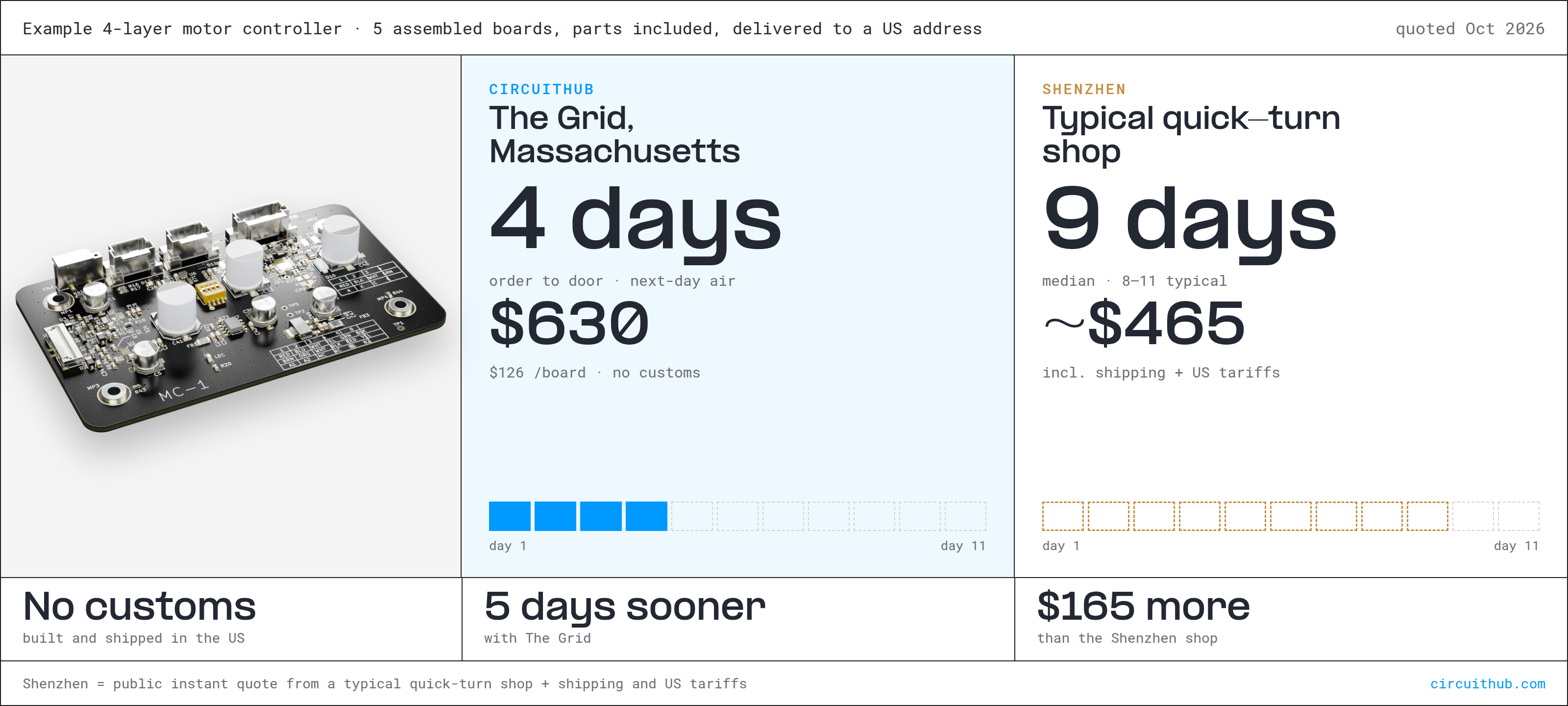
| Path | Time | Cost |
|---|---|---|
| The Grid | 4 days to your door | $630, parts included, no customs |
| Typical quick-turn shop in Shenzhen | 9 days at the median | about $465 after shipping and US tariffs |
The trade-off is easy to read. In this example, a team pays about $165 more than the Shenzhen shop and receives the boards five days sooner, with no customs and a supply chain that can be tracked more closely. For many hardware teams, five days of engineering time is worth much more than $165.
It Has Been Running for Five Years, Not a One-Day Demo
Facts that move it beyond a promise
The Grid has been running for customers for five years. It already builds tens of millions of dollars of electronics a year. Across CircuitHub, more than 2.2 million boards have been shipped, more than 150 million parts have been placed, and more than 26,000 engineers have been served.
Common Misconceptions About On-Demand Electronics Manufacturing
- Misconception: this is just a prototype. The Grid has been running for customers for five years and builds tens of millions of dollars of electronics a year.
- Misconception: flexible manufacturing only matters to startups. Even large companies have many low-volume boards, such as test stations, tooling, R&D, and production batches.
- Misconception: local or automated production is only about being cheaper. The Shenzhen comparison shows the example can cost $165 more but save five days and avoid customs.
- Misconception: high-mix work is impossible to automate. The Grid’s route-per-board model is designed for 100 different designs without changeover.
What Comes Next
Demand is already ahead of current capacity. This year, the plan is to grow capacity 5x, with another big jump in 2027.
The longer-term goal is to make building hardware as fast as designing it. Electronics manufacturing left the West because it could not be automated at the volumes most companies need. The Grid indicates that this limitation may be weakening.
Action Suggestions for Hardware Teams and Curious Readers
- Map your board types: high-volume repeats versus high-mix short runs such as ten, a hundred, and next-week revisions.
- Compare supplier speed as well as unit price: 4 days, 9 days, five days, and customs can change project timelines.
- Check whether quick-turn partners can handle one unit of 100 different designs without setup.
- If you are building in the US and depending on China or Shenzhen paths, add a backup test for a board like a 4-layer motor controller with 118 parts (38 unique).
- Watch whether capacity growth, 5x This year and 2027 expansions, can turn The Grid from a specialty answer into a mainstream option.
Frequently Asked Questions
What is The Grid?
The Grid is a factory-scale robot in Massachusetts that manufactures circuit boards on demand. It routes boards through machines and scheduling systems instead of using a fixed line that needs a new setup for every design.
Why was electronics manufacturing moved overseas?
For 30 years, assembly was labor-intensive, and companies in the US and the West often built products in China because labor was cheaper. That model supported mass production well.
What kind of demand does The Grid target?
It targets the hard middle: work that is too irregular for a dedicated line but too valuable to lose time to manual changeover. Teams that need ten of this, a hundred of that, and a new revision next week fit that description.
Is it faster than a Shenzhen quick-turn shop?
In the example comparison, The Grid delivers in 4 days, while a typical quick-turn shop in Shenzhen shows 9 days at the median. That means the boards arrive five days sooner.
Is it cheaper?
Not in the example. The Grid costs $630 with parts included and no customs, while the Shenzhen path costs about $465 after shipping and US tariffs, leaving a $165 difference. The value depends on whether five days, no customs, and a predictable chain are worth that gap.
Is this still experimental?
The article’s stated experience points to five years of customer use, tens of millions of dollars a year in electronics, and CircuitHub totals of 2.2 million boards, 150 million parts, and 26,000 engineers.
For MyTechDailyNews readers, The Grid is best understood as a practical test case: can automation finally serve the messy, low-volume, revision-heavy side of hardware? The answer, so far, is that it already has for many years, and the next question is how broadly that model can scale.