
Tesla Emergency Drive Away: A Practical MyTechDailyNews Checklist for Avoiding a 539 Dollar Inspection Fee or a 170000 Yuan Bill
A Tesla safety update has turned one of the most common electric-vehicle charging routines into a decision point. In software update 2026.38.3, Tesla introduced Emergency Drive Away, a function that lets a driver force the car away from a Supercharger while the charging gun is still attached. The idea is simple: if a person in the vehicle faces immediate danger, the car should not be trapped by a connector. The practical question is different. When is a tap on the screen a legitimate escape, and when does it become a costly mistake? MyTechDailyNews assembled this guide around the steps, the fee traps, the checklist, and the questions ordinary owners should ask before they touch Activate.
The New Exit Sequence at a Tesla Supercharger
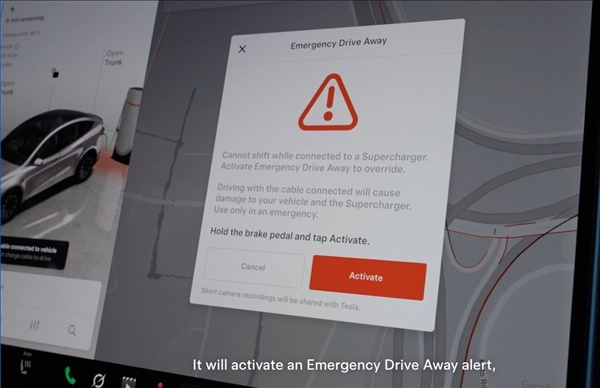
Normally, a Tesla connected to a Supercharger is prevented from selecting a gear. Under the new logic, if a driver attempts to engage a gear while the charging gun remains inserted, the touchscreen shows a red warning. The message is effectively: “Gear cannot be selected while connected to a Supercharger; activating Emergency Drive Away can force release.”
The confirmation path is intentionally awkward. The driver must keep the brake pedal pressed and tap Activate at the same time. Once confirmed, the car can drive away, while the charging connector is forced out of the port. The vehicle also sends a short camera clip to Tesla so the company can evaluate whether the event was a genuine emergency. Along with that clip, Tesla collects vehicle telemetry; these two data points are what allow the company to reconstruct whether the car actually moved while plugged in.
Why Tesla Added This Feature
The background matters because it explains why Tesla chose a high-risk mechanism. Multiple reports, including Electrek, have linked the feature to the fatal shooting at the Twin Falls, Idaho Supercharger; drivers who were plugged in could not immediately leave the scene. The update was described as arriving about two months after that incident, and coverage of the rollout pointed to U.S. Tesla Superchargers rather than ordinary third-party chargers. That context is not a minor detail. Tesla is not selling convenience. It is adding an emergency override that accepts hardware damage as a price of faster escape.
The Cost Map: A Red Alert Can Become Money
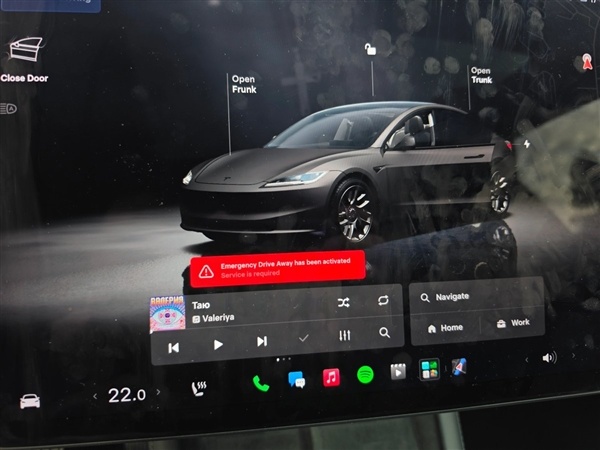
Even if nothing dramatic happens to the car, activation changes the service state. After the function is used, the vehicle keeps displaying a red alert and asks the owner to have the car checked. That is where many users are caught by surprise. X platform user @Tutrifour shared a case in which the car did not move even an inch, yet Tesla service still charged a 539 dollar inspection fee. The Kuai Technology note said the figure was about 3595 yuan, and its purpose was to inspect the charge port and clear the alert. In that state, the car can still plug in and charge normally.
The number that worries owners more is the charger-side exposure. Tesla has said a damaged Supercharger can cost up to 25000 dollars to repair, or 25000 USD. In Chinese-market coverage, that was rendered as 16.7 in ten-thousand yuan — sometimes compressed into the shorthand 16.7 yuan — and the broader warning is that total exposure, when extra penalties are considered, can approach 170000 yuan. The physical damage can be concentrated on the charge port and connector, but the severity depends on drag force and angle. Severe cases may require replacement of the entire charge-port module.
| Scenario | Immediate vehicle response | Financial exposure to watch | What the driver should note |
|---|---|---|---|
| Activation without moving | Red service alert remains | 539 dollars, about 3595 yuan | Record time and location; ask whether camera and telemetry support a remote clearing request |
| True emergency drive-off | Connector forced out, car leaves | Up to 25000 dollars, 16.7 ten-thousand yuan | Personnel safety first; after escape, report the event and preserve evidence of the danger |
| Accidental activation | Car can lock into service-alert state | Inspection fee plus potential station damage | Stop tapping confirm prompts without reading them |
Checklist: What to Do Before and After Activation
- Before charging: confirm that the charging gun is fully seated, the cable is not snagged by the vehicle, and you know the stop button location on the screen.
- Before leaving the stall: look for a red warning rather than treating the screen as a routine confirmation flow. If you see one, stop and identify why the car is still connected.
- If the warning appears: do not press Activate unless you are trying to escape an immediate threat. Check whether the connector is still locked, whether the door is in the way, or whether the car is simply misaligned.
- If an emergency is real: brake, tap Activate, leave the area, and then contact Tesla service with the time, station, and camera evidence available to the vehicle.
- If you activated by mistake: note the moment you saw the warning, whether the car moved even an inch, and the exact service screen wording. Ask whether the camera clip and telemetry can prove a non-moving activation.
- Before paying: ask for the scope of the inspection. A charge-port check and alert clearing are not the same as a full connector replacement estimate.
Common Misconceptions About Emergency Drive Away
- Misconception 1: The feature is a fast way to leave if the gun feels stuck. Tesla treats it as a force-release mechanism; using it casually invites hardware damage and service scrutiny.
- Misconception 2: No movement means no fee. The reported 539 dollar inspection fee happened even when the car did not move an inch.
- Misconception 3: Only the charging gun suffers. Reports describe damage that can affect the connector, cable, cooling liquid, and, in severe cases, station electrical and civil structure. Some coverage also points to glycol-based coolant leaking when the connection is wrenched apart.
- Misconception 4: The screen warning is just a suggestion. The brake-plus-Activate sequence is deliberately gated because Tesla needs to distinguish a deliberate emergency choice from a fat-finger tap.
- Misconception 5: The car is unusable after activation. The shared example indicates the vehicle can still plug in and charge normally after inspection or alert handling, though the alert itself still needs clearing.
The First Accidental Use and What Tesla Says Next
Accidents are already happening. A few days ago, reports shared by D1EV and Securities Star described an owner at an Austin Supercharger who, after fatigue-driven operation, tapped through confirmation prompts and then pulled away with the connector still attached. That case became the first recorded accidental use of the feature. Tesla charging business director Max de Zegher said the company will quickly improve the feature based on user feedback, and accidental activation is a priority for optimization.
The technical counterweight is Tesla’s own verification path. During activation, the system obtains a camera clip and vehicle telemetry, allowing it to determine whether the car really moved while connected. If both checks confirm that the vehicle did not drive away, Tesla can in principle clear the service alert remotely instead of charging for an inspection. That possibility has not yet been translated into a universally accepted owner experience, so the practical guidance remains: read the warning, slow down, and treat Activate as a last-resort emergency control.
FAQ
What is Emergency Drive Away?
It is a Tesla software function in update 2026.38.3 that permits a driver to force the car away from a Supercharger while the charging gun is still inserted. The intended purpose is personal safety in an immediate threat, not convenience.
How does a driver confirm activation?
After the red warning appears, the driver must keep the brake pedal pressed and tap Activate. This two-step design is meant to reduce accidental activation, although the Austin case shows that fatigue and rapid prompt tapping can still defeat it.
Does Tesla inspect the car after activation?
Yes. The vehicle displays a persistent red alert and requires a service check. In the shared example, even without moving an inch, the owner faced a 539 dollar inspection fee, about 3595 yuan according to the Kuai Technology note.
What is the most expensive scenario?
If the car genuinely drags the Supercharger connector away, repair costs can reach 25000 dollars, and additional penalties may push total exposure near 170000 yuan. The car-side charge port may also require repair or module replacement depending on force and angle.
Can Tesla verify that the car did not move?
Tesla can use two data inputs: the short camera clip and vehicle telemetry. If both show that the car remained stationary while plugged in, the company may theoretically clear the alert remotely rather than requiring a fee.
Is this feature meant for every stuck charging session?
No. The safer first response is to stop, verify the screen, check the connector, and contact Tesla support. Emergency Drive Away is an override that accepts damage risk.
Action Recommendations for Tesla Owners
- Treat a red warning at a Supercharger as a stop signal, not a routine step. Read the full sentence before you press anything.
- Use Emergency Drive Away only when leaving the vehicle is necessary for immediate safety.
- If you accidentally activate the function while the car stays still, document the moment and ask whether the two verification checks support remote alert clearing.
- Do not pay blindly. Ask for an itemized explanation of the inspection and whether the fee is for checking the charge port or replacing hardware.
- Before you leave a stall, confirm the gun is disengaged and the cable path is clear. That simple habit is the best defense against a high-cost warning screen.
Why the Feature Still Matters Beyond Tesla
For ordinary readers, the story is not only about one automaker. It shows how emergency systems can create new user mistakes when the interface language shifts from routine to crisis. The safest rule is also the simplest: if a charging screen turns red, pause, read, and decide. In the case of Emergency Drive Away, the difference between a safety escape and a costly service event can be a single careless tap.
This report was prepared by Sarah Chen for MyTechDailyNews, a Tech Daily title. Editorial contact: hello@techdaily.com.