
MyTechDailyNews General: Apple's Ternus Earnings Test — iPhone Price Hikes vs Memory Costs
By Sarah Chen, MyTechDailyNews General
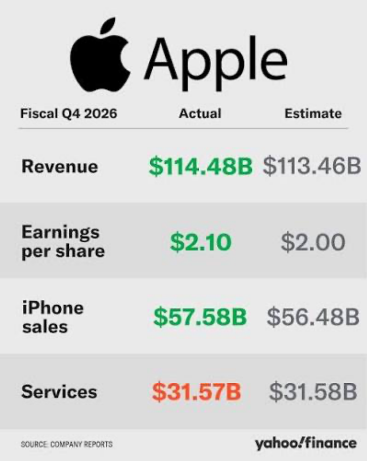
For readers deciding which device to buy this holiday season, Apple's fiscal 2026 fourth-quarter earnings, released on Pacific Time November 2, looks less like a corporate report and more like a shopping warning: the company still grew, but much of the growth came from higher prices, while fewer phones left shelves. A few months ago, Tim Cook described the AI-data-center-driven memory-price surge as “a once-in-a-century flood.” Apple's first result under John Ternus shows how the flood reached consumers: iPhone revenue rose to $57.58 billion, up 17 percent year over year and setting a record for the quarter, yet IDC counted Apple's global smartphone shipments down 4 percent year over year. Apple reported total revenue of $114.5 billion, up 12 percent, and net income of $30.7 billion, both above Wall Street expectations, as confirmed in Apple's own newsroom release. The shares nonetheless dropped 3 percent immediately in after-hours trading.
CNBC's live earnings coverage added a useful comparison: analysts had expected iPhone revenue of $56.54 billion and Mac revenue of $9.61 billion, while the iPad line came in at $6.23 billion. Those numbers matter for everyday buyers because they show that Apple can beat revenue estimates by selling a smaller number of more expensive devices, not by making hardware suddenly easier to own.
Revenue Up, Units Down: The Core Trade-Off
Roughly speaking, if iPhone sales revenue rose 17 percent while Apple's units declined 4 percent, the average selling price needed to increase about 22 percent. The discrepancy is not simply accounting; IDC tracks shipments, while Apple reports revenue from sales into channels, so the measures do not line up perfectly. Still, the directional message is clear: price, not volume, carried the quarter. Apple's stock reaction also stayed negative: after the initial 3 percent after-hours drop, the decline was nearly 3 percent as investors weighed the guidance.
| What Apple reported | What the shipment or comparison data says | Buyer takeaway |
|---|---|---|
| iPhone revenue $57.58B, up 17 percent, record for the quarter | Apple global smartphone shipments down 4 percent, per IDC | Expect fewer cheap options and more premium pricing |
| Total revenue $114.5B, up 12 percent; net income $30.7B | iPhone revenue beat the $56.54B consensus reported by CNBC | Strong financials can coexist with weaker unit demand |
| Mac revenue $10.79B, up 24 percent | Mac shipments down 11.3 percent, per IDC | Laptop upgrades are becoming a more storage- and price-sensitive decision |
| Greater China revenue $17.54B, up 21 percent | China smartphone market contracted 15.4 percent; Apple shipments declined 4.3 percent | Apple stayed competitive by declining less, not by growing units |
| Total gross margin 47.9 percent | Guidance for December quarter margin 45 percent to 46 percent, versus 48.2 percent a year earlier | The next quarter may show whether costs force further increases or discounting |
Why the iPhone Price Table Changed in September
September 9 is the pivot point. Apple raised almost every iPhone. iPhone 18 Pro started from $1,099 and moved to $1,199; iPhone 18 Pro Max started from $1,199 and moved to $1,299. High-capacity models saw larger increases: 1TB versions added $300, while the Pro Max 2TB option rose $500 to $2,499.
Older devices also changed. iPhone 17 jumped from $799 to $899. iPhone Air, iPhone 17e and iPhone 16 each moved up $100. The lowest-priced Plus model was cut. Apple introduced the foldable iPhone Duo with a starting price of $1,999. Media estimates put the average price increase for iPhones in the United States at 13 percent.
- iPhone 17 Pro entered the market last year with a starting price $100 higher than its predecessor, so Apple's July and August sales this year were already tilted toward a pricier model.
- Buyers kept choosing Pro and Pro Max configurations, plus larger storage, which made the product mix more expensive.
- Apple raised the entire iPhone line in early September, making the quarter's revenue reflect the new price architecture even as units fell.
Apple also did not release an affordable edition this autumn. The iPhone 18 series initially offered only Pro and Pro Max; the standard iPhone 18 and entry-level 18e were delayed to spring next year. When analysts asked why, John Ternus avoided the question. Need also to remember the timing effect: Apple's earnings period ended September 26, so iPhone 18 Pro sold for only about 9 days inside the quarter. That means the full pricing effect will land later.
The Memory Flood: How Apple Lost Its Procurement Edge
For years, Apple was the industry's most demanding flash buyer. Two years ago, its purchases were almost twice the combined volume of Microsoft, Amazon, Meta and Google, four major buyers. Apple sought “most-favored-customer” treatment and reserved audit rights. Suppliers, desperate for orders, accepted what many called unequal terms.
The old balance is gone. More than a decade ago, Apple found that Micron had not given it the lowest price and recovered tens of millions of dollars through arbitration. In 2023, flash memory fell to 5 cents per GB, and the industry lost about $19 billion. Apple earned about $14 billion in gross profit from storage upgrades in the same year.
Now Apple is negotiating from the other side. AI data centers and cloud companies are buying flash at roughly twice Apple's volume, and Meta, Microsoft and Amazon have signed more expensive long-term contracts that Apple cannot easily match. TechInsights estimates that flash prices rose about four times in a year. Apple's flash spending is expected to reach about $25 billion, compared with $6 billion for the same quantities last year. A Kioxia executive said plainly that the 2023 conditions should never return.
A market tracker, TrendForce, had earlier forecast that third-quarter 2026 conventional DRAM contract prices would rise 13 to 18 percent and NAND flash prices 10 to 15 percent, while warning that PCs and smartphones were approaching an affordability limit. That context does not change Apple's reported numbers, but it explains why the component bill behind a phone or laptop is no longer a quiet supplier matter.
The whole industry felt the water level. IDC reported that global smartphone shipments in July through September plunged 22 percent year over year. Apple only fell 4 percent, the smallest decline among the top five vendors, and its market share was again close to Samsung.
The Hidden Money Printer: Storage, Macs and China
Apple's cost pass-through is not random. The most aggressive increases landed on capacity upgrades, which have long acted as a hidden money printer. Media analysis of iPhone 17 Pro storage tiers suggests that adding the next tier could lift Apple's component cost from about $15 to about $66, while Apple still charges $200 for the upgrade.

Mac numbers show the same pattern even more clearly. Apple's Mac revenue reached $10.79 billion, up 24 percent, making it the hardware category that looked strongest. IDC, however, tracked Mac shipments down 11.3 percent. Apple had already raised Mac and iPad prices in June, with the MacBook Pro rising $300, and last week unveiled the first touchscreen MacBook Pro with a starting price of $2,899.
China tells a similar story. Greater China revenue hit $17.54 billion, up 21 percent, and John Ternus said the United States and Greater China both delivered strong double-digit growth, setting a September-quarter record. But Wall Street still wanted about $1 billion more. The reason is units: IDC said the Q3 smartphone market in China contracted 15.4 percent, while Apple's shipments declined 4.3 percent. Apple's share rose from 15.8 percent to 17.8 percent not because it sold more, but because its rivals sold much less.
The margin math is important because it shows the cost flood has not fully arrived. Apple's total gross margin was 47.9 percent, above 47.2 percent in the same period last year. But CFO Kevan Parekh said about 1 percentage point came from tariff refunds, and those refunds are largely finished. Excluding the refunds, gross margin was about 46.9 percent, slightly below the year-ago level. Parekh added that, excluding refunds, the margin declined about 1 percentage point from the previous quarter mainly because of rising memory prices.
The Three Percentage Point Margin Question and the December Test
The market's bigger worry is what comes next. Apple guided December-quarter revenue growth of 7 percent to 10 percent, below Wall Street's 11.4 percent expectation and the weakest guidance in nearly five quarters. Gross margin is expected to be 45 percent to 46 percent, versus 48.2 percent a year earlier. If that range holds, it points to a decline of two to three percentage points, with memory costs and the launch of Siri AI cited as key pressures. Apple's shares fell nearly 3 percent.
For buyers, this creates a paradox. Apple said September-quarter switching users hit a record and active iPhone users reached a historical high, which supports its premium strategy. Yet iPad and wearables missed expectations, showing that price increases do not pass through every category equally. John Ternus argued Apple was raising prices “reluctantly” to offset component costs. The data say the trade-off worked for iPhone revenue, but not necessarily for broader demand.
Comparative Review: How Apple's Pricing Changes Change Your Choice
Reading this as a comparative review, the most useful question is not whether Apple beat expectations. The question is where a regular user can still get value.
| Shopping scenario | Stronger choice | Weakness to watch | Decision advice |
|---|---|---|---|
| You need an iPhone now and want the least expensive new option | Wait, if possible | Apple did not release an affordable edition this autumn; Plus is discontinued; standard iPhone 18 and 18e are delayed to spring next year | Do not assume the old entry price is gone forever; watch spring next year or certified refurbished options |
| You use the phone for travel, video or work and need battery and camera depth | iPhone 18 Pro or Pro Max | The starting prices are $1,199 and $1,299, higher than the prior generation | Buy Pro only if you will use the upgraded cameras and display; do not pay for the tier solely because it is named Pro |
| You are tempted by the foldable iPhone Duo | Wait for a full quarter of retail feedback | It starts at $1,999, preorder opened October 16 and sold out in a few hours, shipping stretched to late January next year, and screen-crack issues were acknowledged for a very small portion of returns; the device went on sale October 23 | Unless you specifically need a foldable, treat it as a Christmas-season experiment rather than a safe mainstream holiday gift |
| You buy mostly through cloud storage or need a small phone | Lower storage may be enough | Apple charges $200 for some upgrade tiers, while the underlying component cost may rise from about $15 to about $66 | Compare actual local files, video and app needs before paying for capacity you will rarely fill |
| You are choosing a Mac for school or professional creative work | Choose configuration by workflow, not branding | The first touchscreen MacBook Pro starts at $2,899; prior MacBook Pro prices rose $300 in June | If your workflow is mostly cloud and light document work, an older model may still offer better value than the newest premium tier |
For the foldable iPhone Duo, Apple's own supply and quality signal is mixed. The device is priced at roughly $2,000, a premium category where a few hours of early preorder sellout looks attractive, but the shipping window to late January next year and the confirmed screen issues create a practical buying risk. Because iPhone Duo went on sale October 23, it was absent from this earnings report; its first full quarter will arrive during this Christmas season and will be the biggest variable.
FAQ for Apple Buyers
Why did Apple's iPhone revenue go up if shipments went down?
Because higher prices and product mix did the heavy lifting. iPhone revenue rose 17 percent to $57.58 billion, while IDC tracked Apple smartphone shipments down 4 percent. The implied average selling price increase is about 22 percent. The effect is amplified because iPhone 18 Pro sold only about 9 days in the quarter.
Is Apple just passing a supplier problem to customers?
In part. Apple once had enormous buying power, but AI data centers changed who needs memory most. TechInsights says flash prices rose about four times in a year, and Apple's flash spending is expected to reach about $25 billion from $6 billion for the same quantity. Apple says the increases were reluctant. Consumers still feel the bill.
Will prices continue rising?
Apple has not ruled it out. The guidance says the December quarter revenue growth is 7 percent to 10 percent and gross margin is 45 percent to 46 percent, partly because memory and Siri AI are adding costs. The question is whether the next quarter's unit response will force Apple to find another lever.
Common Misconceptions
- “Apple's revenue rose because everyone bought more iPhones.” Not according to IDC: Apple global smartphone shipments declined 4 percent.
- “A 17 percent iPhone revenue gain means the phone business is healthier for every buyer.” It also reflects higher prices and fewer affordable models.
- “Memory costs are just an industry detail.” They shape the $200 storage upgrade, the $300 MacBook Pro increase and the $2,499 top iPhone tier.
- “iPhone Duo's sold-out preorders prove demand is simple.” The device faces shipping to late January and screen-issue returns, even if Apple says only a very small portion.
- “Apple's gross margin above last year proves the cost flood is over.” Kevan Parekh said about 1 percentage point came from tariff refunds; excluding them, margin was about 46.9 percent, slightly below last year.
Action Checklist Before Buying Apple Hardware
- Compare model price plus storage upgrade before assuming the base price is the real cost.
- Check whether the affordable iPhone 18 or 18e will matter to you; if they will, waiting may avoid the Pro premium.
- For iPhone Duo, treat the $1,999 and roughly $2,000 foldable category as a supply-risk purchase: preorder, delivery timing and return policies matter.
- For Mac buyers, decide whether you need local capacity. The component-cost difference is small compared with the $200 upgrade, but workflow needs can justify part of it.
- Before the Christmas season, watch the December quarter margin and any Siri AI cost commentary; they will reveal whether Apple continues to rely on price hikes.
What This Quarter Actually Proves
For MyTechDailyNews readers, this quarter is a decision point, not just a Wall Street result. Apple proved that premium pricing can offset unit weakness in the iPhone category, with revenue rising while shipments fell, but it also proved that the offset is finite: iPad and wearables disappointed, margin guidance weakened, and a foldable phone sold for the first time without contributing meaningful sales. The real question is no longer whether Apple can still charge more. It is how many users will keep paying before the flood turns into demand destruction.