
Case Files: When One MCU Replaced Four — What STMicroelectronics' Unified STM32 Bet Means for Cloud AI and Physical AI Buyers
By Sarah Chen — MyTechDailyNews / Tech Daily technology desk
What does it take to turn a chip into a platform? STMicroelectronics answered that with proof points rather than promises at its STM32 Summit, an online keynote staged from Silicon Valley on November 3, 2026: one alpha customer moved arc-fault monitoring from four panels to 20 panels on a single microcontroller, a robotics company is designing its next-generation hands around the STM32G5, and AI server racks now demand power control measured in megawatts.
What actually changed, in plain terms
The short version: the thing being sold is no longer the silicon. Maria Erez, executive VP of STMicroelectronics' embedded processing subgroup, frames the unified STM32 platform as a way for customers to reuse existing software, development expertise and manufacturing investments across product generations and application domains — industrial, automotive and robotics together, not three separate roadmaps.
Remi El-Ouazzane, president, microcontrollers, digital ICs, and RF products group at STMicroelectronics, was blunt about the market logic when answering a query posed by EE Times at ST's global press briefing: "There are two rapidly growing markets today, cloud AI and physical AI, and it is our duty at ST to make sure that the STM32 platform will be the king of the microcontroller market in cloud AI and physical AI," he said. For ST, two rapidly growing markets reward the same foundation.
"Across many applications, the challenge for customers and developers is shifting from selecting a single device to finding ways to reuse software, tools, architectures, and engineering expertise across multiple products and evolving requirements," El-Ouazzane said. He added: "In other words, the value is shifting from the individual MCU to the broader platform surrounding it."
The installed community gives that argument weight. Erez said the STM32 ecosystem counts nearly 2 million unique developers, and that the number of active users has grown by around 20% over the past three years. Convergence, in her company's reading, is running across automotive, industrial and other domains in AI, security, safety, connectivity, sensing and control — which is what makes shared technology reusable in the first place.
ST extends the idea to machines that perceive, decide and act in the real world: industrial equipment, automotive systems and robots. Those applications share requirements for connectivity, real-time control, safety, security and software lifecycle management, even though their certification requirements differ by market.
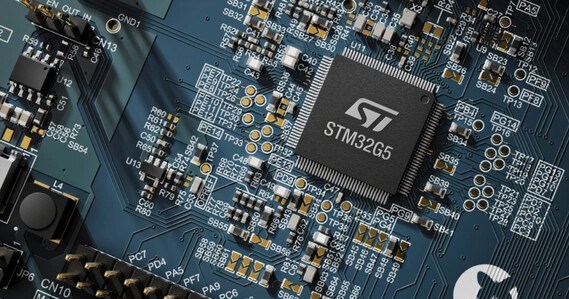
Source: STMicroelectronics
Which new part does which job? A map before the cases
Five additions carry the strategy: the STM32A automotive and high-safety MCU portfolio, the new STM32G5 mixed-signal MCU series, the high-performance STM32H7P with a neural processing unit (NPU), redesigned edge AI development tools, and STM32Cube for agentic AI. Here is how they line up against real workloads.
| Part or tool | Case it unlocks | Anchor spec | Timing |
|---|---|---|---|
| STM32A4 | Entry-level automotive local control nodes and safety systems | First of the family's first three devices sampling to customers | Broader availability planned by STMicroelectronics in 2027 |
| STM32A5 | Mid-range safety-critical work in industrial automation, robotics and energy systems, plus automotive | Real-time control with safety certification | Sampling stage |
| STM32A9 | Safety-critical, multi-domain control | Low latency, Ethernet, deterministic communication | Sampling stage |
| STM32G5 | Digital power, motor control, robotic hands, drones, renewables | Arm Cortex-M33 at 280 MHz — twice the compute performance of the STM32G4 | Now in production; dual-core products planned for 2027 |
| STM32H7P | On-chip AI at the edge, such as solar-inverter safety | Cortex-M7 core paired with ST's proprietary NPU | Volume production in early 2027 |
| STM32Cube for agentic AI | AI coding agents inside embedded firmware work | Model context protocol (MCP) server with validated reference code | Rollout began at the end of October |
Case file 1: the robotic hand that had to feel and move at once
Conclusion: dexterity problems get solved at the control loop, not in the cloud. Robotics company Ruiyan Intelligent is using the STM32G5 in its next-generation robotic hands.
"In humanoid robotics, dexterity depends on combining strength, precision, sensing, and real-time control in an extremely compact space," said Paul Tian, CEO of Ruiyan Intelligent. Independent industry reporting on dexterous hands makes the same point from the sensor side: tactile arrays exist to let a hand detect very small forces and map pressure across the palm, and that data only helps if it reaches the controller fast enough to correct a grip mid-motion (Robotics Tomorrow, 2026).
The hardware backing that pitch is deliberately unglamorous. The STM32G5 series of mixed-signal MCUs is now in production and runs an Arm Cortex-M33 core at 280 MHz; ST says the series delivers twice the compute performance of the STM32G4. Patrick Aidoune, general manager, general purpose and automotive microcontrollers division at STMicroelectronics, framed the ambition this way: "This new generation of microcontrollers addresses the challenge to meet the growing energy needs of AI data centers efficiently, realize more sophisticated humanoid robots, and power more complex motor-control systems," he said.
Two details matter to anyone evaluating a humanoid program. First, the series includes a programmable logic array, PLAy, which lets developers implement custom hardware functions on chip instead of adding a second component. Second, security is not an afterthought: Arm TrustZone, an immutable root of trust for secure boot and firmware updates, and support for ST's post-quantum cryptography (PQC) libraries are on the list, and the device targets Platform Security Architecture (PSA) Level 3 certification.
Reusable lesson: in compact machines, the win comes from integration density — sensing, custom logic, control and security on one die — rather than raw clock speed.
Case file 2: the AI rack that needs milliseconds, not megahertz
Conclusion: the power path inside AI infrastructure has become a control problem, and that is where an MCU earns its place. According to ST, GPU clusters are driving rack power toward 1 MW, and the largest data centers could demand more than 2 GW of peak power by 2030.
Those numbers line up with external accounting. The International Energy Agency projects global data-centre electricity consumption rising from roughly 485 TWh in 2025 to about 945 TWh in 2030 — close to a doubling, and around 3% of world electricity demand (IEA, "Energy and AI"). ST's 1 MW rack and 2 GW campus figures describe the same pressure from the silicon side.
ST says the STM32G5 is the first MCU with the company's enhanced 12-channel high-resolution timer. Equipment makers can use it to reconfigure power supply units dynamically as server workloads change, and the timer also lets the MCU handle the higher switching frequencies of power supplies built with silicon carbide (SiC) and gallium nitride (GaN).
The series is also pointed at data centers, robotics, photovoltaic installations, wind turbines, industrial drives and commercial drones. Price is the part a purchasing reader will want: with 64 Kbytes to 512 Kbytes of on-chip flash and packages from QFN32 to LQFP128, STM32G5 devices start at $1.034 for orders of 10,000 pieces, and ST plans to add dual-core products to the series in 2027.
Reusable lesson: efficiency gains now come from how fast control can react to a changing load, not only from how much power a converter can carry.
Case file 3: twenty solar panels, one chip
Conclusion: on-chip AI converts a distributed safety job into a single-device job. Combining a Cortex-M7 core with ST's proprietary NPU for AI processing, the STM32H7P will enter volume production in early 2027.
Aidoune said one alpha customer working on solar inverters moved from managing arc-fault circuit breakers across four panels to 20 panels using a single MCU. That is a five-fold change in the safety boundary of one device, and it changes a bill of materials, not just a datasheet.
The broader pattern is visible across the industry: arc-fault detection has become a standard showcase for on-chip AI acceleration in inverters, with multiple chip vendors demoing detection built around FFT feature extraction feeding a neural accelerator. ST's claim is that its own NPU plus tooling does the same job on a mainstream MCU line.
Just as important is what ST says about how these designs actually get built: deploying AI models on MCUs depends far more on development tools than on computing power. In other words, a faster chip with weak tooling loses to a modest chip with strong tooling.
Reusable lesson: ask suppliers how many strings, motors or sensors one controller now covers, because consolidation is where the money and the failure modes move.
Case file 4: when a car supplier becomes a robot supplier
Conclusion: safety certification is the wall, and architecture is the door. Extending the STM32 platform into automotive and high-safety systems, the STM32A family has its first three devices sampling to customers, with broader availability planned by STMicroelectronics in 2027.
STM32A5 addresses mid-range safety-critical applications in industrial automation, robotics and energy systems, as well as automotive applications; STM32A9 focuses on safety-critical, multi-domain control where real-time control, low latency, Ethernet and deterministic communication are essential; STM32A4 targets entry-level automotive local control nodes and safety systems.
"This is about continuity," Erez said. "STM32A is not a separate story. It is an extension of the STM32 platform strategy, which we plan to continue and expand."
Both STM32 and STM32A are supported by the STM32Cube ecosystem. Process technologies and intellectual property such as Cortex-M cores, timers, clock sources, analog components and power management can be reused across domains, although safety certification requirements still differ by market: industrial and automotive products must meet different functional safety standards and qualification requirements, with automotive applications commonly assessed under ISO 26262 and its Automotive Safety Integrity Levels (ASILs).
Future STM32 products will be built on ST's 40-nm flash technology and 18-nm fully depleted silicon-on-insulator (FD-SOI) technology with embedded phase-change memory, supplemented by TSMC's embedded non-volatile memory (eNVM) technologies, the company said.
Customers choosing its Stellar automotive MCUs or STM32A have different application requirements, the company said. ST also sees more automotive companies moving into humanoid robotics, citing commonalities in functional safety and architecture, and expects this trend to continue in the coming quarters and years.
Reusable lesson: reuse buys you engineering time, not paperwork. Even with identical peripherals, a design still has to be re-qualified for the market it lands in.
Can an AI agent really write your embedded firmware?
Conclusion: the agent does not replace the workflow, it enters it. ST began rolling out new and redesigned edge AI tools at the end of October, including Model Zoo for finding models, Model Factory for customizing and optimizing models, Dataset Factory for organizing datasets, and tools for basic model testing on ST boards. The company said it offers more than 400 pre-validated models and has supported more than 260,000 active projects with its AI tools over the past 12 months.
Through a model context protocol (MCP) server, STM32Cube for agentic AI gives AI agents access to STM32 knowledge, resources and toolkits, while providing validated reference code and STM32 code generation and review tools. MCP itself is an open standard for connecting AI applications to external systems, which is why this approach can plug into an assistant the developer already uses instead of forcing a new IDE — and why embedded-software vendors are racing to publish their own MCP servers.
Aidoune said the tool complements STM32 Sidekick, ST's AI-based technical support tool. "STM32 Sidekick helps answer developers’ technical questions, while STM32Cube for agentic AI integrates into the coding workflow itself," he said.
El-Ouazzane set the expectation for what comes next: "Today’s announcement of STM32Cube for agentic AI is a step in the right direction, but there is more we can do," he said, arguing that ST needs to strengthen its MCU portfolio with single-core and multicore devices, different security levels, and different types of accelerators, peripherals and memory.
Where Arm fits into the platform story
Conclusion: a shared processor roadmap is the cheapest way to make reuse stick across a decade of products. Through its longstanding partnership with Arm, STMicroelectronics said it will help define the future Cortex-M processor roadmap, aiming to set up a common foundation for embedded systems, and the partnership gives ST early access to Arm cores so it can optimise its platform against that roadmap.
STM32 has helped drive Cortex-M adoption, Erez said, and STMicroelectronics said more than 100 billion devices use Arm Cortex-M cores. The company is working with more than 100 ecosystem companies through Arm's Total Design program for physical AI, announced in September. Arm said the program brings ecosystem partners together to accelerate development in the market, with STMicroelectronics and Cadence as key partners. "Now, we want the entire industry to adopt it," said a company spokesperson during the Q&A session, referring to the Cortex-M roadmap.
"The next major frontier for computing is bringing intelligence into the machines that move, manufacture, and operate in the physical world," said Drew Henry, executive VP, physical AI at Arm.
Is this just a computing-power race? ST says no
Conclusion: differentiation moves to ecosystem depth. Asked by EE Times China whether the industry is heading toward a computing power race, ST said its ecosystem will be its biggest differentiator, and it expects multicore architectures to become a trend within the cost constraints of the microcontroller category.
The company defines physical AI as a subset of edge AI: physical AI systems perceive, decide and act in the physical world, with actual movement through components such as joints and actuators. That, ST says, is where convergence between automotive and industrial applications is strongest.
"The industry needs less fragmentation and a stronger focus on helping MCU technologies converge around a common foundation, while maximizing software reuse," El-Ouazzane said.
External signs support the convergence thesis rather than a single-vendor one: ST has been publishing a physical-AI collaboration track with NVIDIA since early 2026, including integration of ST sensors into NVIDIA-side sensor-bridge modules and an NVIDIA guest slot on the STM32 Summit agenda. For readers, that means the "sensing-to-action" chain is being assembled across companies, not inside one chip.
Four misconceptions worth dropping
- "Higher clock speed means better AI." ST's own position is the opposite: putting models on MCUs depends far more on development tools than on computing power.
- "One unified platform means one part fits every product." Reuse runs across cores, timers, analog and power IP, while industrial and automotive products still face different functional safety standards, including ISO 26262 and its ASIL levels.
- "Agentic tools will remove the firmware engineer." The stated design is a coding-workflow integration with validated reference code and code review, aimed at shortening iteration, not deleting accountability.
- "This is an engineering-only story." Rack-level power, robotic dexterity and safety consolidation are the mechanisms behind product prices, availability and reliability that ordinary users feel.
What to watch next, and what to do
- Check the calendar before the spec sheet. STM32A's first three devices are sampling with broader availability planned in 2027; STM32H7P reaches volume production in early 2027; STM32G5 dual-core parts are planned for 2027. Anyone planning on these today is evaluating samples and tooling.
- Ask suppliers about reuse, not MHz. Request evidence of software, tool and architecture portability across product families — that is exactly the value ST says has moved off the individual MCU.
- Demand tooling proof for AI features. Model libraries, dataset workflows and on-board test hooks are what decide whether an NPU gets used; compare counts such as ST's more than 400 pre-validated models as a starting line, not a finish line.
- Watch the safety paperwork. If a product crosses from industrial to automotive, budget for certification under ISO 26262 even when the silicon is common.
- Follow the power angle. Independent IEA projections of data-centre demand growth toward 2030 make converter and control silicon a mainstream tech-news topic, not a niche one.
FAQ: the questions readers ask most
What is a microcontroller, in everyday language?
An MCU is a tiny all-in-one computer — processor, memory and control circuits on one chip — that runs the physical parts of a device: motors, valves, joints, chargers, solar inverters. The current shift is that these small controllers now also run AI models locally, so a device can decide and move without asking a server first.
Why does "physical AI" show up in chip announcements?
Because the AI race has moved into machines that sense and act. ST's framing is explicit: "There are two rapidly growing markets today, cloud AI and physical AI, and it is our duty at ST to make sure that the STM32 platform will be the king of the microcontroller market in cloud AI and physical AI," Remi El-Ouazzane said.
How much do these parts cost?
Consumer-grade numbers are visible on the STM32G5: from $1.034 for orders of 10,000 pieces, with 64 Kbytes to 512 Kbytes of flash and packages from QFN32 to LQFP128.
Will the tools work with the AI assistant I already use?
That is the intent behind STM32Cube for agentic AI. It exposes STM32 knowledge, resources and toolkits through a model context protocol (MCP) server — an open standard for connecting AI applications to external systems — and pairs with STM32 Sidekick, which answers technical questions instead of writing code.
What is the honest limitation?
Timing and certification. Several families land in 2027, and identical silicon still has to clear different safety regimes in different markets, so platform reuse shortens engineering, not compliance.
Bottom line for everyday tech readers
The interesting story in these announcements is not a new chip — it is a change in who captures value when intelligence moves into machines. If the reusable layer of software, tools and certification knowledge around a controller matters more than the controller itself, expect hardware competition to shift toward ecosystems, and expect the devices people touch — robot hands, home inverters, car systems, data-centre power supplies — to get quieter consolidation wins rather than louder spec bumps. Our tech desk will keep tracking availability dates as they land.
Reference sources
- STMicroelectronics, STM32 Summit event page: https://www.st.com/content/st_com/en/events/stm32-summit.html
- STMicroelectronics newsroom, unified MCU platform announcement: https://newsroom.st.com/media-center/press-item.html/stmicroelectronics-announces-its-unified-mcu-platform-addressing-technology-convergence-across-industrial-automotive-and-physical-ai-applications-t4802.html
- International Energy Agency, "Key Questions on Energy and AI" executive summary (data-centre electricity projections): https://www.iea.org/reports/key-questions-on-energy-and-ai/executive-summary
- STMicroelectronics blog, physical AI and sensor collaboration with NVIDIA: https://blog.st.com/physical-ai/
- Model Context Protocol official documentation: https://modelcontextprotocol.io/docs/2026-07-28/getting-started/intro
- Robotics Tomorrow, on tactile sensing as the humanoid hand's hardest problem: https://www.roboticstomorrow.com/article/2026/09/why-mastering-the-humanoid-hand-is-robotics-hardest-sensing-challenge/27103
Corrections and story tips for this report go to the Tech Daily technology desk at hello@techdaily.com.