
MyTechDailyNews General: When Developer Questions Move From Public Forums to Private AI Chats
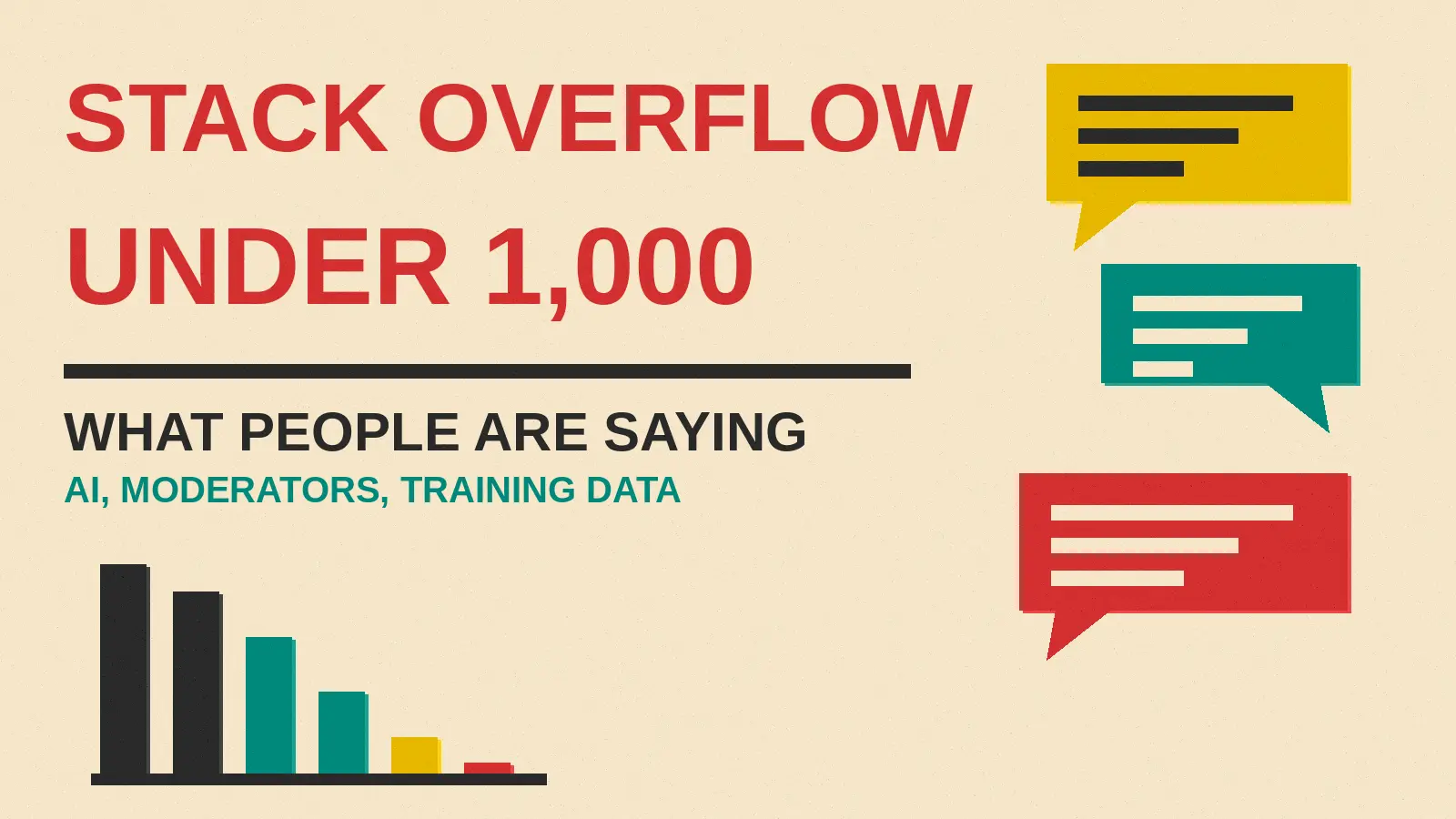
For readers who follow everyday developer tools, the biggest clue is not that a forum became quieter, but that the starting point for solving code problems has changed. Where many people once typed a symptom into search, read archived answers, and compared fixes from different users, many now open a chat window with OpenAI ChatGPT or an AI programming agent and ask it to complete the task in one flow. The monthly question figures attached to Stack Overflow make that shift measurable.
What the monthly question trend shows
The timeline is long, but the pattern is easy to read: high volume for years, a gradual drop, then a much faster drop after conversational AI became widely available. The data points below describe the change without adding extra interpretation.
| Month | Monthly questions | Reader takeaway |
|---|---|---|
| March 2014 | 207,100 | Peak-era scale |
| June 2020 | 171,800 | Still a large public queue |
| November 2022 | 109,100 | Before OpenAI ChatGPT launched |
| October 2023 | 52,300 | One year later, down 50% from the roughly 100,000 period |
| October 2024 | 23,100 | Lower, not a one-off decline |
| October 2025 | 5,200 | Visible acceleration |
| September 2026 | 961 | The new low point in the series |
How OpenAI ChatGPT changed the question path
In late November 2022, OpenAI ChatGPT went online. At that moment, Stack Overflow still sat at around 100,000 monthly questions. One year later, in October 2023, the monthly average had fallen by 50%. This 1-year window matters because it was not only ChatGPT that arrived: a range of AI chatbots appeared during the same period. For ordinary developers, the practical difference is that a question no longer has to be posted publicly to receive an answer. A chat interface can ask follow-ups, accept code snippets, and return a suggested fix in the same conversation.
Why AI programming agents compressed public demand further
After that first wave, AI-based programming agents continued to grow. Instead of asking for a single code snippet, a developer can describe the desired result. The agent can then take over pieces such as architecture design, code generation, debugging, and fixing. This reduces the need to go to Stack Overflow to ask a question, and it also reduces the need to search for an existing solution. The public question count is therefore not just measuring fewer problems; it is also measuring fewer public requests for help.
The public knowledge base feels the pressure
Stack Overflow has accumulated a large public Q&A archive over many years. Developers used search to find historical problems, community edits, and different solutions proposed by different users. AI agents changed both sides of that model. They changed how existing answers are used, and they also changed how new experience travels. A solution created inside a private chat may solve one person's problem, but it does not automatically appear on the internet as a public post that others can search, discuss, or revise.
That gap matters most where change is constant. For programming languages, frameworks, and development tools that update frequently, new questions and new answers still need a continuing supply. Public records help because they expose uncertainty, correction, and version-specific details. When more problem solving happens in private AI conversations, the public layer can become thinner even while individual developers still receive help.
Checklist: What general tech readers should notice
- Monthly questions moved from 207,100 in March 2014 to 961 in September 2026.
- November 2022 marked the arrival of OpenAI ChatGPT, with Stack Overflow still at around 100,000 monthly questions.
- October 2023, one year later, showed a 50% fall, while other AI chatbots were also emerging during that 1 year.
- AI programming agents expanded the path from answering questions to completing development tasks.
- For many years, public Q&A remained useful because it preserved search, discussion, and revision.
Common misconceptions
- Misconception: fewer questions means fewer problems. The data shows fewer public questions, but it does not say the total number of coding problems vanished.
- Misconception: OpenAI ChatGPT is the only reason. The shift also connects to other AI chatbots and programming agents that handle more than isolated answers.
- Misconception: public knowledge bases no longer matter. For frequently updated languages, frameworks, and tools, public new questions and answers still help with search, discussion, and correction.
Action suggestions
- If you read technical answers, compare sources when version-specific details appear, because public archives and AI chats may update at different speeds.
- If you contribute knowledge, consider where your solutions become visible: private chats help one user, while public posts can help later searches.
- If you track developer trends, use the September 2026 count of 961 as a signal of how public Q&A behavior changed, not as proof that one product ended community learning.
FAQ
Why did the drop after November 2022 look so sharp?
Because ChatGPT and other AI chatbots arrived in the same 1-year period, and because developers could ask follow-up questions without publishing a public thread. The result was a measurable drop by October 2023.
What role did programming agents play?
They moved the workflow beyond single-step answering. A developer can provide a requirement, while architecture design, code generation, debugging, and fixing are completed by the agent, reducing the need to post or search.
What does the 961 figure tell the broader tech audience?
It shows that a long-standing public question path can narrow quickly when task completion becomes available through AI. It also points to a question: where will new, version-specific knowledge become visible if more problem solving stays in private conversations?
Information source: LLM Blogs.