
MyTechDailyNews General: Molecular Clues Behind Spider Silk Could Shape Future Materials
A materials story that began with a small arachnid is becoming a broader search for how living systems assemble tough substances. The new angle is not simply that spider thread is strong, but that its protein ingredients can first collect into microscopic droplets that help organize the final solid. For general science readers, the result links biology, materials engineering, and the long-running goal of producing better fibers without harsh industrial processing.
A marbled orb weaver (Araneus marmoreus) builds its web one silk stitch at a time, in a NaturePL photo by Konrad Wothe distributed by Science Source.
A falling spider rarely has to wait for a rescue. Within milliseconds, it produces a protein-rich thread that works as climbing gear. The strand is tougher than Kevlar, the synthetic fiber in bike tires and bulletproof vests, and stronger than steel. It is also flexible and biocompatible, which is why scientists have imagined seat belts, helmets, naval materials, and scaffolds for brain-cell repair.
The unresolved question is how the animal turns “silk dope,” a liquid blend of proteins, water, and salt, from its silk glands into that remarkable solid. Gregory Holland, a chemist and spectroscopist at San Diego State University, has called mapping those mechanisms “really the holy grail.” His recent work describes how molecules in liquid silk dope form condensates, semi-liquid droplets that concentrate and arrange proteins before solidifying.
The finding is both a look inside a spider’s silk factory and a practical guide to how condensates form. Nature appears to use these droplets to organize molecules for genetic processes and for the creation of impressively strong biological materials. By unpacking that strategy, scientists hope to re-create some of nature’s most rugged materials.
What researchers know about silk and condensates
“It’s becoming clear that [condensates are] a common strategy that’s being used across a range of different organisms,” Matthew Harrington, a biological materials scientist at McGill University who did not take part in the study, said.
Spiders are compact material factories: they can spin up to seven types of silk, and the same spider can often spin several. Aciniform silk wraps up insects for later eating. Rubbery flagelliform silk reinforces capture spirals to absorb shock. Dragline silk anchors webs and spiders to walls. Each type’s properties vary by species and molecular assembly, and even silks of the same type can differ slightly across species.
Long research history informs the new work. In 1907, scientists discovered that spider silk is made of long, modular proteins, later named spidroins, which are in the same group of fiber proteins as collagen and keratin. More than half a century later, X-rays started to reveal the fiber’s underlying structure: flat protein sheets known as beta sheets, embedded in a less ordered, non-crystalline matrix.
In the early 2000s, researchers inspecting spidroins in solution did not see fixed structures like those in many proteins. Instead, the spidroins had intrinsically disordered regions that fluttered around, forming and re-forming various shapes. That raised a deeper question: how can a soup of unstructured proteins organize into a strong, solid fiber?
One early theory proposed a transitional state known as “liquid crystal.” Another compared spider silk to silkworm silk, whose proteins are organized into micelles, or small spheres, that compress into fiber.
Illustration: Kristina Armitage, Quanta Magazine.
The condensate connection arrived through broader biology. In 2007, researchers noted that lab-engineered spidroins formed liquidlike globs. In 2009, scientists at the Marine Biological Laboratory in Massachusetts and the Max Planck Institute in Germany found droplets of aggregated RNA molecules in fertilized worm eggs. These were condensates — liquid- or gel-like bubbles of concentrated proteins suspended in solution. Condensates had been observed for more than a century, but were increasingly seen as a critical organizational tool across life.
Condensates concentrate molecules and pre-organize them in a flexible microenvironment instead of locking them into a solid shape. “Because they’re fluid, they’re malleable,” Harrington said, “so you [i.e., biology] can kind of shape them into whatever you want.”
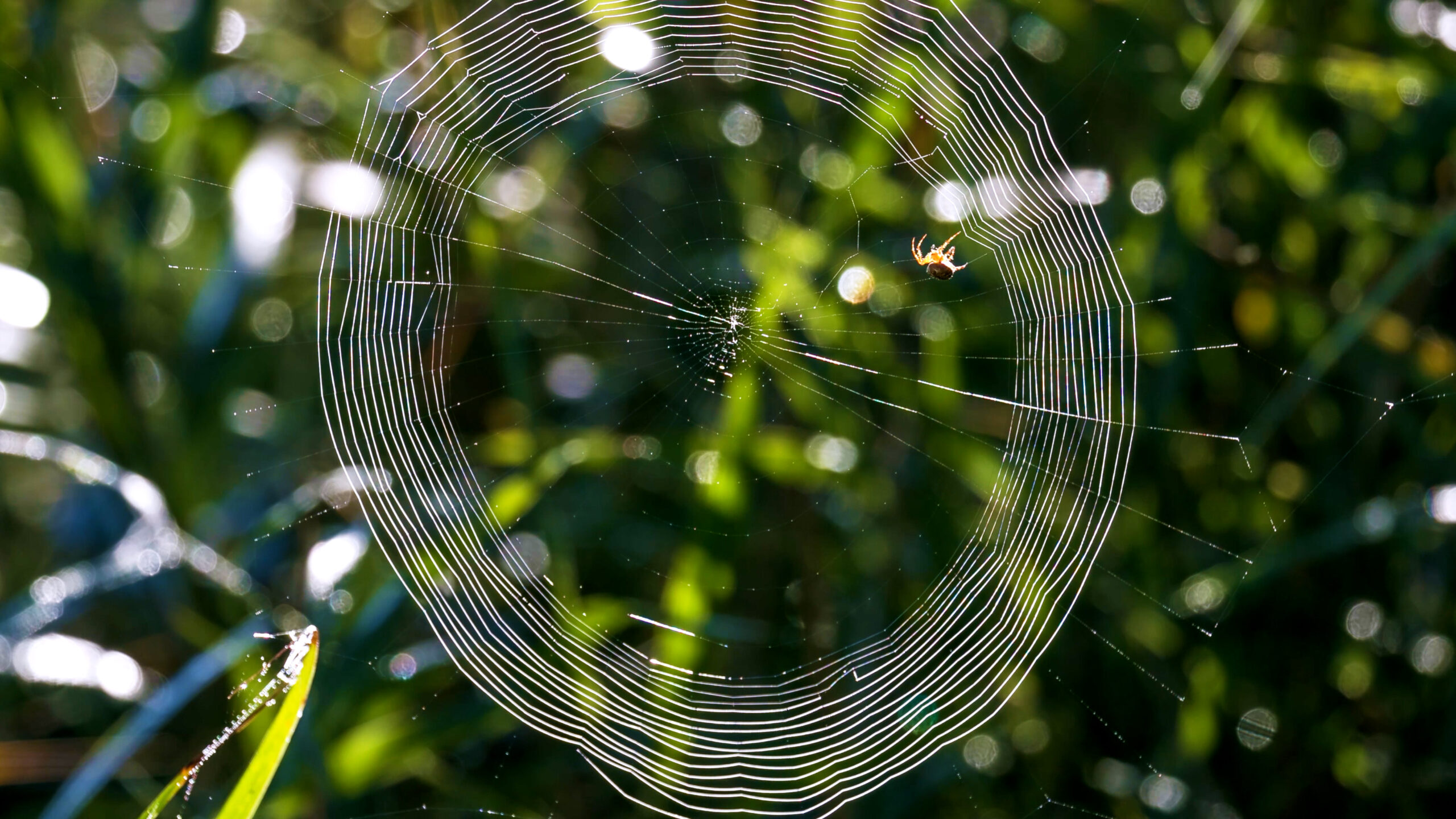
A time-lapse video shows an orb-weaving European garden spider (Araneus diadematus) spinning its web; photo credit: Konrad Wothe, NaturePL, Science Source.
More research showed that living cells use condensates everywhere, to organize DNA, regulate gene expression, and package proteins. At a larger scale, condensates help species build interesting materials: they help mold squid beaks into a gradient of stiff parts, form strong mussel adhesives for rocks, and create marine cement that sandcastle worms use for protective tubes.
“It’s been a hot area in biology,” Holland said.
Though researchers had described condensate-like blobs forming in lab-made spidroins more than a decade earlier, those blobs were not generally thought of as condensates until 2020. Keiji Numata, a biomaterials chemist at Kyoto University, suggested that spider silk undergoes a condensate phase during its transition from liquid dope to solid thread.
Condensates form by liquid-liquid phase separation, when molecules in a liquid start to interact weakly, easily forming and breaking bonds because of a stimulus such as a change in pH, chemicals, or temperature. Numata proposed that phosphate in the ampulla, the middle section of a spider’s silk glands, might initiate those interactions. The missing piece was the atomic-scale mechanism.
Inside the black widow experiments
Hannah Johnson, then a graduate student in Holland’s lab, decided to look. Every few months throughout 2023 and 2024, a package of female black widow spiders arrived at the San Diego State University chemistry department. The arachnids, jet black with a dash of red, can produce venom painful to humans, but they are good silk-study subjects. Their dragline silk spidroin proteins are some of the best-characterized in spiders. They are also available year-round, unlike some spiders that spin webs seasonally.
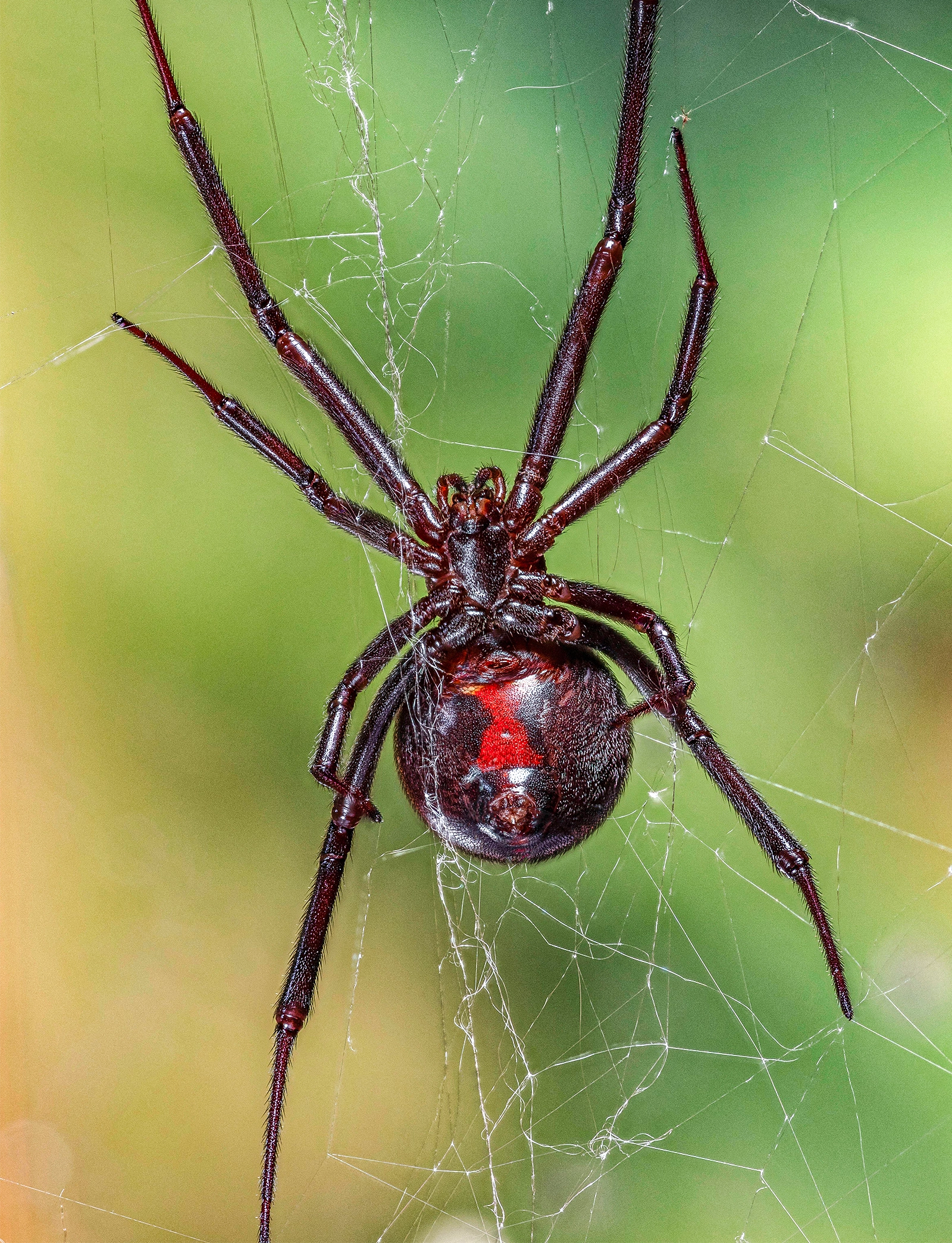
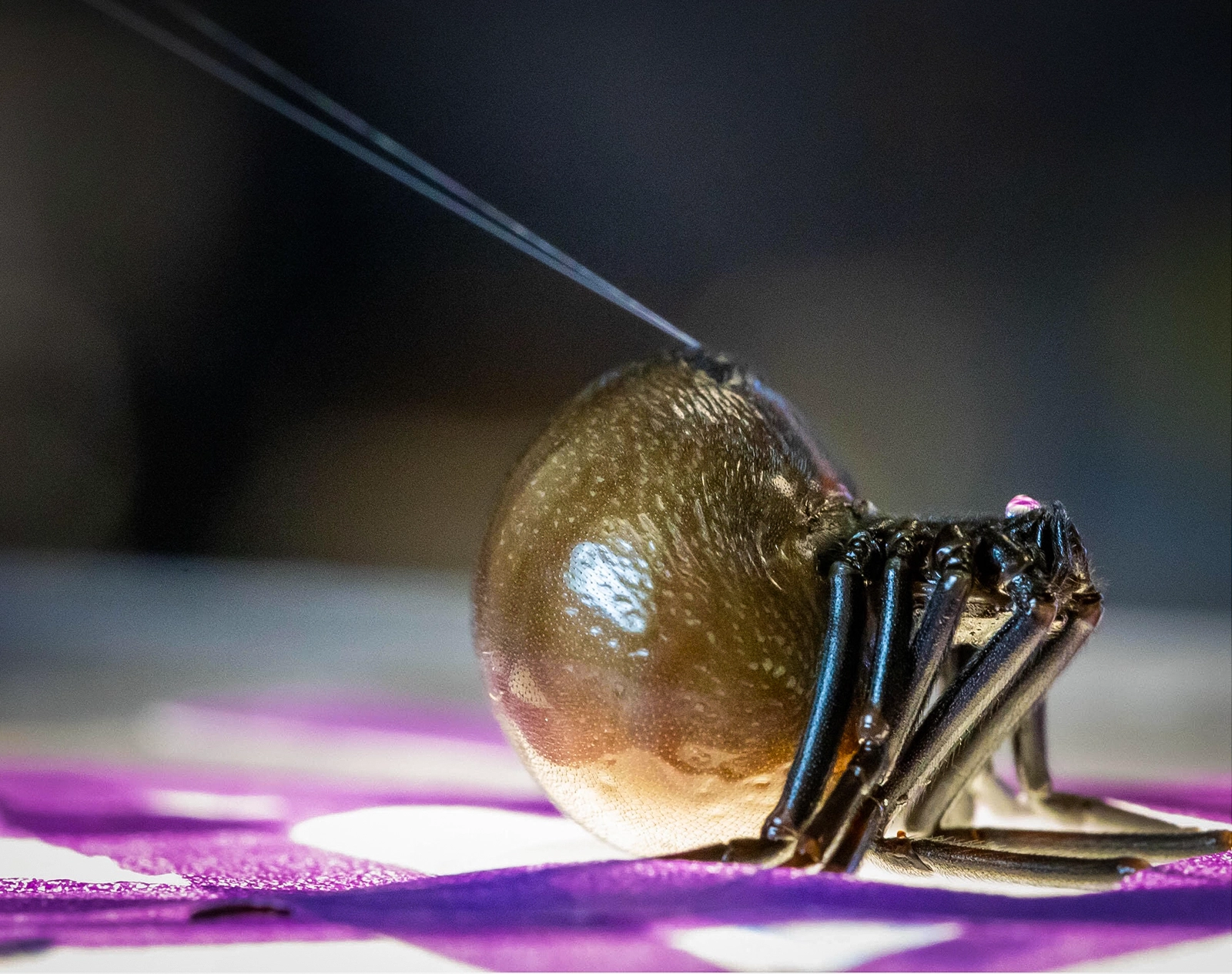
To catch prey, black widows lay a mess of sticky strands that acts as a trip wire. To collect silk for experiments, scientists gently reeled in strands from the spiders’ spinnerets. Images: Phil Degginger, Alamy; courtesy of Gregory Holland.
Six times over the course of two weeks, Johnson put on two pairs of protective gloves. Over the course of an hour, she and several students “silked” black widow spiders that had been knocked unconscious by carbon dioxide. With tweezers, the scientists pulled strands from the spinnerets — the abdominal spigots that fibers emerge from — and reeled them in by winding the silk around a vial with a spinning motor.
“The spiders who give a ton of silk are our favorites,” Johnson said, “but I have a soft spot for the rebels who don’t want to cooperate.” Throughout the process, the researchers fed the black widows a cocktail of amino acids, like “protein shakes,” enriched with particular isotopes that could be detected in the lab.
Nuclear magnetic resonance spectroscopy, or NMR, can map molecular structure. It sends out radio frequencies to disturb nuclei inside atoms, which then move in ways characteristic of the atom type. Johnson used NMR on liquid spider dope and on condensates collected from the spiders’ ampullae. Kevin Chalek, then a postdoctoral researcher in Holland’s lab and now a researcher at the University of California, Los Angeles, mapped the atomic structure of proteins in the solid fiber.
“We were trying to bridge the gap between what is happening when the protein is inside the spider and when it’s outside the spider,” Chalek said. “These are the same protein, [so] how can they be so different? And what exactly is happening between the two?”
Johnson saw that after phosphate was added to liquid silk dope to start condensation, side groups on two amino acids — arginine and tyrosine — in the intrinsically disordered regions of the spidroin proteins began to interact weakly. The interaction displaced water and organized the disordered proteins into a denser, gel-like condensate. The interaction persisted in the solid fiber, suggesting the amino acids serve as molecular stickers that guide proteins into condensates and ultimately into fibers.
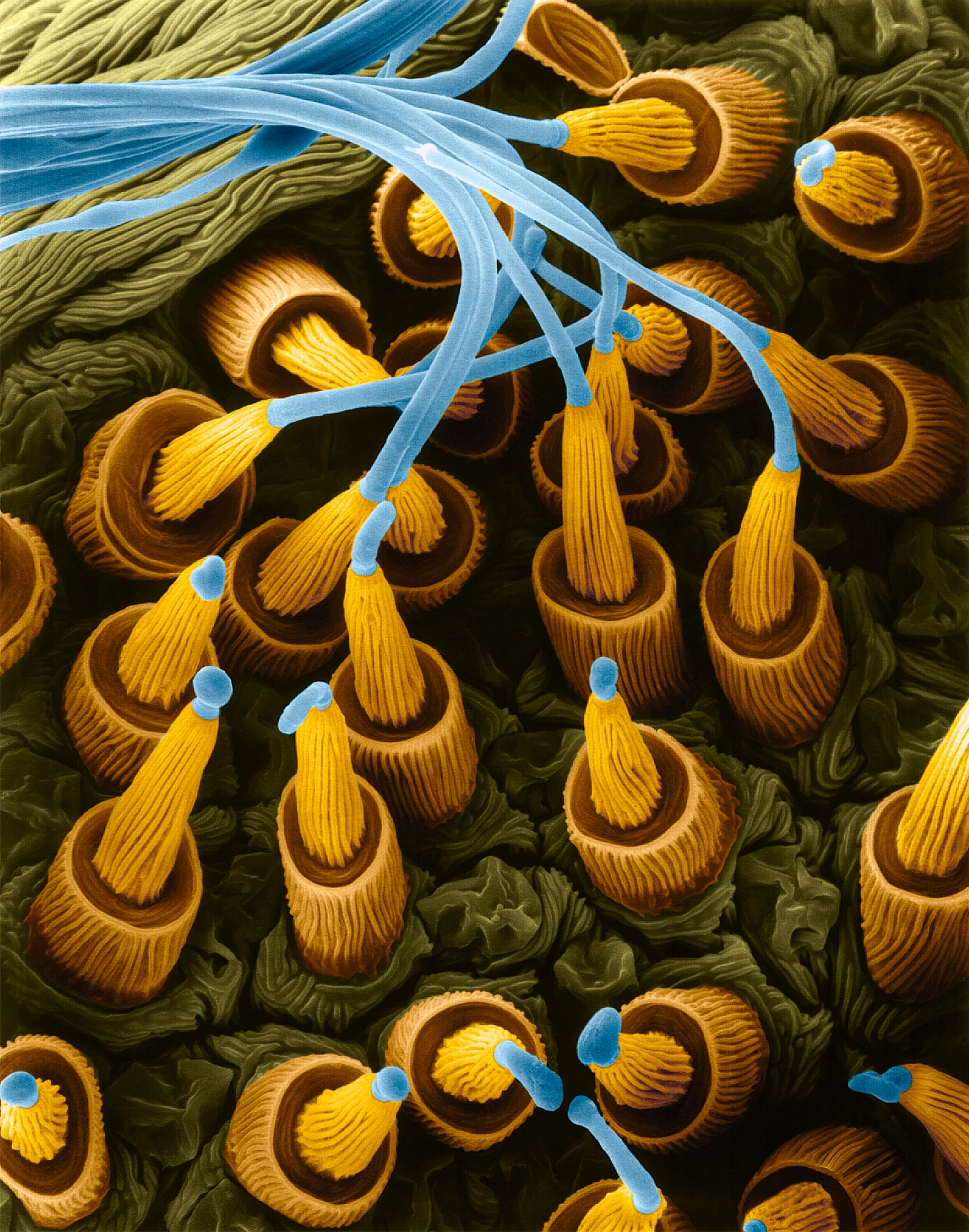
A scanning electron micrograph of spider silk spigots on a spiny-backed orb weaver (Gasteracantha cancriformis) is credited to Dennis Kunkel Microscopy, Science Photo Library.
Other team members used AlphaFold, an artificial intelligence tool that models protein structures, and molecular dynamics software to predict the process computationally. Spider silk’s strength is associated with sturdy beta-sheet structures in its final fiber. The simulations showed that the amino acid side groups line up at the bends in beta sheets, suggesting they help guide spidroins into their final structure.
“Understanding how those side groups interact and how they can develop structure that’s greater than the sum of its individual parts … is fantastic,” said Chris Holland, a biologist at the University of Sheffield who was not involved in the study and is not related to Gregory Holland. He also praised the team for using real spiders, instead of synthetic silks, “which is brilliant.”
Daiwen Yang, a biologist at the National University of Singapore, said their findings are “direct evidence” that condensates can form from native silk and are “quite significant,” within the broader attempt to understand silk assembly.
Gregory Holland had previously shown the presence of micelles in native spider silk. The new description of condensates does not rule out older ideas. He suggested that all three — micelles, condensates, and liquid crystals — could be stages of the same phase transition. Micelles may prevent messy disordered proteins from clumping and getting tangled. The proteins can also pre-assemble into condensates, or align into structures like liquid crystals, before being released from spinnerets as highly ordered fibers. Yet the process is probably “more dynamic and heterogenous,” with several structures forming in the mixture at the same time.
“I don’t think these are mutually exclusive,” Harrington said. “You might have different sorts of phase transitions that are occurring at different stages of the processing.”
There are likely other significant amino acid interactions that have not yet been mapped in detail. Researchers also want to find triggers that initiate the process beyond phosphate. “There could be a range of other things that are driving structural changes in these proteins,” Chris Holland said. “We don’t know all of the switches yet.”
Why practical spider silk is still hard
Describing the full silk-spinning process will take effort, but the payoff could be large. Spiders produce small amounts of usable silk compared with silkworms, which have been reared for cocoons for more than 4,000 years. It takes thousands of silkworms to make a silk shirt; it would take around 1 million spiders, partly because they do not produce cocoons that can be easily processed. There is a practical obstacle too: their cannibalistic nature makes them difficult to keep, because each spider needs its own container.
Producing spider silk in the lab could create a new range of strong yet flexible materials. Kevlar is a synthetic fiber and is currently among the toughest materials available, but it requires processing at very high temperatures and acidic conditions. “Here, you have an organism like a spider or a mussel,” Harrington said, “which is basically making a superior material under ambient conditions in seawater or in just plain air.”
Humans have not yet figured out how to match those organisms. When scientists synthesize spider silk in the lab, using the exact sequence of amino acids to build a spidroin protein, the resulting silk is not as strong as natural silk. “Something is happening there that we’re also struggling to mimic,” Chalek said. He thinks the extra strength may come from something beyond the protein’s beta sheets, perhaps from other aspects of silk’s structure or from parts of spidroin proteins frequently left out of synthetic silk solutions.
Common misconceptions
- Spider silk is not simply a strong protein. It is also flexible, biocompatible, and formed through molecular organization before becoming solid.
- Condensates are not necessarily the only explanation. The researchers suggested that micelles, condensates, and liquid crystals may all play roles.
- Lab-made silk is not automatically equivalent to native silk. Even when scientists copy amino acid sequences, they may miss structures that help natural fiber become stronger.
Checklist for readers
- Check whether a report describes natural silk, lab-made spidroins, or computational models.
- Separate material properties, such as strength and flexibility, from manufacturing conditions.
- Watch for follow-up findings about phosphate, other triggers, and additional amino acid interactions.
- Treat condensates as one clue in a broader materials-assembly story, not as a finished product recipe.
FAQ
What are condensates in this story? They are fluid or gel-like droplets of concentrated proteins suspended in solution. The research suggests they can form before silk proteins turn into solid fiber.
Why do black widows matter to the study? Their dragline silk spidroins are among the best-characterized spider silk proteins, and the animals can be used year-round. Researchers collected silk from their spinnerets to compare liquid dope, condensates, and solid fiber.
Does the research mean commercial spider-silk materials are already here? No. It describes progress in understanding how natural silk forms, not a ready manufacturing pathway. Laboratory spider silk still does not match the strength of natural spider silk.
How could the finding help materials scientists? By revealing a molecular route that nature uses under ambient conditions, it may guide efforts to build strong, flexible, and biologically compatible materials without harsh processing.
Action suggestions
- Follow future studies that expand the list of molecular “switches” involved in silk formation.
- Look for comparisons between natural silk properties and synthetic spidroin experiments, especially where beta-sheet structure is discussed.
- Pay attention to other biology-inspired materials, including adhesives and cements that may use condensate-based organization.
- Share the story with readers interested in materials science, health-related scaffolds, and strong, flexible materials inspired by spider silk.
The spider remains, for now, a better factory than any laboratory has built. But the new molecular clues suggest that the route from protein fluid to ultra-strong fiber is no longer hidden behind a general mystery of strength. As Chris Holland put it, “I think once we really understand those blueprints,” researchers will be closer to the day when “we’ll be able to do more stuff with silk.”