
MyTechDailyNews Case Study: How South Korea’s AI Chip Exports Reached the $1 Trillion Threshold
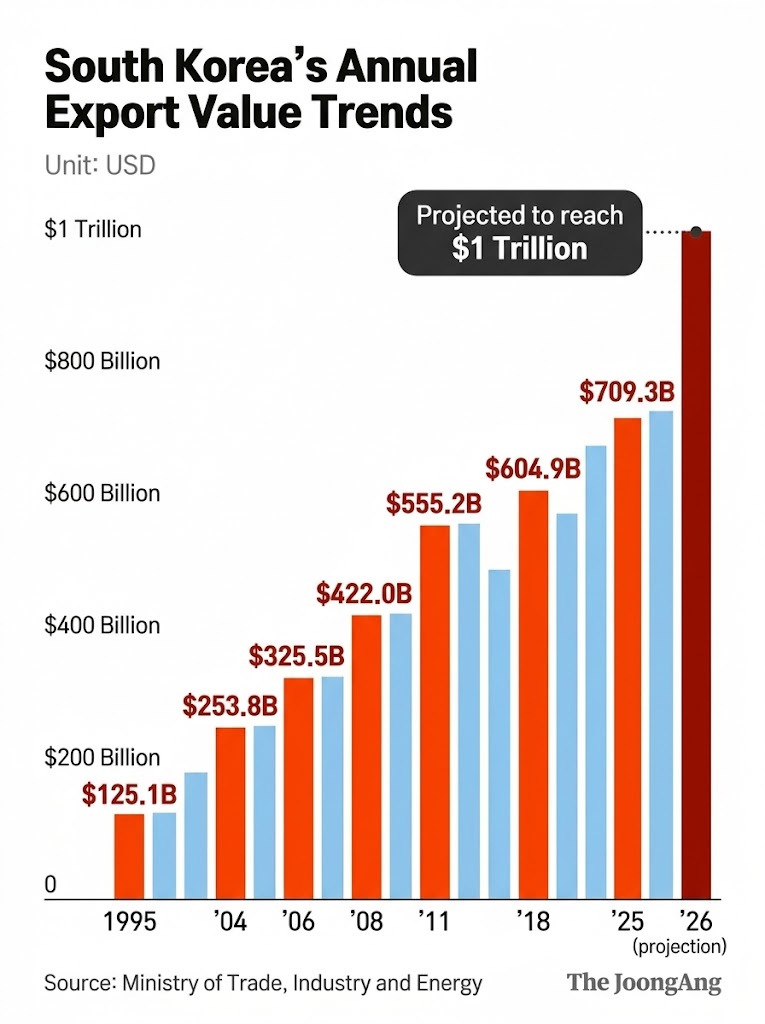
Every trade story becomes easier to understand when a single month turns into a test case. For South Korea, that test arrived in October: a narrow group of AI-linked hardware categories lifted the country’s export ledger so sharply that a full-year total above $1 trillion moved from symbolic ambition into near-term expectation. If the milestone is reached, the country would stand as the fourth major economy to clear the $1 trillion annual export mark. The path was long. Exports first passed $100 billion in 1995; 31 years later, the AI infrastructure cycle has rewritten the scale of the story.
Case snapshot: the line item that changed the score
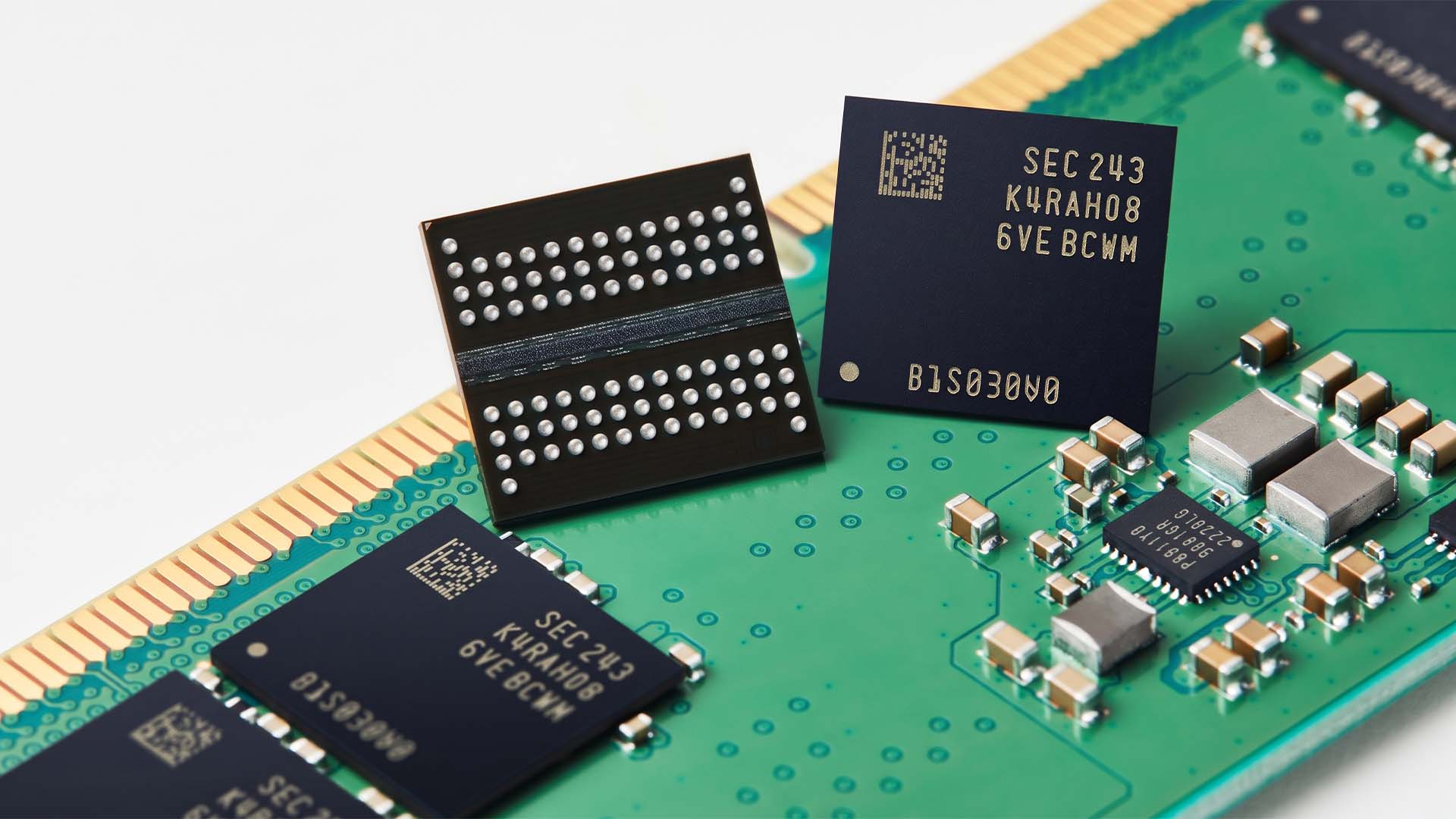
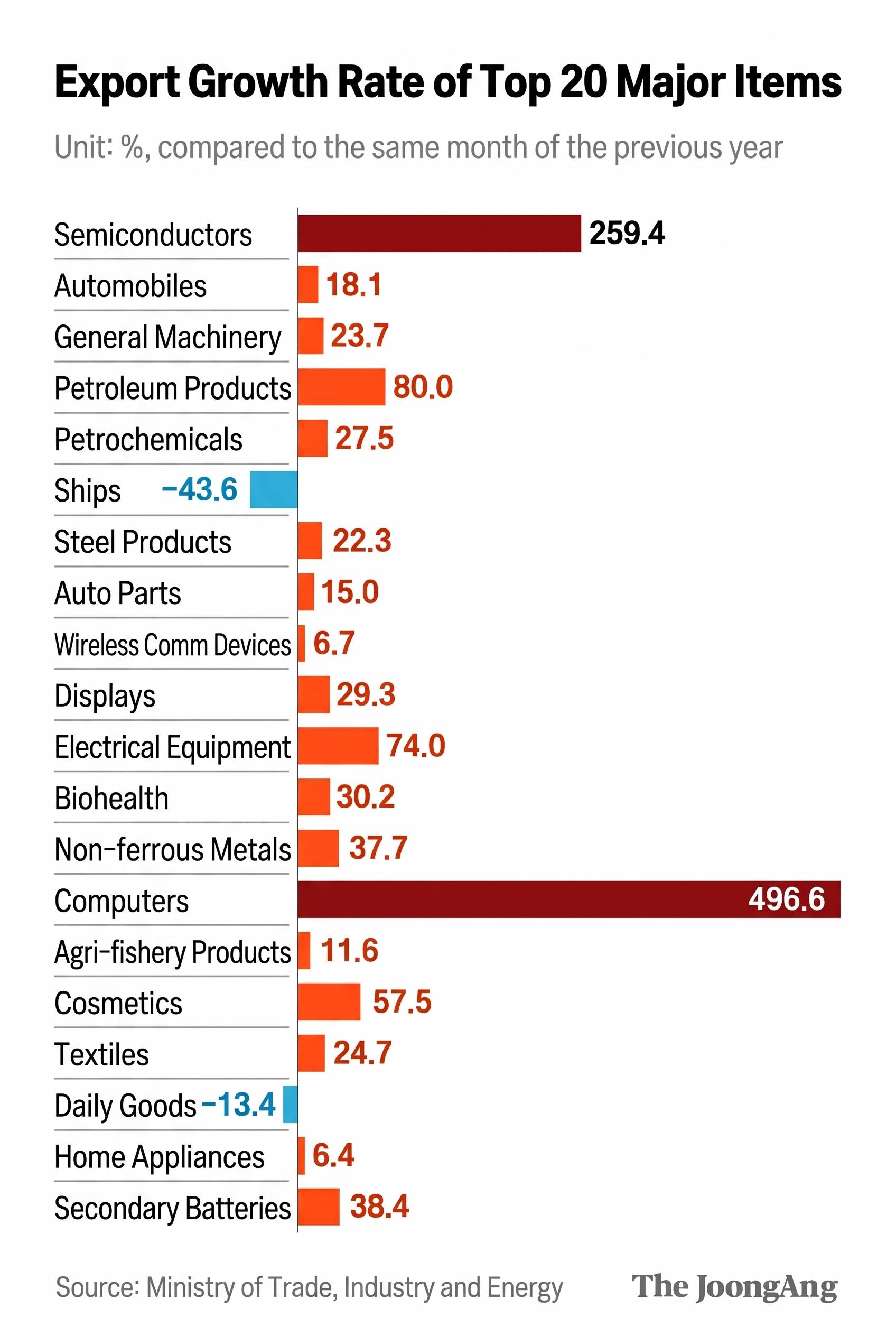
The cleanest opening fact is the October semiconductor figure: exports reached $56.44 billion, up 259.4% year on year. In this case, the number matters because it is not simply another product category doing well. Semiconductors alone represented 49% of the month’s export total, making the AI memory cycle the engine room of the entire trade performance. Samsung Electronics and SK Hynix are the most visible beneficiaries, but the result also shows how concentrated South Korea’s upside has become.
A useful addition from Korea’s Ministry of Trade, Industry and Energy October release is that total exports were about $115.3 billion, up 93.7% year on year, while computer-related exports rose by a striking margin. The same release also gives a consumer-facing explanation for why the boom looked so strong: 16Gb DDR5 DRAM pricing reached about $50.0 in October, higher than September, while 128Gb NAND flash remained around $30.6. In plain terms, demand was not only increasing shipment volume; it was also supporting prices.
That price detail is important for a general-audience case study. It helps connect a seemingly remote AI trend to a product reality: when data-center operators race to secure memory for accelerators, server platforms, and storage systems, the ripple can move from factory utilization to retail PC and smartphone component costs. The October result, therefore, is not just a customs statistic. It is a preview of how AI spending reshapes the supply chain.
How demand flowed: markets, categories, and the AI stack
The demand map also widened the case beyond one customer or one region. Exports to China increased 133.6%, while shipments to the United States jumped 185.8%. Europe and Southeast Asia remained strong enough to reinforce the idea that this was not a one-market surge. At the same time, computer equipment tied closely to AI infrastructure grew 496.6%, adding a second hardware channel that amplifies the memory story rather than diluting it.
| Case element | Reported result | Why it matters |
|---|---|---|
| Core export driver | $56.44 billion in October semiconductor exports, up 259.4% | Shows how much of the monthly headline depended on AI-related memory demand. |
| Export concentration | Semiconductors accounted for 49% of total exports | Creates a powerful growth lever, but also a structural exposure if data-center spending cools. |
| Adjacent hardware channel | Computer equipment exports up 496.6% | Links South Korea to the broader server, storage, and computing infrastructure build-out. |
| Demand breadth | China up 133.6%, United States up 185.8%, Europe and Southeast Asia also strong | Reduces the impression that the boom rests on a single procurement cycle. |
| Company exposure | Samsung Electronics and SK Hynix benefit most visibly | Helps explain why market reaction and investor attention clustered around a few names. |
What went well: the AI infrastructure play
The first lesson from the case is that South Korea’s position in advanced memory turned a global capex trend into a national trade advantage. Large technology companies are building AI capacity, not merely experimenting with it, and that requires predictable access to high-bandwidth memory and storage systems. When those inputs are in short supply, suppliers with scale and reliability become strategic assets. Samsung Electronics and SK Hynix sit at the center of that story, which is why the October data reads less like a consumer-electronics recovery and more like an infrastructure supply report.
The second lesson is that adjacent equipment categories can strengthen the main narrative. A 496.6% rise in computer equipment exports suggests that buyers are not only purchasing chips in isolation. They are assembling larger computing systems, including server platforms and storage-heavy architectures, where memory is a necessary part of the whole package. For ordinary tech readers, the practical takeaway is that AI is no longer a software abstraction; it is a physical build-out with visible trade consequences.
Where the case breaks down: the domestic transmission gap
Despite the headline strength, the story did not become a broad economic recovery. The third quarter shows the mismatch clearly: retail sales fell 0.5% year on year, interrupting the previous expansion and highlighting weak household spending. The macro picture is also mixed. Preliminary data reported by Xinhua Finance showed third-quarter GDP grew 1.0% from the previous quarter and 3.4% year on year, but the domestic side of that result did not feel equally warm.
One underreported piece of evidence is how unevenly export gains reached firms of different sizes. Korea Customs Service data cited by financial media showed that in August, large-company exports were $77.1 billion, up 94.2% year on year, while small and medium-sized enterprise exports were $10.1 billion, up 20.4%. That gap matters. It suggests that the AI chip boom was concentrated in high-capacity supply chains that many smaller manufacturers, local service firms, and consumer-facing businesses could not enter directly.
Experts caution that semiconductors are highly advanced, high-value industries, but their ability to spread growth into employment and local commerce is narrower than in automotive, construction, or consumer services. A single memory supplier can win an order while nearby restaurants, retailers, and small factories see little change. This is the core case lesson: a trillion-dollar export ceiling does not automatically create a healthier everyday economy.
Common misconceptions
- A record export month means a healthy domestic market. The October figures were exceptionally strong, but third-quarter retail sales were still down 0.5%, showing that external demand and household demand can move in opposite directions.
- Semiconductor strength automatically solves the small-business squeeze. Company-size data suggests the gains flowed first to large export-oriented firms, not broadly through the SME sector.
- Price increases are only a short-term inventory issue. The October DDR5 price detail points to a deeper problem: AI build-out is consuming components that many other electronics categories also need.
- The $1 trillion milestone proves the model is sustainable. It proves scale and momentum, not durability. If AI infrastructure investment slows, concentration becomes a vulnerability.
FAQ: what readers should ask next
Is the $1 trillion target mainly about chips?
The anchor is chips. October semiconductor exports of $56.44 billion and a 259.4% increase show how central memory products became. But computer equipment, storage systems, and server-linked hardware also contributed, making this an AI supply-chain story rather than a single-product story.
Why do ordinary consumers care?
Because memory and computing hardware feed everyday products. Higher prices for DDR5 DRAM and sustained demand for NAND flash can move into laptop costs, smartphone storage options, gaming hardware, and cloud-service pricing. The trade ledger eventually touches shopping carts.
What could cool the boom?
The most obvious risk is slower spending on AI infrastructure. If major technology companies postpone data-center expansion or cut advanced storage orders, South Korea’s export momentum could lose speed more quickly than a more diversified economy.
What would make the growth more balanced?
Growth needs more domestic transmission: broader SME participation, stronger local demand, and new industries that absorb labor and spending across regions. The export record is impressive, but a balanced economy needs more than a strong October.
Reusable lessons for tech companies and product teams
- Watch component price signals, not only shipment totals. The October DDR5 and NAND figures reveal where purchasing pressure is building before end-market demand fully adjusts.
- Treat AI infrastructure as a physical supply challenge. The 496.6% rise in computer equipment shows that compute demand expands through servers, storage, and networking, not just chips.
- Map concentration risk honestly. When one category carries 49% of exports, every positive headline also raises a dependency question.
- Distinguish national results from local conditions. Strong trade statistics can coexist with soft retail, weak consumer confidence, and uneven SME performance.
Action advice for general tech readers
- Follow monthly semiconductor and computer equipment export data as a leading signal for AI hardware demand.
- Compare national headline growth with retail sales and SME indicators before drawing conclusions about everyday economic health.
- Remember that memory price movements may foreshadow future costs for PCs, phones, cloud services, and AI devices.
- Be cautious about treating the $1 trillion target as proof of stability; concentration is both the engine and the risk.
For MyTechDailyNews, this case is not just a story about one country’s trade milestone. It is a practical demonstration of how AI spending can reshape entire supply chains within months, rewarding firms that sit close to critical hardware while leaving many smaller businesses outside the fastest lane. South Korea’s next test will be whether the $1 trillion export run can be converted into broader domestic participation. If that transmission remains weak, the record will still stand as proof of global demand, but also as a reminder that macro headlines and lived economic experience can diverge sharply.
Written by Sarah Chen for MyTechDailyNews. For feedback or tips, contact Tech Daily at hello@techdaily.com.