
MyTechDailyNews Guide: Solar Power Passes Nuclear — What Cheap Panels, Batteries and Global Factories Mean for Daily Electricity
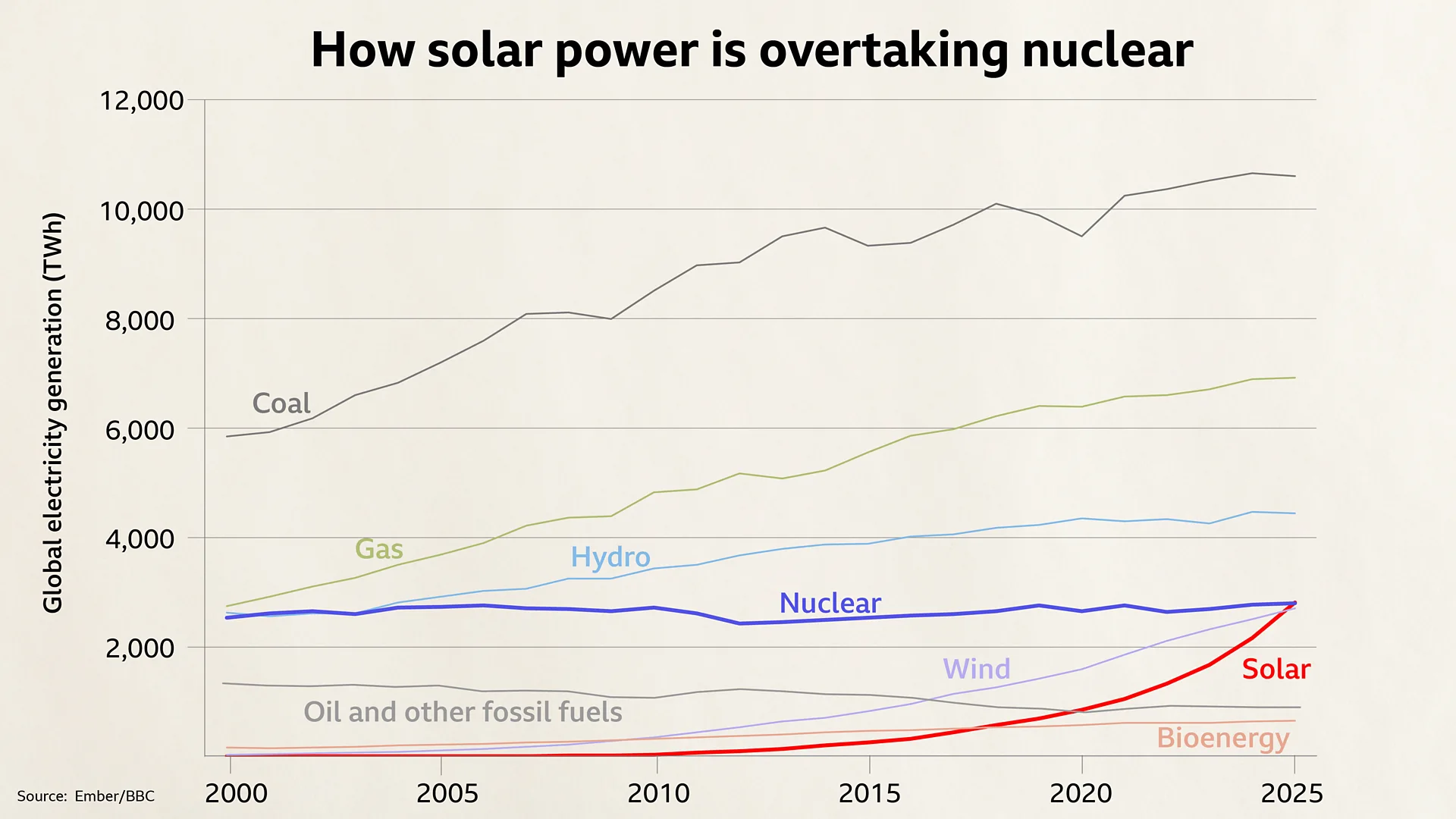
If you switch on a light after sunset, the electricity behind it may not match the world's energy plan from ten years ago. In 2025, solar generation edged past nuclear power over a full year, and in 2026 the gap widened. Ember's data for the 12 months ending in September 2026 puts solar about 13% higher than nuclear, a change over the past decade that many analysts did not fully expect.
Quick checklist: the numbers behind the shift
- Ten years ago, solar supplied only about 1% of global electricity; nuclear output was roughly ten times larger, and wind also led.
- In 2025, global solar generation reached about 2,778 terawatt-hours, growing 30% year on year.
- Solar was the fastest-growing major electricity source and met roughly three-quarters of the world's new electricity demand that year.
- Nuclear output has changed little since 2000, while solar has increased by several thousand times over more than two decades.
Why the cost curve bent so sharply
As photovoltaic technology matured, cell conversion efficiency rose and each module used less silicon, silver and other inputs. China's large solar manufacturing chain expanded production, and competition plus excess capacity pushed module prices down. Ember co-founder David Jones says that between 2023 and 2024, prices fell so much that solar entered an extremely low-cost stage: a standard module can now cost under $100 and generate power for 30 to 40 years with little extra fuel.
This matters because coal and gas plants must keep buying fuel and managing transport, storage and volatile prices. Solar is different: the money is mostly upfront, then costs shift to maintenance, land, financing and grid connection. That logic is especially attractive where electricity prices are high or fuel supply is unstable.
Oxford University energy and climate policy expert Jan Rosenow argues that solar has become a central driver of the energy transition. Many mainstream forecasts once imagined linear growth and slow price declines, but manufacturing scale and technology progress repeatedly exceeded those assumptions.
Where solar is changing ordinary electricity supply
- China remains the world's largest solar market and a leading maker of modules, cells and related equipment. Its capacity has helped lower global prices. Domestic new installation growth may slow, but low-cost Chinese-made modules continue flowing into overseas markets.
- For many developing countries, imported solar gear is often easier to start than a large conventional plant and can expand electricity supply quickly.
- The United States remains the world's second-largest solar market. Even with tariffs and other restrictions, capacity has kept growing. Researchers at the University of Maryland say trade barriers and policy limits can raise costs and slow installation, but solar is still one of the cheapest new power options in many regions.
- In India, solar met about 60% of new electricity demand over the past two years.
- Australia has more than 4 million households with rooftop solar, representing over a third of all households.
- In Pakistan, Lebanon and Nigeria, weak grids and diesel generators have made solar more attractive when oil prices rise.
- Pakistan is a striking example: solar's share was below 2% in 2019 and is now about 24%, helped by costly, unreliable grid prices and low-cost imports from China.
- In Germany, balcony solar systems spread in recent years, letting households use small modules through ordinary outlets. They make less power than large rooftop systems but lower the barrier for everyday participation.
Storage, grids and the evening test
Solar has one unavoidable limitation: it produces electricity only when the sun shines. Without storage and suitable grids, cheap panels cannot alone deliver round-the-clock supply. Falling battery costs are changing that. More solar plants are pairing with batteries to store daytime surplus and release it in the evening or at night. In sunny regions, solar plus storage can already compete economically with new fossil-fuel plants.
California shows how the pattern is shifting. In the first half of 2026, solar and battery systems met more than a quarter of electricity demand between 7 p.m. and 9 p.m., an evening peak. Solar is no longer just a midday source; storage lets it influence the whole grid day.
Still, batteries mainly move power within a day. Long cloudy stretches, seasonal change and winter demand require longer-duration storage, wider regional grid connections and dispatchable backup. The energy system must build capacity to absorb and redistribute solar power, not merely add more panels.
New demand and the real bottlenecks
Electric vehicles, industrial electrification and AI data centers are reshaping electricity demand. Solar can provide low-cost power for these loads and reduce dependence on coal, gas and oil. Yet if demand grows faster than transmission, storage and market flexibility, the solar expansion may hit a new ceiling.
Energy expert Julia Sude warns that electrification alone does not automatically make energy systems more resilient. Without planning, concentrated new loads can make grids weaker. The main constraint is moving from module price and factory capacity to grid construction, storage deployment and electricity demand management.
What comes next for solar technology
Solar formats are diversifying. Agriculture-plus-solar projects let farmers grow crops or graze animals beneath panels, reducing single-purpose land use. Some U.S. solar farms allow sheep to graze between arrays, helping control vegetation while keeping farm income.
Floating solar, mirror-concentrating systems, perovskite cells and power-generating solar windows may broaden use later. They are unlikely to replace conventional silicon modules immediately, but they can bring solar into places where large rooftops or fields are difficult.
2026 growth, policy timing and the 2030 picture
Despite the momentum, global new solar installation growth in 2026 may slow for the first time, mainly because of China. In the summer of 2025, China adjusted pricing mechanisms and support policies for new energy projects, prompting many developers to build earlier and connect before old rules ended. That rush pulled forward demand that might otherwise have appeared later.
Excluding China, solar modules installed in other markets in 2026 may still exceed the same period last year. The growth story is therefore not dependent on one domestic market alone; it is spreading across more countries and regions.
The International Energy Agency expects global solar generation to reach twice the 2025 level by 2030 and to pass hydropower around 2029, becoming the world's third-largest electricity source behind other larger sources. As solar expands, power structures may keep shifting from coal and other fossil fuels toward lower-carbon options.
Common misconceptions
- Misconception: "Solar overtaking nuclear means nuclear is finished." Reality: Nuclear still provides continuous low-carbon power, does not depend on sunshine and can supply stable grid output. With AI data centers and industrial electrification raising demand, nuclear may attract new investment in some countries. The comparison shows different trajectories, not inevitable replacement.
- Misconception: "Cheap panels automatically mean reliable 24-hour electricity." Reality: Storage, grids, longer-duration backup and demand management decide whether solar power can be used all day.
- Misconception: "Trade barriers can stop solar adoption." Reality: They can raise costs and slow deployment, as the University of Maryland research suggests, but the United States still remains the world's second-largest market despite tariffs and restrictions.
FAQ
Why is the 2025 solar-over-nuclear figure important?
It marks the first time on an annual basis that global solar generation slightly exceeded nuclear output. The 2026 comparison over the 12 months ending in September 2026 shows the gap widening to about 13%, making it a structural signal rather than a one-year statistical blip.
What made solar modules so cheap?
Higher cell efficiency, lower material use, scale manufacturing and price competition all contributed. China's expanded solar chain played a major role. David Jones highlighted the sharp between 2023 and 2024 price drop, after which a standard module could be bought for under $100 and operate for 30 to 40 years.
Does China's slowdown matter?
Yes, because China shapes global prices and installation volume. The summer of 2025 policy adjustment caused a rush before old support rules ended, contributing to a 2026 growth pause. But outside China, other markets may still install more solar modules in 2026 than in the same period last year.
How close are we to a 1.5 degrees Celsius problem?
Climate risk remains severe, and the world is increasingly likely to exceed the Paris Agreement's 1.5 degrees Celsius limit. Still, the fast expansion of clean power shows that energy transitions can move faster than even optimistic predictions, and lower-carbon electricity growth has reduced demand for new coal projects in some areas.
Action advice for readers
For households and small businesses, treat solar less as a distant climate issue and more as an electricity supply choice: look at local reliability, peak-hour costs, rooftop or balcony feasibility, and whether batteries or time-of-use plans make sense. For organizations, track three variables: grid capacity, storage deployment and policy signals around imports. For general readers, watch whether solar's next constraint is solved by infrastructure and market design, not just by cheaper panels. The question is no longer whether solar can be low-cost; it is whether countries can convert abundant sunlight into dependable all-day power.
The deeper change is that solar has moved from a subsidized alternative to one of the most competitive new sources in many markets. Whether it can keep growing now depends on timely transmission, storage, flexible power markets and open equipment trade. Cheap modules are only part of the story; the harder task is turning variable sunshine into stable electricity at night, in winter and during extreme heat waves, without breaking the grid.