
MyTechDailyNews General: Solar Panels Under $100 Are Reshaping the Global Grid
A decade ago, solar panels were easy to dismiss as a small part of global power, contributing only 1% of electricity. By 2026, the technology looks set to reach 10% and pass nuclear, the source that anchored electricity systems since the late 1970s. For MyTechDailyNews readers, the story is not just climate policy: it is a mass-market hardware shift driven by prices, supply chains, batteries and household choices. Ember and BBC analysis of 12 months up to September 2026 found solar generation running 13% above nuclear after a narrow crossover in 2025. There are seven reasons behind that rise — and several practical takeaways for people who care about devices, energy costs and the next big tech adoption cycle.

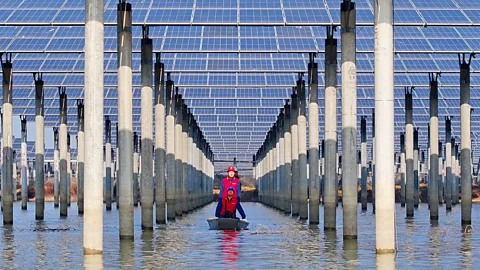 Getty Images
1. The force most forecasters underestimated
Dave Jones, co-founder of Ember, said, “[Solar] generating more electricity than all the world's nuclear power plants is a pretty insane stat, for sure,” but the numbers show the direction clearly. Jan Rosenow, a professor at the University of Oxford, said, “Solar is now the engine of the power transition,” and noted that the scale of the change surprised analysts. He added, “It wasn't expected,” pointing to forecasts from institutions such as the International Energy Agency, or IEA, an intergovernmental organisation based in Paris. In his view, those outlooks “assumed linear growth and slowly falling costs, and got both wrong”.
Over 2026, several sources indicate solar generation will almost certainly move well ahead of nuclear. Nuclear output has been broadly stable since 2000, while solar has grown 2,700-fold. In 2025, solar met three-quarters of global electricity-demand growth and edged past wind, another fast-growing but slightly slower source.
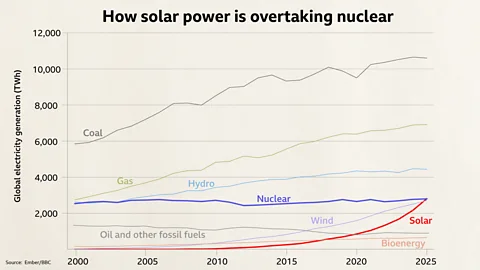 Ember and BBC data: solar generation moved slightly past nuclear in 2025; Over 2026, the gap is expected to be much wider.
2. It's offensively cheap
Solar has been a mature technology for some 15 years, and in 2020 it became the cheapest electricity in history. Dave Jones, co-founder of Ember, a UK-based energy think tank, says efficiency gains, scale and lower silicon and silver use in panels pushed prices down again. Rosenow added, “Massive Chinese manufacturing scale and current overcapacity have pushed module prices to record lows,” a sentence that explains why solar moved from expensive alternative to obvious default.
The collapse in panel prices in 2023-24 pushed the market into what Jones calls an offensively cheap era. “A panel in itself is just so unbelievably cheap,” he said. “It's well under $100 (£75)… and that's going to keep you generating electricity for 30, 40 years without any input at all.”
The savings also extend beyond the meter. Researchers calculated that rising US wind and solar generation produced $249bn (£186bn) in climate and health benefits between 2019 and 2022.
3. Global uptake is not one-country theatre
China is still the world's biggest solar power by far, but the adoption map is broad. Despite a variety of tariffs, the US is the second country for installations, and deployment remains high, especially in states won by President Trump in 2024. The US now has enough solar to power more than one-third of its households.
Alicia Zhao, an expert at the University of Maryland, said, “Tariffs and other federal policies that constrain renewable energy growth are certainly expected to raise costs and slow expansion relative to what we otherwise would have seen,” then added, “However, economics are a key part of why solar has been able to grow so quickly. Even with rising costs, solar is still one of the cheapest sources of new power in the US. And it is getting built regardless of political lines.”
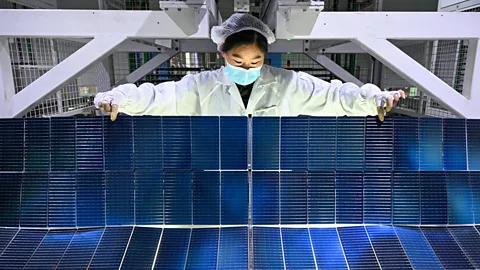 Getty Images: China's domestic solar boom is cooling, yet exports of inexpensive panels continue to climb.
India is moving away from fossil fuels far faster than China did, and new solar has met 60% of its rise in power demand in the past two years. In Australia, over four million homes now have rooftop solar: well over a third of all households.
4. Unreliable fossil power pushes people to rooftop systems
Countries such as Pakistan and Lebanon have begun installing solar at breakneck speeds, while across Africa some 100,000 solar panels a day are being fitted. In many places, rising diesel prices linked to the Russia-Ukraine conflict and the US-Israel war with Iran have swung the cost balance further toward solar. This is especially visible in African markets where home diesel generators have been a necessity because grids are unreliable. Rooftop panels, nearly all imported from China, have become the practical alternative.
Ethiopia has even banned the import of petrol and diesel cars to reduce oil dependency and pollution, Jones said. Pakistan has become a surprise poster child: in 2019, solar provided less than 2% of its electricity; now it is 24%, helped by expensive, unreliable grid power and cheap Chinese imports. Jones said, “What's really incredible in Pakistan is… generally most of the solar boom has been out of people's pockets,” adding, “People can afford it, without needing to take out loans.”
A similar story appears in several other sun-belt markets, from Lebanon to Nigeria. Rosenow said, “[Solar] lets households act without waiting for governments or utilities,” and added, “In uncertain times, that speed and independence is extremely valuable.”
5. The battery revolution closes the timing gap
Solar can only produce during daylight, so the next layer is storage. Rosenow said, “Solar plus storage is now routinely cheaper than new fossil plants in sunny regions,” and added, “Batteries have largely solved the daily problem of shifting midday sun into the evening.”
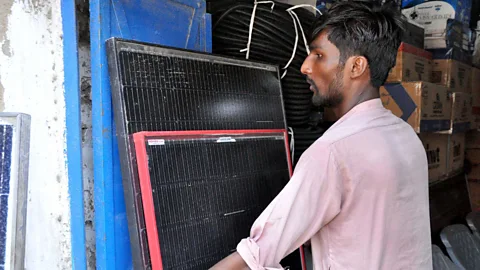 Alamy: Solar moved from Pakistan's fifth-largest electricity source in 2023 to its biggest in 2025, Rosenow said.
California offers a clear example: over the first half of 2026, solar and batteries met on average over a quarter of electricity demand from 19:00-21:00, the evening peak. In the US, states such as Vermont are now rolling out grid-integrated home-battery systems, often paired with solar. Both Rosenow and Jones caution that longer-term storage across seasons, cloudy periods and monsoon seasons remains difficult. The integration of solar into the wider electricity system still matters.
6. Electrify everything — but plan for resilience
Solar is now seen as a key part of electrification, cutting fossil fuel use in areas that previously did not rely on electricity, such as transport via electric cars. Electrification has been chosen as a major theme at this year's UN climate talks in Turkey. Jones said, “That's where solar's going, to not just be king of electricity, but king of energy,” framing solar as the bridge between power and broader energy systems.
Julia Souder, chief executive of the Long Duration Energy Storage Council, a global executive-led non-profit established at COP26, warned in a blog for international policy network Ren21, “There is an inherent danger in uncontrolled electrification, and adding massive new loads without built-in flexibility creates a fragile system,” and stressed, “Electrification is not automatically resilient.”
Rosenow argued that the limits are now grids, storage and the pace of demand electrification, not panels or cost. His summary was: “The bigger question is no longer whether solar grows but whether our power systems and institutions can keep up.”
Zhao pointed to the US, where data centres and electrification mean power demand is growing for the first time in decades, while energy security has become a national priority. She said, “Renewables already make up over 90% of new capacity in the US,” and added, “This need for secure, quickly deployable electricity could create a critical opportunity for [further] renewable energy growth even without support from the current federal government.”
7. Expanding technology: balconies, farms, water and windows
Plug-in panels, or “balcony solar”, have spread rapidly in Germany, generating less electricity than rooftop arrays but feeding homes through a standard socket. They have been approved in several other countries and US states, including California. Agrivoltaics, which combines food production and solar panels, is being promoted as a way to answer land-use concerns in some areas.
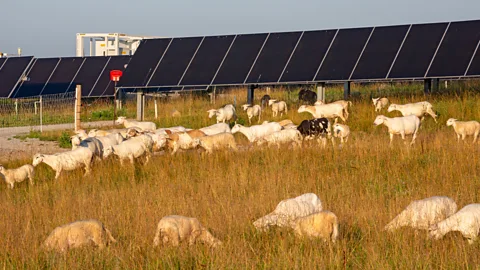 Getty Images: In Kentucky, US, a solar ranch pays a local farmer to graze sheep among its panels, producing pasture-fed meat while keeping grass and weeds down.
Other technologies, from floating and “mirror” solar plants to perovskite panels and solar windows, could all see growth in coming years.
What comes next: a larger base, possibly a slower edge
In 2026, global solar capacity will continue rising, but the pace of expansion may slow for the first time ever, Jones said. The reason is China: last summer, it changed the regime for managing and supporting new installations, causing a burst of installations in 2025 to fall under the old price rules. Outside that effect, the picture is different. Jones said, “If you exclude China, there's more panels being installed this year than last year,” although overall growth can still be uneven.
By 2030, the IEA expects solar generation to reach double the 2025 level, with solar overtaking hydro to become the world's third-largest electricity source. Rosenow said, “Wherever grid power is costly and unreliable, the economics keep pulling people towards solar,” before adding, “There is one caveat: if Chinese solar panels are difficult to import this will not happen at speed.”
Climate news remains grim. It is now incredibly likely that the 1.5C global limit set in Paris in 2015 will be breached, while the world moves closer to several tipping points this century. Yet the solar story shows that progress can appear where it was not forecast. Jones said “no one was getting close to expecting that to happen” and noted that clean-electricity growth has directly translated into fewer coal plants being built. “Now, worst cases [of climate change] are somewhere between 2-3C of warming, rather than 4C.”
Checklist: what tech and energy watchers should track
- Price signals: If panel costs stay near the offensively cheap range, adoption can keep outrunning political debates and older projections.
- Battery pairing: Storage matters more than raw solar capacity when the goal is evening and peak reliability.
- Import exposure: Because cheap modules often come from China, supply-chain rules are as important as technology breakthroughs.
- Grid readiness: Electrification adds new loads; without flexibility, a larger renewable system can become fragile.
- Consumer-led rollout: In places where grid power is costly and unreliable, households can move faster than public utilities.
Common misconceptions
- Misconception: solar only matters to environmental policy. The data describe a hardware-cost and adoption shift that affects energy prices, devices and global trade.
- Misconception: one country explains the whole trend. China is dominant, but US, India, Australia, Pakistan, Lebanon, Nigeria and African markets show broad uptake.
- Misconception: cheap panels alone solve the grid. Storage, transmission and flexible demand remain limiting factors.
- Misconception: tariffs stop deployment. They can raise costs and slow growth, but economics still keep solar competitive.
FAQ
Has solar really overtaken nuclear?
Based on Ember and BBC analysis, solar electricity generation moved slightly past nuclear in 2025 and was 13% higher over the 12 months up to September 2026. The milestone matters because nuclear was a mainstay since the late 1970s.
Why are panels so inexpensive now?
Solar has been a mature technology for some 15 years and became the cheapest electricity in history in 2020. Massive Chinese manufacturing scale and current overcapacity have pushed module prices to record lows, while efficiency gains and lower material use added further reductions.
Does the solar transition depend on government support?
Public policy still affects costs and speed, but the reporting shows households and businesses often act without waiting for governments or utilities, especially when grid power is costly and unreliable.
What could slow progress?
Grid limits, longer-term storage challenges and difficulty importing Chinese solar panels are the caveats raised in the analysis.
Why is this a climate-positive sign?
It does not erase the likelihood that the 1.5C limit will be breached, but it shows that clean-electricity growth has reduced plans for new coal plants and moved the worst-case outlook from 4C to between 2-3C of warming.
Action advice for readers and teams
- Readers: Treat solar, batteries and tariffs as consumer-tech issues because panel prices, storage systems and rooftop choices now shape household costs.
- Product teams: Design energy devices around timing and flexibility, not just capacity; the daily shift from noon to evening is the immediate problem batteries solved.
- Operations and market teams: Track supply-chain rules and import availability, since Chinese module prices are a central lever in the global market.
- Workplaces: Ask whether electrification plans include enough flexibility; adding load without storage or demand response can make systems fragile.
- Follow-up: For questions about this MyTechDailyNews General column, email hello@techdaily.com.
For everyday tech users, the lesson is less about a single number and more about a pattern: when a mature device becomes absurdly affordable, demand can move faster than institutions expect. Solar's rise from 1% to 10% of global power is a warning, an opportunity and a template for how hardware can change a basic system.