
MyTechDailyNews General Guide: SK hynix Record Quarter as AI Memory Shortage May Last to 2030
A memory maker rarely puts out numbers that affect everyone from data-center buyers to consumers comparing laptops. Yet SK hynix did exactly that on October 28, 2026, when it reported third-quarter results that reset the industry’s expectations for scale and profitability. Revenue came to 104.6155 trillion won, marking the first time the company crossed 100 trillion won in a quarter. Operating profit was 83.3338 trillion won, net profit was 39.7756 trillion won, and the operating margin reached 80%. The figures point to one core driver: AI storage demand.
For MyTechDailyNews readers, the practical question is not whether the quarter looked strong. It is whether this strength changes what buyers, companies, and product teams should expect from memory supply, device pricing, and hardware roadmaps over the next several years.
What pushed the quarter to a record
SK hynix attributed the improvement to three main product currents: DDR5 server memory, HBM4 high-bandwidth memory shipments, and sales growth in 321-layer TLC enterprise SSDs. As AI models become larger, data centers need more than raw storage capacity. They also need higher data-transfer bandwidth and lower access latency, which turns memory into a key hardware layer for AI infrastructure.
HBM sits at the center of this story because it is not just “faster DRAM” in the everyday PC sense. It is built by stacking multiple memory chips and connecting them through advanced packaging so they can work closely with compute chips. As NVIDIA and other companies release newer AI accelerators, HBM demand rises, encouraging memory suppliers to move more production resources toward higher-margin products.
Why the shortage is expected to persist
The company described an expanding investment loop. Businesses use AI to improve software development, customer service, search and other workflows, earn new revenue, then increase spending on AI applications and infrastructure. This wave is no longer limited to a few large technology firms; ordinary enterprises and national projects are also adding to data-center demand.
SK hynix also sees future memory demand coming from areas beyond large language models and cloud computing. As physical AI applications such as autonomous vehicles and robots grow, devices must process more data from sensors, cameras and real-time control systems. That raises requirements for memory capacity, speed and reliability.
Production, however, cannot expand at the same pace. Advanced DRAM process development and mass production have become more difficult. Building a new semiconductor fab involves factory construction, cleanroom installation, production equipment placement, process tuning and yield ramp-up, usually requiring several years. Even if suppliers decide to invest aggressively, added capacity does not immediately become market supply.
For that reason, SK hynix expects the global memory market’s structural shortage to last until 2030. The company had previously warned that 2027 could be one of the tightest supply years. Even with continued capacity expansion, new supply may still fall short of demand from ongoing AI infrastructure growth.
Capacity, products and long-term contracts
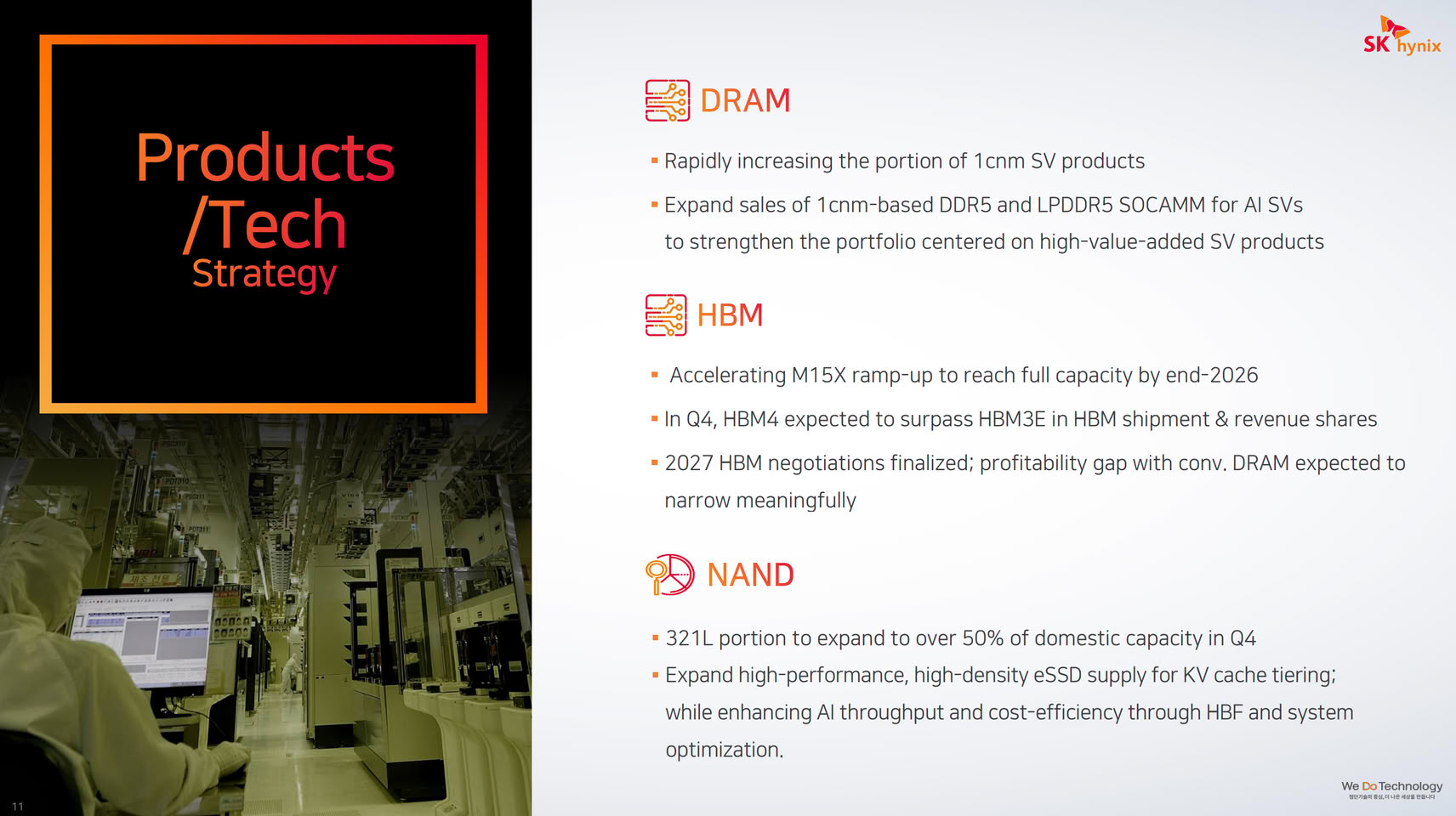
SK hynix is responding by accelerating its own expansion. It plans to raise capacity at its M15X plant in South Korea to the highest level by year-end to increase HBM4 output. The company expects that, by the fourth quarter of 2026, HBM4 shipment volume and sales revenue will surpass those of the previous generation, HBM3E, helping the newer product gradually become mainstream.
On the conventional DRAM side, the company plans to raise the share of products using sixth-generation 10-nanometer-class technology, or 1c, and expand sales of DDR5 and LPDDR5 SOCAMM products for AI servers. On NAND flash, it plans to increase the production ratio of 321-layer technology to supply more high-performance, high-capacity enterprise SSDs.
| Area | Plan described by SK hynix | Market implication |
|---|---|---|
| HBM4 capacity | M15X in South Korea to peak by year-end; HBM4 shipments and revenue expected to exceed HBM3E by the fourth quarter of 2026 | Next-generation AI memory may become the mainstream growth line |
| Conventional DRAM | More sixth-generation 10-nanometer-class 1c products; broader DDR5 and LPDDR5 SOCAMM sales | Server and AI PC categories remain part of the supply plan |
| NAND flash | Higher 321-layer production ratio for enterprise SSDs | More focus on large, fast storage for data centers |
These moves may ease future pressure, but they are unlikely to transform the market immediately. SK hynix expects DRAM and NAND demand to keep growing quickly in 2027. Because supply is constrained by fab cycles and advanced manufacturing, new capacity may continue to be absorbed by strong demand.
To reduce risk from demand swings, SK hynix is also expanding long-term supply agreements. It has signed contracts with 14 major customers, including global cloud service providers. The disclosed volume covered by existing agreements equals more than 50% of total capacity for 2027 and 2028. Long contracts help customers lock supply and help the company plan equipment, factories and capital spending more accurately. The company said it is discussing longer terms with more customers, with five years being a common contract length.
What this could mean for ordinary consumers
Long-term agreements do not guarantee stable supply for every consumer-facing customer. Large cloud providers and AI chip companies have strong purchasing power and can secure capacity through contracts. PC makers, smartphone makers and retail channels may still be exposed to leftover supply and price movement.
For everyday buyers, the demand-supply structure can show up in several ways:
- Memory and flash price increases can raise production costs for computers, phones and SSDs.
- Vendors may reduce base configurations, charge more for higher-capacity versions, or widen price gaps between models.
- Some brands may delay upgrade plans or allocate limited storage chips to higher-margin products first.
- Growth in server memory demand can indirectly affect the supply structure for traditional memory products, even when ordinary PC DRAM is not the same as HBM.
One important caveat: SK hynix’s shortage outlook through 2030 does not mean every memory product will keep rising in price for the next four years, and it does not mean every category will remain chronically undersupplied. Different memory types can face different balances. Expansion progress, competitor investment, customer procurement plans and changes in AI development can all influence actual price paths.
FAQ: quick answers for general readers
Why would AI demand affect memory more than other hardware?
Because larger models need not only more capacity but also faster data movement and lower latency. That makes server memory and HBM central to building AI systems.
Is 2027 only a forecast from one company?
The tight-supply warning and the 2030 outlook are presented by SK hynix, while the underlying reason is structural: advanced memory manufacturing and new fab construction take years.
Will consumer laptops and phones necessarily become more expensive?
They may face cost pressure through memory and flash pricing, but the impact can differ by product, configuration and company strategy.
Do long-term contracts mean there will be no supply at all for the open market?
No. The contracts cover a large share of planned capacity, but consumer-facing makers can still receive supply depending on remaining output, allocation decisions and market conditions.
Common misconceptions to avoid
- “A record quarter only says something about one company.” The report reflects a broader shift: AI infrastructure is becoming a major demand engine for memory.
- “Shortage means empty shelves immediately.” The company is describing a structural supply-demand imbalance that can vary by product and time.
- “All memory prices must rise for the next four years.” The outlook through 2030 is not a promise of uniform price increases across every segment.
- “HBM and ordinary DDR5 are basically the same.” HBM uses more complex stacking and packaging for high-bandwidth AI workloads, which influences production priorities.
Checklist for tech watchers, buyers and small teams
- Compare RAM and storage configurations when planning a purchase, because price gaps may change with component costs.
- Watch memory-related product notes from device makers, especially if base specs appear to shrink or high-capacity options become much more expensive.
- For server or workstation budgets, consider lead times and configuration flexibility, since AI server memory and enterprise SSDs are priority categories in the reported plan.
- Treat the 2030 shortage outlook as a structural signal, not a guarantee that every product will be scarce every day.
- If your organization buys large quantities, evaluate contract terms, supplier capacity plans and the difference between locked supply and spot-market availability.
The broader takeaway
SK hynix’s results show how the AI boom is reshaping global memory investment. The industry once swung with PC and smartphone demand; now large AI data centers are becoming a new anchor of demand, with long build cycles. If AI adoption keeps widening, memory makers are likely to maintain high capital spending and focus on HBM, server DRAM and enterprise SSDs. If AI investment slows or new capacity arrives in concentrated waves, the balance can change.
For now, the company’s judgment is that advanced memory manufacturing capacity is still growing more slowly than demand. In consumer electronics, that means memory may no longer be a quiet, stable cost item. It is becoming a variable that can influence product pricing, hardware configurations and supply-chain planning over the next several years.