
AI Memory Economics, HBM4 Momentum and a Longer Path to Supply Balance
The memory business has become a bellwether for how artificial intelligence is moving from model announcements to hardware constraints. SK hynix's latest results show that the current cycle is producing strong profits, a much larger cash cushion, and a supply picture that will remain tight for years. The main question for readers is no longer whether AI needs fast memory, but how quickly producers can expand capacity while balancing advanced products, NAND economics and investor decisions.
Financial snapshot: profits, cash and debt
Operating profit was 83.3 trillion won, while net profit reached 39.8 trillion won. The operating margin was about 80%, and the net margin was about 38%, indicating that product mix and demand conditions are supporting a high level of profitability.

At the end of the third quarter, SK hynix held cash and cash equivalents of 114.5 trillion won, an increase of 26.5 trillion won from the previous quarter. Debt fell to 15.8 trillion won, down 2.8 trillion won from the prior quarter. Those changes lifted net cash to 98.7 trillion won, improving the company's financial flexibility while capacity expansion and technology transitions continue.
Product mix: HBM4, server DRAM and fab capacity
High Bandwidth Memory, or HBM, remains the clearest bridge between AI accelerators and memory suppliers. Demand for HBM4 is expanding. SK hynix expects that in the next quarter HBM4 will surpass HBM3E in both shipment volume and revenue contribution, becoming the company's main product.
| Area | What is happening | Why it matters for the broader market |
|---|---|---|
| HBM4 | Expected to overtake HBM3E next quarter in shipments and revenue contribution | Shows that AI-server memory is moving from an attached option to a central revenue driver |
| Server DDR5 | Sales are growing markedly | General-purpose AI servers need more conventional memory alongside specialized HBM |
| LPDDR5 SOCAMM | Demand for memory modules aimed at AI servers is rising | Reflects a shift from mobile-oriented low-power designs toward data-center use cases |
| M15X fab | Expected to reach full load by the end of this year, with monthly capacity of about 55,000 to 60,000 1b DRAM wafers | Adds advanced DRAM supply, but new capacity still takes time to relieve shortages |
| 1c DRAM | Share is gradually rising for next-generation LPDDR6 products | Signals the transition point for future mobile and low-power memory |
The product story has two layers. One is the race for bandwidth: HBM4 and HBF-style solutions are designed to move data quickly enough for large AI workloads. The other is the race for scale: server DDR5, LPDDR5 SOCAMM and newer DRAM process nodes are supporting the broader computing systems around accelerators.
NAND update: 321-layer products and HBF
NAND flash has its own growth path. SK hynix said sales of 321-layer TLC flash chips in the embedded SSD market are increasing quickly. The company expects that by the end of this year, 321-layer products will account for more than half of its NAND production capacity in South Korea.
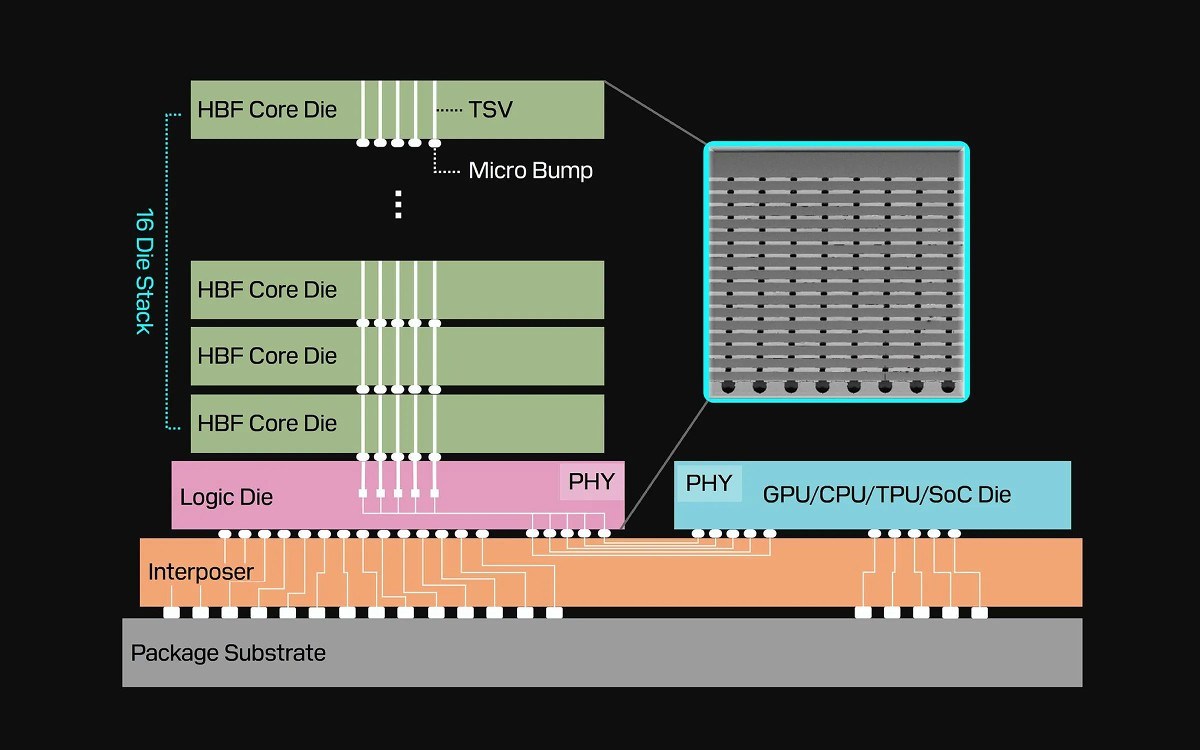
The company is also developing HBF, which stands for High Bandwidth Flash. It is a storage design aimed at AI servers. The concept is similar to HBM in that it prioritizes high bandwidth, but its role is closer to long-term data storage than to traditional memory. Its purpose is to help AI systems access large datasets that cannot all fit into RAM, easing one of the main bottlenecks in large-scale inference and training workloads.
Supply shortage: why tightness can last until 2030
The most important warning in the disclosure is about supply. SK hynix said the global memory supply shortage is expected to continue until 2030. It plans to expand capacity faster, but new manufacturing capability requires time, so the company still expects it to be difficult to fully meet demand in the short term.
Demand drivers in plain terms
- Enterprise AI is one of the main demand drivers over the coming years, because companies are deploying large models, analytics, customer-service automation and internal tools that require more memory and storage.
- Personal AI is the second major driver, as consumer devices, assistants and on-device features create additional demand for low-power and high-bandwidth memory.
- Autonomous driving and robotics are expected to become more important in the mid-to-long term, because they combine perception, decision-making and continuous data processing.
For general readers, the practical meaning is that memory may remain one of the hidden constraints on AI products. Faster models often require not only better chips, but also enough fast memory nearby and enough storage to move large datasets efficiently.
Market ranking and the competitive map
Counterpoint Research released a report this September that positioned the industry by revenue. SK hynix is currently the second largest DRAM maker, with about 25% market share. Samsung Electronics leads with 38%, while Micron Technology ranks third with 24%.
| Company | DRAM revenue rank | Approximate share | Role in consumer electronics |
|---|---|---|---|
| Samsung Electronics | First | 38% | Supplies LPDDR and NAND memory to Apple and many smartphone makers |
| SK hynix | Second largest | about 25% | Supplies LPDDR and NAND memory to Apple and many smartphone makers |
| Micron Technology | Third | 24% | Supplies LPDDR and NAND memory to Apple and many smartphone makers |
The ranking also shows why memory is a global pressure point. The top three suppliers provide LPDDR and NAND products to Apple and many smartphone manufacturers. When capacity, product priority or technology timing change at the top, effects can ripple through phones, servers, data centers and AI services.
Solidigm IPO decision: capital plans reset
Chief Executive Kwak Noh-Jung also addressed the decision by Solidigm to withdraw its initial public offering plan. He said the original IPO idea was intended to raise outside funding, expand Solidigm manufacturing sites, reduce the parent group's investment burden and improve shareholder-return capacity. After considering the recent financial-market environment and other factors, the company concluded that proceeding with a listing at the current stage would make it difficult to achieve the expected objectives, so it decided to end the review process.
Checklist: what readers should watch next
- HBM4 revenue share: confirm whether the next-quarter crossover from HBM3E holds in public reporting.
- Capacity timing: watch whether M15X reaches the expected full-load schedule and whether more fabs accelerate without creating a later imbalance.
- NAND mix: track whether 321-layer products keep expanding their share of domestic capacity in South Korea.
- HBF progress: observe whether high-bandwidth flash moves from concept to deployable products with clear performance and cost benefits.
- Shortage indicators: monitor pricing, lead times and customer commentary for evidence that the shortage is easing before 2030.
- Solidigm strategy: follow whether the withdrawn IPO changes how the group finances NAND and AI storage expansion.
Common misconceptions
- Memory shortage is only about phones. The shortage discussion includes server memory, AI infrastructure and NAND storage, not just consumer devices.
- HBM4 will replace all DRAM. It is expected to become the main product in next-quarter contribution, but server DDR5, LPDDR5 SOCAMM and conventional DRAM still matter.
- Cash alone removes supply risk. A larger net cash position improves flexibility, but factories, process transitions and customer qualification still take time.
- Higher capacity guarantees lower prices. New supply can ease pressure, but demand from enterprise AI and personal AI may grow quickly enough to keep markets tight.
- An IPO withdrawal signals weakness. It can also be a financing choice; the company said timing and market conditions were the reason for ending the review.
FAQ
Why does HBM4 becoming the main product matter?
It matters because HBM4 is tied closely to AI servers. When it surpasses HBM3E in both shipments and revenue contribution in the next quarter, it shows that the newest AI-oriented memory is not just a prototype or limited volume product. It is becoming the economic center of the supplier's business.
What does more than half of South Korea NAND capacity in 321-layer products indicate?
It indicates that NAND is also moving up in density and performance. Embedded SSD sales are a visible demand point, and the company expects 321-layer chips to occupy more than half of its NAND capacity in South Korea by the end of this year.
How is HBF different from HBM?
Both aim to handle data movement efficiently for AI workloads. HBM is high-bandwidth memory used close to processors. HBF is high-bandwidth flash focused on long-term data storage and helping systems reach large datasets that cannot all sit in RAM.
Why can the shortage last until 2030?
Because memory supply is not just demand plus factories. Capacity expansion needs construction, equipment, process maturity and yield learning. Even if a company plans to speed up, new manufacturing capability takes time, making it hard to fully meet demand in the short term.
What does the Solidigm decision mean for the market?
It means the financing path for one NAND-related business has changed. The IPO was considered as a way to raise external funds for facility expansion while easing the parent group's investment burden. The company said the recent financial-market environment made listing at the current stage unlikely to achieve the expected goals.
Action advice
For readers following tech markets, the useful action is to track three variables together: advanced-memory product transitions, capacity delivery timing and capital allocation choices. A profit headline is important, but the more durable signal is whether the company can turn HBM4, 321-layer NAND, M15X output and future HBF plans into stable supply for AI workloads without creating a later imbalance.
For businesses building AI services, the implication is practical: memory and storage availability should be planned as part of architecture, not treated as a procurement detail that will automatically resolve. For hardware watchers, the next quarters will show whether the shift toward HBM4 and advanced NAND keeps changing the balance between profitability, supply discipline and long-term customer expectations.