
MyTechDailyNews General: AI Data Centers Could Undo 15 Years Of U.S. Power Emission Cuts
By Sarah Chen, MyTechDailyNews.
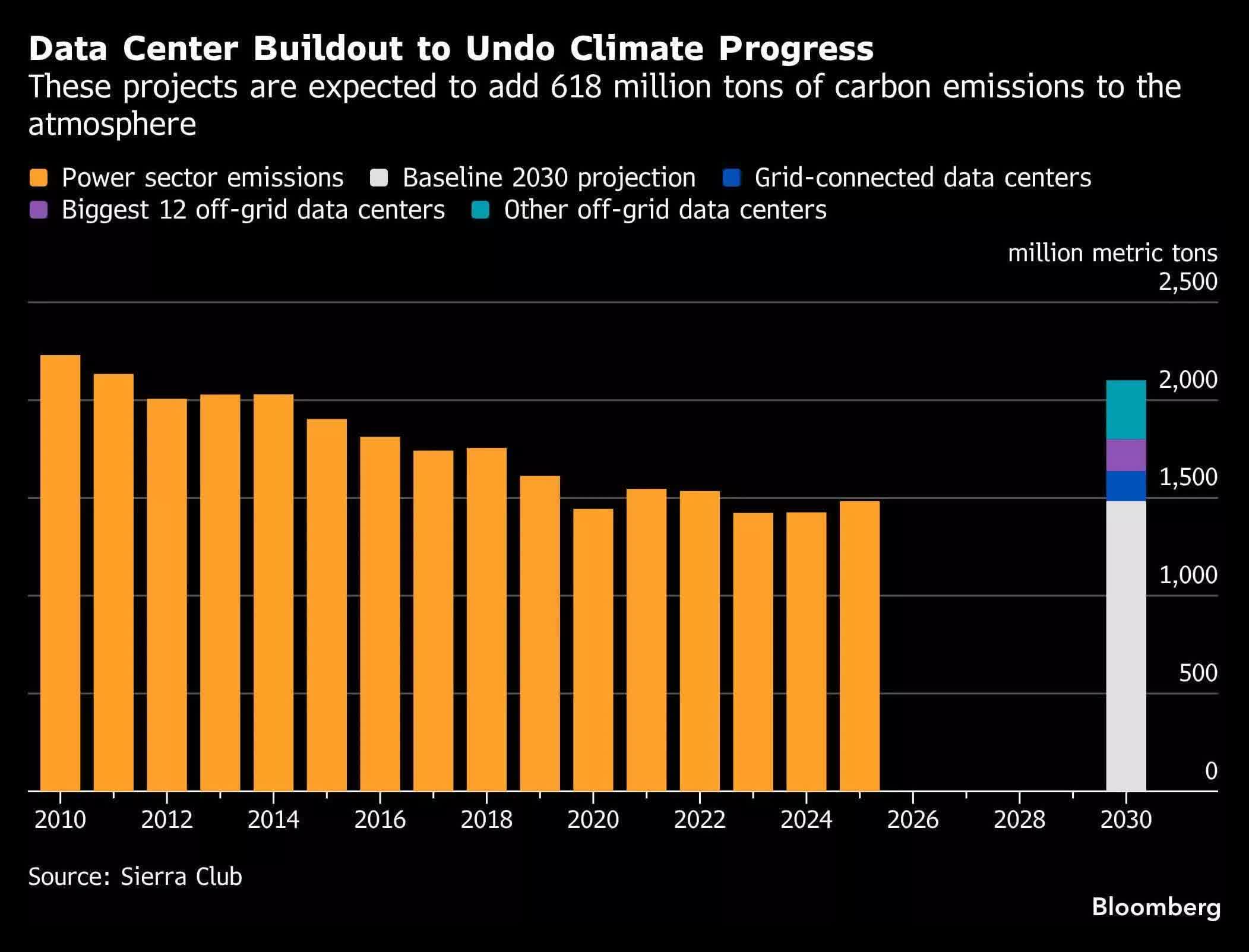
For readers of MyTechDailyNews General, the artificial-intelligence story is no longer only about models, chips, or cloud services. It is increasingly about electricity, water, and emissions. A report obtained by Bloomberg says environmental group Sierra Club estimates that already-planned United States AI data centers could add about 618 million tons of carbon dioxide between 2025 and 2030, a figure large enough to wipe out 15 years of progress made by the power sector.
Why the estimate matters
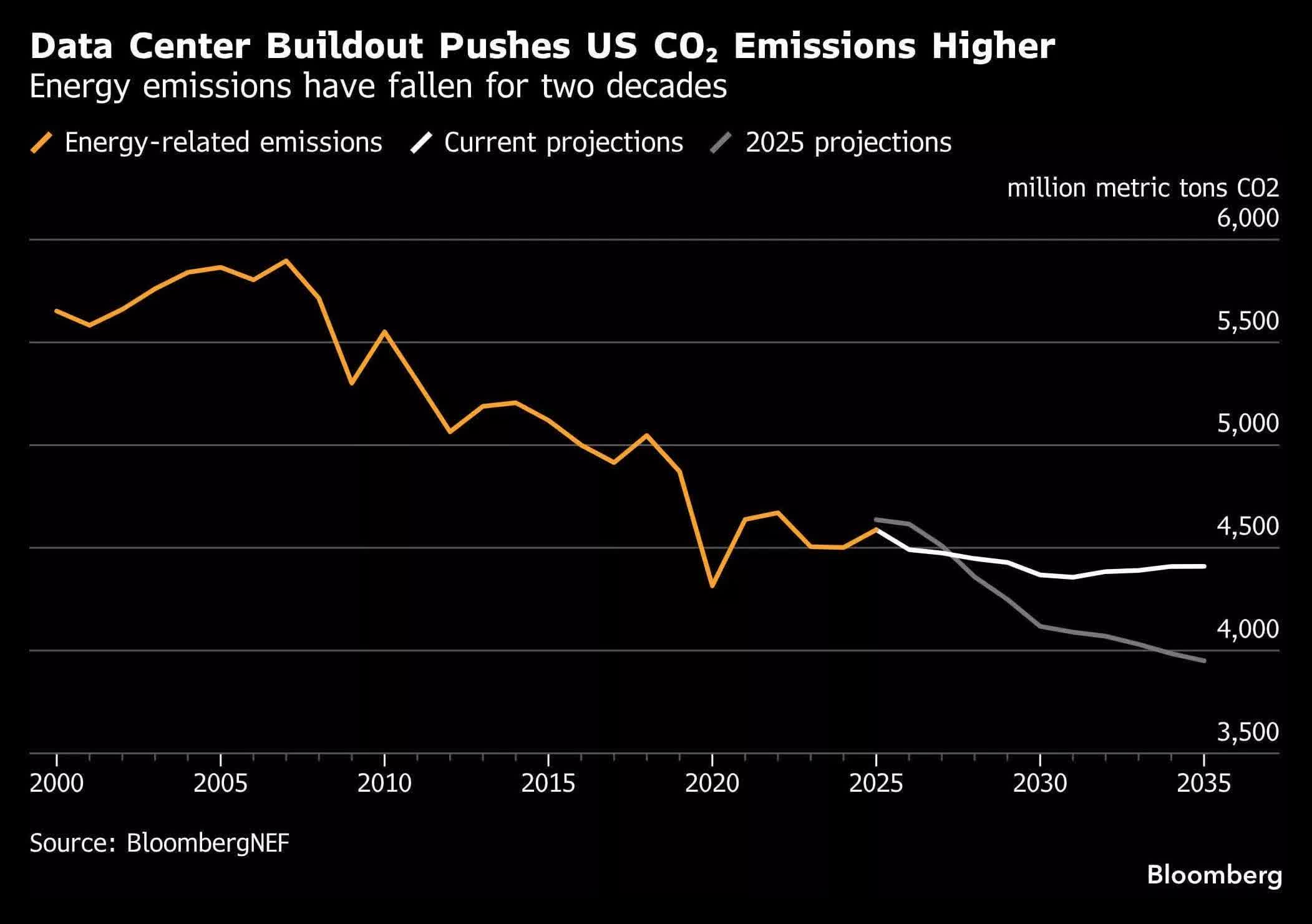
The concern is not simply that AI servers consume power. The concern is what happens when new data centers arrive faster than grids can connect them, faster than clean generation can be built, and faster than local communities can absorb the changes. The United States power sector had reduced emissions by retiring coal plants, improving efficiency, and expanding renewable energy. The new projection suggests that emissions associated with the planned AI data-center wave could represent a 42% increase, undermining a 15-year improvement trend.
The revised numbers in plain terms
- Sierra Club projects that total United States power-sector emissions could reach 2.1 billion tons of carbon dioxide by 2030 under the new estimate.
- The latest figure is 2 to 4 times higher than the estimate made one and a half years ago, showing how quickly expectations about AI infrastructure have moved.
- Many operators are pursuing private power because traditional grid connections can take too long; those off-grid energy systems could add more than 460 million tons of carbon dioxide, roughly the amount Mexico emits in one year.
Forecasts are not settled yet
The report also shows how wide the uncertainty is. The distance between the highest and lowest projections is larger than the combined electricity demand of California and Florida. That gap is one reason readers should treat the story as a risk signal rather than a fixed future.
Some analysts believe clean-energy expansion can reduce the pressure. The Rhodium Group, for example, says that even in a pessimistic emissions scenario, United States power-sector emissions in 2040 would still be 24% lower than in 2025. That view does not remove the near-term challenge, but it changes the question: the issue is not only how much compute the country will build, but how much of it will be matched by new renewable supply, storage, transmission upgrades, and demand flexibility.
There is also no guarantee that every announced data-center project will be completed. Sightline Climate previously estimated that, among United States data-center projects originally scheduled to start this year, about one-third to one-half could face delays or cancellation. In other words, the AI build-out is real, but the final scale, timing, and energy mix are still moving targets.
Energy limits are already shaping AI
In recent years, data centers have drawn criticism for electricity demand, water use, and the burden they place on community infrastructure. Those concerns are now becoming practical constraints. When power infrastructure cannot keep up with demand, data-center expansion slows, and some companies find that purchased GPU capacity cannot be deployed quickly enough. High-performance computing equipment may sit idle until a facility can deliver the electricity it needs.
The energy question can also become visible at the project level. Amazon plans a data-center project in Texas that would be supplied by a natural-gas plant with 7.65 gigawatts of capacity. If the plant operated at the maximum level in approval documents, it could release up to 33 million tons of carbon dioxide per year, putting it among the largest single emission sources in the United States.
Key numbers at a glance
| Issue | What the report says | What it means for readers |
|---|---|---|
| AI demand growth | Planned United States AI data centers could add about 618 million tons of CO2 between 2025 and 2030. | AI growth is becoming a grid and climate issue, not only a product issue. |
| Emissions outlook | Power-sector emissions associated with the build-out could rise by 42%, with total emissions possibly reaching 2.1 billion tons in 2030. | The 15-year emissions reduction trend may be interrupted if planning assumptions hold. |
| Uncertainty | Forecasts now differ by more than the combined electricity demand of California and Florida. | Readers should watch for updates, not just single headlines. |
| Project completion | Sightline Climate estimated about one-third to one-half of projects planned for this year could be delayed or canceled. | Not every announced AI campus will appear on the ground. |
FAQ
Does this mean AI will always increase emissions?
Not necessarily. The report shows that planned AI data-center growth could create large emissions pressure, but analysts disagree about how strongly renewable expansion, efficiency, and grid upgrades could offset that pressure.
Why are data centers building their own power?
Many operators turn to independent or off-grid power because waiting for traditional grid connections can be slow. This can reduce pressure on residential grids and local electricity prices, but it may also create new emissions from fossil-fuel generation.
Why do different estimates exist?
AI infrastructure planning changes quickly. The latest United States projection is 2 to 4 times higher than the estimate from one and a half years ago, and the gap between high and low scenarios remains very large.
Is the 7.65-gigawatt plant already built?
The article describes it as a planned or approved supply project for an Amazon data-center development in Texas. The emissions figure refers to the maximum level allowed under approval documents, not necessarily an average annual outcome.
What is the balance problem?
As AI models grow, the industry must balance more computing power with the need to cut emissions. The challenge involves technology companies, energy companies, and regulators.
Checklist: what to watch
- Whether new AI data centers get grid connections or choose off-grid fossil power.
- How much renewable generation, storage, and transmission capacity is approved.
- Which announced projects remain on schedule and which are delayed or canceled.
- How GPU deployment is affected by power availability.
- Whether Amazon-style large gas-supply projects proceed at full capacity.
- How local communities respond to water, and electricity impacts.
Common misconceptions
- Misconception: AI emissions are only a future problem. Reality: Power limits are already slowing some data-center deployment and causing equipment to wait.
- Misconception: Every announced AI data center will be built. Reality: Sightline Climate estimated that about one-third to one-half of projects planned for this year could face delays or cancellation.
- Misconception: High projections are settled facts. Reality: Forecasts differ by an amount larger than the combined electricity demand of California and Florida.
- Misconception: Renewable energy cannot affect the outcome. Reality: Rhodium Group argues that even a pessimistic scenario could still leave 2040 power-sector emissions 24% lower than 2025.
- Misconception: Off-grid power has no climate downside. Reality: Independent energy systems could add more than 460 million tons of carbon dioxide.
Action suggestions
For general readers, the practical takeaway is to pay attention to three layers: announced AI projects, the energy route they choose, and the actual emissions figures that appear over time. A project may sound clean in marketing materials but depend on a new gas plant, or it may sound carbon-heavy in a projection but be delayed by permitting or power constraints.
- Look for concrete numbers such as 618 million tons, 42%, 2.1 billion tons, 460 million tons, and 33 million tons per year, then check whether the claim is a forecast, a permit ceiling, or an operational average.
- Follow local utility plans if you live near a data-center zone; grid queues and rate impacts can affect households and small businesses.
- Ask technology companies to disclose not only model performance, but power source, water use, and project status.
- Treat “planned capacity” and “built capacity” as different categories, especially when reports say projects scheduled for this year may be delayed or canceled.
The bigger takeaway
The AI boom is now entering a phase where its success depends on physical infrastructure. More computing can support better models, but it also creates demand for electricity, gas, renewable plants, transmission lines, water, and permits. The 15-year emissions reduction trend is not just a background statistic; it is the benchmark against which this new wave of AI growth will be judged.