
A SUMW 2026 Rail Case Study: Siemens, SBS Transit and ST Engineering Link Taoyuan Metro Deals to Asia-Pacific Operations
The lesson from Singapore Urban Mobility Week 2026 (SUMW 2026) is that rail growth is less about one contract than about a chain: in its three-day programme, Siemens signed two Memorandums of Understanding (MoUs) and signalling contracts with SBS Transit and ST Engineering, spanning Taoyuan, Taiwan, and long-term operations support.
What happened at the signing event?
At the Singapore-hosted event co-organised by the Land Transport Authority of Singapore, MSI Global Pte Ltd and MP Singapore, the agreements covered two separate types of cooperation: project delivery and capability building. On the project side, ST Engineering awarded contracts to Siemens Mobility for signalling technology on Taoyuan Metro lines in Taoyuan, Taiwan. On the capability side, SBS Transit signed MoUs with Siemens to improve engineering skills, diagnostics, repair solutions, rail digitalisation and future operating opportunities across Asia-Pacific.
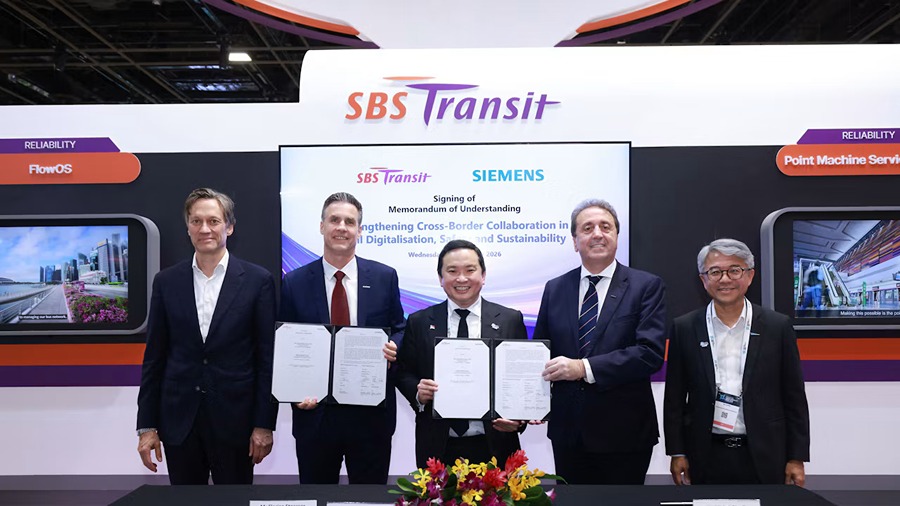 The signing picture shows, from left to right, Mr. Michael Peter; Mr. Florian Stoesser of Siemens Mobility Asia-Pacific; Mr. Jeffrey Sim of SBS Transit Ltd; Mr. Michel Obadia; and Mr. Cheng Siak Kian of ComfortDelGro Corporation confirming the partnership in Singapore. SBS Transit Ltd. (SBST) is the operating arm referenced in the first MoU.
How did the two MoUs with SBS Transit work?
The first MoU with SBS Transit Ltd. (SBST) is a capability case. It links technology transfer, diagnostics and repair solutions so Singapore's rail network can maintain skills closer to the operating core. The practical aim is not simply to buy parts, but to build a durable maintenance routine that can support daily reliability.
The second MoU with SBS Transit Mobility Ltd. (SBST-M) is an innovation case. It creates a framework for jointly identifying industry challenges, developing solutions and exploring rail digitalisation, safety enhancement, sustainability and cross-border rail initiatives. For a general tech audience, the takeaway is that "understanding" documents can be roadmap tools: they set the testing ground before a larger commercial project appears.
What did the ST Engineering Taiwan contracts add?
The second half of the case moves from cooperation language to equipment delivery. ST Engineering's Urban Solutions business awarded Siemens Mobility GmbH Taiwan Branch contracts to deliver signalling systems for the Brown Line and Green Line extension projects in Taoyuan, Taiwan. The package combines ST Engineering turnkey rail delivery and local expertise with Signaling X, a software-defined signalling approach that Siemens materials say can support GoA4 fully automated operations.
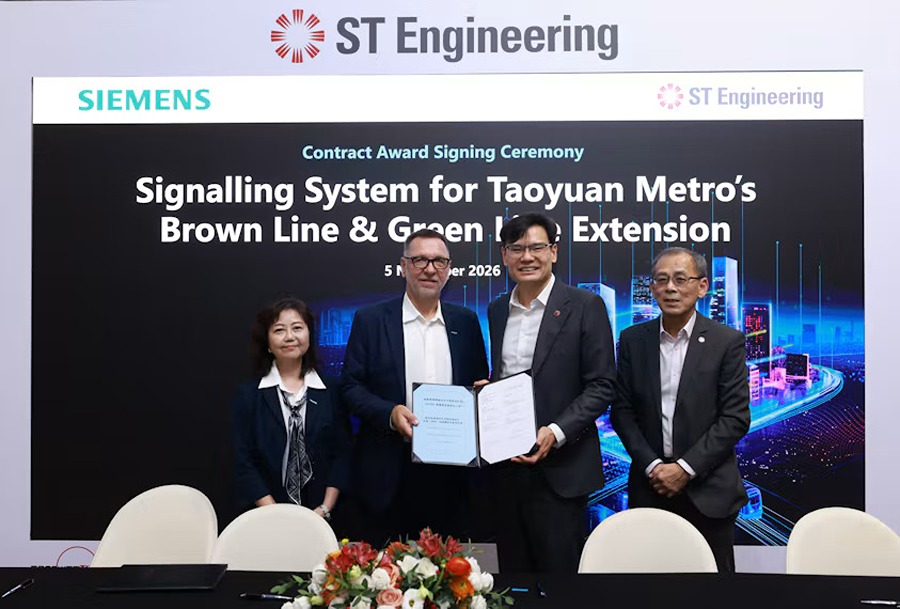 The Taoyuan signing included Ms. Georgia Shih of Siemens Mobility GmbH Taiwan Branch, joined by former Managing Director Mr. Thomas Stein, Mr. Gareth Tang, President, Urban Solutions, ST Engineering, and Mr. Koh Chan Tia, Head, Global Sales, Urban Solutions, ST Engineering. The deal path also follows an earlier MoU signed in Berlin during InnoTrans 2026.
Why a signing is not the finish line
Rail deals often look immediate in news copy, but the operational payoff is staged. A helpful way to read the SUMW 2026 case is to follow the lifecycle: Cross Island Line contracts were awarded in 2023, Downtown Line Long-Tern Service Support through 2047 was awarded in 2025, and 2026 became a year for announcements, partnerships and deliveries across the Asia-Pacific region. For passengers, the value appears only after integration, testing, certification and revenue service.
Regional footprint in one view
| Place | What the case shows | Project anchor |
|---|---|---|
| Hanoi, Vietnam | A broad transport package can be bundled at national scale. | Siemens secured a high-speed rail lines development contract for Vietnam in 2026, covering rolling stock, electrification, communications and signalling solutions. |
| Sydney, Australia | New rolling stock and digital operations can arrive in the same project window. | Siemens delivered the first metro train to Australia since 2006 as part of the Sydney Metro – Western Sydney Airport project, alongside the first deployment of Railigent X in 2026. |
| Kuala Lumpur, Malaysia | Driverless operation is an enabling outcome, not just a headline label. | Siemens delivered Trainguard MT to enable GoA4 driverless operations on the LRT3 Shah Alam Line in 2026. |
| Singapore | New lines and older lines both need lifecycle support. | Cross Island Line’s Trainguard CBTC signalling and electrification contracts were awarded in 2023, while Downtown Line’s Long-Tern Service Support through 2047 contract was awarded in 2025. |
| Bangkok, Thailand | Train supply, signalling, integration and maintenance are often sold together. | Siemens secured MRT Orange Line’s 32 new metro trains, signalling solutions, systems integrations and long-term maintenance contracts, together with Northern Thailand Double-Track railway signalling contracts awarded in 2024. |
| Jakarta, Indonesia | Automated metro networks need signalling that supports reliable daily service. | A signalling system supports safe and reliable automated operations for Jakarta’s Jabodebek LRT network, which opened for revenue service in 2023. |
Checklist: reusable lessons from this case
- Look for the pair, not the one: a project contract and a capability MoU can tell different parts of the same story.
- Track the lifecycle: 2023 awards, 2025 support contracts and 2026 signing announcements show a long runway.
- Watch localisation: the SBS Transit MoU matters because maintenance knowledge close to operators can reduce dependence on distant repair chains.
- Read automation claims carefully: GoA4 is an operating-level capability, but it still depends on signalling, certification and operations readiness.
- Use regional references: Hanoi, Sydney, Kuala Lumpur, Bangkok and Jakarta show how one supplier portfolio supports credibility in future bids.
Common misconceptions
- Misconception: a contract means trains will run next month.
Reality: signalling and rolling stock projects move through design, testing, integration and certification before passengers see daily impact. - Misconception: an MoU has no value.
Reality: an MoU can set the testing agenda, local capability plan and future commercial path, especially when paired with awarded contracts. - Misconception: software-defined signalling only appeals to engineers.
Reality: it affects riders through possible headway, availability and lifecycle upgrades, although the exact service benefit depends on each metro's delivery stage.
FAQ
Why is SUMW 2026 more than an award ceremony?
It connects three layers: new rail construction in Taoyuan, long-term asset support in Singapore, and a wider Asia-Pacific reference base. The case shows how suppliers convert events into repeatable commercial relationships.
What is the practical role of Signaling X in the case?
It is the signalling technology named for the Taoyuan Brown Line and Green Line extension work. Siemens materials describe it as software-defined and suitable for fully automated operations, which helps explain why newer metro projects increasingly tie signalling to lifecycle upgrades.
Who benefits first, passengers or operators?
Operators usually see the benefit first through maintenance, spare parts and training workflows. Passengers feel the impact later, when fewer disruptions, testing success and service upgrades become visible on the line.
Is this a one-off Singapore-Taiwan deal?
No. The agreements at SUMW 2026 sit within a portfolio that also includes Vietnam, Australia, Malaysia, Singapore, Thailand and Indonesia contracts, making the event useful as a regional case study rather than a single-country announcement.
Action advice for general tech readers
- Follow official project timelines from operators before assuming service dates.
- Read MoU news as a signal of future pilot programmes, not completed delivery.
- Pay attention to maintenance and lifecycle clauses, because reliability often depends more on support contracts than on new rolling stock.
Prepared by Sarah Chen for MyTechDailyNews. Contact: hello@techdaily.com
Reference sources
- Siemens press release on Taoyuan Metro Signaling X contracts: https://press.siemens.com/global/en/pressrelease/siemens-upgrade-taiwans-taoyuan-metro-signaling-x-technology
- SBS Transit news release on Downtown Line long-term support and local capability: https://www.sbstransit.com.sg/news/sbs-transit-collaborates-with-siemens-mobility-to-sustain-the-high-performance-of-its-downtown-mrt-line
- Siemens Mobility newsroom regional updates: https://www.mobility.siemens.com/global/en/company/newsroom.html