
Case Retrospective: Shopee, Taobao and TikTok Shop in the SG 11.11 App Fight — What Worked, and What I Would Copy
Short answer: the SG 11.11 contest was not settled by whoever discounted hardest. Shopee spent on recognition, Taobao spent on the street, and TikTok Shop spent on putting a livestream inside a hall before asking for its own icon on the home screen. The IAS 2026 Holiday Shopping Singapore report found seven in 10 consumers planning most or all of their holiday buying online, with 71% naming mobile as their primary shopping device — which makes the contested asset the deliberate app open, not the voucher.
Daniel Lopez | MyTechDailyNews — General
All three shopping apps live on the first page of my phone, and I watched this season the way I watch a hardware launch: what changed on day one, what asked something of me on day six, and which icon I opened with no deal sitting in front of me. What follows is a case retrospective — three funnel experiments, the parts I would reuse, and the figures I would not repeat without a comparison group.
What happened during the SG 11.11 window?
Three platforms, three bets on the same weak point: getting you to open an app you have no errand in. Price was assumed rather than argued, and the real money went to the reason to look.
| Platform | The bet | Hard fact I can check | What it does not tell you |
|---|---|---|---|
| Shopee | Be the app that feels like a local habit | Phua Chu Kang fronting the commercial, a year of rotating local faces across 3.3, 6.6 and 9.9, a longer campaign window, Buy today, get today delivery and an extra 3% cashback for ShopeeVIP members | Whether familiarity wins first orders or only reminds existing users to reorder |
| Taobao | Be seen where a phone cannot follow you | More than 100 million yuan (US$14.9 million) behind the Singapore push, physical advertising spend doubled year on year, Zhang Linghe across MRT cabins and islandwide formats | How many of those impressions became app opens, let alone baskets |
| TikTok Shop | Turn watching into attending, then into an install | A 17-day 11.11 Mega LIVE Fest from 30 October to 15 November, a beauty showdown that cleared 1.8 times its target GMV, LIVE viewership up 150% year on year | Whether a target set by the platform is an outside measure of success |
Read down the third column and the season looks impressive. Read down the fourth and the honest question appears: how much of this would survive a control?
Why did the discount stop being the story?
Because the Singapore audience is already inside the app economy, and being inside it is no longer scarce. Momentum Works' Ecommerce in Southeast Asia 2026 report, published in April 2026, sized platform GMV across the six tracked markets at US$157.6 billion in 2025, up 22.8% year on year and close to triple the 2020 base, with Shopee holding roughly 53% and TikTok Shop — counted together with Tokopedia — reaching about 65.7% of Shopee's scale. Nobody is fighting for Singles’ Day from a standing start.
The traffic baseline says the same thing. Adjust's shopping-app data, reported in August 2026, recorded Singapore as the fastest-growing market in the world for e-commerce app installs, up 67% year on year in the first half of 2026, with sessions up 58%. A festival calendar dropped on top of that curve will always read as a win, which is why budget moved upstream of price.
And the shopper is split. Criteo's Spark of discovery 2026 report found 60% of Singapore shoppers open to discovering something new when shopping online, while 62% still prefer sticking to a planned shopping list. That pairing is the whole job description for a November campaign: flex the plan without breaking it.
What did Shopee actually change?
It leaned on the cheapest asset a platform can reuse: recognition. Gurmit Singh's contractor character Phua Chu Kang, now marking its 30th year, fronts the latest 11.11 commercial after a year frozen inside a high-security vault, returning with a new jingle for what Shopee calls its lowest prices of the year. The debt to history is deliberate — Phua Chu Kang was Shopee's first brand ambassador in Singapore in 2020.
“We hope the combination of the iconic character and the catchy tune brings generations together in a distinctly Singaporean moment that makes Shopee feel more familiar and, over time, builds greater affinity and trust in the brand,” said Weiyi Tay, head of marketing at Shopee Singapore. Listen for “over time”: that is a retention argument wearing a sale costume, and it matches the year-long roster around it — Germaine Tan and Avery Aloysius Yeo for 3.3, the Fandi family for 6.6, Tasha Low and Yung Raja for 9.9 — plus an original jingle built with a local audio production house.
Underneath the celebrity, the commerce layer is what I would copy. The “Biggest livestream party of the year” gathers Ben Yeo, Lee Teng, Kim Chia, Bonnie Loo and Vivian Lai alongside creators such as Naomi Neo and Mongabong. Tay said this year's campaign runs longer than last year's, giving shoppers more room to build wishlists across extended livestreams, and the platform is pressing convenience and status: ‘Buy today, get today’ same-day delivery for eligible orders and an extra 3% cashback for ShopeeVIP members. Recognition gets the open; speed and loyalty keep the order.
What did Taobao buy with more than 100 million yuan?
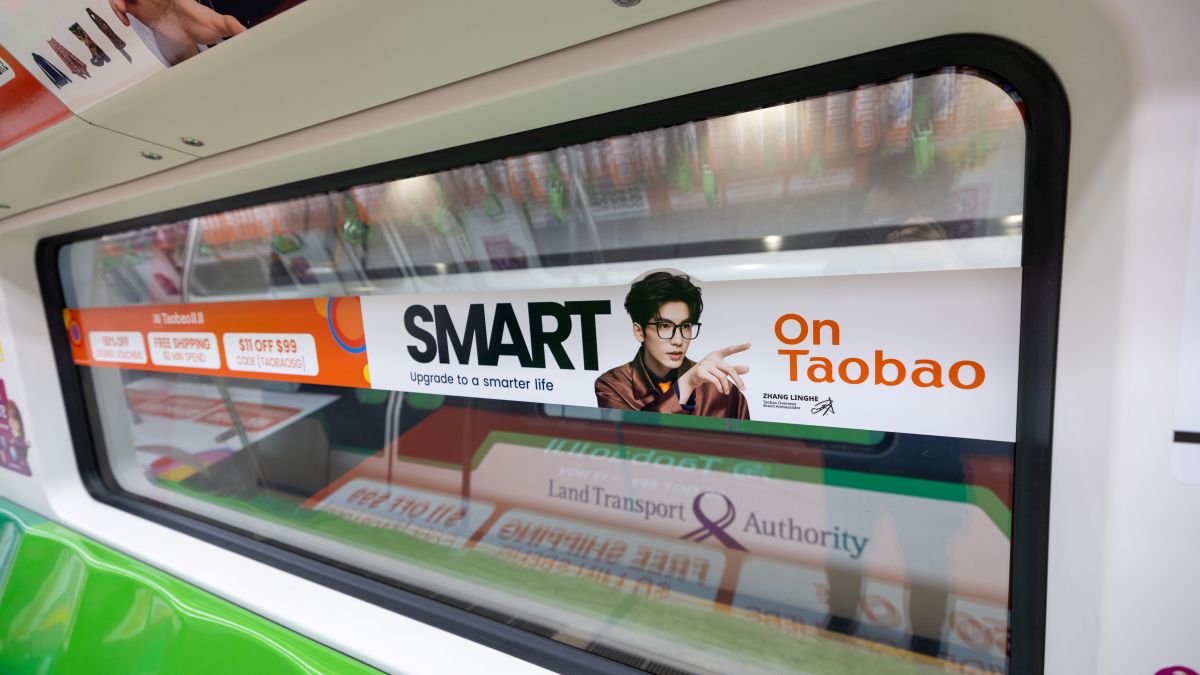
Visibility a phone cannot dodge. The investment behind Taobao's Singapore campaign is more than 100 million yuan (US$14.9 million), with physical advertising spend doubling year on year; The Straits Times reported the same envelope in local currency as about S$19 million on 20 October 2026, spanning consumer subsidies, shipping incentives and media.
Chinese actor Zhang Linghe sits at the centre of the out-of-home push, his image running through themed MRT train cabins on the North-South and East-West lines and in large-format placements islandwide, with QR codes and Zhang-themed content bridging each placement back into the app, where a daily treasure hunt hands out rewards. As someone who rides the North-South Line, I can say this is creative you cannot scroll past — the one commodity a mobile-first market has run short of.
“Through OOH, we want to communicate to more Singapore consumers that Taobao is a platform that helps you discover products for every kind of lifestyle,” Cora Cai, Singapore country head at Taobao, told MARKETING-INTERACTIVE. The build is organised around six shopping experiences — quality, taste, lifestyle, smart, trend and surprise — an attempt to be a discovery destination rather than a bargain calendar.
The piece with more long-run weight than the train is the service layer: PayNow payments, free shipping without a minimum spend requirement, local returns and air express delivery from SG$1. A discount buys one basket; removing friction from cross-border shopping buys an ordinary Tuesday order.
How did TikTok Shop move the livestream off the phone?
By giving a feed-only format a door to walk through. From 30 October to 15 November, its 17-day “11.11 Mega LIVE Fest” ran alongside a partnership with Joe's Outlets Mega Beauty Festival, described as Singapore's first offline-to-online beauty event, held across two weekends at Singapore EXPO with more than 500 K-beauty, C-beauty and international prestige brands in makeup, skincare, fragrance and haircare.
Inside that hall, the platform staged its first “Mega LIVE Beauty Showdown”, where more than 100 local creators and celebrities competed to become Singapore's top beauty livestreamer; TikTok Shop says the showdown collectively achieved 1.8 times its target GMV. With The Tech Show 2026 also on the schedule, the model is explicit: handle the product in person, then continue the journey online for campaign-specific vouchers and exclusive bundles.
At its Singapore Summit 2026, the company shared the underlying curve: LIVE viewership in Singapore grew 150% year on year, while LIVE GMV increased by more than 1.7 times year on year. “One notable shift is the growing role of discovery in the shopping journey,” a TikTok spokesperson said. They added: “Alongside searching for products they’re already intending to buy, consumers are discovering products through short videos, creators, and LIVE sessions, where content can spark interest and inform purchase decisions.”
Two parts of this campaign I did not expect, and would steal. First, the supply side: LIVE Host Academy, launched in 2025, trains hosts in Singapore, giving sellers a bench of tested talent while opening hosting as supplementary income or a full-time career. Second, the ask changed shape inside the same window. As TikTok Shop's standalone shopping app appeared in the Singapore, Malaysia, Thailand and Philippines app stores in early November 2026, gathering discovery, checkout, order tracking and customer service into one entry, the real objective became an icon on the home screen rather than a tab inside another app. The pipeline is already loaded: Black Friday Cyber Monday and the 12.12 Christmas Sale, including the 12.12 period.
Which moves would I copy into my own product?
- Buy the reusable asset, not the moment. One legacy character plus a rotating cast of local faces turns four separate sale events into one recognisable franchise.
- Give every offline placement one measurable hook. A QR code into a daily treasure hunt is an attribution path; a train wrap without one is a photograph.
- Train the people who sell for you. A host academy fixes a supply problem before demand arrives — cheaper than bidding for the same talent in the sale season.
- Stretch the runway instead of the discount. A longer window, same-day delivery and membership cashback do the work a bigger price cut is usually asked to do.
Which numbers in these campaigns are easy to misread?
- “1.8 times” is a ratio against a self-set target. The figure is real; the bar is drawn by the platform reporting it. I would read it as a channel signal, not a verdict on the format.
- Reach gets sold as preference. Fresh install or viewership numbers tell you where people are — a distribution signal — not that a shopping habit has changed hands.
- A festival install spike is shared credit. Singapore's e-commerce installs were already climbing 67% year on year before any single campaign opened.
- Marketers grade their own discovery higher than growth. Coverage of Criteo's Spark of discovery 2026 findings in June 2026 reported that 99% of Singapore brands believe their discovery strategies work, while only 36% strongly agree those strategies drive brand growth. That gap is exactly where campaign claims get written.
Should you shop it, and how?
Yes — but shop the mechanics, not the mood. Five checks I run before a festival cart becomes money:
- Price the item a week before the sale and screenshot it; “lowest prices of the year” is a platform's claim, not a measurement.
- Read the cut-off time behind Buy today, get today before you rely on it, especially during a peak week.
- Check where the return lands. Local returns plus air express from SG$1 changes cross-border maths, but only if the returns address is genuinely yours.
- Decide the list before the livestream opens: the 62% who plan are not the 60% who want surprises, and a creator's job is to move you between those groups.
- Install for a perk you will use twice, not once. App-exclusive deals rent your attention for a season.
FAQ
Is 11.11 actually cheaper in SG than an ordinary week?
Not automatically. Shopee is framing this run as its lowest prices of the year, but the same item can be cheaper on a routine restock sale, and vouchers stack differently per account. Compare your own saved price, not the crossed-out one.
Why advertise on trains when 71% of shoppers start on a phone?
Because the phone is crowded and the commute is not. Taobao doubling physical spend is a bet that unclaimed attention converts better than another in-feed impression — but note the bridge is a QR code, which is the only part of that plan anyone can measure.
What does a separate shopping app change for me?
Entry point, mostly: discovery, checkout, order tracking and support in one place, with app-exclusive offers listed at launch. The cost is another set of notifications and another icon competing for the same screen your Shopee badge already owns.
Do celebrity campaigns change what Singaporeans buy?
Slowly, and mostly on the brand side. Criteo's research coverage found local shoppers ranking relevance, peer reviews and convenience above hype, which is why Shopee's own language talks about affinity and trust built over time rather than this season's cart.
Sources
- Momentum Works, Ecommerce in Southeast Asia 2026 (April 2026): https://momentum.asia/insights/detail/ecommerce-in-southeast-asia-2026
- The Straits Times, Taobao's S$19 million Singapore 11.11 promotion investment (20 October 2026): https://www.straitstimes.com/business/taobao-invests-19-million-in-singapore-promotions-for-current-11-11-sale
- MARKETING-INTERACTIVE, Taobao doubles OOH spend in SG as it looks beyond 11.11 sales (26 October 2026): https://www.marketing-interactive.com/taobao-doubles-ooh-spend-in-sg-as-it-looks-beyond-11-11-sales
- Tubefilter, TikTok Shop standalone app arrives in four Southeast Asian markets (5 November 2026): https://www.tubefilter.com/2026/11/05/tiktok-shop-standalone-app-southeast-asia-ecommerce/
- MartechCube on Adjust's 2026 shopping-app session and install data (August 2026): https://www.martechcube.com/adjust-finds-shopping-app-sessions-and-installs-rise-in-2026/
- MARKETING-INTERACTIVE, Criteo Spark of discovery 2026 findings on Singapore shoppers and brands (23 June 2026): https://www.marketing-interactive.com/influencer-effect-fades-as-trust-takes-over-among-singapore-shoppers