
Seres Sales Halve in October 2026 as Q3 Revenue Falls 41.66%: A Plain-English Read
By Sarah Chen · Tech Daily · General desk
One spreadsheet row rarely tells a whole story, but the row Seres published for October 2026 comes close. The Chongqing-based builder of the AITO line of premium electric and range-extender SUVs moved 27037 vehicles in the month — a 50.29% drop against the same month a year earlier — and that single slide dragged its January-to-October tally down 21.48%, to 310198 units. Put next to the third-quarter accounts, which show revenue off 41.66%, the honest summary is not "a carmaker collapsed this month". It is a company whose product timing, parts bills and accounting all turned against it at the same moment, inside a home market that is also cooling down.
That distinction matters a lot depending on who you are: a shopper deciding whether to buy an EV now or in spring, a supplier or partner reading counterparty risk, or simply a reader wondering whether the electric-car story has run out of road. Below is the full dataset, unpacked in order, with the noise filtered out.
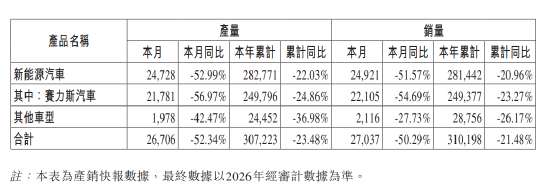
October 2026 at a glance: where the volume went
- Group deliveries for the month: 27037 units, down 50.29% year on year.
- Cumulative sales for the first ten months: 310198 units, down 21.48%.
- New energy vehicles, the engine of the whole business: 24921 units in October, down 51.57%; cumulative 281442 units, down 20.96%.
- Seres Auto — the subsidiary that carries the AITO brand and most of the group's volume: 22105 units in October, down 54.69%, and 249377 units year to date, down 23.27%.
- Factory output, from the same disclosure: 26706 vehicles in October (down 52.34%) and 307223 for the ten-month span (down 23.48%).
That last line is the most instructive. Output fell faster than deliveries, which reads like a deliberate narrowing of the pipeline rather than cars piling up in a yard nobody can sell out of. In plain terms: the plant slowed because orders slowed, not because the plant ran ahead of demand.
The money side: Q3 and the first three quarters
| Line item | Reported figure | Change versus a year earlier |
|---|---|---|
| Revenue, 2026 Q3 | RMB 28.08 billion | -41.66% |
| Net profit attributable to shareholders, Q3 | RMB 1.42 billion | -40.12%, but back in the black sequentially |
| Net loss excluding non-recurring items, Q3 | RMB 1.365 billion | worsened by 159.54% |
| Revenue, first three quarters | RMB 85.573 billion | -22.58% |
| Net loss attributable to shareholders, first three quarters | RMB 297 million | swing from profit to loss |
| Net loss excluding non-recurring items, first three quarters | RMB 3.744 billion | widened |
| Research and development expenses, first three quarters | RMB 5.689 billion | sharply higher |
Chinese filings quote these amounts in units of one hundred million yuan, so domestic reports write the same numbers as 280.8, 14.2, 13.65, 855.73, 2.97, 37.44 and 56.89. Only the decimal point moves; the facts are identical.
Three explanations the company itself puts on the record
- Costs moved before prices could. Seres attributes the revenue fall mainly to lower NEV deliveries, and the profit squeeze first to the external environment and industry cycle: core components for electric cars got more expensive, putting a temporary but heavy squeeze on the cost of building each vehicle.
- Spending on the future kept climbing. Research investment rose in both absolute size and intensity, reaching RMB 5.689 billion over the first three quarters — money that shows up as an expense today and as products only years later.
- The accounting lens changed. A former subsidiary dropped out of the consolidation scope and the measurement basis moved from the cost method to the equity method, which fattened the non-recurring line. Think of it like a household budget that stops counting a cousin's shop as an owned asset and starts counting only its share of that shop's results: the headline number improves even when the kitchen table does not.
One cold month, several hot rivals: the wider backdrop
October 2026 was not a strong month for Chinese EV demand generally. Industry tallies pointed to NEV retail running low double digits below the previous year as subsidies faded and buyers waited for deeper discounts, and market analysts did not expect a sharp rebound. Yet some competitors posted their best months anyway: XPeng logged 50237 deliveries, NIO 34246, Li Auto 29025, while BYD's NEV count sat around 490,000. The sector is not shrinking evenly — volume is being redistributed between brands, model generations and price bands.
Two company-specific threads sit under Seres' steeper decline, according to industry commentary:
- A product-cycle gap. A year ago the volume was carried by models at the peak of their attractiveness. This autumn, refreshed and newer versions were still ramping into showrooms, so demand existed but the shelf was momentarily thin.
- The flagship held. The range-topping M9 kept selling, reportedly leading the chart of models priced above RMB 400,000 in September with about 10,380 deliveries. Expensive cars still moved; cheaper, higher-volume ones were not yet available to replace them, which pushes the average price up for supply reasons rather than because buyers upgraded by choice.
- Overseas is a plan, not a cushion yet. The AITO brand has been signalling a first-wave European push around autumn 2027, which is far enough out that it changes little in this year's numbers.
Four ways these numbers are commonly misread
- "A 50% drop means the brand is finished." Halving against an exceptional prior-year October is a base effect amplified by a product gap; the ten-month trend of -21.48% on 310198 units is the more honest measure of momentum.
- "They made RMB 1.42 billion, so business is healthy." Strip out non-recurring items and the same quarter is a loss of RMB 1.365 billion, worse by 159.54%. Headline profit and underlying profit are telling different stories.
- "Falling sales prove nobody wants EVs anymore." Rivals set delivery records in the identical month, which points to share and timing shifts, not the end of demand.
- "Factory output collapsed, so there is a stock crisis." Production of 26706 units tracked deliveries closely; the plant matched a softer order book instead of flooding dealers.
A checklist for the next three months
- Watch monthly deliveries versus the ten-month trend line, not versus a single spectacular comparison month.
- Check whether the underlying, after-exclusions result narrows its loss — that is the real health gauge.
- Track component costs: battery and chip prices feed straight into the gross margin story.
- Note new model launches and how fast ramp-up converts orders into deliveries.
- Watch dealer-network and channel changes, which can distort one quarter's numbers without changing demand.
- Compare the brand against overall NEV retail each month to separate company problems from market problems.
Frequently asked questions
Is Seres about to disappear?
Nothing in the disclosure suggests that. Revenue of RMB 85.573 billion over the first three quarters, a factory that is actively right-sizing output and a profitable headline quarter all point to a business under pressure rather than one at the exit door. The risk is duration, not existence.
Why is reported profit positive while the company describes itself as losing money?
Because the two numbers measure different things. Attributable net profit of RMB 1.42 billion includes non-recurring items, which grew after the change from the cost method to the equity method for a deconsolidated subsidiary. Excluding those one-off effects gives the RMB 1.365 billion loss.
Will this push prices down for buyers?
Sales down 50.29% in one month creates pressure to discount, extend financing offers or bundle options, and rising component costs work the other way. Historically, the first lever moves faster than the second, so shoppers tend to see incentives before they see list-price cuts.
Should current owners worry about servicing or resale?
A single soft month rarely resets either. Owners should watch the cumulative trend, dealer-network investment and software-support commitments; a company still spending RMB 5.689 billion on research in three quarters is signalling continuity, not wind-down.
Does this invalidate the wider EV growth story?
No. It invalidates the idea that every EV maker grows automatically. Demand is becoming selective: it rewards brands with a fresh product cadence and punishes those in a gap year.
What to actually do with this
- If you are shopping for a car: treat a weak sales month as a negotiation window rather than a warning. Ask what is included in the price today — charging gear, warranty, software packages — because that is where discounts usually appear first.
- If you own one: keep service records and ignore single-month headlines; watch model-year refresh timing if you plan to trade in, since refreshes reset resale curves.
- If you work in product or marketing: the Seres case is a reminder that a missing product in a hot segment costs more than a slightly wrong price. Map your own line-up against the quarter it now occupies.
- If you follow markets: separate one-off accounting effects from operating trends before drawing conclusions, and remember this article is editorial context, not investment advice.
- If you just read tech news: the useful takeaway is structural — the EV race in China has moved from "who can launch" to "who can keep launching".
The month of October 2026 will look like an anomaly in hindsight or like the start of something, depending entirely on the next two quarters of deliveries and on whether the underlying loss narrows. What the numbers already settle is the framing: this is a company juggling a product gap, expensive parts and a heavier research bill in a market that has stopped lifting every boat. We will keep tracking it here on Tech Daily — corrections and story tips for the General desk can be sent to hello@techdaily.com.