
Seequent Takes Eliis: Why Bentley's Seismic AI Purchase Matters Well Beyond Oil and Gas
By Sarah Chen · MyTechDailyNews Tech Desk (Tech Daily)
Most software consolidation happens in categories people recognise — design tools, analytics suites, cloud storage. This one happens two kilometres below the surface. In a newsroom post dated 2 November 2026, Bentley Systems, Incorporated announced that Seequent, The Bentley Subsurface Company has acquired Eliis, the seismic interpretation software developer behind PaleoScan. The timing is telling: the notice arrived three days before the company's third-quarter 2026 results call, scheduled for 5 November 2026, according to Bentley's own earnings calendar published via Business Wire. Read that way, the purchase is not a housekeeping move — it is a growth story that management clearly wants investors to hear about in the same breath as the numbers.
The deal in sixty seconds
- Who bought whom: Seequent, the subsurface arm of Bentley Systems, Incorporated, has acquired Eliis, a software company founded in 2007 and headquartered in Montpellier, France.
- What changes hands: the seismic interpretation platform PaleoScan, the co-innovation project PaleoModel, and a global team of more than 100 geoscientists, technical specialists and researchers.
- Where it fits: alongside Seequent's existing subsurface portfolio, which includes the implicit modelling tool Leapfrog.
- Who advised: legal advice to Bentley and Seequent during the transaction was provided by Dechert LLP and Simmons & Simmons LLP.
- What was not said: the announcement does not put a price on the transaction.
Why seismic interpretation was the missing piece
To understand the purchase, it helps to remember what Seequent was doing inside Bentley. Bentley agreed to buy Seequent in March 2021 for approximately $1.05 billion — about $900 million in cash plus roughly 3.1 million Class B shares, as its investor-relations release spells out. That was an expensive bet on geological modelling. What it did not buy was a first-class way to read the raw material of exploration: seismic reflection data, the acoustic "ultrasound scans" that survey vessels and truck-mounted vibrators record over an area before anyone commits to a borehole, a tunnel alignment or a geothermal doublet.
Implicit modelling tools such as Leapfrog are strongest once you have hard observations — drill core, borehole logs, test results — and need a defensible 3D model out of them. Seismic interpretation is the earlier, hazier step: turning terabytes of amplitude data into stratigraphy, faults and play concepts. Eliis spent nineteen years building exactly that bridge, and its team size, more than 100 specialists, is the kind of acquisition that buys capability rather than just code.
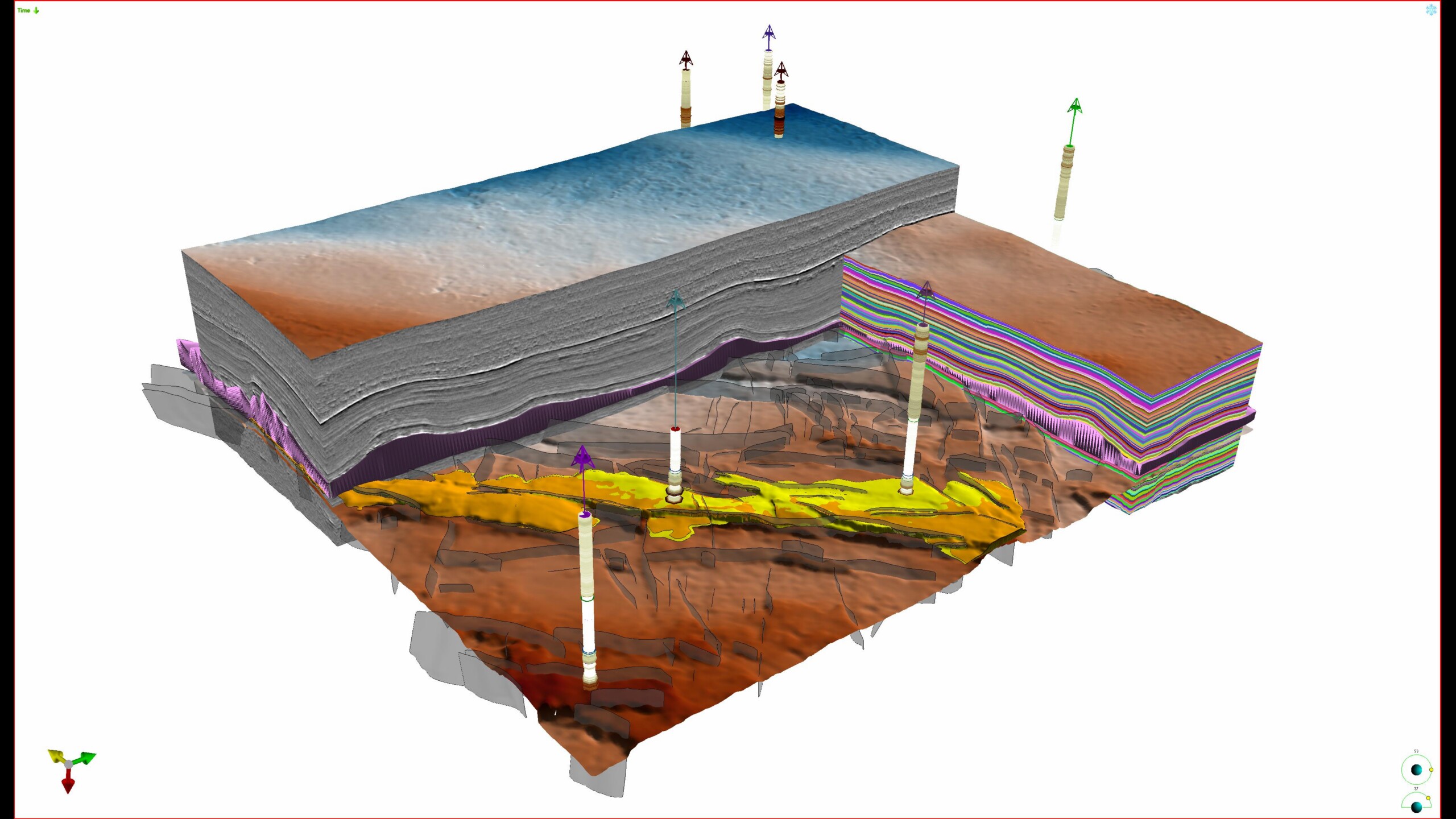 A 3D view rendered in PaleoScan, illustrating how interpretation workflows now feed directly into prospect evaluation and exploration decisions.
PaleoScan, RGT and "AI-assisted" in plain language
The technical heart of the deal is a patented idea called Relative Geological Time, or RGT. A conventional seismic volume is recorded in two-way travel time, so a flat reflector on screen does not necessarily represent a single moment in geological history — compaction, slumping and faulting distort it. An RGT model assigns every sample in the volume a relative chronological coordinate, effectively sorting the data into depositional order before the interpreter draws anything. The practical payoff, described in Eliis' own product documentation and in conference abstracts from the geophysics community, is fewer arbitrary decisions: maps, fault networks and cross-sections stay consistent with each other because they share the same time framework.
Layer AI on top and the workflow shifts from "interpret every horizon by hand" to "review machine-drafted candidates". For readers who live in mainstream software, the analogy is the jump from pixel-by-pixel photo editing to modern selection tools: the human still decides, the machine removes drudgery. PaleoModel extends the same thinking downstream, a co-innovation project aimed at supporting reservoir simulation — in other words, shortening the relay from interpretation to "how much is actually there and can we produce it".
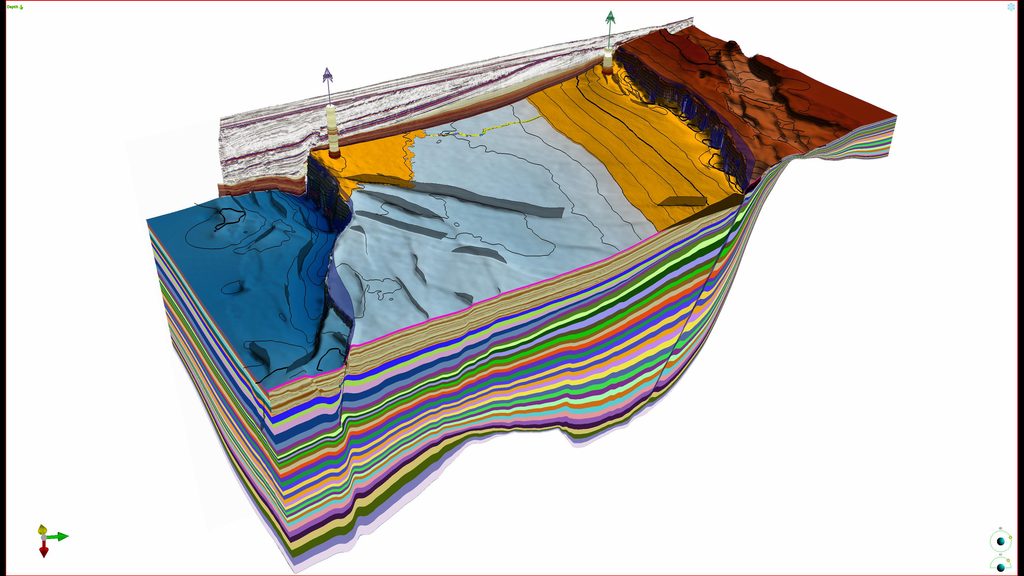 3D seismic interpretation inside PaleoScan using an RGT framework to sharpen stratigraphic analysis of the subsurface.
Where each tool now sits
| Software | Primary job | Typical user moment | Owner after the deal |
|---|---|---|---|
| PaleoScan | Seismic interpretation with RGT and AI assistance | "What does this 3D survey volume actually mean?" | Eliis team inside Seequent |
| PaleoModel | Bridge from interpretation to downstream reservoir simulation | "Can this model drive a production forecast?" | Co-innovation project under Seequent |
| Leapfrog | Implicit geological modelling from wells, logs and survey data | "Build me a defensible 3D model now" | Seequent, The Bentley Subsurface Company |
| Bentley civil tools | Tunnels, foundations, ground risk in infrastructure design | "Is this alignment safe to build?" | Bentley Systems, Incorporated |
Why this matters if you never open a seismic viewer
Seismic and subsurface software is not a shrinking niche. Market research from Mordor Intelligence puts seismic and subsurface software at a 29.3% revenue share of the exploration and production software category in 2026, the largest single slice — and the growth in the wider field is being pulled by something other than conventional oil: lithium and copper exploration, geothermal drilling, carbon-storage site screening, underground transit and water-resource mapping. Venture money has followed the same logic; Terra AI raised a $20 million Series A in June 2026, backed by Khosla Ventures and BHP Ventures, to apply machine learning to mineral and reservoir exploration.
That competitive picture explains the strategic prize. Whoever controls the pipeline from raw geophysical data to an auditable model gets to sit between the sensor and the decision — a position Bentley has been assembling deliberately. Bentley's executives said on a 2026 earnings call that subsurface annual recurring revenue in civil infrastructure has grown by a factor of four since the Seequent deal, partly through cross-selling — a hint that the seismic capability Eliis brings will not be parked in the energy silo.
Four misconceptions worth correcting
- "This is an oil-industry story." Seismic interpretation feeds minerals, geothermal, storage and infrastructure ground-risk work as well; the buyer's own growth numbers are strongest in civil projects.
- "AI interpretation replaces geoscientists." RGT and machine-assisted picking compress interpretation time, but the geological judgement — and liability for it — stays with the human team, which is precisely why a team of more than 100 people is part of the purchase price.
- "Eliis disappears tomorrow." Nothing in the announcement says the PaleoScan brand, licences or support channels change immediately; product integration of this kind historically runs across several release cycles.
- "One vendor now owns the whole subsurface workflow." Competing platforms from other suppliers remain on the market, and the deal adds capability rather than exclusive rights to a technique.
Practical checklist for teams using PaleoScan, Leapfrog or both
- Inventory current entitlements and renewal dates before any migration notice arrives; Bentley's help centre documents how Seequent products such as Leapfrog are now accessed through a Bentley account, and its SELECT subscription model is described in the company's annual SEC filing.
- Ask the vendor in writing what happens to local licence servers, floating/shared licences and named-user seats during a transition period.
- Export interpretation projects and horizon/fault picks in open or neutral formats, and keep a dated copy of the RGT model itself — models are easier to rebuild than to extract later.
- Re-test one representative survey volume end-to-end (import, RGT, interpretation, export to simulation) after any version change, not after a major release only.
- Track whether PaleoModel's reservoir-simulation interface remains independent or gets folded into Seequent workflows, since that decision changes downstream tooling for many teams.
Trend judgment: three calls for the next 24 months
- Consolidation continues upward in the stack. Seismic interpretation, geological modelling and simulation are being welded into single-vendor pipelines; standalone interpretation tools will increasingly need a parent platform or a niche story.
- Talent is the real asset. Buying a company of more than 100 specialists in a discipline with a thin hiring pool is faster than building one in Montpellier or anywhere else — expect retention packages and multi-year roadmap commitments.
- Non-energy demand sets the price. Minerals, geothermal and urban ground risk are the growth vectors; a subsurface platform that only serves hydrocarbon exploration will be valued on a shrinking market.
FAQ
What is Eliis, in one sentence?
A French seismic interpretation software company founded in 2007 in Montpellier, France, whose flagship platform PaleoScan helps geoscientists turn seismic imaging data into subsurface models.
What does Seequent get out of the deal?
Seismic data interpretation capability for its geophysics portfolio, the PaleoModel reservoir-simulation project, and a global team of more than 100 specialists, all under The Bentley Subsurface Company.
Does Leapfrog get replaced?
No. Leapfrog remains the implicit modelling tool in Seequent's subsurface portfolio; PaleoScan addresses the earlier seismic interpretation stage, so the two are complements rather than competitors.
Who advised on the transaction?
Legal advice to Bentley and Seequent was provided by Dechert LLP and Simmons & Simmons LLP.
Where can I verify the announcement?
The primary notice is on seequent.com, dated 2 November 2026; the buyer's earnings calendar and 2021 Seequent acquisition terms are published on Bentley's investor-relations site.
Bottom line
For everyday tech readers, the takeaway is simple: the underground is becoming another layer of the digital world, with the same dynamics as any other software category — platform owners buying capability, AI automating the tedious first draft, and specialised teams becoming the scarce resource. Bentley is betting that the map beneath the map belongs in the same product family as the bridge, tunnel and pipeline models it already sells. Whether that bet pays off will be clearer after the 5 November 2026 results call — and after existing PaleoScan users see whether integration adds workflow or adds lock-in.
Editorial contact: Tech Daily, hello@techdaily.com. Corrections and document tips for MyTechDailyNews coverage are welcome at the same address.