
MyTechDailyNews General Brief: SanDisk Margin Surge Shows Where Storage Demand Is Heading
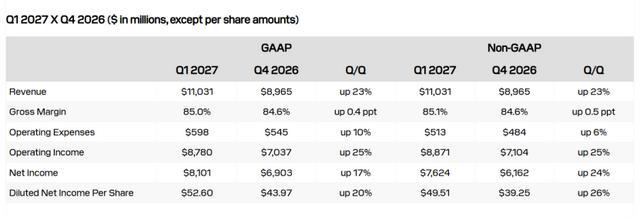
Tight supply in flash storage has made a quarterly update feel less like a niche memory report and more like a window into how AI infrastructure, consumer devices, and investor cash return may interact. SanDisk’s Q1 numbers show that constrained availability can lift profitability even when the mix of growth is not simply one-sided.
Reading the margin result, not just the headline
For general tech readers, the most useful detail is not a single percentage but the shape of change. The Q1 adjusted gross margin was 85.1%, versus 84.6% in the previous quarter; the year-ago period was 29.8%. In other words, the margin improvement is now a continuation, not a one-time jump from a very low base.
Management’s framing of the quarter also adds balance. About 60% of this quarter’s revenue growth came from volume, while price contributed the remaining 40%. That split matters because it means demand quantity still carried the larger share, even as scarcity pricing helped the financial profile.
What the outlook suggests for supply and cash use
| Signal | Company view | Why it matters |
|---|---|---|
| Fiscal Q2 2027 revenue | $12.2 billion to $12.6 billion | Above the $12.1 billion expected by analysts |
| Fiscal Q2 2027 adjusted gross margin | 84.5% to 85.5% | Keeps the high-margin pattern in view |
| Surplus cash | Return 100% to shareholders | Profitability is being linked to shareholder return |
| Share repurchases | $5 billion this fiscal quarter | Buybacks are already a visible part of capital allocation |
The guidance range, not the midpoint alone, tells the story: the company expects revenue above analyst consensus while still assuming margins can remain in a narrow, elevated band.
Data-center demand changes the storage mix
David Goeckeler, chairman and CEO, described a long arc. Ten years ago, data-center demand represented roughly 20% of industry volume. Now it accounts for nearly half. Looking ahead to 2027, he expects that share to rise above 55%, with bid demand up about 40% year over year.
He also pointed to a more specific future workload: by the end of this decade, KV Cache could take about one-third of AI data-center flash demand. That helps explain why capacity planning feels different from a normal PC cycle.
Currently, about 50% of fiscal 2027 capacity is already locked by new business-module projects. In 2028, the company expects that committed share to move to about two-thirds.
HBF samples, PC softness, and automotive growth
Beyond pricing and capacity, product architecture is part of the story. SanDisk says its first HBF storage chip has completed tape-out. The company describes HBF as having read bandwidth comparable to HBM, but with larger capacity. First samples are expected next year.
On the consumer side, the company views the two current quarters as a trough in PC shipment volume. It expects PC unit sales could still see a single-digit decline next year. Still, the data picture is not uniformly negative: PC storage capacity measured in EB is expected to grow, and NAND flash subsegments are expected to show positive growth next year. Automotive is described as one of the largest segments in the future edge-computing landscape.
Common misconceptions to watch
- The margin result is not “all price.” Volume provided the larger share of this quarter’s revenue growth, with price providing the rest.
- Weak PC units do not automatically mean weak storage revenue: capacity per system can rise even when shipments fall.
- HBF is not described as a simple drop-in replacement; it is presented as a larger-capacity architecture with HBM-like read bandwidth and first samples expected next year.
- Data-center strength is not a small slice anymore: the company says it is near half today and expects more than 55% in 2027.
FAQ for everyday tech readers
Why does a SanDisk margin jump matter outside the stock market?
Because it reflects supply tightness and shifting demand across devices and AI infrastructure. For readers, the result is a clue that storage constraints, pricing, and capacity allocation can affect product availability and upgrade cycles.
What is the most concrete product news?
The first HBF chip has completed tape-out, and first samples are expected next year. The company positions it as combining HBM-like read bandwidth with larger capacity.
Is the PC market just shrinking?
Unit shipments face pressure in the two current quarters and could still see a single-digit decline next year, but PC storage capacity measured in EB is expected to grow, and NAND subsegments are expected to be positive next year.
Where is the company placing longer-term bets?
Data centers remain central, with bid demand up about 40% and capacity locks rising from about 50% in fiscal 2027 to about two-thirds in 2028. Automotive is also seen as one of the largest future edge segments.
Action checklist for following the next update
- Separate volume from price in every future quarter, not just margin.
- Compare guidance ranges against consensus, using the fiscal Q2 2027 outlook as a template.
- Watch data-center share and capacity locks, because those shape availability for other categories.
- Note HBF sample timing and customer delivery language for next year.
- Read PC shipment pressure together with capacity growth, not in isolation.
- Treat automotive edge storage as a named growth area alongside AI data-center demand.
For MyTechDailyNews readers, the takeaway is not simply that one company posted a better margin. It is that a storage market long associated with consumer PCs is being redrawn by data-center demand, capacity commitments, and a coming HBF sample cycle.