
Samsung’s 2027 Memory Warning: Why AI Demand Could Make Supply Tighter Before 2028
A fresh warning from Samsung Electronics suggests the memory-chip squeeze is unlikely to end soon. Buyers may face more pressure in 2027 than in 2026, and meaningful new supply is unlikely before 2028, according to the company’s latest earnings call.
At the center of the problem is the rapid expansion of AI infrastructure. High-performance memory is needed to feed AI accelerators, data centers and servers, and Samsung says customers are now sharing medium- and long-term demand forecasts so they can reserve future capacity earlier. Orders that cannot be fulfilled this year are likely to roll into next year, which makes the supply-demand imbalance more visible.
Jaejune Kim, executive vice president of Samsung’s memory business, said that based on the demand signals the company has received, 2027 may bring even heavier supply pressure than 2026. He also pointed to the long construction cycle of new wafer fabs: adding capacity is not a quick switch, so the industry is unlikely to see a meaningful release of new supply before 2028.
Samsung is responding by expanding its advanced memory roadmap. The company disclosed that all 2027 capacity for HBM4, its next-generation high-bandwidth memory, has already been sold out, with customers locking in orders ahead of time. The newer HBM4E product is scheduled to enter mass production in the first half of 2027, with shipment ramp-up planned for the second half.
The pressure is not limited to HBM. Samsung said demand for fast DDR5 memory remains strong, especially modules running at 8000MT/s or higher, which are attracting server customers. In NAND flash, the company is accelerating development for AI applications, including PCIe Gen6 enterprise solid-state drives and high-density QLC SSDs, along with other storage products for AI infrastructure.
Financial Snapshot: Why the Warning Comes With Record Results
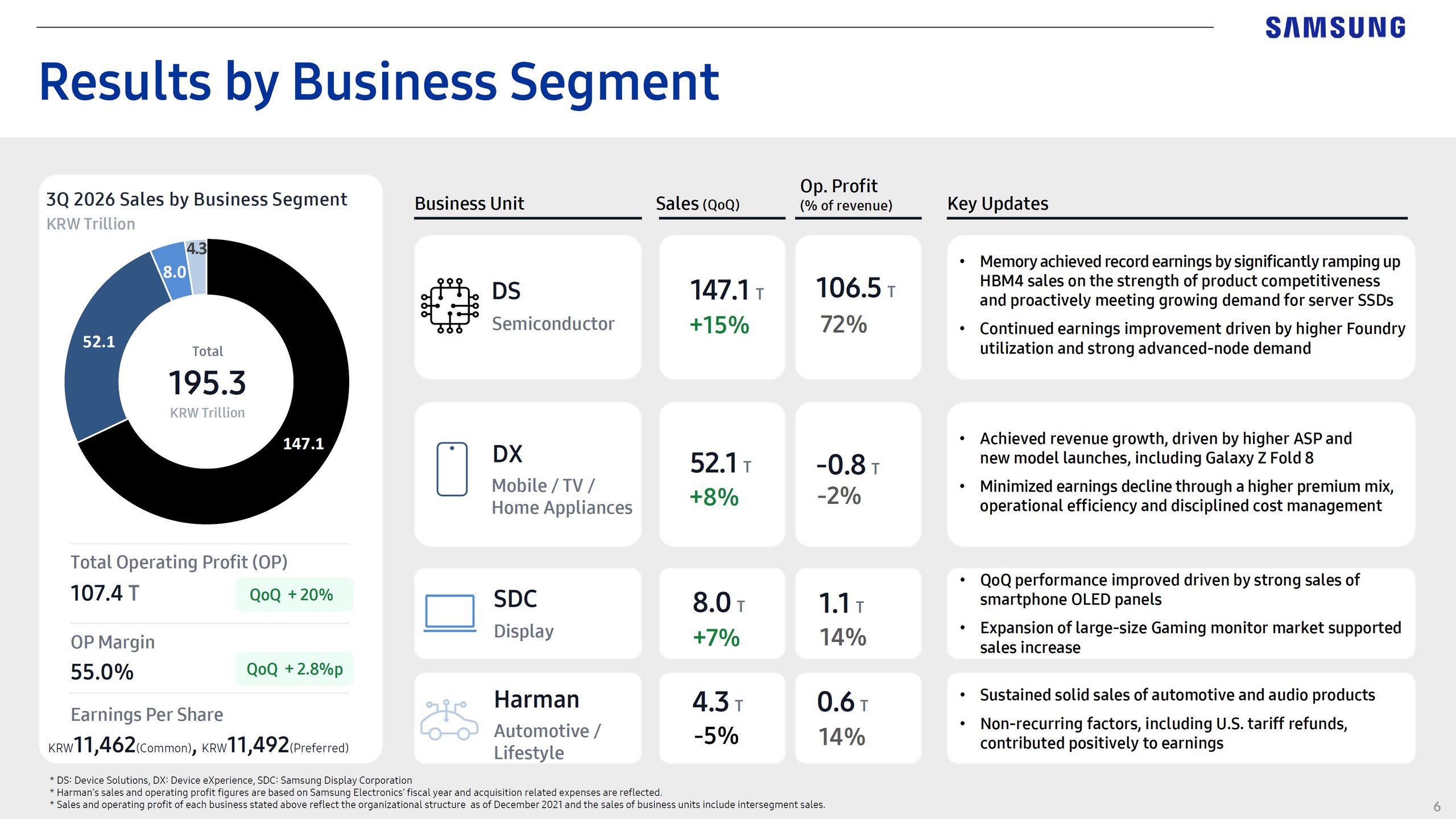
The supply outlook was shared alongside exceptionally strong quarterly results. Samsung reported that AI server building demand helped lift its performance to a record third quarter of 2026, making the company the first global technology company to report quarterly operating profit above 100 trillion won.
| Item | Reported result | Change |
|---|---|---|
| Quarterly revenue | 195.3 trillion won | 127% year over year, 14% quarter over quarter |
| Operating profit | above 100 trillion won | 783% year over year, 20% quarter over quarter |
| Research and development spending | 14.4 trillion won | 63% year over year |
| Samsung DS division | driven by HBM, DRAM and SSD demand | operating profit up 72%, revenue up 15% |
Samsung said it is putting those resources toward capacity expansion, next-generation memory development and new production facilities. The semiconductor unit, known as the Samsung DS division, stood out because AI servers require a combination of memory and storage: HBM, DRAM and SSD demand together boosted its revenue and profit.
Another important detail from the call was contract behavior. Samsung expects more large AI companies and data-center operators to sign multi-year supply agreements to secure future memory output. The company plans to move about 60% to 70% of capacity into long-term supply agreements, with customers willing to sign such contracts receiving higher priority for deliveries.
That shift has a simple meaning for ordinary technology users: advanced memory may continue to flow first toward AI data centers, while consumer-oriented categories receive a smaller share of available output. Smartphones, personal computers, graphics cards and consumer storage products may face cost pressure for some time.
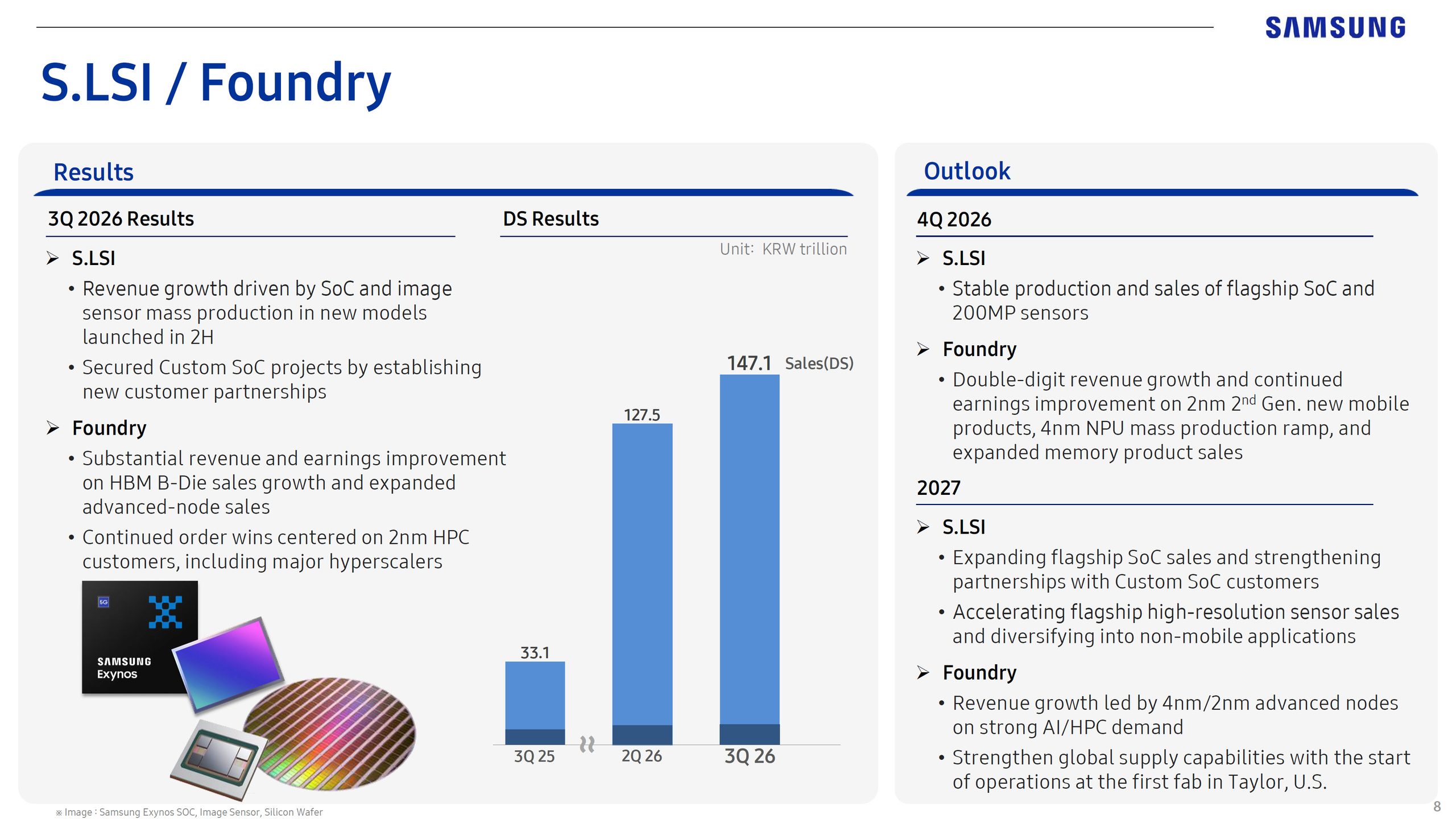
The supply issue also extends beyond memory. Samsung said orders for its 2nm foundry process are expected to grow by more than double this year, as AI chip customers look for advanced manufacturing. The company said 2nm and 4nm advanced processes will continue to create new growth drivers, with 4nm already used by several large United States AI customers and main 2nm customer products scheduled to enter mass production in the second half of this year.
Taken together, the message is not that Samsung is unable to produce more. Rather, it is that AI demand is growing faster than the physical pace of factory construction, and the best available output is being reserved before it reaches the broader market. For general tech readers, this means supply headlines may continue to affect pricing and product planning well into 2027, even as new technology generations arrive.
Checklist: What the Supply Warning Actually Covers
- Time frame: pressure may be heavier in 2027 than in 2026, with limited new supply before 2028.
- Cause: AI infrastructure is pulling high-performance memory forward in the production queue.
- Captured capacity: 2027 HBM4 capacity is already sold out, and HBM4E is scheduled for production in the first half of 2027.
- Broader memory market: DDR5 at 8000MT/s or above and NAND flash products for AI are also seeing strong demand.
- Business effect: record 2026 results are being reinvested in R&D, capacity and production facilities.
Common Misconceptions
- “Sold out means Samsung cannot make more.” It means existing 2027 HBM4 capacity has already been reserved by customers, not that future production is impossible.
- “AI shortages only affect data centers.” The effects can spread to consumer devices because manufacturers allocate scarce memory and storage to higher-priority customers.
- “New fabs solve the problem quickly.” Wafer plant construction and qualification take years, which is why Samsung still discusses relief before 2028.
FAQ
Why could 2027 be worse than 2026? Samsung says customer demand it has received suggests greater pressure next year, and unfulfilled orders can roll forward into next year.
Will HBM4 and HBM4E ease the shortage? They are part of the response, but 2027 HBM4 capacity is already reserved. HBM4E begins production in the first half of 2027, with shipments increasing in the second half.
Why does this affect my phone or PC? If advanced production is allocated to AI infrastructure first, consumer memory and storage may face less available supply and higher cost pressure.
Is Samsung’s business weak? No. The company reported record 2026 quarterly figures and is increasing R&D, but that success reflects strong demand rather than abundant supply.
Action Suggestions
- Watch memory-heavy categories, including premium PCs, AI laptops, SSDs and high-end GPUs, for gradual pricing changes.
- For business buying, lock critical memory or storage needs earlier if forecasts show long lead times.
- Treat 2027 as a planning year for supply-sensitive hardware decisions, not a year when new capacity alone should solve shortages.
- Read future supplier announcements with one question in mind: is the company reserving capacity through long-term contracts, or creating new capacity?