
The S&P 493 Still Can't Feel It: Why AI Has Yet to Pay Off Beyond the Magnificent Seven
By Sarah Chen · Tech Daily, MyTechDailyNews General coverage
Fresh milestones in large language model research are pulling in enormous sums of money and an almost equal amount of noise. Step away from the announcement cycle, though, and a different story appears in the numbers. As things stand, artificial intelligence has not delivered a financial payoff to the corporate world in the United States outside of the technology sector. A small group of technology-related companies has banked real gains; for the overwhelming majority of the S&P 500 index, spending on generative artificial intelligence and large language models has produced almost nothing visible on the income statement.
That is the argument Slok makes in his Daily Spark column, and it is worth unpacking because it reframes how ordinary readers should judge artificial intelligence news for the rest of this cycle.
A two-track result sheet
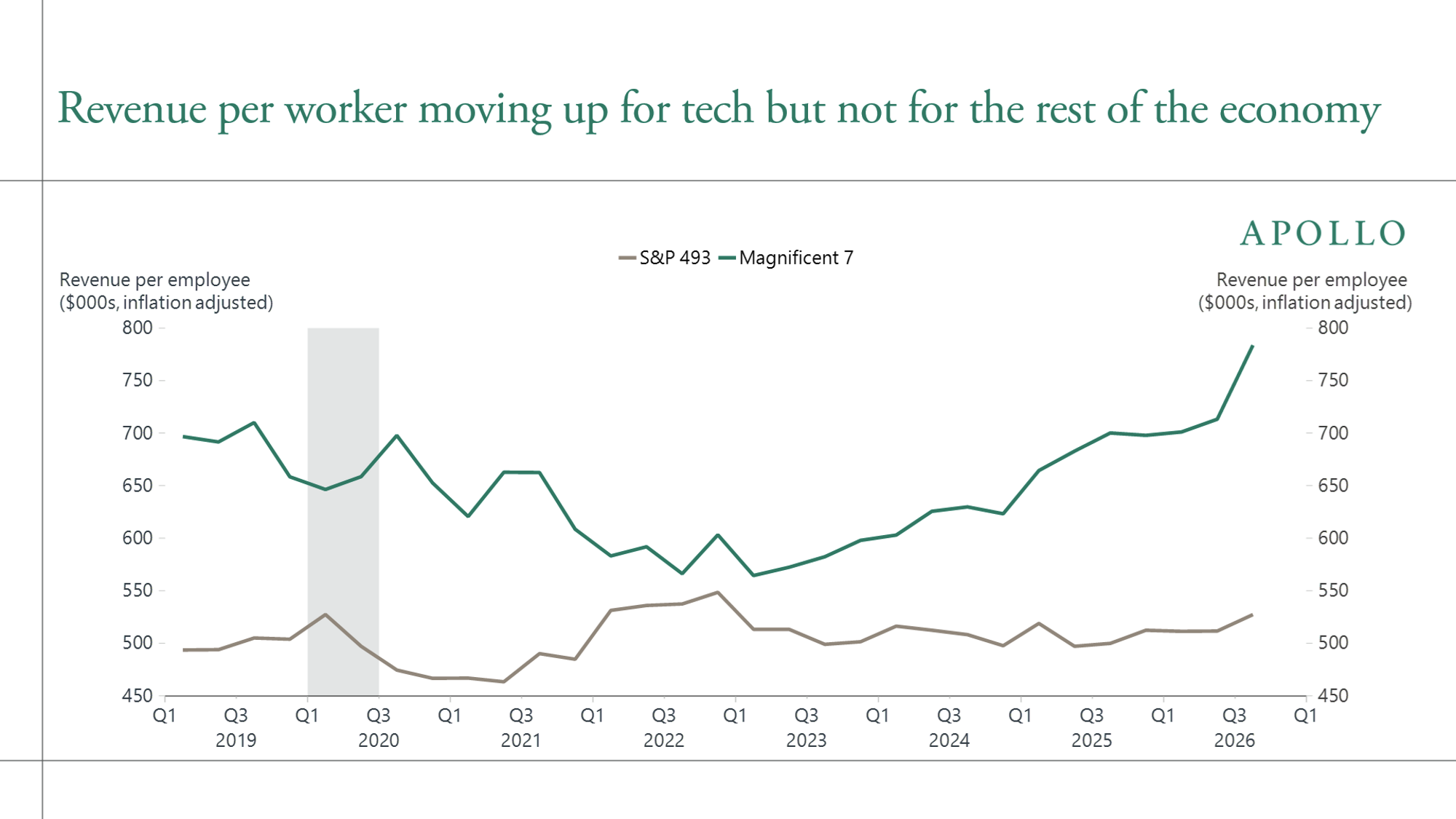
The starting point is a simple metric: inflation-adjusted revenue per employee. On that measure, Slok observes, only the "Magnificent Seven" are trending upward. This is the technology-heaviest slice of the S&P 500, and it comprises Nvidia, Tesla, Amazon, Microsoft, Google's parent company Alphabet, Apple and Meta. Their profit margins are climbing alongside it.
Everything else in the index — the companies he labels the "S&P 493" — tells a flatter story. Revenue per employee is level. Margins are level. No lift, no drag, nothing that a chief financial officer could point to and call a return.
For a general audience, the cleanest way to picture it is a single busy restaurant on a high street that has doubled its covers while forty-nine neighbouring cafés report the same quiet Tuesday they reported a year ago. The street looks lively; only one address is actually getting busier.
Productivity is the missing proof point
The Apollo economist also looked for a broader fingerprint of artificial intelligence and did not find one: there is no sign yet that the technology is pushing productivity higher. Put differently, generative artificial intelligence and large language models have not moved the profits of companies sitting outside the technology industry.
That absence matters because productivity growth is the bridge between a technology being interesting and a technology being valuable. Without it, the spending has nothing to lean on.
Tokens stop being a story and start being a bill
Once results fail to appear, the money changes character. With no demonstrated payoff, mainstream companies in the S&P 500 have begun trimming the huge budgets attached to artificial intelligence. The unit at the centre of that shift is the token: the amount of work a model consumes when you ask it to do something. Slok reports that these firms now treat token consumption as a cost that weighs on profit margins rather than as a potential source of future growth — the same line item, reclassified from investment to expense.
The split runs straight through the middle of the market. Companies backed by venture capital are still increasing their artificial intelligence token spending. Mainstream enterprises, by contrast, are described as neither needing the newest model nor willing to pay for it.
Slok's macroeconomic conclusion follows directly: if artificial intelligence ends up touching only a small part of the overall economy, its aggregate effect will be limited.
The commodity scenario — and the catch
There is a path from here to a different outcome. Artificial intelligence models could gradually commoditize, and tokens could eventually become cheap enough to drive revenue growth and margin expansion. A utility that costs almost nothing to run is easy to deploy everywhere.
Slok's objection is not to the arithmetic but to the difficulty, and to a category error he thinks people keep making. He compares artificial intelligence to a very powerful calculator, then stresses that organisations run on good judgment rather than on number-crunching. In his words: "AI does not understand accountability, trust, culture, unwritten rules, moral trade-offs or fairness, and all of those factors shape reputational risk and ultimately drive revenue growth and margin expansion."
His framing of the endgame is blunt: the ultimate direction of the artificial intelligence story depends on the "S&P 493", not on the financial splendour of the Magnificent Seven.
Two desks, two verdicts
| Voice | Position | Why it carries weight |
|---|---|---|
| Slok, Apollo | No financial return yet outside technology; macro impact likely limited if coverage stays narrow. | Apollo manages assets of about $1 trillion, which gives its economic read real heft. |
| Gartner | Cautious. The consultancy estimates that by the end of 2030, more than $3.5 trillion of artificial intelligence infrastructure investment may face impairment. | Widely watched third-party research that echoes the same warning. |
| Jan Hatzius, Goldman Sachs | Bullish. Artificial intelligence investment will ultimately translate into higher productivity and profit returns across the whole economy. | The main counterweight to the pessimistic camp. |
Note what is and is not in dispute. Both sides expect heavy spending today; they disagree on whether that spending becomes productivity, and on how long the conversion takes.
Common misconceptions
- "Breakthrough models mean breakthrough profits." Research progress and reported profit run on different clocks; the argument here is that the second clock has not chimed yet outside technology.
- "The Magnificent Seven prove it is working." Those seven are the technology-heaviest names in the S&P 500 index, so their rise says most about selling artificial intelligence, not about using it.
- "Cutting token budgets means abandoning artificial intelligence." The reported shift is one of classification: the same consumption is now read as a margin-dragging cost instead of a growth investment.
- "Cheap tokens automatically fix the problem." Commoditization is described as a possible path to revenue growth and margin expansion, and one whose execution may be far harder than outsiders imagine.
A quick checklist for reading the next AI headline
- Ask which companies the claim is about: the Magnificent Seven, or the S&P 493.
- Look for revenue per employee and profit margins, not model benchmark scores.
- Check whether token consumption is being reported as investment or as cost.
- Separate venture-backed spending behaviour from mainstream corporate spending behaviour.
- Turn any macro promise into a productivity claim — if no productivity evidence is offered, the bridge is missing.
Action guidance
- Product and marketing teams: describe artificial intelligence work in margin language — cost per unit of output — because that is the language decision-makers are currently using to decide whether to keep funding it.
- Managers: before defending an artificial intelligence budget, decide in advance what would count as evidence: a productivity figure, a margin figure, or a revenue-per-employee figure.
- General readers: treat this artificial intelligence cycle as a two-track story. Excitement at the model layer and flatness at the corporate layer can, and right now do, coexist.
FAQ
What exactly is the "S&P 493"?
A shorthand for the companies in the S&P 500 other than the Magnificent Seven. Slok uses it to isolate the group where a financial return from artificial intelligence should show up if the technology were genuinely spreading.
Has artificial intelligence done nothing for business?
The claim is narrower than that: so far it has not delivered a financial payoff to companies in the United States outside the technology industry, and no productivity lift has been detected in that group.
Why does about $1 trillion of assets under management matter here?
Apollo manages assets of roughly that size, which is the stated reason its economist's read is treated as consequential rather than as one opinion among many.
Who disagrees with the cautious view?
Jan Hatzius of Goldman Sachs argues that artificial intelligence investment will eventually convert into higher productivity and profit returns economy-wide — the optimistic counterpoint in the column.
What is the biggest downside number floating around?
Gartner's estimate that by the end of 2030, more than $3.5 trillion of artificial intelligence infrastructure investment may face impairment.
Bottom line
The interesting change in this cycle is not that spending has stopped; it is that spending has started to be judged. When token consumption gets reclassified from a growth bet into a margin problem, the argument moves from capability to evidence — and, in Slok's telling, the verdict will be written by the "S&P 493" rather than by the seven names already celebrated for their results. For anyone following artificial intelligence as a reader rather than as a speculator, the practical takeaway is simple: keep your eye on the flat part of the chart.