
Robot Mount Tai Climbing Competition: A Practical Guide to 3.9 km, 3100 Steps and Real Lessons
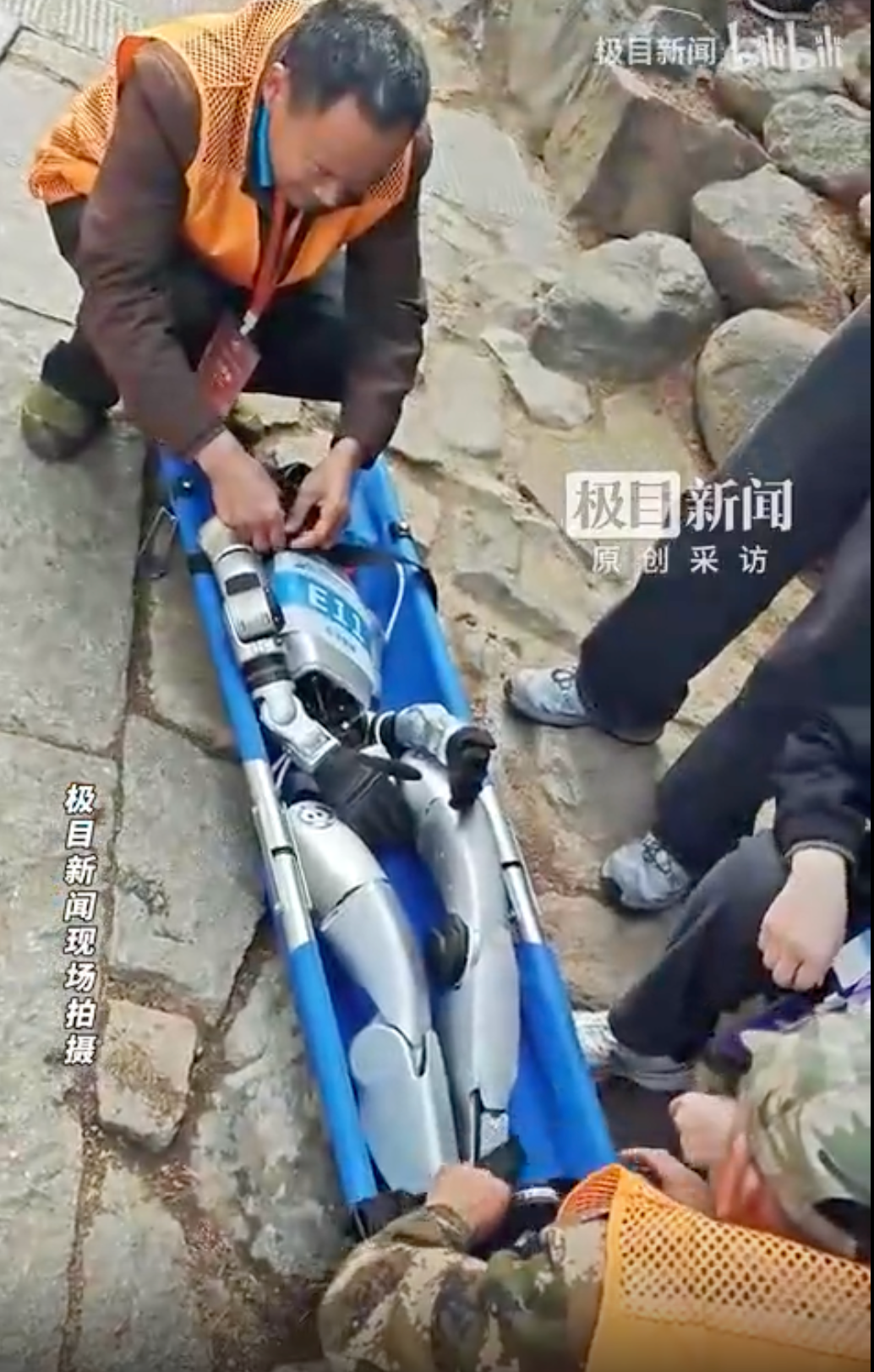
A mountain stairway is a brutally honest test environment for embodied AI. The Robot Mount Tai Climbing Competition compressed that honesty into a single course: 3.9 kilometers, 3100-plus steps, and a live audience watching machines try to behave like reliable robots rather than laboratory prototypes. The first finisher reached the result line, but the final uphill steps still exposed wobbling, uneven footing and a movement that briefly resembled one step forward, three steps back. That moment is more useful to readers than a polished keynote: it shows where today's mobile robots still lose confidence.
MyTechDailyNews treats the event as a practical guide rather than a stunt report. The goal is to help ordinary technology readers, product teams and market professionals separate spectacle from usable information: what actually happened, which metrics matter, what the different race formats test, and how to judge whether similar robot mobility is ready for real deployments.
What the Robot Mount Tai Climbing Competition tells a practical reader
At the simplest level, the competition is a public stress test of locomotion control. A flat showroom floor lets a humanoid robot demonstrate a symmetrical gait. Mount Tai does not cooperate. Its ancient stone steps vary in shape, wear and edge visibility; rain can make surfaces slick; and the course stretches long enough that a robot must manage endurance, heat, perception drift and recovery, not just one impressive jump or one stable photo.
English-language reporting has framed the event as the CMG World Robot Mount Tai Climbing Competition and noted that qualifying runs preceded the main competition in Tai'an, Shandong (peoplesdaily.pdnews.cn). Chinese central-media results coverage also described roughly 90 teams participating (finance.sina.cn). Those details add a practical point: this was not a single demo video, but a multi-round competition with many systems running the same hard course. Scale matters because repeated failures become statistically visible: if several machines stumble on the same type of step, the issue is terrain-aware control, not just one prototype's luck.
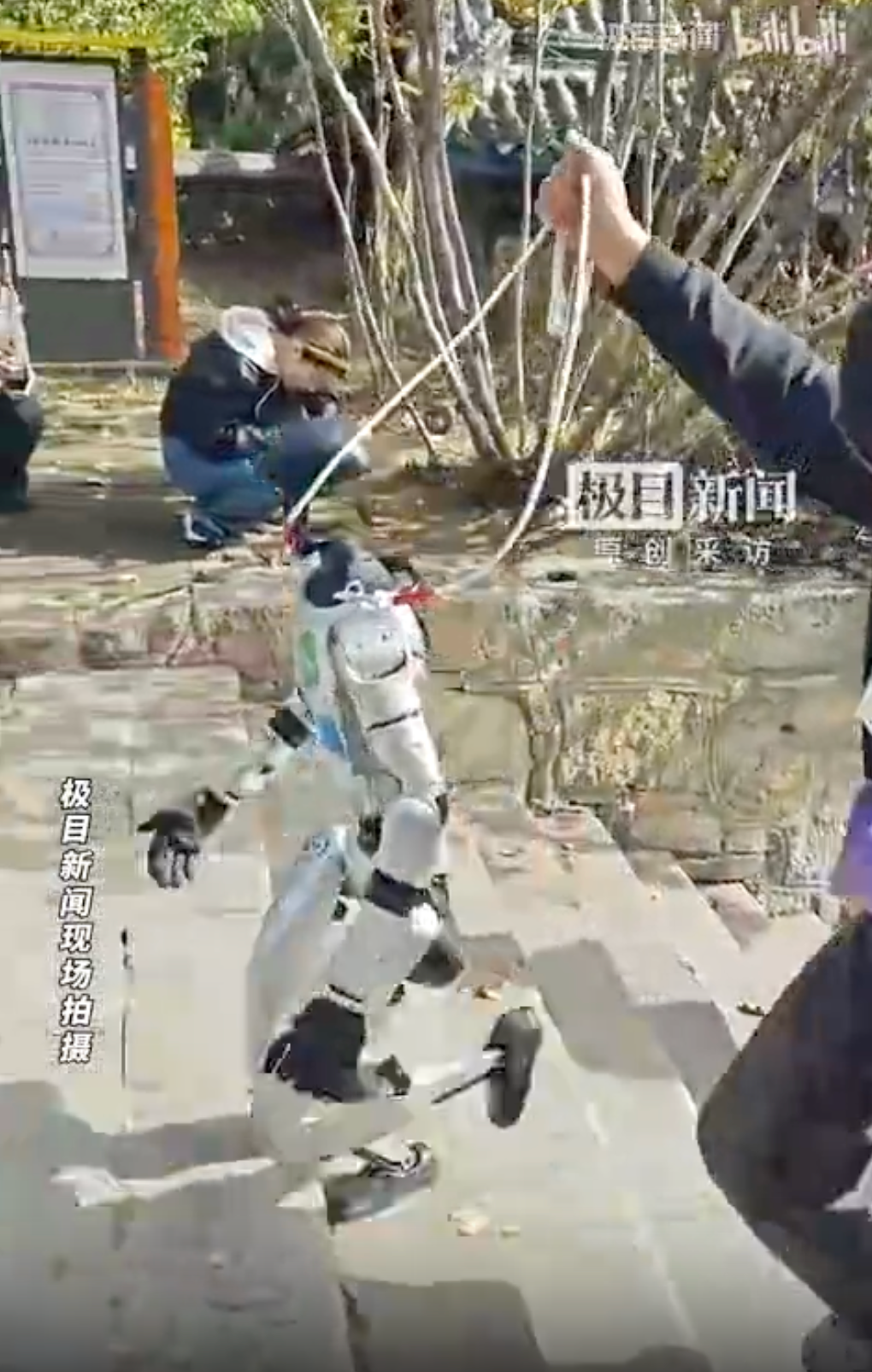
The visual result from the race day also included non-humanoid robots moving under operator guidance. Some robots completed the route after controllers used a rope to guide them, and one machine's recovery looked more like a safety intervention than an autonomous product demonstration. For readers, that is not automatically a flaw; it is a classification question. The important distinction is whether the machine solved the problem through onboard balance and perception, or whether external control compensated for a gap.
The course format: a checklist for reading the race
The competition's structure is the fastest way to understand what each robot is supposed to prove. The event included 4 official events: the humanoid robot speed race, the legged robot speed race, the legged robot load-carrying race and the exoskeleton robot assistance race. Alongside them was 1 full-domain mobile pathfinding challenge event, known as the full-domain mobile pathfinding challenge. The split matters because speed on stairs is only one skill. A robot can finish quickly and still fail at carrying useful mass; it can also be excellent at mapping a route but poor at steady climbing.
| Race or format | What it tests | Practical takeaway for readers |
|---|---|---|
| Humanoid robot speed race | Bipedal balance, stair detection, recovery and pace control on narrow ancient steps. | A humanoid that climbs slowly but steadily may be closer to product-grade than one that rushes and recovers from falls. |
| Legged robot speed race | Quadruped or legged mobility on uneven outdoor terrain, often with lower center of gravity than humanoids. | Watch for foot placement consistency, not just how close the robot is to the front of the pack. |
| Legged robot load-carrying race | Stability while carrying mass, braking, turning and step traversal under added inertia. | Load tests map more directly to warehouse, inspection and rescue roles than pure speed tests. |
| Exoskeleton robot assistance race | Assistive power delivery to a wearer during uphill movement, fatigue reduction and coordination. | Exoskeleton performance depends on human-machine fit as much as on motor output. |
| Full-domain mobile pathfinding challenge | Autonomous navigation, mapping and path selection across mixed terrain and complex environments. | Best used to judge software robustness: can the machine know where it is and what the next safe route is? |
Three practical steps to evaluate a robot stair-climbing demo
Use the following mini-method whenever a mobility video, livestream or event clip goes viral.
-
Step 1: Separate the machine from the course
Ask what the course punished: height variation, edge confusion, slippery stone, fatigue, narrow landing zones or unexpected pedestrians. In the Robot Mount Tai Climbing Competition, a 3.9 kilometers route with 3100-plus steps turns small perception errors into large risk. If a demo only shows clean indoor stairs, it has not yet proven outdoor reliability.
-
Step 2: Watch recovery, not the first step
A robot may enter a staircase with a controlled posture, then lose confidence after multiple irregular steps. The first finisher in the Mount Tai race reached the end line, but the final uphill section still produced wobbling and one step forward, three steps back behavior. Recovery quality is the difference between a lab success and a deployable machine.
-
Step 3: Identify the control mode
Check whether the robot is autonomous, supervised, teleoperated or guided by external safety equipment. A rope-guided finish can be a valid race safety measure, but it should not be interpreted as a claim that the robot independently solved every stair. For buyers and builders, control mode determines maintenance cost, training needs and insurance risk.
Quick checklist before trusting a mobility claim
- Surface type: polished indoor tile, metal stairs, mountain stone and wet steps are not equivalent.
- Step geometry: irregular rise, worn edges and narrow surfaces are where balance errors appear.
- Distance: short clips hide fatigue; the course's 3.9 kilometers and 3100-plus steps show endurance stress.
- Interruptions: rain, glare, crowd noise and passing pedestrians can change sensor behavior.
- Failure handling: did the robot recover, stop safely, get lifted, or continue while unstable?
- Operator role: external pulling, remote takeover and physical assistance should be counted as part of the outcome, not hidden as background detail.
Common pitfalls that turn spectacle into hype
Pitfall 1: Treating a finish as full autonomy
The strongest practical lesson from this kind of event is that finishing is not the same as proving autonomy. If an operator guides the robot with a rope, the audience can still learn something important: the team recognized an unstable edge and chose safety over showmanship. The misleading part begins when that same moment is sold as fully autonomous stair climbing.
Pitfall 2: Judging only speed
Speed is easy to see and hard to interpret. A slower robot with controlled foot placement may be more useful than a faster robot that repeatedly corrects its posture. The legged robot speed race, legged robot load-carrying race and full-domain mobile pathfinding challenge each test different values, so readers should ask which metric corresponds to the deployment being discussed.
Pitfall 3: Ignoring thermal and endurance limits
Outdoor stair climbing creates sustained joint load, repeated braking and motor heat. Chinese media reports described overheating or withdrawal cases during the Mount Tai robot event, according to coverage of the competition day. For product planners, that is a warning sign worth tracking: a machine that works for two minutes may still fail after dozens of climb cycles, especially on steep, uneven steps.
What ordinary users should expect from robot mobility today
The Robot Mount Tai Climbing Competition is not evidence that home robots are ready to replace stair users. It is evidence that mobile robots are moving from closed demonstrations into messy public environments where mistakes are visible. The first finisher still exposed unstable footing, and the 3100-plus steps amplified small errors. That is normal for early-stage embodied AI, but it changes the consumer promise.
For readers, the near-term promise is narrower and more practical: robots can assist in logistics, inspection, research, entertainment and support tasks under controlled conditions. General-purpose stair climbing in crowded heritage landscapes will be harder than a marketing clip suggests. If a company cannot state whether a robot used autonomous balance, operator guidance or external safety help, treat its readiness claims cautiously.
Action suggestions for tech readers, product teams and marketers
- Read the format first: check whether the robot competed in the humanoid robot speed race, the legged robot speed race, the legged robot load-carrying race, the exoskeleton robot assistance race or the full-domain mobile pathfinding challenge.
- Ask for distance and repetition: 3.9 kilometers is not a background detail; it converts short demonstrations into an endurance problem.
- Compare terrain, not just brand: ancient stone stairs and factory stairs are different engineering environments.
- Demand disclosure of assistance: ropes, remote takeover, physical carry or human-led pacing should appear in any result summary.
- Track failure categories: foot slip, perception misjudgment, heat, fatigue, unstable recovery and route planning errors point to different fixes.
FAQ: What readers usually ask after seeing the robot stair race
Why was the race on Mount Tai instead of a stadium?
Because Mount Tai provides irregular, outdoor and culturally familiar terrain that cannot be standardized. The public route's length and step count test endurance, perception and balance at the same time.
Does the first finisher prove humanoid stair climbing is solved?
No. The first finisher completed the course, but visible wobbling and the one step forward, three steps back moment show that recovery and final-section stability remain difficult.
Which event matters most for real products?
It depends on the target. The legged robot load-carrying race is closer to logistics and material transport. The full-domain mobile pathfinding challenge is closer to autonomous navigation. The humanoid robot speed race is more of a general-purpose mobility benchmark.
Should people avoid visiting during such races?
Organizers need clear separation between robots, operators, referees and visitors. Readers should expect course closures, safety monitoring and controlled viewing, because fast-moving machines on stone steps can create hazards.
The practical takeaway: use robot races as risk maps
The value of the Robot Mount Tai Climbing Competition is not that robots conquered stairs. It is that the course revealed the remaining risk map: perception uncertainty, irregular step contact, operator intervention, heat, fatigue and unstable uphill recovery. The first finisher showed that completing a hard route is possible, while one step forward, three steps back showed that product-level confidence is still being earned. For MyTechDailyNews readers, the smartest response is not awe or dismissal, but a practical checklist: terrain, distance, autonomy, recovery and disclosure. Those five questions turn a viral clip into usable technology insight.