
ByteDance Time or Tencent Time? We Compared Both Sides of China's Screen-Time Fight
Attention has quietly become the most contested currency on the internet, and this week the argument about who owns it left the comment section entirely. Qin Shuo announced today that, in response to remarks published by "Li Liang of Douyin Group" that he says harm his reputation, he has instructed lawyers to file a case with a People's Court, to take measures protecting his lawful rights and to pursue the infringing side's legal responsibility. For anyone who simply wants to understand where their own evenings go, the lawsuit is the headline but not the story. The real story is a comparison: two credible accounts of the same dataset, arriving at opposite conclusions. We put them side by side.
Quick verdict: one side is describing a trend, the other is defending a definition
The "duel of words" between the two men is not really about feelings toward short video. It is about denominators. Both camps quote the same chain of numbers; they disagree about what those numbers are allowed to prove.
| What you are comparing | Qin Shuo's frame: "ByteDance Time" | Li Liang's counter-frame | Takeaway for readers |
|---|---|---|---|
| Headline claim | The ByteDance family already holds more than 40% of users' total time, so "the ByteDance Time of China's internet" labels a real trend | No company can become "the XX Time of China's internet"; the label is extremely unrigorous | A trend label and a market-power label are different claims |
| Numbers cited | August 2026, mobile internet usage-time Top 50 apps: ByteDance family 41.8%, Tencent family 28.6%, a gap of about 13.2 percentage points | The same report is a "tracked estimate", and the newest September edition shows WeChat back on the most-used app throne at 19.3% | One month of data cannot settle an era |
| Denominator | The Top 50 apps hold 93% of all mobile internet time, so they roughly equal the whole | It is only the time split inside the Top 50 on mobile: no long tail, no PC hours, no office software left open all day | Always ask which pool a percentage is drawn from |
| Legal test invoked | Article 24 of the Anti-Monopoly Law: one operator reaching one-half of a relevant market may be presumed dominant; at 40%-plus, ByteDance has real dominance over the time dimension | 41.8% is not even one-half, and outside instant messaging the leading banner changes constantly | Time share is not automatically monopoly share |
| Rhetorical device | Henry Luce's 1941 "the 20th century was the American century" analogy | Calling a scholar's guess a "grand qualitative label" without reading the report is irresponsible | Analogy is persuasive, never evidential |
If you only remember one line from the table: Qin Shuo is making a statement about where attention is flowing, and Li Liang is making a statement about how competition works. Both can be partly right.
Timeline: five days from essay to courtroom
- In recent days the question "does a ByteDance Time actually exist in China's internet" turned Qin Shuo, founder of the media column Qin Shuo Pengyouquan, and Li Liang, vice-president of Douyin Group, into open adversaries; the two have kept firing public challenges at each other in a duel of words.
- October 26 — Qin Shuo publishes the signed essay "The Fearsome Hongguo and the ByteDance Time of China's Internet", comparing Tencent-family and Douyin-family consumption time and asking whether a new order is opening: from Tencent Time to ByteDance Time, from WeChat Time to a "Douyin + Hongguo Time".
- October 27 — Li Liang answers on Weibo, arguing that one reason users increasingly like Hongguo is exactly the steady rise of its content quality, and that the "ByteDance Time of China's internet" label is extremely unrigorous — "pure nonsense!"
- October 28, morning — Li Liang posts again, saying the analysis contains several basic common-sense errors.
- October 28, afternoon — the exchange widens: Qin Shuo replies on WeChat Moments with the Nomura Securities figures, Li Liang issues a third rebuttal, and media coverage of the quarrel peaks.
- Today — Qin Shuo releases a statement confirming a reputation-rights lawsuit against Li Liang of Douyin Group.
Round one: the data — which denominator survives scrutiny?
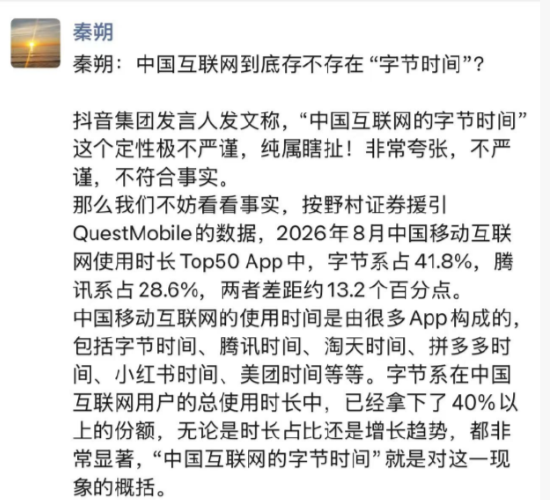
Qin Shuo's case rests on numbers attributed to Nomura Securities, citing QuestMobile: in the August 2026 ranking of the Top 50 apps by usage time in China's mobile internet, the ByteDance family took 41.8% while the Tencent family took 28.6%, leaving a gap of roughly 13.2 percentage points. Because Chinese mobile internet time is made up of many apps — ByteDance time, Tencent time, Taotian time, Pinduoduo time, Xiaohongshu time, Meituan time and so on — he argues that holding more than 40% of total user time is a significant enough share, and significant enough trend, to deserve a name.
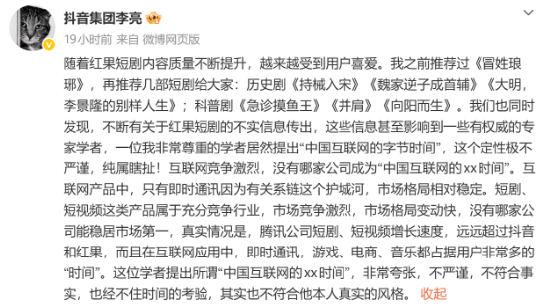
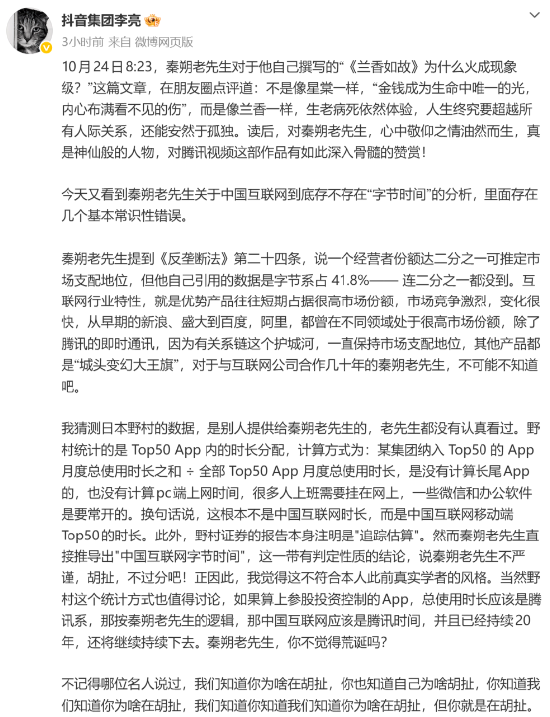
Li Liang's objection is procedural rather than emotional. "I suspect the data from Nomura in Japan was handed to Mr Qin Shuo by someone else, and that he never read it carefully," he wrote. "Nomura measured the time split inside the Top 50 apps, calculated as: the sum of monthly usage time of a group's apps that made the Top 50, divided by the monthly usage time of all Top 50 apps. Long-tail apps were not counted, and PC internet time was not counted either — plenty of people have to stay connected at work, and some WeChat and office software stays open all day." His conclusion: this is not China's internet time at all, it is the time of China's mobile Top 50, and the report itself is labelled a tracked estimate. Turning that into a verdict, he says, is what makes the phrase "China internet ByteDance Time" a judgement nobody earned — "to call Mr Qin Shuo unrigorous, or nonsense, is not unfair, is it?"
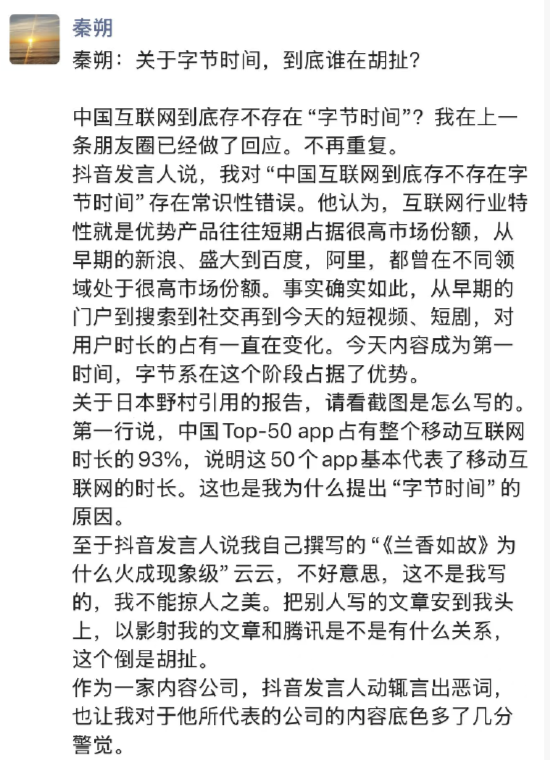
Qin Shuo's counter is also about the report's own text. He says the first line of the Nomura study states that China's Top 50 apps account for 93% of mobile internet usage time, which means those 50 apps basically represent mobile internet time — and that, he writes, is precisely why he proposed the term "ByteDance Time". Facing the charge of basic common-sense errors, he also accepted the historical fact that leading products' shares churn fast: portals, then search, then social, then short video and short drama, with the hold on user time always moving. His own summary of the moment: "Today content has become the first destination for time, and the Douyin family, and the wider ByteDance family behind it, holds the advantage at this stage."
Worth adding, because it shows how fast this ground shifts: the same report chain, as relayed by Sina Finance and NetEase coverage of the dispute, placed Douyin ahead of WeChat for the first time in July 2026 among the Top 50 apps, at 19.4% against 18.8%, with the ByteDance family at 40.9% versus the Tencent family's 29.1% — while a year earlier the ByteDance family held 33.6% and the Tencent family 30.9%. In other words, Li Liang's point about volatility has data behind it too: a share that jumps several percentage points in twelve months is a trend, not a throne.
Round two: the law — is 41.8% of your time the same as market power?
Qin Shuo reaches for Article 24 of the Anti-Monopoly Law, which says that where one operator's share of the relevant market reaches one-half, dominance may be presumed. With China's mobile internet hosting an uncountable number of apps competing for time, and one group alone at more than 40%, he argues that ByteDance has acquired a degree of dominance on the single dimension of time, so "ByteDance Time" is a very real fact rather than something conjured out of thin air.
Two clarifications make the exchange far less confusing. First, the text of Article 24 in the official statute ties every threshold to a "relevant market" that must be defined before the maths means anything; legal commentary and court guidance on the platform economy treat that definition as the hard part, not the fraction. China's antitrust law also expressly lets a presumed operator rebut the presumption with evidence. Second, time share is a very awkward proxy for market power. China had 1.125 billion internet users and an 80.1% penetration rate as of December 2025, with 1.121 billion of them going online on phones, according to the 57th statistical report of CNNIC — a population far larger than any Top 50 measurement pool, and one that includes work hours nobody tracks as app time.
Li Liang pushes the same logic back at his opponent. Apart from Tencent's instant messaging, protected by the moat of a relationship chain and holding market dominance throughout, every other product category sees "the banner on the city wall change every day", he writes; short drama and short video are fully contested industries, market structure shifts quickly, and no company sits permanently at number one. Then he turns the counting rule into a reductio: "This statistical method from Nomura also deserves debate. If you include apps in which a group holds equity or investment control, the total usage time should belong to the Tencent family; by Mr Qin Shuo's own logic China's internet would be Tencent Time, and it already has been for 20 years and will keep going. Mr Qin Shuo, don't you find that absurd?"
His characterisation of the whole essay is blunt, and it is now part of the legal record: "This scholar puts forward a so-called 'XX Time of China's internet'. It is highly exaggerated, unrigorous, does not match the facts, and cannot survive the test of time — in truth it does not match his own real style either." He closes with a joke he attributes to an unnamed famous person: "I cannot remember which celebrity said it: we know why you are talking nonsense, you know you are talking nonsense, you know that we know why you are talking nonsense, we know that you know that we know why you are talking nonsense — but you talk nonsense anyway."
Round three: Hongguo — the app that moved the argument
Behind the abstractions sits one product. By total user time, Hongguo has become the fourth-largest app in China, behind only Douyin, WeChat and Douyin Lite, and its per-user daily time is striking: February this year it hit 125 minutes, above both Douyin and WeChat. Qin Shuo's summary is that Hongguo has become a machine driven by four parts together — free content, algorithmic recommendation, advertising monetisation and platform ecosystem — and therefore works as an emotion dispenser and a time absorber.
Tencent has not watched this passively: under Hongguo's pressure it launched a "Green Bubble" short-drama product embedded in WeChat mini programs, an attempt to fight red with green. Qin Shuo is not optimistic, because Hongguo, like many of ByteDance's other products, is a highly algorithm-driven distribution machine, and he writes that the gene ByteDance was born with is to hold human nature through algorithms, with an understanding and grip on people that borders on the unsurpassable.
His warning is where ordinary readers get most value. A daily 125 minutes is good data for ByteDance, he says, but nothing to celebrate for users or society: the opportunity cost of those minutes is less time in nature, less reading, less thinking, less time with family — and this kind of buzz is expensive, with effects that will last a long time. He hopes ByteDance will use its powerful content flow to take on more social value, to offset the social cost it occupies, noting that Toutiao and Douyin have already made some effort here and achieved some results.
The commercial stakes explain the temperature of the quarrel. QuestMobile's 2026 short-drama insight report puts the industry's user base at 718 million and says Hongguo's free short-drama app crossed 300 million monthly active users in February this year, having grown from the tens of millions in roughly two and a half years; DataEye's industry estimates, reported by Sina Finance, value China's micro-drama and animation-drama market at about 100 billion yuan in 2025 and forecast more than 120 billion yuan in 2026. Whoever owns the time owns that budget.
Volume is not value: the trade-off most coverage skips
Both men concede the same asymmetry, and it is the most useful idea in the whole exchange. Qin Shuo states plainly that the ByteDance family holding 40%-plus of user time does not mean it created a comparable share of user value: Alipay, Meituan, JD and Pinduoduo are service and transaction apps where people finish a task and leave, so they can never compete with Douyin or Hongguo on duration, yet that does not make the value they create for users and society smaller than Hongguo's. He also grants that WeChat holds dominance in social, that the whole Tencent family remains important in user time — "but the ByteDance Time of China's internet has overtaken Tencent Time, that is a fact and not exaggerated at all" — and ends by telling ByteDance that instead of feeling inexplicably worried about the phrase "ByteDance Time", it should work to make that time more socially valuable and meaningful.
Li Liang's competing picture is that Tencent the company is growing short drama and short video far faster than Douyin and Hongguo, and that instant messaging, gaming, e-commerce and music all take enormous amounts of user time. In his reading, time is a crowded field with many landlords, not one.
Round four: tone, attribution and the trip to court
The final turn was personal rather than statistical. Li Liang had written that Qin Shuo "wrote it himself" a Moments commentary on why the Tencent Video title Lan Xiang Ru Gu became a phenomenon, in which the drama's characters were praised as truly heavenly figures — implying a link between Qin Shuo's essay and Tencent. Qin Shuo's reply: "This was not written by me, and I cannot claim beauty that belongs to someone else. Pinning someone else's article on me in order to insinuate that my writing has something to do with Tencent — that is the real nonsense." He added: "For a content company whose spokesperson so readily reaches for abusive words, I am more alert than before to the content character of the company he represents."
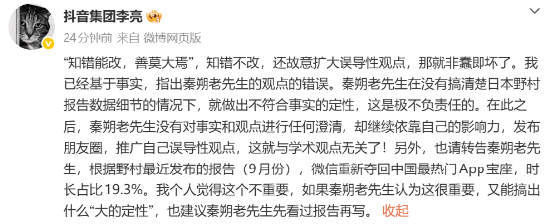
Li Liang's latest post escalates rather than de-escalates: correcting a mistake is the greatest virtue, he says, but refusing to correct one and deliberately expanding a misleading view is either foolish or malicious; and continuing to rely on personal influence to push a misleading view through Moments, without any clarification of fact or opinion, "has nothing to do with academic debate". He also supplied his own number for anyone wanting a counter-label: according to the report Nomura released most recently, for September, WeChat reclaimed the throne of China's most popular app with a 19.3% share of time. He considers that unimportant, but added that if Mr Qin Shuo thinks it is, and wants to attempt another "grand qualitative label", he should read the report first.
Three readers, three ways to use this fight
- Product and marketing teams: trust the shape of the curve over any single month. ByteDance family at 41.8% against Tencent family at 28.6% in August 2026 tells you where cheap attention sits; the September reversal to WeChat at 19.3% tells you how fast acquisition costs can move.
- Policy and legal watchers: treat the Article 24 discussion as a definitional argument. Time share inside the Top 50 is not a relevant market, and a presumption can be rebutted.
- Everyday users and parents: the 125-minute figure is the only number here that changes your Tuesday evening. Use the comparison as a reminder to set your own limits before an algorithm sets them for you.
Common misconceptions
- "41.8% means ByteDance owns 41.8% of all internet time in China." It is a share of tracked mobile usage time inside the Top 50 apps, computed from a report described as a tracked estimate.
- "A big share of time equals monopoly power." Article 24 of the Anti-Monopoly Law speaks of a relevant market and a threshold of one-half, and the presumption can be rebutted by evidence.
- "One crossover proves an era." Douyin passing WeChat in July 2026 and WeChat retaking the top seat in September at 19.3% are both real — churn is exactly Li Liang's point.
- "The century analogy proves the claim." Qin Shuo compares his label with Henry Luce's line that the 20th century was the American century, offered in 1941 when, he notes, the United States accounted for a little over 30% of world GDP, whereas China's GDP is about 17% to 18% of the global total today; a phrase such as the 21st century being China's century is a judgement about direction, not a measurement.
- "More minutes mean more value." Qin Shuo himself rejects this, and the argument about service and transaction apps points the same way.
Checklist: vet any "one app owns your time" claim in sixty seconds
- Find the pool: is the percentage of all internet time, mobile time, or the time of a Top 50 shortlist?
- Read the report's own first line — the 93% coverage claim is what Qin Shuo leans on, and what Li Liang says was never checked.
- Check the window and the method: monthly tracked estimates move, and a single month is not a structural shift.
- Compare the runner-up: the gap of 13.2 percentage points matters more than either share alone.
- Separate duration from value — task-based apps such as Alipay, Meituan, JD and Pinduoduo are built to be used quickly.
- Watch for legal vocabulary used loosely; "dominance" without a defined market is rhetoric.
FAQ
What exactly is "ByteDance Time"? It is Qin Shuo's shorthand for a shift in which the ByteDance family captures more than 40% of Chinese mobile users' time, so that an algorithmic content economy, rather than a social graph, sets the rhythm of attention.
Why does Li Liang call it "pure nonsense"? He says the cited figures only cover the Top 50 apps on mobile, never reach one-half, come from a tracked estimate, and that fully contested categories such as short video and short drama rotate leaders — so no firm can be labelled as China's internet's XX Time.
Which app is really at the centre of this? Hongguo. It is China's fourth-largest app by total user time and, at 125 minutes per user per day in February this year, outranks Douyin and WeChat on that single measure.
Has the argument ended now that it is in court? No. Qin Shuo says he has entrusted lawyers to sue over remarks he considers defamatory; Li Liang says he has corrected the facts and will keep doing so. Meanwhile the numbers both sides quote keep moving month to month.
Action tips
- Pull up your own screen-time report this week and compare it with the 125-minute benchmark; if one feed outspends your reading, calls and sleep, rebalance before the app does it for you.
- When you cite market-share news, record the definition of the pool — Top 50, all apps, mobile only or total internet — because that is exactly where this fight was decided.
- For advertising budgets, treat time-share rankings as a monthly variable, not an annual constant; verify at least two consecutive months before committing spend.
- If you publish about companies, keep primary sources on file; a disagreement over one report's scope has now become a reputation-rights case at a People's Court.
Two readings of this dispute survive the evidence, and they are not contradictory. As a description of where attention is flowing, "ByteDance Time" is hard to dismiss; as a statement about permanent control of China's internet, it is equally hard to prove. What no court date will settle is the part that actually concerns readers: whether the next hour you spend online is one you chose. That, uniquely, remains your metric to define.
By Sarah Chen, MyTechDailyNews — General desk. Tips and corrections: hello@techdaily.com. Tech Daily publishes independent daily coverage of the platforms, data disputes and policy questions shaping consumer technology.