
Does China's Internet Really Run on 'ByteDance Time'? Inside the Qin Shuo-Li Liang Debate
For many readers, the debate is not only about two technology companies. It is about the minutes people spend each day on short dramas, videos and chat apps, and about whether a free entertainment feed has become powerful enough to reshape China's internet order. Recently, Qin Shuo and Li Liang, vice president of Douyin Group, clashed over the question of whether China's internet really has ByteDance time. Their public argument, or debate, moved from user-duration data to platform competition, content value, and the social cost of attention.
The claim that started the debate
On October 26, Qin Shuo published an article titled Terrifying Hongguo and the ByteDance Time of China's Internet. He compared the user time held by the Tencent camp and the Douyin camp. His question was simple but provocative: is China's internet moving from Tencent time and WeChat time toward ByteDance time, and toward a Douyin+Hongguo time?
At the data level, Qin Shuo pointed to Hongguo becoming the fourth-largest app in China, sitting behind Douyin, WeChat and Douyin Express. In February this year, he said, Hongguo's per-user daily usage time reached 125 minutes, surpassing Douyin and WeChat. His summary was that Hongguo is driven by four elements: free content, algorithm recommendation, advertising monetization and platform ecosystem. In that reading, the app has become an emotion distribution device and a time absorption device.
Why Tencent pushed back and Qin Shuo worried
Under Hongguo's impact, Tencent launched Green Bubble short drama and placed it inside the WeChat Mini Program environment. The move was described as using green to resist red. Qin Shuo was not optimistic about the response. He argued that Hongguo, like many products of ByteDance, or Byte, is a highly algorithm-driven distribution machine. In his view, ByteDance's natural gene is to use algorithms to understand and manage human nature, and that capability has reached the peak.
Qin Shuo also said that Hongguo users spending 125 minutes each day is good data for ByteDance, but not something users or society should take as purely reassuring. The opportunity cost of those 125 minutes, he argued, means less time in nature, less reading, less thinking and less time with family. The price of pleasure is high, he warned, and its influence can last a long time. He hoped ByteDance could use its strong content flow to take on more social responsibility and make up for the social cost of occupying attention. He acknowledged that Toutiao and Douyin had already made some efforts and achieved certain results.
Li Liang's reply: no company owns China's internet time
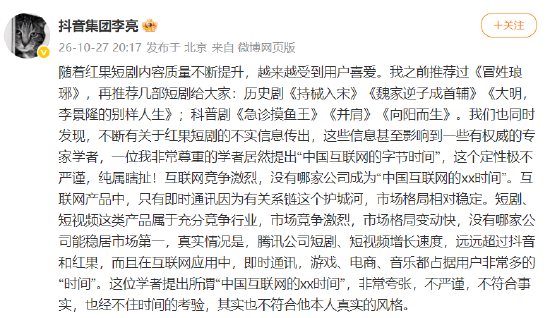
On October 27, Li Liang responded on Weibo. He said one reason users increasingly like Hongguo is that content quality keeps improving. He rejected the characterization of China's internet's ByteDance time, calling the description extremely imprecise and saying it was pure nonsense!
Li Liang's larger point was that China's internet is highly competitive, and no company can claim to become China's internet's xx time. He noted that only instant communication has a relatively stable market structure because its social relationship chain is a moat. By contrast, short drama and short video are fully competitive categories, and market leadership can change quickly. No company can firmly keep market first for long.
According to Li Liang, the real situation is that Tencent company's short drama and short video businesses are growing far faster than Douyin and Hongguo. He also listed instant communication, games, e-commerce, music and other internet applications as areas that still occupy large amounts of user time. He criticized the original framing without naming Qin Shuo, saying the so-called China's internet's xx time proposed by this scholar is very exaggerated, not rigorous, inconsistent with facts, cannot stand the test of time, and does not match the scholar's own real style.
Qin Shuo's data-backed counterargument
Qin Shuo responded again on his Moments account. He cited Nomura Securities, quoting QuestMobile data, to say that among the Top50 China mobile internet apps by usage time in August 2026, the ByteDance camp held 41.8% and the Tencent camp held 28.6%. The difference was about 13.2 percentage points. For him, China's internet usage time is made of many apps and many camps, including ByteDance time, Tencent time, Taotian time, Pinduoduo time, Xiaohongshu time, Meituan time and more. The ByteDance camp, he argued, has already captured more than 40% of total user time, and its share and growth trend are significant enough to support the phrase China's internet's ByteDance time.
What each side argued
| Issue | Qin Shuo's position | Li Liang's position |
|---|---|---|
| Meaning of the phrase | ByteDance time is a realistic description of a shift in user time | China's internet's xx time is an exaggerated framing of a competitive market |
| Main data | 41.8% for ByteDance camp, 28.6% for Tencent camp, about 13.2 percentage points apart | Tencent company's short drama and short video growth exceeds Douyin and Hongguo, and other apps also consume time |
| Market structure | More than 40% share gives dominance in the time dimension | Only instant communication has a stable moat; short video and short drama are highly fluid |
| User value | Long time does not automatically mean more social or user value | Growing user preference can reflect improving content quality |
The analogy: trend language and market-share language
To defend his use of the phrase, Qin Shuo offered two analogies. First, he said many scholars and media at home and abroad describe the 21st century as China's century. That is a trend judgment, not a claim that China already matches every historical measure of global power. He noted that China's gross domestic product is around 17%-18% of the global total. By contrast, in 1941, when Henry Luce proposed that the 20th century is the American century, the United States accounted for a little more than 30% of world GDP.
Second, he referred to the Anti-Monopoly Law, specifically Article 24. The law says that if one operator reaches a one-half market share in the relevant market, it may be presumed to have a dominant position. Qin Shuo's point was not that the entire internet market has been monopolized by ByteDance. He focused on user time, where he said China's mobile internet has countless apps competing for minutes. If the ByteDance camp already has more than 40% in that dimension, it has acquired a certain dominant position in time, so ByteDance time is not groundless.
He also made a concession: WeChat has a dominant position in social communication, and the whole Tencent camp remains important in user time. But he maintained that China's internet's ByteDance time has surpassed Tencent time, and he called that a fact that is not exaggerated at all.
Why the argument matters to ordinary readers
For product teams, marketers and everyday users, the dispute is a reminder that time has become a strategic asset. If users give more minutes to free short dramas, platforms gain more opportunities to show advertising, recommend content and shape habits. If Tencent, Pinduoduo, Xiaohongshu, Meituan, Alipay and JD create value through transaction, search, travel, payments or community, they may need less time per user while still changing daily life.
Common misconceptions
- More usage time always means more platform power. This is not necessarily true. Time is one metric, but value can also come from transactions, payments, local services and knowledge transfer.
- A market-share phrase is the same as a monopoly conclusion. The Anti-Monopoly Law threshold discussed by Qin Shuo was one-half in the relevant market. His more-than-40% time-share argument was an analogy to describe attention, not a legal finding that one company controls all apps.
- The conflict is only ByteDance versus Tencent. China's internet user time is also distributed among Taotian, Pinduoduo, Xiaohongshu, Meituan and many service apps. The debate is about relative gravity, not about a two-party universe.
- Free short dramas are simply harmless entertainment. They may be convenient and useful, but long sessions can crowd out reading, sleep, offline exercise, thinking and family interaction.
Checklist for readers and content professionals
- Check where the largest share of personal screen time is going this month.
- Separate communication time, service time and entertainment time before judging a platform's value.
- Look at the business model: is the app paid, ad-supported, transaction-based or membership-based?
- Review whether algorithmic recommendations are creating repeatable engagement or genuine usefulness.
- For teams, compare time share with conversion, retention, payment and content-quality metrics instead of treating time as the only ranking signal.
FAQ
What does ByteDance time mean in this debate?
It refers to the share of user attention and usage time held by ByteDance apps, especially Douyin and Hongguo, compared with Tencent's ecosystem. Qin Shuo used it to describe a shift in the center of gravity of China's internet.
Did Li Liang deny Hongguo's popularity?
No. His response emphasized that users like Hongguo partly because content quality improves, while disputing the idea that any company has become China's internet's xx time.
Is Hongguo the largest app in China?
Not according to the data discussed in the article. It was described as the fourth-largest app, after Douyin, WeChat and Douyin Express, while its per-user daily time in February this year was reported at 125 minutes.
Does the debate prove a monopoly?
No. The discussion concerns attention share and market gravity. Legal dominance needs a clearly defined relevant market, share thresholds and behavioral evidence. The quote about Article 24 was used as a comparison, not as a final verdict.
Action suggestions
- Use app-level screen-time reports to set limits for short-video and short-drama feeds.
- Keep one or two fixed periods for entertainment so it does not absorb the whole day.
- Replace some passive scrolling with reading, outdoor time or family conversation if users feel those areas are missing.
- When choosing platforms, pay attention to whether the company is investing in content quality, public value and transparent recommendations, not only engagement.
The debate did not produce a single winner. It reframed a familiar question: how much of everyday attention has moved toward free, algorithmic entertainment, and what should platforms do once they hold so much time? For China's internet, the value of the argument is not the slogan ByteDance time, but the need to measure success beyond minutes and to make that time more meaningful for users and society.