
Why Perplexity's Teammates May Change Enterprise AI Work: Long-Running Agents, Slack and a $200 Price Tag
Perplexity recently launched Teammates, a long-running AI coworker that can manage ongoing projects, coordinate several agents, and communicate inside Slack. The move matters because it shifts the company from answer-giving search toward persistent digital labor, while also testing how far enterprises will pay for autonomous workflow help.
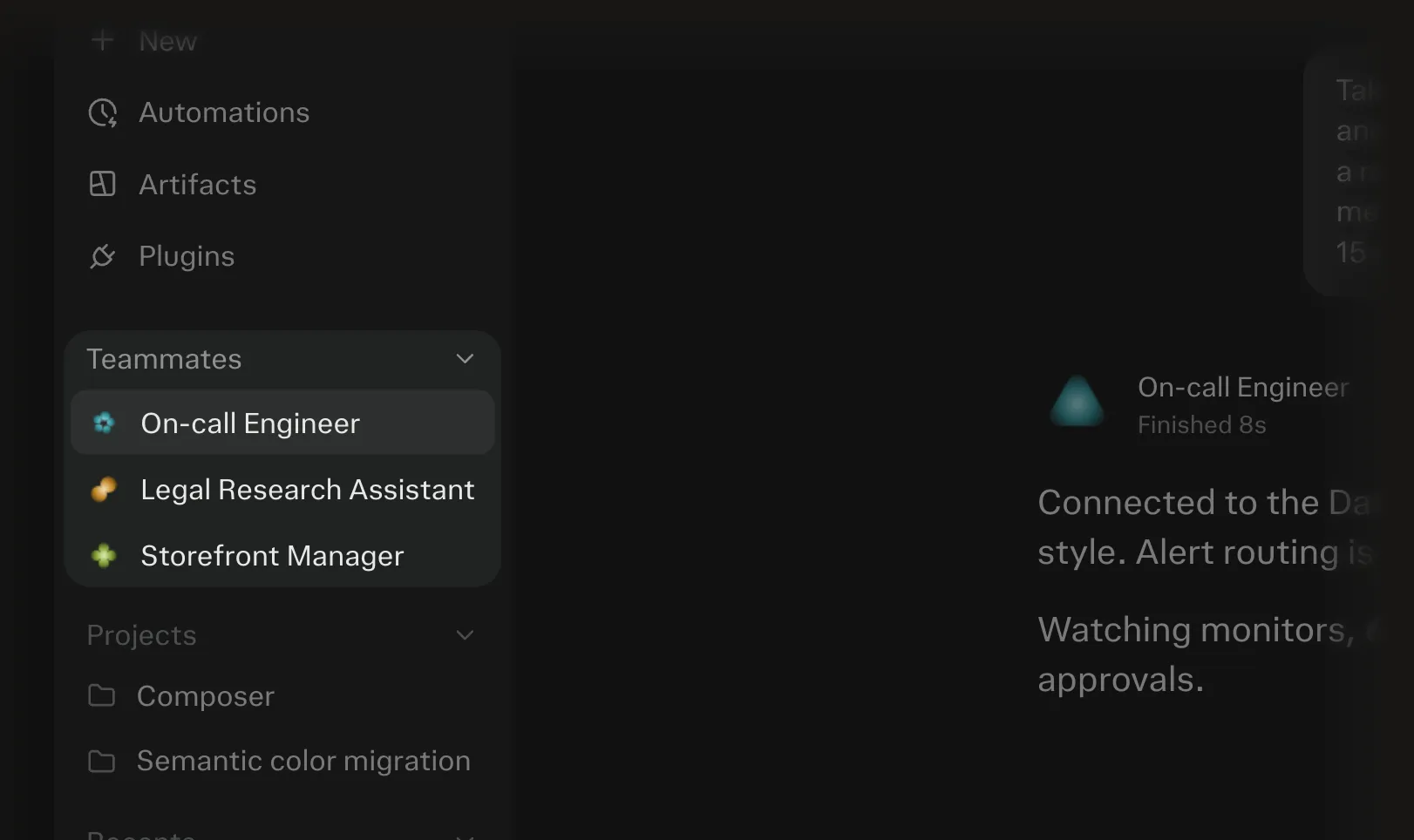
What Teammates are and why the launch matters
Teammates are not a new chat window that returns answers and disappears. They are persistent AI work units: a user can assign a role, ask the system to keep tracking progress, and let the agent resume work over time. The core promise is continuity. Instead of treating artificial intelligence as a single-turn helper, Perplexity is packaging it as a member of a workflow.
This places Teammates in a growing rivalry with OpenAI and Anthropic, which have also pushed beyond conversational assistants into agent-based productivity. Perplexity compares its direction with OpenAI's Dots and Anthropic's Claude Duet, all of which explore how multiple AI agents can divide work, retain context, and help teams finish larger tasks. The difference is that Perplexity is tying the experiment to its existing Computer infrastructure and its search-derived enterprise identity.
From search engine to digital workforce: the strategic shift
For years, Perplexity was widely known as an AI search product. The company answered questions, cited sources, and helped users navigate information faster. Teammates points to a different future: one where the platform does not only retrieve knowledge but also carries out responsibilities inside business processes.
The strategic logic is straightforward. If AI can only summarize, it competes with search and productivity tools. If AI can monitor, plan, follow up, and coordinate across applications, it becomes closer to staff. That is why the product description emphasizes long-running projects rather than one-time prompts.
Three signals hidden in the launch
- Continuity over conversation: The product is framed around ongoing tasks, not isolated queries.
- Coordination over completion: Agents can work together and hand off pieces of a project.
- Enterprise workflow over consumer novelty: Slack integration signals that the intended stage is team communication, not personal Q&A.
How a Teammate differs from Computer and rival multi-agent tools
Computer is the execution layer. It lets AI agents operate tools, browse, and complete concrete actions inside a user's environment. Teammates adds a management layer above that execution. A Teammate can inherit projects, skills, memory, tools, and permissions from the broader Computer setup, then keep ownership of a longer assignment. The relationship is closer to a supervisor of recurring work than a simple task runner.
Each Teammate also keeps a separate and continuing thread. That design choice reduces the friction that many users encounter with early AI assistants: having to repeat project background, re-upload context, or re-explain constraints. When memory is tied to a role, the agent can build on previous outputs rather than start from zero every morning.
In the sales example provided around the launch, an agent might notice that a long-time customer has stopped placing orders. It could then review order history, support records, and likely reasons, propose next steps, and prepare a retention offer. This is not only answering a question; it is detecting a pattern, investigating it, and initiating a workflow.
Slack, memory and multi-agent coordination
The Slack connection is one of the most practical parts of the rollout. If AI agents live in a separate dashboard, adoption depends on whether workers remember to check that dashboard. If they can assign work, ask for status, and receive updates inside Slack, the tool enters the existing rhythm of collaboration.
Multi-agent coordination follows the same principle. A marketing agent might gather campaign data, a support agent might review customer issues, and an operations agent might summarize bottlenecks. The system can let one agent pass findings to another. For example, one Teammate could identify a website vulnerability, then transfer the evidence to another agent assigned to recommend remediation. That kind of handoff is closer to a team structure than a single assistant.
According to Perplexity's product page, Teammates are initially available on the web for Perplexity Max subscribers, with mobile support planned. Industry coverage also describes the launch as bringing isolated environments and access controls, which are important because enterprise AI agents need boundaries when they touch files, accounts, or internal communication tools.
Pricing: what US$200 per month changes
Teammates currently sit behind the Perplexity Max subscription, with a price of US$200 per month. That cost is not trivial for individuals, and it is a deliberate positioning choice. Perplexity is not treating the product as a casual upgrade for search users. It is pitching it as an advanced business tool.
For buyers, the question is not simply "Is this AI impressive?" It is "Can it remove enough recurring coordination work to justify a high monthly subscription?" The answer will depend on how much time teams spend tracking tasks, switching between tools, and rebuilding context. In knowledge-work settings where coordination is expensive, a persistent agent may seem practical. In lighter workflows, the same price may be harder to defend.
Who should pay closer attention
| Reader type | Why Teammates may matter | Practical caution |
|---|---|---|
| Operations leaders | They care about follow-ups, escalations, and cross-team status updates. | Check whether agents can explain decisions clearly enough for audits. |
| Marketing and sales teams | Campaign monitoring and account follow-up are repetitive and data-heavy. | Do not assume every recommendation matches brand voice or policy. |
| IT and security teams | Isolated environments, access controls, and tool permissions become central. | Map which systems an agent may touch before wider rollout. |
| Small businesses | They may get leverage without hiring more coordinators. | The US$200 per month threshold may force a pilot rather than full adoption. |
What the chief executive's vision reveals
Perplexity chief executive Aravind Srinivas frames the product as a long-term transformation of office work. The stated vision is that employees could eventually be surrounded by hundreds of dedicated agents, each helping with tasks that now consume human attention: tracking, scheduling, checking, summarizing, and following up. The broader claim is that AI should absorb coordination labor, not just writing or research.
This matters because it clarifies Perplexity's ambition. The company is not positioning Teammates as one more productivity widget. It is introducing an early version of a staffing metaphor: human workers direct goals, while agents maintain the process. Whether that model becomes normal or remains a premium experiment will depend on reliability, cost, governance, and user trust.
Common misconceptions about Teammates
1. "Any AI agent can do long-term work"
Not necessarily. Many agents still fail when tasks cross sessions, tools, or team boundaries. The key challenge is not just executing one command, but maintaining accurate memory, knowing when to escalate, and preserving the right permissions across a longer timeline.
2. "Teammates will replace team software"
The launch points to collaboration, not replacement. Slack is used because teams already communicate there. The more realistic near-term use case is layering autonomous follow-up on top of existing systems, not making those systems disappear.
3. "A higher price guarantees enterprise readiness"
Pricing can signal seriousness, but enterprise readiness depends on auditability, access controls, data isolation, failure recovery, and governance. A powerful demo is different from a dependable business process.
4. "Multi-agent systems are always more efficient"
More agents can mean more coordination overhead. If every handoff needs review, the system may add steps rather than remove them. The useful test is whether a Teammate reduces human follow-up without increasing the number of approvals.
Checklist before adopting Teammates
- Start with one repeatable workflow: Pick a task that happens weekly, has clear inputs, and produces a measurable output.
- Define the agent's role narrowly: A Teammate should not begin as a general assistant. Give it a bounded responsibility such as account monitoring, support triage, or campaign reporting.
- Map permissions first: List the files, channels, calendars, tickets, and internal accounts it can access, and remove everything else.
- Require handoff logs: If multiple agents interact, the system should show which agent acted, what was passed, and when.
- Keep a human checkpoint: The first version should submit work for review rather than execute high-impact actions without confirmation.
- Measure saved coordination time: Track how much manual status chasing, context re-explanation, and follow-up the product actually removes.
FAQ about Perplexity Teammates
Are Teammates only for enterprises?
They are positioned for business and team workflows, but availability begins with individual Perplexity Max subscribers on the web. The product's Slack coordination, memory, and role-based design are aimed at teams, even if early access is narrower than a full enterprise rollout.
What is the main difference between Computer and Teammates?
Computer focuses on executing tasks inside a user environment. Teammates adds persistent ownership of projects, role assignment, memory continuity, and coordination across multiple agents. In simple terms, Computer helps an agent do things; Teammates helps an agent keep working on something.
Why does Slack integration matter so much?
Because enterprise AI rarely fails because it is not smart. It fails because it sits outside daily communication. Slack makes the assistant visible where decisions, updates, and interruptions already happen.
Is the US$200 per month price a barrier?
It depends on the value it replaces. If a team spends hours each week tracking follow-ups, re-explaining project history, and moving information between tools, the subscription may be easier to justify. If the workflow is already simple, the price may feel like an experiment rather than a necessity.
Could this become standard in office software?
The direction suggests it could. OpenAI and Anthropic are already moving toward agent-based productivity, and Dots and Claude Duet show that the concept is not isolated to one company. Teammates is an early version of a broader transition: office software may increasingly include autonomous staff, not only collaborative apps.
Action recommendations for readers
- For daily browser readers: Treat Teammates as a sign that AI assistants are moving from "answer tools" to "work assignees." The useful question is not whether they are clever, but whether they can remember and continue.
- For managers: Pilot one low-risk process first, such as support request tracking or campaign follow-up summaries. Avoid giving an agent authority over payments, legal decisions, or direct customer commitments.
- For product teams: The biggest design lesson is continuity. Persistent threads, memory, and clear role boundaries may matter more than raw model power.
- For enterprises evaluating agents: Compare products by auditability, not by demo fluency. Ask how the system records decisions, controls access, handles errors, and hands work between agents.
Final takeaway
Teammates is interesting less because it is another AI assistant and more because it tries to make AI occupy a durable seat inside team workflows. Perplexity recently moved from search toward persistent agents, OpenAI and Anthropic remain central competitors, Computer provides the execution foundation, Slack provides the collaboration surface, and the US$200 per month price shows the company is betting on premium enterprise work before mass adoption. The launch does not prove that every office will soon need hundreds of dedicated agents, but it does show where the current race is heading: from asking AI for information to assigning AI ongoing responsibility.
Reference sources
- Perplexity Teammates product page — official availability and product description.
- Sina Finance technology report — coverage of the November 4 announcement, Max subscription access, and planned iOS expansion.
- Chinaz AI news report — coverage of persistent project management, business workflows, isolated environments, and access controls.