
Pangram Scan Finds 92% of Anthropic Prospectus Read as Human, but High-Confidence AI Traces Remain
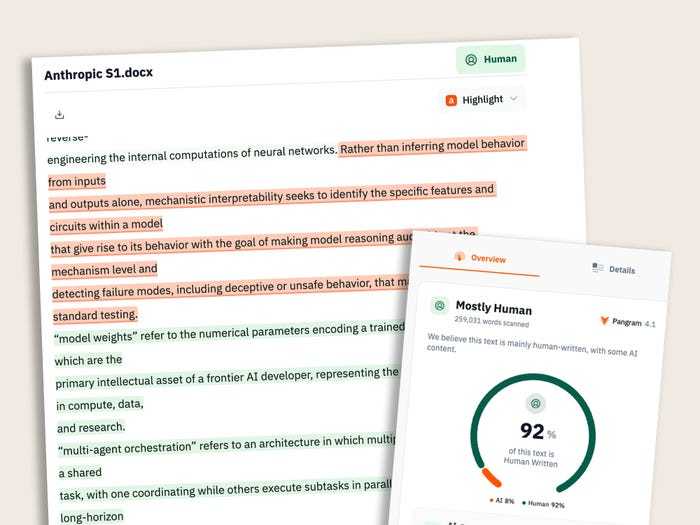
A detector result that raises more questions than it answers
A large corporate filing has become a useful test case for the messy boundary between human drafting and AI editing. Pangram examined a document of approximately 259,000 words and classified 92% of it as human-written. At the same time, some sentences and paragraphs were marked as containing AI traces with high confidence. The result is less a verdict than a signal: automated tools can point to patterns, but they do not reveal who typed each line.
What the scan did—and did not—prove
The core finding is specific enough to discuss but broad enough to require caution. The detector said most of the file looked human, while certain passages looked as if machine assistance may have been involved. It did not prove that Anthropic used Claude, nor did it identify every human-written sentence or exclude every AI-assisted passage.
That limitation matters because an AI company’s paperwork carries an obvious narrative pull. Readers may expect a firm building artificial intelligence to rely heavily on its own tools in its public documents. The detection result, however, only describes statistical traces. It cannot, by itself, settle whether a company used Claude internally or whether a writer merely reused a model-generated phrase.
How the full-document test became possible
Business Insider reported that a journalist initially tried to examine the entire filing personally but ran into a practical barrier: the document was too large for the usual workflow. Max Spero, Pangram’s co-founder and chief executive, later helped complete the full-text scan.
Spero’s interpretation focused on degree rather than origin. He suggested the filing may have gone through light editing at the sentence level, or AI may have been used only in localized ways, while the document as a whole did not appear to contain large sections fully generated by AI.
The flagged passage and the human-review problem
Among the sentences flagged as possibly using AI was a passage describing how quickly the industry moves. In essence, it noted that artificial intelligence advances so rapidly that new model releases are often separated by months rather than years.
That kind of passage is where detectors become hardest to evaluate. A polished summary of an obvious industry trend may look AI-like because models are trained on large amounts of similar text. But a human analyst can also write a clean, general observation that resembles model output.
Business Insider also emphasized that AI-writing detectors are not completely accurate. Different habits—using AI for brainstorming, editing, proofreading, or phrasing tweaks—can leave different signals. A tool may flag a sentence that was drafted by a person and later revised with a machine.
One example reported by Business Insider makes the uncertainty concrete. A journalist fed previously published LinkedIn posts and already published articles into Pangram. The tool judged one sentence as AI-written. After reviewing the writing process, the journalist said the sentence originally came from the journalist, who later accepted a rewriting suggestion from ChatGPT.
Watermarks, silence from the company, and the SEC factor
For Anthropic, the public record on the company’s response was straightforward: it did not answer Business Insider’s request for comment on the detection result.
Business Insider also noted that Anthropic’s own AI watermarking system was not open to ordinary users at the time, so it was not used in the scan. That detail helps explain why the test relied on Pangram’s statistical judgment rather than a direct authenticity signal.
Another practical reason complicates the “why not use AI?” question: a prospectus is not an ordinary blog post. It is subject to review by the U.S. Securities and Exchange Commission, and its wording can receive intense scrutiny. Human involvement may therefore be reasonable, not suspicious, because companies and advisers may want every line to survive regulator review.
Katie Notopoulos, writing for Business Insider, framed the situation as an interesting question: if Anthropic is an AI company, why did the filing not use its own tools more extensively? At the same time, the article noted the regulatory context, which gives a plausible reason for human drafting and human review.
Key misconceptions
| Misconception | What the report actually supports |
|---|---|
| A high AI score means most of the text was written by AI. | The file was classified as 92% human-written; only selected passages had AI traces. |
| A detector can prove whether Claude was used. | No. The scan could not confirm Anthropic’s use of Claude. |
| A human can be certain a sentence is AI when a tool flags it. | Tools may be wrong; editing or suggested rewrites can create ambiguous results. |
Reader checklist
- Ask what the detector measured: full document, one paragraph, one sentence, or writing style.
- Look for confidence labels. In this case, the AI traces were described as high, while most of the file was labeled human.
- Separate statistical pattern from proof. A flagged sentence is not evidence of authorship identity.
- Check whether the company or author responded. Here, Anthropic did not respond to the request for comment.
- Remember the document type. A regulatory filing may involve more careful human editing than social posts.
Action advice
- For ordinary readers, treat AI-detection headlines as a prompt to inspect context, not as a final verdict.
- For teams that publish filings or formal documents, define clear rules for AI drafting, editing, and final human review.
- For reporters and analysts, ask whether the tool used was calibrated for the file size, language, and document genre.
- For companies, maintain records of drafting workflows if public trust depends on distinguishing human oversight from automated generation.
FAQ
| Question | Short answer |
|---|---|
| What was scanned? | A filing of approximately 259,000 words. |
| What percentage was judged human? | 92%, according to Pangram. |
| Were there AI traces? | Yes, some sentences and paragraphs were marked with high confidence. |
| Does this prove Anthropic used Claude? | No. The report explicitly says the result cannot confirm that. |
| Why might humans be involved? | The prospectus is subject to review by the U.S. Securities and Exchange Commission, so human review is reasonable. |