
MyTechDailyNews Guide to AI Trust: Offloading, Surrender and the Orchestration Tax Compared
Every polished AI answer creates a quiet tradeoff: the reader gains speed in seconds but may lose the habit of testing whether the answer deserves belief. For MyTechDailyNews readers, the practical question is not whether to use AI, but how much judgment to retain when the result looks clean.
Why Better Output Can Make Human Review Weaker
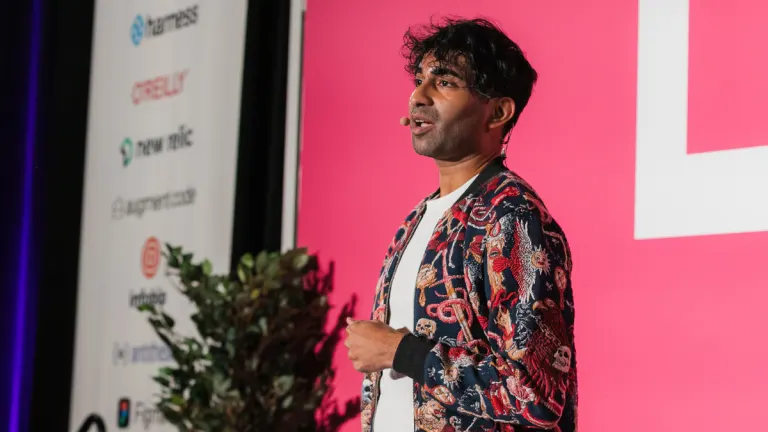
Osmani, who now works on Claude Code at Anthropic, is not an anti-automation voice. Before his current role, he spent more than 14 years at Google, where he led Chrome developer experience and Google cloud AI work. That background matters: he has seen both developer tooling at scale and the newest AI coding agents. His warning is about an unexpected side effect of success. As models reduce obvious mistakes, users receive fewer cues to stop and ask, “How did this get here?”
The danger appears when a model’s fluency feels like proof. A response may contain headings, numbers, steps and confident phrasing, yet it may still rest on a wrong assumption. The user’s mind often moves from “let me verify” to “it looks fine.” Osmani has described this as a change in what the reader checks, not only whether the reader checks.
Three Levels of AI Dependence, Compared
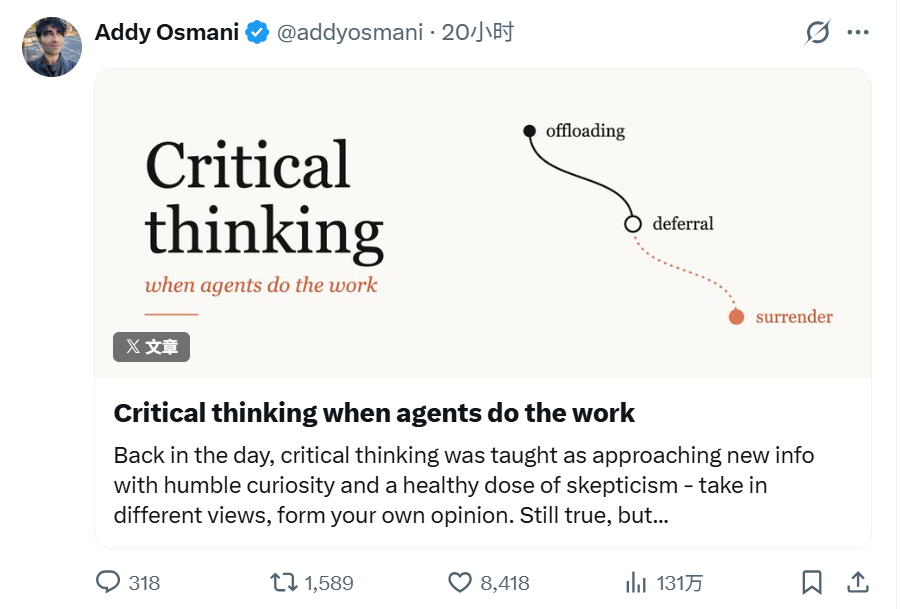
Osmani groups user behavior into three levels: Cognitive Offloading, Deferral and Cognitive Surrender. The three levels form a gradient. The first can be healthy, the second can save time when boundaries are clear, and the third becomes risky because the user no longer feels there is anything left to review.
| Level | What it looks like | When it can work | Warning sign | Better move |
|---|---|---|---|---|
| Cognitive Offloading | AI completes a task while the person still owns the result. | Routine drafts, repetitive code, summaries, low-stakes formatting. | None if checks remain clear. | Keep evidence and review criteria visible. |
| Deferral | AI output is treated as a foundation instead of a hypothesis. | Exploratory work where errors are cheap and reversible. | The user begins building on untested claims. | Insert a checkpoint before using the result for a decision. |
| Cognitive Surrender | The user adopts AI output as their own judgment and stops feeling the need to check. | Should not be the default for consequential decisions. | The person cannot explain the logic when questioned. | Rewind to hypothesis testing and source checking. |
“Cognitive Surrender,” in Osmani’s description on his own blog, happens when the model’s output quietly becomes the user’s own view, leaving little that feels worth checking. The concept is also rooted in academic work from the Wharton School. Steven Shaw and Gideon Nave introduced the idea in research later discussed by Wharton Executive Education and The Economist, including the paper “Thinking—Fast, Slow, and Artificial,” available through SSRN. Their framing emphasizes a key distinction: AI doing a narrow task is different from AI making the decision while a person adopts it as their own conclusion.
The Gradual Drift: First Report, Second Report, Third Report
Osmani says the shift is rarely dramatic. A user may read the first report carefully, scan the second report quickly, and check only the outline of the third report. By the fourth or fifth round, the habit may already be weaker than the person realizes. That pattern is important for ordinary workers, students and consumers because the risk is cumulative. The first good answer teaches trust; the tenth good answer may quietly remove the verification step.
Cognitive Debt: When Systems Work but Nobody Understands Them
The software version of the problem is what Osmani calls Cognitive Debt. In a codebase, AI can generate many lines, tests can pass, and the project can ship. Yet the team’s mental model of the system shrinks. Later, when a bug, migration, security change or product pivot arrives, people discover that no one can explain why the feature works. The system is not broken, but the human map of the system is incomplete.
Osmani does not argue that every engineer must memorize every codebase. The Claude Code team also uses AI to rebuild understanding of a module when needed. His point is narrower: people need to know what they do not understand, and they need the ability to learn it again when consequences matter.
Orchestration Tax: More Agents Can Exceed Human Review Capacity
AI agents can now write code, run tests, read errors and revise repeatedly until tests pass. But if the tests are also written by AI, a passed test may only prove that the model’s code and the model’s test share the same blind spot. Osmani says the bottleneck has moved from typing code to deciding what counts as verified. Acceptance should depend on real test output, logs, screenshots or other checkable evidence, not a smooth summary from the agent.
He also names the Orchestration Tax: the gap between how fast AI produces outputs and how slowly humans can meaningfully review them while remaining willing to own the result. When work piles up faster than judgment, adding more agents does not solve the problem. Teams should improve automated verification, narrow the scope of each task or slow the generation pace so review remains possible.
He suggests a simple practice: weekly time to work without AI on a small task, and monthly review of skills that have faded. The goal is not purism. It is maintaining enough ability to ask good questions when automation misleads.
Supervision Paradox: The Skill Needed to Oversee AI May Be the Skill AI Erodes
One of the sharpest observations comes from Anthropic research about its own engineers and researchers. Osmani calls it the supervision paradox: supervising Claude requires programming ability, yet heavy reliance on AI can weaken that same ability. The paradox extends beyond software. A manager reviewing AI strategy needs judgment; a writer checking AI drafts needs editing taste; a student using AI for analysis needs basic reasoning. If the assistant removes too much practice, the supervisor may no longer be qualified to supervise.
Decision Map: Where AI Should Lead, Assist or Obey
| Task type | Typical risk | AI role | Human role | Acceptance evidence |
|---|---|---|---|---|
| Low-cost tasks | Mistakes are easy to detect and fix. | Draft, summarize, refactor, propose options. | Set goals and sample-check. | Quick visual or spot check. |
| Medium-risk tasks | Errors can cost time, budget or reputation. | Compare options, outline tests, flag unknowns. | Choose assumptions and approve next step. | Logs, test cases, source references, screenshots. |
| High-stakes tasks | Errors affect money, safety, health, career, privacy or other people. | Assist research, generate scenarios, list counterarguments. | Keep key judgment and responsibility. | Primary data, expert review, reproducible evidence. |
Common Misconceptions About AI Reliance
- “If AI is accurate, checking is unnecessary.” Accuracy reduces obvious errors, but it does not expose missing assumptions, stale data, biased context or hidden risks.
- “A passed test is proof.” AI-generated tests may validate AI-generated code without proving the real-world behavior the user cares about.
- “More parallel agents mean more productivity.” More outputs can increase review burden; the human ceiling becomes the rate limit.
- “Confidence equals competence.” A model can sound calm while making a simple factual error.
- “Using AI is cheating.” Using it is not the issue; adopting a decision without ownership is.
A Practical Checklist Before Accepting an AI Answer
- Write your own first guess before reading the AI output. A rough hypothesis helps you notice when you are merely agreeing.
- Ask for the opposite case. Request evidence, constraints or failure scenarios that could challenge the answer.
- Check the source of key facts. For high-stakes claims, use primary documents, logs, screenshots or official data.
- Ask the agent to list assumptions and ignored conditions. These details often disappear from summaries.
- Set acceptance criteria before the task begins. Decide what counts as evidence, not what counts as convincing prose.
- Keep a human accountable. Name the person who can explain and defend the final decision.
FAQ: Everyday Questions About AI Trust
Does Osmani want people to use AI less?
No. He says tasks with low cost of failure can be handed to AI more freely. The issue is reserving human judgment for choices that affect careers, money, safety, public products or other people.
Is Cognitive Offloading bad?
Not by itself. The model handles the task while the person still owns and checks the result. Problems start when the output becomes a base for further decisions without verification.
What should I do when AI makes fewer visible mistakes?
Raise the standard of evidence. Ask what the output did not consider, which tests were run, where the data came from and what would disprove the answer.
Why does the “third report” example matter?
It shows how trust can creep forward. If the first report is checked, the second skimmed and the third only outlined, the person may be relying on a habit rather than a process.
Action Suggestions for Readers and Teams
- For individuals: keep one weekly no-AI task as a mental calibration, and one monthly skill review to see what has faded.
- For teams: require decision logs from agents, including autonomous choices, assumptions, ignored constraints and evidence used.
- For leaders: measure review capacity, not only generation speed. If the queue of AI outputs grows while scrutiny falls, slow the pipeline or improve validation.
The Final Rule
The future will likely bring systems that can detect some errors better than humans. That does not remove human accountability. Choosing what to build, why it matters, whom it affects and what cost the team accepts remains a human decision. Osmani’s final reminder is simple: “You can hand off work and most review tasks to AI, but you cannot hand off responsibility.”