
GPT 6.2 Astra vs GPT 6 Astra: Reading the 47% BenchCAD Claim, the Codex Rollout Clues and Your Next Move
If you scrolled a tech feed recently, you almost certainly left with the impression that OpenAI had already switched on its next flagship. Look closer and the story splits into two separate threads. One is user-generated instrumentation: an entry labelled gpt-6.2-astra quietly appearing inside ordinary Codex usage dashboards, with a single account recording 19.8% of its calls against it. The other is an official publication in which a newer internal model scores roughly 47.3% higher than the GPT 6 Astra people use today on an engineering benchmark. Neither thread is a launch on its own. Read side by side, though, they answer a question that matters more than the rumor itself: do you wait, experiment now, or plan around the model you can actually access? Here is the comparison, with a scorecard for every clue, a plain-language read of the benchmark numbers, and a decision checklist at the end.
Two stories are being told as if they were one
The first story surfaced in billing-style telemetry rather than on a stage. TestingCatalog reported that from October 31 some Codex users began seeing GPT 6.2 Astra as its own row in the usage analytics page, while the model picker in the same product still read GPT 6 Astra. On the X platform, blogger Token Gremlin posted a screenshot in which about 19.8% of model calls were attributed to GPT 6.2 Astra and about 80% remained with GPT 6 Astra. Splits differed from account to account, which is why developers suspect background request routing: the interface keeps the old name while some traffic is served by something else. That is a gray-test pattern, not a product announcement.
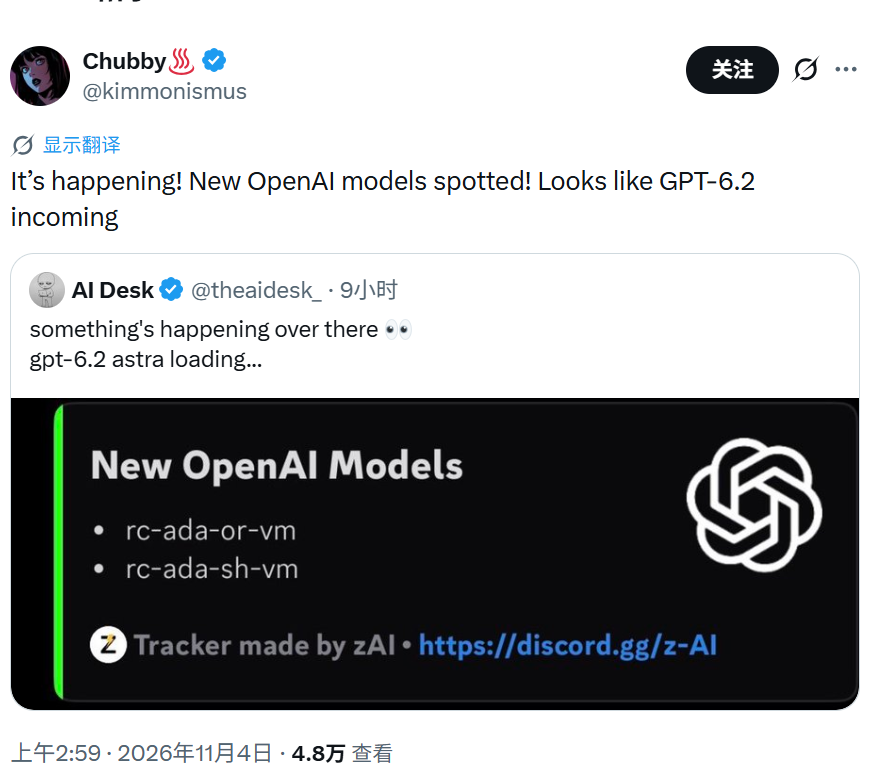
The second thread is thinner than the screenshots suggest. On November 3, model-tracking account LuminaBench claimed that two unfamiliar identifiers, "rc-ada-or-vm" and "rc-ada-sh-vm", appeared briefly in the OpenAI API model list and then disappeared. No document ties those names to GPT 6.2 Astra, and the demo clips circulating on social platforms have their own authenticity disputes, so they cannot be treated as evidence that the new model's capabilities have been verified.
The official story is narrower and better documented: a November 3 technical blog post from OpenAI titled "Accelerating engineering for the physical world" (openai.com/index/accelerating-engineering-for-the-physical-world/), covering benchmark results, an end-to-end hardware design case, internal adoption figures and two industry partnerships. It does not contain the string 6.2 anywhere, and OpenAI has confirmed neither a gray test nor a release date.
Signal scorecard: what each clue does and does not prove
| Clue | Where it came from | What it establishes | What it cannot show |
|---|---|---|---|
| gpt-6.2-astra listed separately in Codex usage analytics from October 31 | TestingCatalog, echoed by user screenshots | Some accounts' requests are being recorded against a distinct model name | Official availability, pricing, or a public model card |
| about 19.8% vs about 80% call split on one account | X platform post by Token Gremlin | Traffic is being divided, consistent with A/B routing | Any capability advantage over GPT 6 Astra |
| rc-ada-or-vm and rc-ada-sh-vm visible briefly in the OpenAI API list | LuminaBench | Unpublished identifiers exist | That they belong to GPT 6.2 Astra |
| newer internal model scoring 0.875 against GPT 6 Astra at 0.594 | OpenAI blog post, November 3 | A large jump on one engineering benchmark | Real-world manufacturing yield, or the model's shipping name |
| Front-end HTML strings naming a rival's next model | Community screenshots of Anthropic's site on November 1, reported by Sina Finance | Version labels leak before announcements across the industry | That any of these models have shipped |
The one official number: BenchCAD 2.0, explained without jargon
The headline figure is the one OpenAI did publish. On BenchCAD 2.0, GPT 6 Astra averages 0.594 at its highest reasoning setting, while a newer internal model — unnamed in the post — averages 0.875, a relative gain of about 47.3%, rounded in coverage to roughly 47%.
Understanding what the test asks is more useful than the number itself. BenchCAD 2.0 evaluates whether a model can rebuild 3D mechanical parts and assemblies and identify connections on circuit boards. The benchmark's own site (benchcad.com/blog/benchcad-2) describes version 2.0 as targeting real-world hardware engineering tasks such as reconstructing 3D parts and assemblies from engineering drawings, and the public dataset lists 100 held-out cases spread across six tasks. In plain terms: the model is asked to write executable CAD geometry that reproduces a physical component, and it is graded by running that geometry, not by how convincing the answer sounds. Think of it as a mechanic's practical exam rather than a written test.
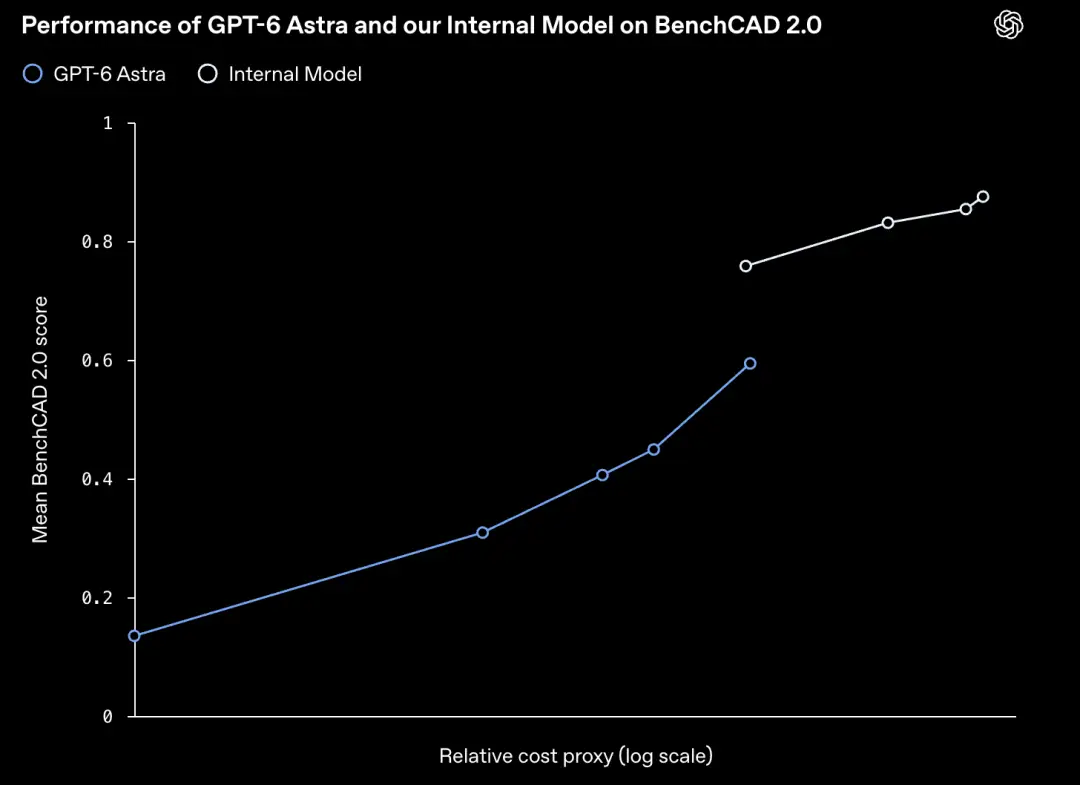
OpenAI's own framing is cautious: the result suggests a next-generation model could speed up iteration in professional engineering design. The post also states that the score belongs to a specific engineering benchmark and cannot be read as an overall success rate on real manufacturing jobs. There is also a naming trap worth flagging: OpenAI's September launch post for GPT 6 Astra cited a separate "about 47%" statistic — time saved per computer-use task — so any 47% figure in coverage should be traced to which measurement it refers to.
Head-to-head: the model you have vs the model people are guessing about
| Comparison axis | GPT 6 Astra (shipped) | GPT 6.2 Astra (unconfirmed) | How to weigh it |
|---|---|---|---|
| Status | Generally available since September 3, 2026 | No announcement; only a label in some usage dashboards | Only one is dependable for planning |
| Engineering benchmark evidence | 0.594 average on BenchCAD 2.0 at maximum reasoning | Not officially assigned any score; the 0.875 belongs to an unnamed newer internal model | Treat the 47.3% gain as direction, not as this model's spec |
| Physical-product work | Documented device design, Mazda aerodynamics and crash-safety research, Chip Ganassi Racing reverse modelling | Nothing disclosed | Case studies exist only for the current model |
| Cost and quota behaviour | Priced per token under published tiers; some Codex users report faster credit drain during the current window | Completely unknown, including whether it consumes the same credits | The gap most reviews skip, and the one that will shape adoption |
| Best fit today | CAD drafting support, drawing generation, simulation setup, design review, coding agents | Benchmarks and evaluation harnesses only | Ship on the confirmed model, test on the rumor |
Widen the frame and the pattern becomes clearer. Reports carried by outlets including Sina Finance on November 1 describe a rival lab's next-generation Claude 5.5 family surfacing in its own website's HTML source, with two front-end variants reportedly sharing one underlying model and differing mainly in how strictly guardrails are applied. Meanwhile, community trackers noted faster quota consumption on GPT 6 Astra during the same window (tech.sina.cn). Version labels are now leaking ahead of announcements industry-wide, and neither lab has published a model card to match.
A second caution applies when you compare numbers across vendors. Reporting from IT Home noted that figures quoted for GPT 6 Astra and a rival flagship did not line up exactly with the public Terminal-Bench listing, and that results move with reasoning effort and harness configuration. OpenAI's own table is a good example: 0.594 is explicitly the maximum-reasoning score, not the model's typical behaviour at everyday settings. A cross-model comparison that does not match reasoning levels, prompt scaffolding and task config is a marketing artifact, not a measurement.
Where the gains look concrete: two documented cases
OpenAI's post spends more time on deployed capability than on the next version. Two engineers used GPT 6 Astra to complete the design of a portable AI device in less than a week, with the model touching the enclosure structure, internal mechanical components, the PCB, electronic components, the user interface and firmware. During the design phase the engineers did not hand-edit the model's output, and a contract manufacturer produced a small batch of physical prototypes in less than a month.
The company is equally clear about the limits: turning a design into something manufacturable still takes multiple rounds of human review, because the model cannot consistently account for production process constraints, manufacturing tolerances and assembly details. That caveat is the most useful line in the whole post for anyone budgeting engineering hours — the tool accelerates iteration, not sign-off.
Internally, OpenAI says its hardware team's AI token consumption has grown 23x since February this year, with Codex and ChatGPT applied to computer-aided design, manufacturing drawing generation, engineering simulation and design review. Externally, a new research collaboration with Mazda explores aerodynamics and crash-safety design: GPT 6 Astra proposes alternative nose geometries that are then evaluated with airflow simulation. Mazda chief engineer Akihiro Nakata said that exploring and simulating dozens of design variants with AI helps engineers see which styling features actually move aerodynamic performance, and where designers retain freedom. The expanded partnership with IndyCar team Chip Ganassi Racing targets a different bottleneck — converting 3D scans of existing components into editable CAD models and 2D manufacturing drawings, cutting repetitive reverse-modelling work.
Five misconceptions worth killing now
- "The 19.8% share proves the new model is better." It only proves some requests were routed to a differently named model.
- "The 47% improvement is GPT 6.2 Astra's score." OpenAI named neither a version nor a release for the newer internal model behind the 0.875 result.
- "A BenchCAD win means it can build products." The score measures reconstructed geometry and identified board connections, not production yield.
- "A missing name means a cancelled model." Identifiers appearing and vanishing in a model list is normal staging behaviour and proves nothing either way.
- "Skipping a version number means something dramatic." Community explanations for the absence of a 6.1 label remain speculation, not statements from OpenAI.
A six-step checklist for vetting any model-rollout rumor
- Open the vendor's model catalogue, changelog and documentation first. If a model is absent there, it is not generally available, regardless of what your dashboard shows.
- Read your own usage analytics for names you never selected — that is how the gpt-6.2-astra records came to light in the first place.
- Separate interface labels from backend routing before concluding anything about a rollout.
- Archive pages the moment a name appears. Web archive snapshots are the only way to check identifiers that vanish, as the HTML-source case showed.
- Match test conditions — reasoning level, harness, task set — before comparing two models' numbers.
- Track your token and credit consumption for a full billing cycle; capability claims rarely come with cost disclosures.
Action advice, by role
- Developers: don't refactor anything around a phantom model. Add a label-detection step to your logging so you can see which model name served each request, and keep evaluation runs on fixed reasoning settings so a future switch is measurable.
- Product and marketing teams: plan launches against GPT 6 Astra. If you build a wait-and-see roadmap item, set a trigger — an official model card or changelog entry — rather than a date.
- Hardware and mechanical engineers: the documented workflow — scan to editable CAD, geometry drafts feeding simulation, human tolerance review — is available today and worth piloting on one non-critical part family.
- Everyday readers: treat leak screenshots as evidence of intent, not of quality. The only durable number so far is the one OpenAI published itself.
FAQ
Has GPT 6.2 Astra been released?
No. OpenAI has neither announced the model nor confirmed the gray test or a timeline; the evidence so far is a label in Codex usage statistics plus speculation about transient API identifiers.
Did OpenAI confirm that the 47.3%-better model is GPT 6.2 Astra?
No. The blog post calls it "a newer internal model" and does not disclose its name, so linking the 0.875 BenchCAD 2.0 score to any version number is inference by outsiders.
Is BenchCAD 2.0 run by OpenAI?
No. It is an external benchmark for programmatic CAD, with the 2.0 release describing hardware engineering tasks such as rebuilding 3D parts and assemblies from drawings and a 100-case, six-task held-out set (benchcad.com).
Will this change what I pay?
Unknown, and that is the honest answer. No pricing or credit weighting has been published for the rumored model, while some users report credits draining faster on the current model during the same window.
What should I watch for next?
Three things in order: an entry in the official OpenAI API model list, a published model card with evaluation settings, and a stated price. Screenshots of dashboards rank below all three.
Bottom line
The interesting part of this cycle is not which model wins, but how the industry now reveals it: labels appear in users' billing data and front-end source code weeks before any specification exists. Between the 19.8% traffic split, the two vanishing API identifiers and an official 0.875 score attached to a nameless model, what you have is a strong signal of direction and almost no signal of specifics. Keep your roadmap on the model you can document today, run your evaluation harness so a real upgrade shows up as a measurable delta, and let the vendor's changelog — not a screenshot — be the trigger for change.
Written by Sarah Chen, MyTechDailyNews (Tech Daily). Corrections and tips: hello@techdaily.com. Sources consulted: OpenAI, "Accelerating engineering for the physical world" and the GPT-6 Astra launch post (openai.com); TestingCatalog rollout reporting as carried by IT Home (tech.sina.cn, November 3); BenchCAD 2.0 task definitions (benchcad.com/blog/benchcad-2); version-leak reporting on the rival camp (finance.sina.com.cn).