
Nokia 2360 Flip: MyTechDailyNews General Guide to a Dual-Screen Safety Phone
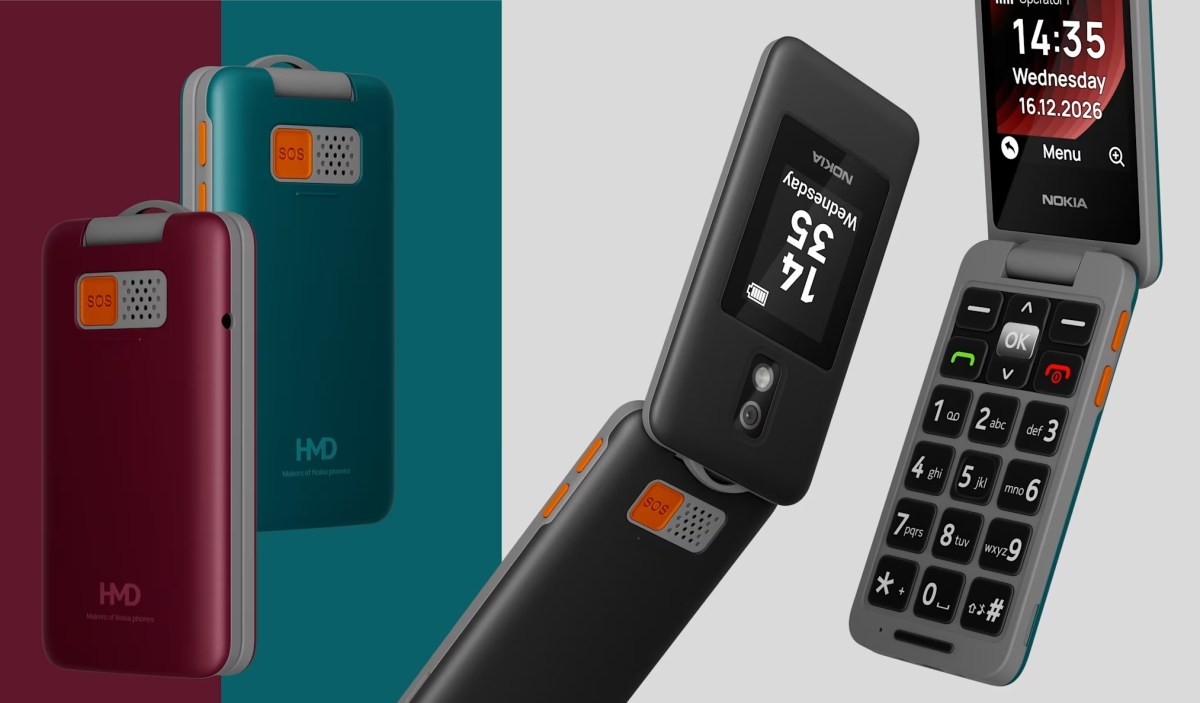
A recently announced product from HMD Global brings the flip phone back into the conversation: the Nokia 2360 Flip. This MyTechDailyNews General guide looks at why the dual screen handset is being sold as a family-safety device rather than a pocket computer. It targets people who need simple calling, predictable behavior, and a way for relatives to help set it up: older users, students, and anyone who wants less smartphone complexity.
Target users and the problem the phone tries to solve
The Nokia device is not positioned as a compact smartphone alternative. Instead, the 2360 Flip is built around a narrower audience that may be uncomfortable with touch-first interfaces, endless notifications, and frequent app updates. The product combines long battery life with communication basics and a set of remote controls that can be managed by someone else.
- Older users: the physical keypad, large menu icons, standalone speaker, and hearing-aid compatibility lower the effort needed for ordinary use.
- Students: School Mode can reduce access to games, camera functions, and unrelated phone use during class.
- Simplicity seekers: the phone stays close to calling and texting, with family management handled from a separate smartphone.
SOS button, Family Assist, and School Mode
A dedicated SOS emergency key is the clearest safety feature. On the Nokia 2360 Flip, holding the key for three seconds automatically calls a preset contact and sends an SMS alert to up to five emergency contacts. The contact list and emergency message settings can be configured through the associated app.
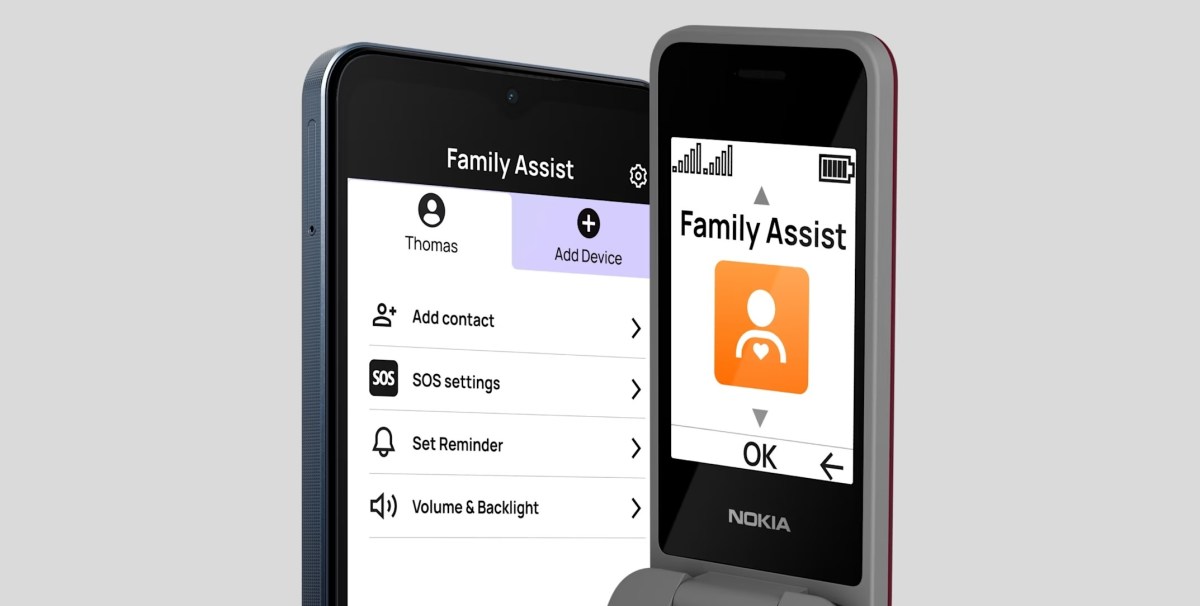
HMD developed Family Assist for Android and iOS. It allows a relative to manage the 2360 Flip remotely from a smartphone. Supported tasks include adding or editing address-book contacts, setting reminder notes, adjusting volume, and configuring emergency-help functions. Remote management is performed through SMS, so the user of the flip phone does not need a mobile data package or a Wi-Fi connection.
In a child-use scenario, the phone offers parental controls. School Mode limits the screen to a clock display while still allowing emergency calls, which helps reduce classroom disruption. A parent can also create a contacts whitelist so calls and texts only go to approved numbers, and can disable the camera or games separately. These restrictions are protected by a Family PIN, making it harder for a child to remove them alone.
Flip form, dual screen layout, and everyday usability
The design keeps a traditional clamshell shape. The inside screen is a 2.8-inch QVGA main display. The outside includes a 1.77-inch QQVGA sub-screen, which lets the owner see incoming-call details without opening the lid. For older users, the larger icons, real numeric keys, separate speaker, and hearing-aid compatibility are intended to reduce friction. These hardware choices reinforce the phone’s basic direction: make common actions visible and simple.
Hardware, battery, size, and colors
| Feature | Specification |
|---|---|
| Operating system | HMD S30+ |
| Memory and storage | 4MB RAM; 4MB internal storage |
| Storage expansion | microSD card support up to 32GB |
| Camera | Basic QVGA rear camera with LED flash |
| Audio and ports | FM radio; 3.5mm headphone jack; USB-C charging |
| Battery | 1450mAh removable battery; up to 15 days standby; up to 27.5 hours talk time |
| Dimensions and weight | 111.85×55.56×18.95 mm; about 121 g |
| Colors | three color options |
| Network | GSM 900/1800MHz; 2G only; no 4G LTE |
The removable battery is also important in a simple-phone context. When the battery ages, the owner can replace it directly instead of sending the whole phone for repair. That keeps the product practical over a longer period, as long as cellular service remains available.
The 2G limitation is the main purchase warning
The major restriction is network compatibility. The Nokia 2360 Flip supports GSM 900/1800MHz and does not support 4G LTE. As mobile networks continue moving toward 4G and 5G, this matters more than the small RAM or basic camera. In countries or regions where 2G service has already been closed, the phone may not be able to connect at all. Carriers in several European countries have been retiring 2G coverage, so buyers should not assume that the device will remain usable everywhere.
Pricing status and how it differs from HMD 2660 Flip
To date, HMD has not announced a unified global price or a complete launch plan. Buyers also need to distinguish the 2360 Flip from the earlier HMD 2660 Flip. The two are not the same model. The HMD 2660 Flip provides 4G network support, while the Nokia 2360 Flip uses a more straightforward 2G communications option.
Common misconceptions
- “A simple phone is automatically useless today.” The Nokia 2360 Flip is still useful for a narrow task set: SOS, whitelisted communication, School Mode, and basic calling.
- “Remote family management requires data or Wi-Fi.” The described workflow uses SMS, so the feature phone does not need a data plan or Wi-Fi.
- “Child restrictions are easy to bypass.” Family PIN is used to protect limits, and features can be disabled from the parent-management side.
- “Network support is a minor spec detail.” For a 2G-only device, the future of GSM 900/1800MHz coverage can decide whether the phone can be used in a given market.
Action checklist before buying or setting up
- Check whether GSM 900/1800MHz 2G service remains available from the intended carrier in the buyer’s country.
- Confirm the SOS workflow with the intended emergency contacts, keeping the maximum of up to five SMS alert recipients in mind.
- Set up Family Assist on an Android or iOS smartphone, then configure contacts, reminders, volume, and emergency settings.
- If the phone is for a student, enable School Mode, create the whitelist, and protect the setup with a Family PIN.
- If 4G LTE is required, compare the HMD 2660 Flip rather than assuming all Nokia flip phones share the same network support.
FAQ
Is the Nokia 2360 Flip a smartphone?
No. It is a feature phone built for basic calls, texts, long standby time, and supervised use, not for app-heavy smartphone work.
How does the SOS button work?
The user presses and holds it for three seconds. The phone then calls a preset contact and can send an emergency SMS to up to five contacts.
Does the phone need Wi-Fi for Family Assist?
No. The remote management path described for the 2360 Flip uses SMS, so it does not require Wi-Fi or mobile data on the flip phone.
Will School Mode completely block the phone?
No. It reduces access to a clock display and emergency calls, while normal functions remain available when the mode is not active or when the Family PIN-protected restrictions are changed by an authorized manager.
Is the Nokia 2360 Flip the same as the HMD 2660 Flip?
No. HMD 2660 Flip supports 4G, while the Nokia 2360 Flip remains limited to GSM 2G networking.
Bottom line for MyTechDailyNews General readers
The Nokia 2360 Flip is best judged as a family safety handset, not as a nostalgia-driven smartphone substitute. Its dual screen flip body, SOS button, Family Assist remote management, School Mode, and long standby time address real needs for a limited audience. The decisive question for MyTechDailyNews General readers is coverage: because this HMD phone remains on GSM 900/1800MHz and lacks 4G LTE, its long-term usefulness depends on whether the local 2G network survives in a 4G and 5G era.