
MyTechDailyNews General: Why Mercedes-Benz Is Replacing Drive Pilot L3 With L2++ and L4 Tests
Mercedes-Benz is pulling Drive Pilot from the new S-Class and the updated EQS because the L3 system solved a narrow driving problem at a high cost, while everyday buyers need something they can actually use. The company's replacement is MB.DRIVE ASSIST PRO, a broader L2++ assistance system, and it is also pushing L4 robotaxi trials with Momenta instead of polishing a half-way autonomous layer.
What changed in the S-Class and EQS lineup?
The headline change is removal: the previous flagship automated-driving badge is no longer positioned as a practical feature on the latest S-Class or on the updated EQS. Instead of offering a special L3 package tied to rare conditions, Mercedes-Benz is making a full-trip assistance system the main software story, while treating L4 as a future operational program rather than an optional accessory for private cars.
- Drive Pilot is no longer the flagship driver-off option on these models.
- MB.DRIVE ASSIST PRO is taking its place as the everyday assistance system.
- L4 is being developed through robotaxi testing, not as an immediate private-car subscription.
Why did Drive Pilot not stick?
Drive Pilot was historically important. At the end of 2021 it received approval from the German Federal Transport Authority, making it the first production L3 system legally allowed on public roads. In 2023, the system moved into Nevada and California in the United States, which strengthened the idea that Mercedes-Benz had opened the commercial path for conditional automation.
The limitation was not the certification itself; it was the shape of the use case. When active, Drive Pilot allowed hands-off and eyes-off operation, and if an accident occurred while the system was engaged, Mercedes-Benz accepted responsibility. But the system worked only at 64km/h, in congested highway traffic, during daylight, in fair weather, and in map-covered areas. It was useful in traffic jams, yet much less valuable when traffic flowed.
Price made the gap wider. In Germany, the option ranged from 5,000 to 9,000 euros, while the American arrangement was an annual subscription of $2,500. Mercedes-Benz's own conclusion, as summarized by Burzer in media remarks, was that introducing the technology too early exposed a hard question: what would customers actually pay for in daily driving? By January this year, the new S-Class had already moved away from Drive Pilot, and the updated EQS dropped it as well.
How does MB.DRIVE ASSIST PRO compare?
MB.DRIVE ASSIST PRO is the successor buyers are likely to meet first. Its value is not a higher legal automation layer; it is broader usefulness. The system is designed to provide assistance from start to destination on highways and city roads, including lane changes, intersection passage, turns, traffic-light recognition and response. It can be used in more ordinary trips, but it remains L2, so the driver must keep hands on the steering wheel and eyes on the road.
| Comparison point | Drive Pilot | MB.DRIVE ASSIST PRO | L4 robotaxi route |
|---|---|---|---|
| Automation label | L3 | L2++ | L4 |
| Practical aim | Hands-off and eyes-off in a narrow traffic-jam zone | Broader trip assistance on highways and city roads | Unsupervised vehicle operation in defined conditions |
| Driver responsibility | Mercedes-Benz took responsibility when the system was active | The driver remains responsible | No driver supervision is the goal inside the operational design domain |
| Main adoption barrier | Harsh conditions, price, liability and low usage | Still an assistance layer, not autonomous driving | Long technical, legal and fleet deployment timeline |
For buyers, the most important nuance is that L2++ is not simply a marketing synonym for L3. It gives a wider experience, but it does not move legal supervision away from the human driver. That is why the system has been framed as a practical bridge rather than a claim that car ownership has moved into driverless territory.
What do the 27 sensors add to the new S-Class?
The hardware explains why Mercedes-Benz believes the new platform can carry more software functions. The new S-Class can use up to 27 sensors, made up of 10 cameras, 5 millimeter-wave radars and 12 ultrasonic sensors, with a 254 TOPS compute platform. This kind of configuration matters because assistance features are not only about one camera or one map: they need redundant perception, road modeling, vehicle-speed context and fail-safe responses.
External coverage adds a useful perspective. NVIDIA's automotive blog describes the new S-Class as built around an L4-ready architecture, using full-stack DRIVE AV software with end-to-end AI and parallel classical driving systems to handle rare, messy road scenarios. That does not mean every private S-Class is a robotaxi today. It means the vehicle's electrical and compute foundation is being prepared for a long software road.
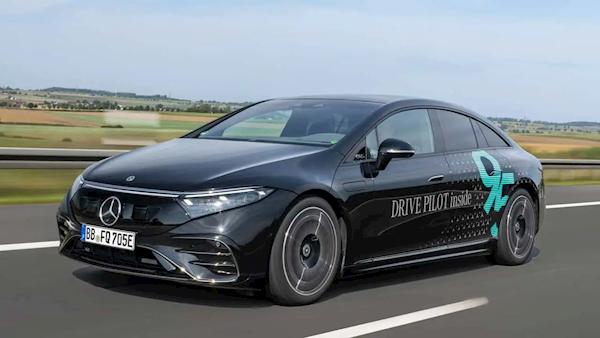
Mercedes-Benz is already testing the longer path: with Momenta, S-Class prototypes are being used for public-road L4 robotaxi testing in Abu Dhabi. Burzer expects L4 vehicles to enter mass production after 2030, followed by gradual rollout rather than an instant consumer switch.
Where does this route shift land for China, the United States and Europe?
MB.DRIVE ASSIST PRO has already been deployed first in the China market, with plans to expand to the United States and Europe. That sequencing tells readers how the company is thinking: test the broader assistance layer in markets where full-trip driver assistance is already highly visible, then bring the same architecture westward and into the brand's home region.
A route shift should not be confused with unrelated service news. For readers separating software strategy from vehicle quality issues, a separate article on Mercedes-Benz recalls 180,300 cars in China explains how recall notices, high-voltage components and door-lock defects belong to a different consumer-risk category.
Common misconceptions about Drive Pilot, L2++ and L4
- Misconception 1: L2++ is just another word for L3. It is not. The legal difference is supervision: L2 keeps responsibility with the driver, while L3 can place the system in charge inside a limited range.
- Misconception 2: Removing Drive Pilot means Mercedes-Benz abandoned automated driving. The route changed: L2++ is for current vehicles, while L4 is a longer development goal.
- Misconception 3: More sensors automatically create a self-driving car. Sensors are necessary but not sufficient; operational rules, compute safety, legal approval and fleet operations decide how far a system can go.
- Misconception 4: A robotaxi trial means private buyers will soon get unsupervised driving. Burzer's post-2030 timing suggests a phased transition, not an immediate showroom feature.
A practical decision checklist before buying or subscribing
- Check the activation conditions. Ask whether the system works only on mapped highways, only below a speed limit, only in certain weather, or across mixed urban routes.
- Check who is legally responsible. Hands-off convenience does not always mean eyes-off responsibility.
- Compare total ownership cost. A one-time option, subscription and possible software expansion may create very different resale expectations.
- Try the feature in your commute. If a function is mostly useful in traffic jams, it may not justify a premium in low-traffic driving.
- Watch update timing. L4-ready hardware does not guarantee L4 functions; future software rollout may remain uncertain.
FAQ: readers' main questions after the route change
Is Drive Pilot gone forever?
For the new S-Class and the updated EQS, yes: Drive Pilot is no longer offered on these vehicles. Mercedes-Benz is still pursuing higher automation through L4 testing, but that is a different product path from the earlier optional L3 system.
Should buyers care about 254 TOPS?
Only as one part of the system. Compute power matters because assistance functions must process many sensor streams and react reliably. The more useful questions are whether the function covers your routes, how it handles construction zones, and what responsibility rules apply.
Why is L4 considered later than L2++?
L4 needs the vehicle to complete driving tasks without human supervision inside defined conditions. That creates harder technical, regulatory and operational demands than L2++ or L3, especially around edge cases, remote handling and fleet service.
What is the simplest way to read this change?
Mercedes-Benz is moving from a narrow premium experiment to a broader daily assistance layer, while keeping full autonomy as a separate engineering and mobility-service goal.
Sources and related reading
- NVIDIA blog: Mercedes-Benz new S-Class L4-ready architecture
- Sina Auto: conditions that made Drive Pilot difficult in practice
- WardsAuto: market shift from Drive Pilot to MB.DRIVE ASSIST PRO
- MotorTrend: next-generation S-Class sensor and software context
- ZOL: MB.DRIVE ASSIST PRO operating scenarios and sensor configuration