
MyTechDailyNews General Tech Explainer: Mercedes-Benz’s PLM.AI Backbone Links Engineering to After-Sales While Targeting 30% Faster Development and Testing Cut by half
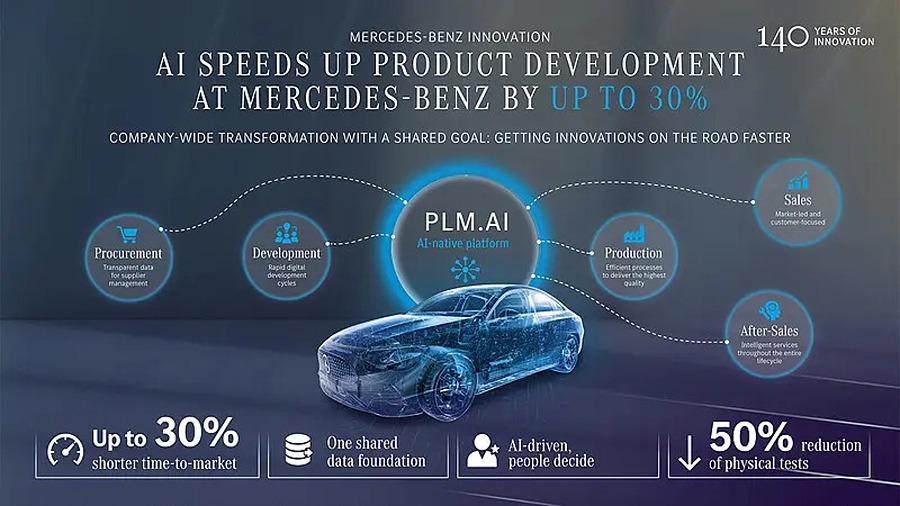
In product development, information often lives in separate departments, documents and tools. Mercedes-Benz is trying to change that pattern with PLM.AI, a digital backbone intended to connect product knowledge across the entire lifecycle. Instead of treating artificial intelligence as a series of standalone assistants, the company is using standardized data models and end-to-end integration to make the same information flow through development, procurement, production, sales and after-sales. The stated direction is to reach series maturity faster, more efficiently and more sustainably while maintaining existing quality and safety expectations.
© Mercedes-Benz AG
For general technology readers, the story is less about one vendor tool and more about how lifecycle data becomes usable for intelligent applications. PLM data becomes 100 percent AI-ready for applications, according to the company’s plan, because the data is intended to be consistently structured and accessible through a continuous digital thread. That matters when a change early in development has commercial, safety or production consequences later. The goal is to help teams evaluate interdependencies earlier, use resources more efficiently and validate decisions sooner.
What Changes When Lifecycle Data Becomes AI-ready
Artificial intelligence is already involved in several engineering tasks, including material-cost optimization, certification and homologation, fault detection and resolution, and software work. The difference with PLM.AI is connection. Many existing AI agents are mostly confined to separate process steps; the new backbone is intended to link applications across development workflows. In practical terms, that means related information can be reused in real time, coordination becomes simpler, and new technologies can be moved toward customer benefits more quickly. The company frames the investment of around half a billion euros as preparation for a more connected, data-driven and intelligent development generation.
The expected productivity effect is process-dependent. Development time can fall by up to 30 percent, while some individual engineering processes may gain up to 50 percent in efficiency. The broader target also includes a 30% reduction in development time and cutting physical testing by half over time. The same benchmarks that define every Mercedes-Benz are intended to remain unchanged; quality and safety remain as high as ever. Shorter cycles are described as the result of better, earlier decisions, not lower standards.
One Example: Weight Optimization
One area that illustrates the need for cross-domain visibility is weight optimization. Changing a component can affect costs, crash behavior, hardware and software functions, and production processes. Specialized AI agents are expected to analyze these interdependencies simultaneously. Teams can then receive an overall picture faster and evaluate options that account for safety, quality and commercial considerations. Linking product, service and operating data also opens new potential in after-sales.
Two Strong Technology Partners and One Lead Role
Two strategic technology partners support the platform: CONTACT Software and Siemens. CONTACT Software supplies the open PLM core layer through CONTACT Elements, a modular and scalable foundation for integrating product data, processes and applications along the product development process and for incorporating future AI technologies flexibly. Siemens contributes comprehensive solutions and know-how in AI-enabled automotive design, simulation and digital validation for the digital twin. Through the shared data and process foundation of PLM.AI, key engineering domains can be interconnected and accelerated.
Mercedes-Benz remains the lead organization for the end-to-end transformation. It defines the target vision, target architecture, data models and governance of PLM.AI, manages global implementation within an agile transformation program, and continues developing the digital backbone. The company also retains full ownership and control of its data, as well as of the AI models developed and used on that basis.
Why This Matters to Non-Engineering Readers
- Faster technology transfer: PLM.AI is designed to help new products and technologies reach series maturity more quickly, more efficiently and more sustainably.
- Earlier trade-off visibility: AI-supported connections may help teams spot safety, cost, quality and production interdependencies earlier.
- More targeted validation: AI-powered simulations and development workflows make physical testing more targeted, which could reduce physical testing by half over time.
- People remain central: Product-decision responsibility stays with teams; the platform is intended to assist analysis, not remove accountability.
- Data governance matters: Standardized data, clear standards and continuous integration are presented as the conditions that make applications work together.
FAQs: Common Questions About PLM.AI
Is PLM.AI replacing Mercedes-Benz’s engineering teams?
No. The stated role is to support better decisions earlier by giving appropriate staff appropriate information when needed. People remain central, and product-decision responsibility stays with the teams.
Does cutting physical testing mean lowering safety standards?
No. The plan says existing quality and safety standards are maintained. The 30% and up to 30 percent targets are framed as coming from better coordination, real-time information and more targeted validation.
Why does “AI-ready” matter more than adding another AI tool?
Because separate AI assistants are mostly confined to separate process steps. PLM.AI pushes capability further by linking applications across development workflows. Standardized data models and a continuous digital thread are intended to make PLM data 100 percent AI-ready for applications.
What role do CONTACT Software and Siemens play?
Two partners are named. CONTACT Software provides the open PLM core layer through CONTACT Elements. Siemens contributes solutions and know-how in AI-enabled automotive design, simulation and digital validation for the digital twin. Mercedes-Benz retains ownership and control of its data and related AI models.
Common Misconceptions Before the News Becomes Clearer
- Misconception: A digital backbone is just a larger database. In the PLM.AI description, the differentiator is connected lifecycle data, AI applications and governance, not storage alone.
- Misconception: AI autonomy equals decision autonomy. The company’s framing keeps people in product-decision responsibility.
- Misconception: Efficiency gains are uniform across every task. The stated range includes up to 30 percent for development time and up to 50 percent for some individual engineering processes.
- Misconception: Partner platforms imply loss of data control. The stated position is that Mercedes-Benz retains full ownership and control of its data and of the AI models developed and used on that basis.
Action Advice: What to Watch as PLM.AI Develops
- Check whether PLM data is described as connected across development, procurement, production, sales and after-sales, not just digitized within one team.
- Look for governance signals: target architecture, data models, standards and ownership should be clear before the promise of an AI-ready foundation can be assessed.
- Treat efficiency numbers as planned direction rather than final delivered results: the source frames them as potential outcomes, including a 30% reduction and testing cut by half.
- Follow how One example, weight optimization, is implemented in practice; cross-domain simulation and earlier trade-off visibility may become the clearest measure of progress.
- Watch Two partner roles, CONTACT Software and Siemens, plus Mercedes-Benz leadership, because responsibility for architecture, integration and data control shapes how durable the transformation may be.