
Why the 127-page Martech for 2026 Report Ships Free — and What It Signals for Everyday Marketing Teams
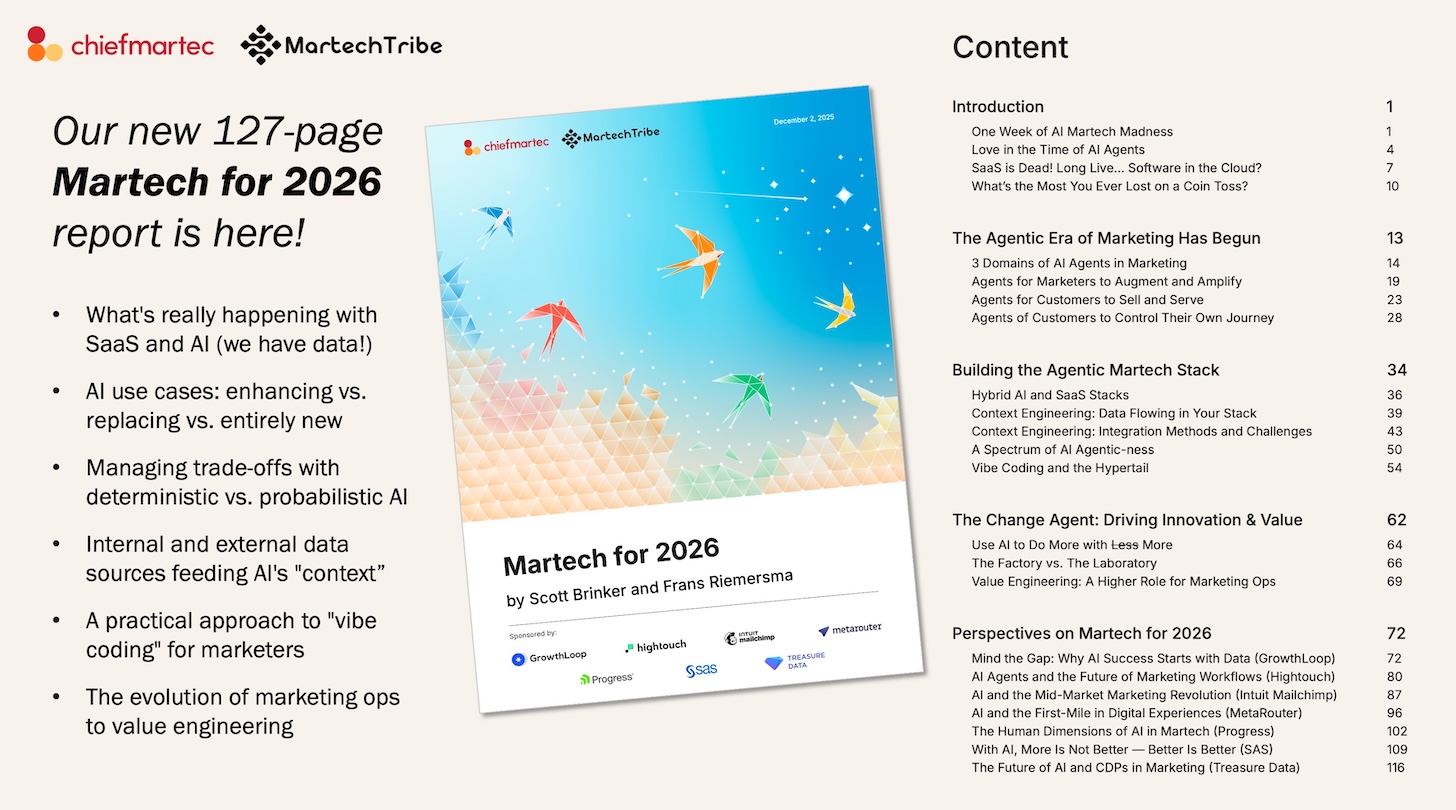
Short answer: a brand-new industry study titled Martech for 2026 has been released as a free, ungated 127-page PDF, and the release model tells you almost as much as the research inside it. It maps 7 major subjects for the year ahead — from the 3 types of AI agents now entering marketing stacks to the shift toward Marketing Ops 3.0 — using survey data collected a couple of months ago. The headline finding for ordinary readers: AI agents are now normal to try, still rare to run well, and the winners of the next cycle will be teams that ask value questions rather than buy more tools.
For a general tech audience, this matters beyond the marketing aisle. The same agent architecture described in the report is what quietly decides how fast a support inbox clears, how a product feed gets personalised, and how much of the content you scroll past this year was assembled by software rather than typed by a person.
What does the 127-page Martech for 2026 report actually cover?
Conclusion first: seven themes, written for humans rather than for engineers, each with a plain-language explainer and a visual. Nothing here requires a data-science background.
- What SaaS & AI genuinely deliver inside marketing tooling once the hype layer is peeled off
- 3 types of AI agents, and why only one of them behaves like a true category-breaker
- Context engineering — the unglamorous work of feeding an agent the right internal information
- A dial, not a switch: the spectrum from deterministic to non-deterministic automation
- Where vibe coding already pays off for non-technical staff, and where it becomes a liability
- Two management mindsets: The Factory for dependable output versus The Laboratory for experimentation
- Marketing Ops 3.0, where value engineering is ranked above the popular GTM engineering playbook
The evidence base is the AI & Data in Marketing survey, fielded a couple of months ago and worked up into charts rather than jargon. That framing choice is deliberate: the report is written to be readable by a marketing director who has never opened a terminal.
Why give away months of work for zero dollars?
Answer: somebody else paid for it. The authors estimate the research could easily carry a price tag of $1,000 or more; instead, 7 sponsors funded the effort so that access costs nothing — which is why there is no form to fill and no “leave a comment on LinkedIn” arm twisting before you can read it. The full document is downloadable exactly as published, and the sponsors themselves had no input or editorial review of the content; they first saw the finished report yesterday.
What the sponsors did get was an interview-based chapter each, kept separate from the analysis:
- GrowthLoop on why AI outcomes live or die on data readiness
- Hightouch on how agents redraw everyday marketing workflows
- Intuit Mailchimp on what the AI shift means for mid-market budgets
- MetaRouter on the “first mile” — the moment user data enters a digital experience
- Progress on the human dimension: trust, skills and anxiety inside tool-owning teams
- SAS on why more models is not better, and why better beats more
- Treasure Data on the future of CDPs once agents handle the plumbing
One editorial read on this model, flagged here as analysis rather than fact from the report: ungated publishing is becoming a competitive tactic in itself. When generative tools can summarise any paywalled PDF in seconds, the durable asset stops being the document and becomes the audience that trusts the name on it. Handing out a 127-page study for free is less charity than a bet on reach.
Why do most AI agents never reach production?
Conclusion first: the bottleneck is supervision and context, not raw model quality. Post-release analyses of the report’s survey numbers put adoption at roughly 90.3% of marketing organisations using agents in some form, while only about 23.3% have them running in full production (see growthmethod.com and martech.zone write-ups of the same dataset). That gap — pilots everywhere, production scarce — is the most quotable number in the whole document.
The report’s explanation maps neatly onto that gap. Deterministic automation does exactly what a rule told it to do, so an approval trail can be audited after the fact. Non-deterministic agent work improvises within a goal, which is why it feels powerful in a demo and terrifying in a live campaign. Context engineering sits in between: the practical question is not how smart the agent is, but whether the customer list, pricing rules, brand restrictions and past decisions are packaged in a form the agent can actually consult. A useful analogy for non-specialists: an agent is a brilliant new hire with no badge, no access to the shared drive, and no manager with time to review every sentence before it ships.
That framing also explains why only one of the 3 types of AI agents is called disruptive. The other two accelerate work that already existed; the third removes the human step from the loop entirely, and it is the one that forces rewrites of staffing plans, not just software budgets.
The Factory or The Laboratory: which one are you running?
Conclusion first: most teams claim to want The Laboratory while paying for The Factory, and the report treats that mismatch as a management failure, not a personality trait.
| Dimension | The Factory | The Laboratory |
|---|---|---|
| Core question | Can we ship reliable output at predictable cost? | Can we learn something we did not know last quarter? |
| Automation posture | Deterministic, rule-bound, auditable | Non-deterministic, exploratory, tolerance for failure |
| How vibe coding is used | Small internal utilities that save hours | Rapid prototypes nobody signs off on yet |
| Typical failure mode | Efficiency without differentiation | Constant experiments, nothing ever scaled |
The practical advice is separation of accounting, not of people: a budget line that expects production reliability, and a smaller line that explicitly expects a share of experiments to fail. Marketing Ops 3.0 is the label the report uses for teams that stop measuring themselves on campaign throughput and start measuring the value those systems create.
What changes for you as a reader?
Conclusion first: expect faster, more granular personalisation and more machine-assembled content — and expect your own data to be the raw material.
- Speed of service: agent-assisted support and workflow automation compress response times, so a two-day wait starts to look unacceptable.
- Mid-market leverage: capabilities once reserved for large enterprises become affordable to smaller teams, per the mid-market chapter contributed by Intuit Mailchimp.
- More first-party-data requests: since context is the limiter, brands compete harder for permission to store and use your preferences.
- More AI-labelled output: the practical value of anything you read shifts toward sourcing, data and editorial independence — the very things this ungated release foregrounds.
Three misconceptions worth dropping before planning for 2026
- “Tool count equals capability.” The landscape census contradicts it: the number of marketing technology products has plateaued, so buying another app is no longer the obvious answer.
- “An agent in a demo is an agent in production.” The roughly 90% versus 23% gap says most deployments are not live yet.
- “Free means low value.” Sponsorship covered months of work; the absence of a paywall is a funding choice, not a quality signal.
A 30-day action list for readers who work around these tools
- Download the PDF and read the 7 major subjects section once without taking notes; mark the two themes that touch your daily workflow.
- Inventory which of the 3 types of AI agents you already use — assistant, copilot or autonomous loop — and where each sits on the deterministic-to-improvised spectrum.
- List the data sources an agent would need to act on your behalf, and check who actually maintains them.
- Split your next quarter of experiments into Factory work and Laboratory work, with different success criteria for each.
- Try vibe coding one genuinely low-risk internal utility, then write down what slowed you down — usually governance, not code generation.
- Set one review checkpoint before the year closes: which automation produced measurable value, and which produced only volume.
Trend judgment: what to watch in the next twelve months
Conclusion first: expect consolidation and role redefinition rather than a gold rush. Three signals support that read. First, the industry census now records about 15,505 marketing technology products, up only 0.79% from the previous year — the flattest year in the fifteen-year run of the count, according to the follow-up landscape analysis published in May 2026 on chiefmartec.com and covered by martech.org. Second, that follow-up catalogue maps roughly 70 AI use cases across six major marketing functions, which suggests the fight has moved from “which tool” to “which job”. Third, a survey of 300 marketing leaders published by the same newsletter found that vibe coding can and should be done within guardrails and governance — the author’s warning that casual code from non-technical staff needs review like anything else that touches customer data.
Our own projection, offered as analysis: the next competitive gap between brands will not be who owns the most agents, but who can put an agent in production without a compliance incident. That is a boring, operational kind of advantage — and the most durable one in this cycle.
FAQ: the questions readers keep asking
Is the Martech for 2026 report genuinely free?
Yes. It is published ungated as a 127-page PDF: no registration form, no social-comment requirement, no paywall. Access is funded by 7 sponsors who had no editorial say, and who first saw the finished document yesterday.
Do I need a technical background to follow it?
No. The writing avoids techno-jargon and leans on plain-language explanation plus visual illustration. Concepts such as context engineering and the deterministic-to-improvised automation spectrum are introduced from the business side.
What is the single most useful finding for a non-marketer?
That experimentation and production are different disciplines. Adoption of AI agents is broad while fully live deployments remain a minority, and the difference is governance and context — the same pattern shows up in consumer-facing apps of every kind.
Who produced the report, and who wrote this article?
Frans Riemersma and his co-author compiled the study. This summary and analysis for MyTechDailyNews is by Sarah Chen, Tech Daily.
Where should I send corrections or feedback?
To our editorial desk at hello@techdaily.com — the same channel we use for reader questions on general tech coverage.
Sources and further reading
- Original report announcement and download: chiefmartec.com — “Here’s your copy of our Martech for 2026 report” (https://chiefmartec.com/2025/12/heres-your-copy-of-our-martech-for-2026-report-free-and-ungated/)
- Adoption-versus-production figures as analysed after release: growthmethod.com (https://growthmethod.com/martech-2026-biggest-takeaways/) and martech.zone (https://zh-cn.martech.zone/martech-for-2026/)
- Tool-count plateau, 15,505 products and 0.79% growth: chiefmartec.com 2026 landscape supergraphic (https://chiefmartec.com/2026/05/2026-marketing-technology-landscape-supergraphic-peak-martech-achieved-maybe/) and martech.org (https://martech.org/martech-2026-ai-drives-a-major-industry-reset/)
- Vibe coding guardrails from the 300-marketer survey: newsletter.chiefmartec.com (https://newsletter.chiefmartec.com/p/vibe-coding-in-marketing-we-surveyed-300-marketing-leaders-on-its-adoption)
- Successor study with roughly 70 mapped AI use cases: newsletter.chiefmartec.com (https://newsletter.chiefmartec.com/p/here-s-your-ungated-copy-of-the-state-of-martech-2026-report)
Written by Sarah Chen for MyTechDailyNews, General. Published by Tech Daily — feedback and corrections: hello@techdaily.com.