
MyTechDailyNews Guide: Turning the Martech 2030 Scoreboard into a 2026 Action Plan
By Sarah Chen · MyTechDailyNews (published by Tech Daily)
Short answer: the marketing-technology bets placed at the start of this decade have aged well enough that, for most teams in 2026, the real job is no longer experimenting with AI tools but governing, measuring and retiring them. The half-time scorecard is worth reading as a purchasing list: it shows which habits to fund now and which ones are still soft everywhere except on paper.
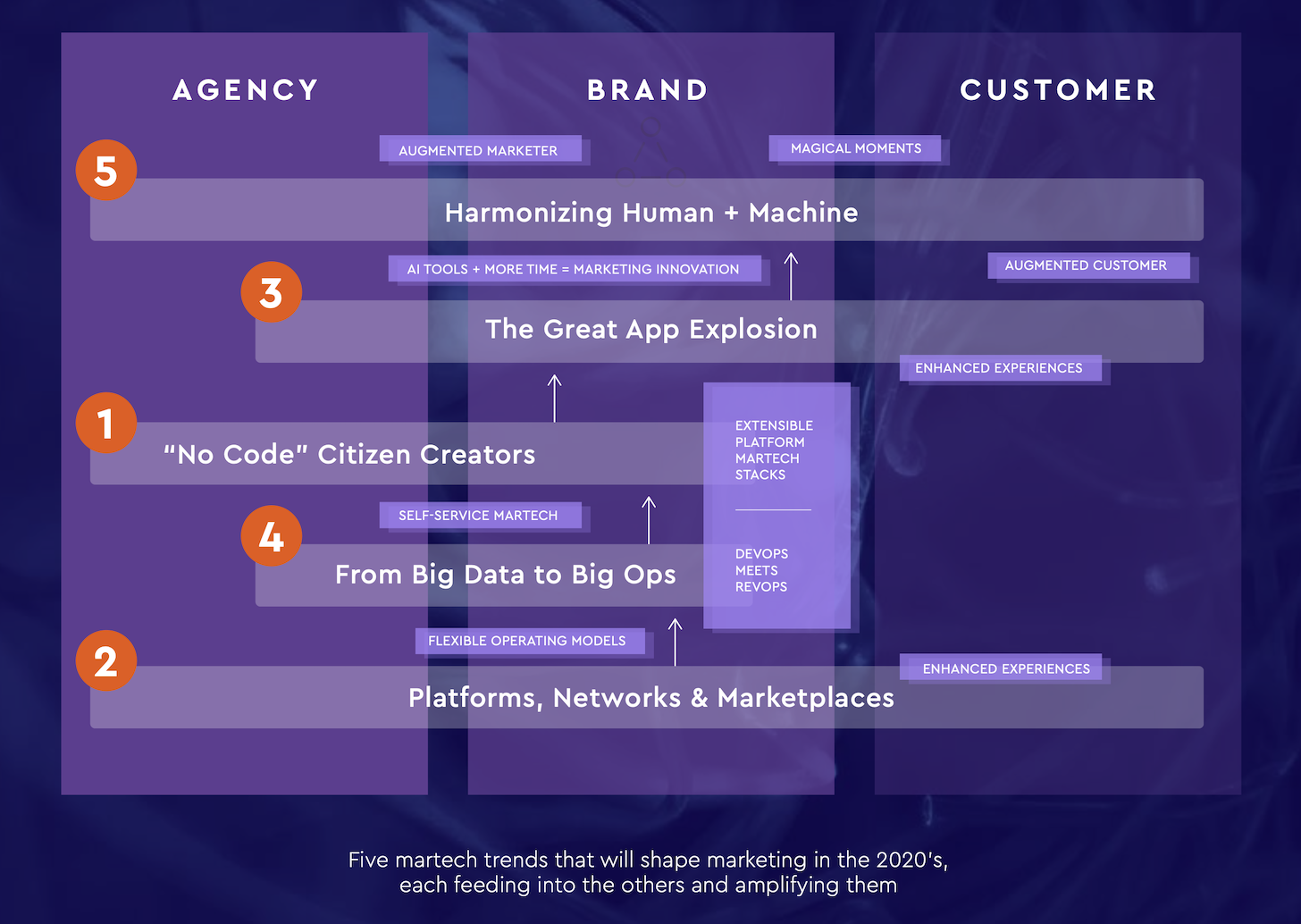
Five years ago Jason Baldwin and Scott Brinker released Martech 2030 (a free, ungated PDF), a report describing five major trends that would shape marketing and martech through what they christened The Decade of the Augmented Marketer. At the start of 2026 the clock reached half-time, and the authors asked ChatGPT, Claude and Gemini to grade their own forecast. The machines were generous, most of all about the report's vision of “harmonizing humans & machines.” Claude and Gemini handed that item A+’s, which the authors note is itself a small joke about harmony.
This guide takes the exercise one step further for general tech readers rather than martech specialists: for each trend, what a normal team should actually do this quarter — with checklists, a 90-day plan, the traps that ruin good rollouts, and the questions readers keep asking. Every number, name and date below is kept exactly as the report states it; anything added comes from named external sources, linked at the end.
What did the report predict, and how did each trend score?
Verdict first: the two trends ordinary people feel in their daily work — self-service building, and humans working alongside machines — are the strongest; the two that remain uneven are structural, namely ecosystem commerce and operations. That split is the single most useful planning signal in the whole review.
| Trend | The 2020 bet in one line | Half-time mark | Reader takeaway |
|---|---|---|---|
| Trend #1 | “No Code” citizen creators build their own digital assets | The authors call it a direct hit | Skill beats licence: automate one recurring request |
| Trend #2 | Platforms, networks and marketplaces replace linear chains | A-/B+ | Check where your software is really bought |
| Trend #3 | The Great App Explosion | Delivered, and bigger than forecast | Audit before you add anything |
| Trend #4 | Big Data gives way to Big Ops | B/B+ | Guardrails are the missing budget line |
| Trend #5 | Harmonizing humans & machines. | A+’s | Prepare for AI buyers, not only AI senders |
The category is not deflating either. MarketsandMarkets' March 2025 press release sized global MarTech at USD 175.95 billion in 2025 and projected USD 296.88 billion by 2030, an 11.0% compound annual growth rate — although another 2025 outlook values the same category at USD 412.48 billion in 2024, so definitions differ hugely and any single figure should be treated as directional. The original question still stands: do these trends match your lived reality? Treat the grades below as a checklist, not a scoreboard to admire.
How should a team act on Trend #1, the “No Code” citizen creator?
Start with your request queue, not with a new platform: the cheapest early win is turning repetitive build requests into approved, self-service templates. Everything else in this trend follows from that.
The bet goes back to the previous decade, when the authors argued that “No Code” platforms would let marketers implement their own digital ideas. Airtable, Webflow and Zapier were their reference examples for databases, websites and workflow automation respectively; Gartner labelled this population citizen creators, while the report preferred its own term, “marketing makers,” meaning builders inside go-to-market teams. Their mid-decade assessment is blunt — they consider this prediction a direct hit — and credit something they did not foresee: the generative AI explosion that started in late 2022.
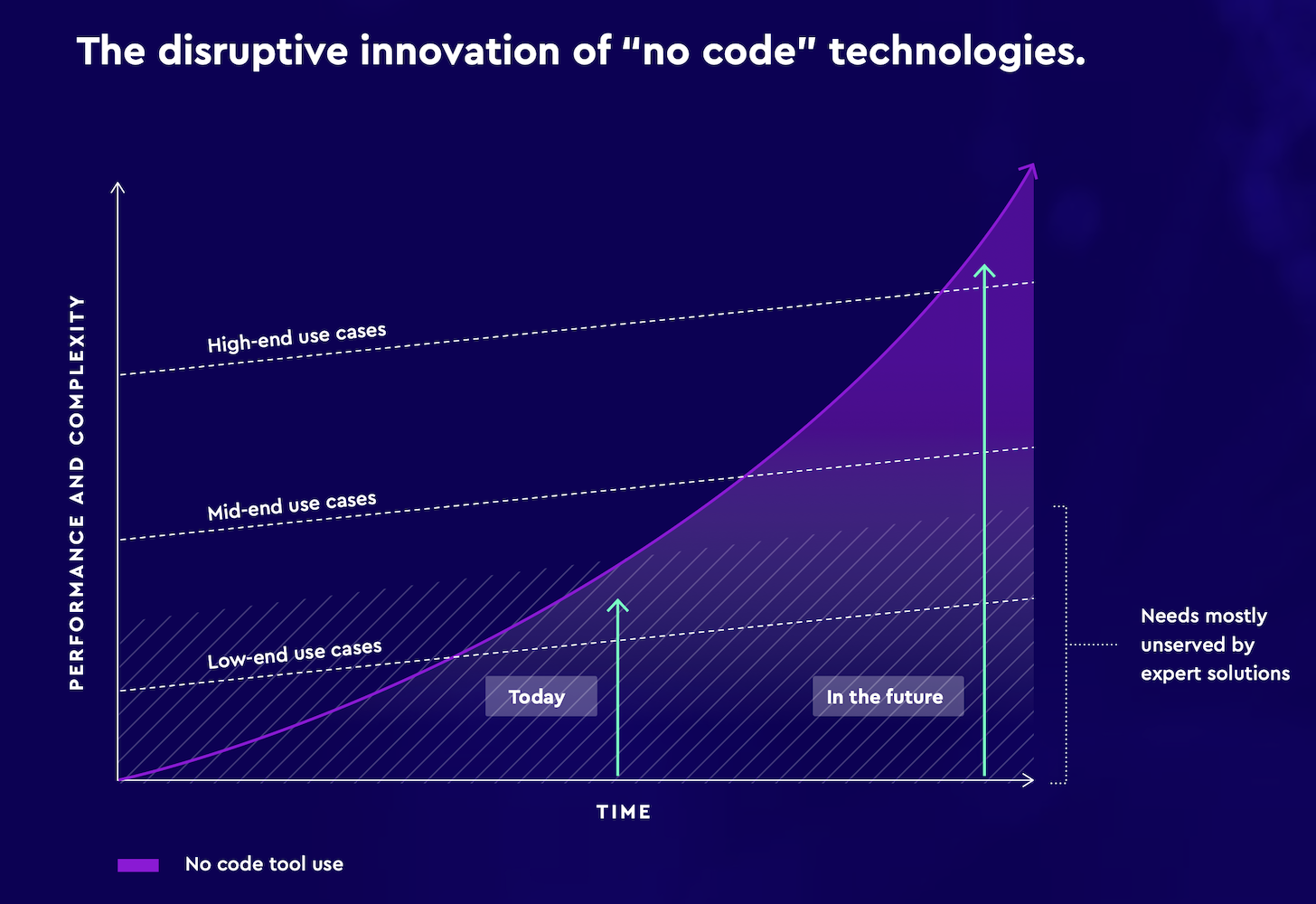
Two years ago no-code meant drag-and-drop. With large language models you describe the thing and it appears. Early results were text plus images with six fingers (a wink at Inigo Montoya). Across the past two years, though, people have talked themselves into working apps, agents, videos, infographics, workflows, campaigns, data analyses and PowerPoint decks. It remains a jagged frontier, but many of those outputs are now genuinely usable. Andrej Karpathy's much-quoted line fits perfectly: “The hottest new programming language is English.” In 2025 vibe coding — a term Karpathy coined — pushed the whole thing into hyperdrive, with non-engineers shipping apps and agents through Bolt, Lovable, Replit and Vercel. It worked best on simple jobs, which is precisely the underserved entry point Clay Christensen identified as the seedbed of disruptive innovation. If you need a yardstick for how far to trust a prompt-built app, Brinker's own scoring rubric, the Lemkin Scale of Vibe Coding, is the reference point.
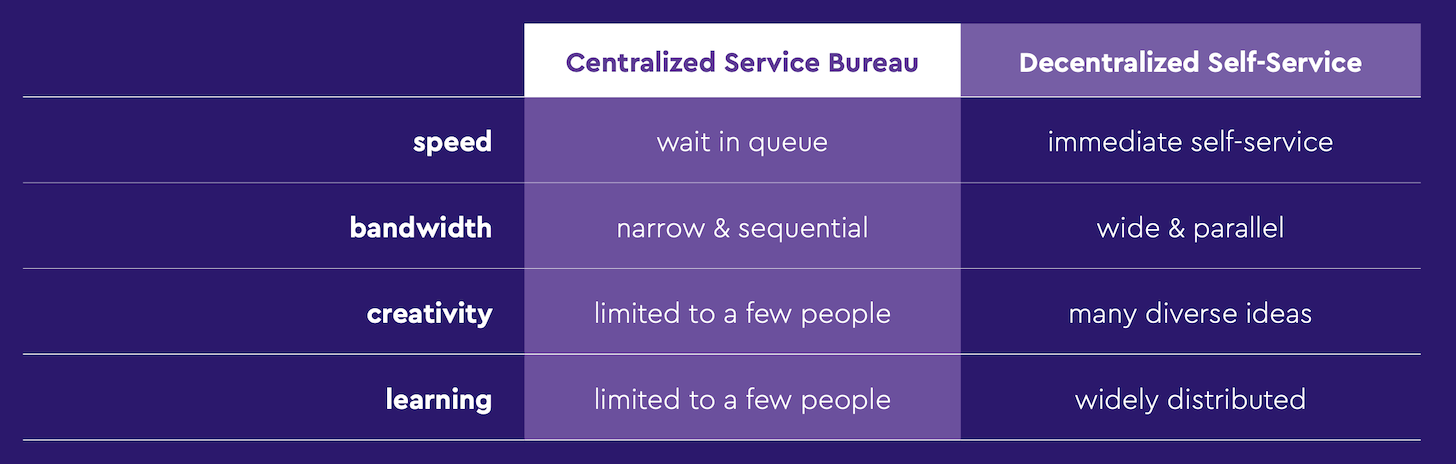
Worth saying to your CFO: the major assistants themselves — ChatGPT, Claude and Gemini — have become über no-code platforms producing an ever wider range of digital assets on demand. Teams that leaned in gained speed, bandwidth, creativity and the compounding benefit of decentralized self-service.
Copy-this checklist (first 30 days):
- Pick the one recurring request your team resends weekly — a landing page, a reporting sheet, an enrichment job.
- Build it once with an approved tool, then package it as a template with locked fields.
- Give every citizen-built asset a named owner and an expiry date on the file itself.
- Keep customer data inside sanctioned systems; the prompt may travel, the record may not.
- Publish a one-page “what you may build unaided” list, with an escalation route for everything else.
- Measure time-to-ship before and after, so the win is defensible in the next budget round.
Where teams slip: the report itself flags governance and guardrails for citizen-created assets as immature — brand drift, compliance blind spots, and single-person apps nobody can maintain. Gartner's April 2025 research on supporting and governing low-code applications at scale is the closest thing to a copyable template right now, and most of its advice is organizational rather than a new licence purchase.
What does Trend #2 change about how software gets bought?
Look at your purchase path before your product roadmap: in 2026 a growing share of enterprise software is transacted through someone else's storefront, and that quietly changes your negotiating leverage.
The reasoning: if prior decades were about firms optimizing linear chains — value chains, supply chains, distribution chains — business structure and strategy would increasingly be driven by interconnected graphs and ecosystems built on platforms, networks and marketplaces. In martech, platform ecosystems have fully displaced the old suite-versus-best-of-breed argument. Brinker contributed to that shift as VP platform ecosystem of HubSpot, a role he left this past September after 8 years of building the company's ISV program from the ground up.
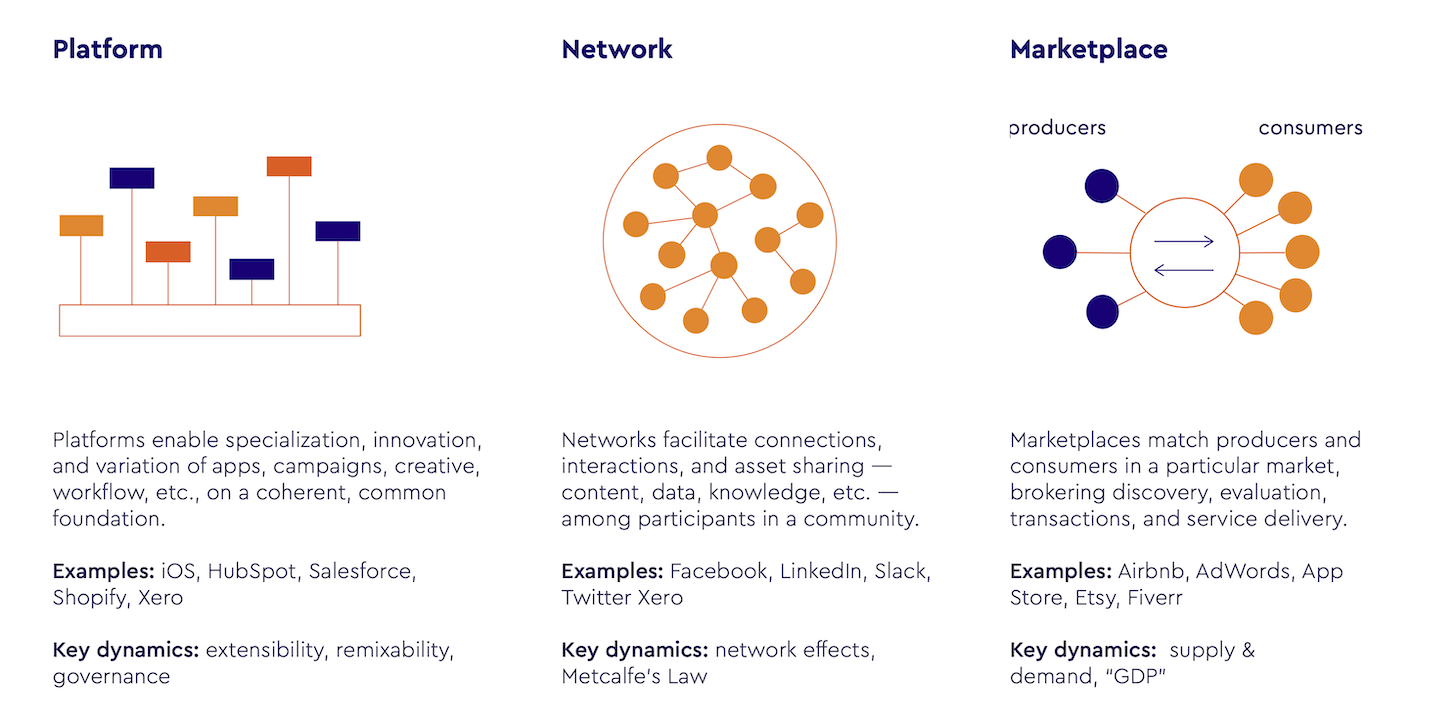
Two of the hottest platforms today are Databricks and Snowflake, which act as universal data layers cutting across heterogeneous tech stacks. The most intriguing platform candidates heading into 2026 are the major AI engines, with MCP connectors and the emerging concept of ChatGPT Apps. On the network side, digital marketplaces have multiplied; the most noteworthy in martech are the hyperscaler storefronts — AWS Marketplace, Google Cloud Marketplace and Microsoft Marketplace — which now transact an estimated $45 billion in annual enterprise software sales, a channel through which Adobe, HubSpot and Salesforce all sell.
The paradox the report calls “a Zen koan for the digital age”: these ecosystems drive decentralized growth and innovation through centralized control of standards and governance. You centralize to decentralize. That tension is also why this trend sits at only A-/B+ — ecosystem dynamics still feel new to many companies, which prefer the control, or the illusion of control, offered by direct linear go-to-market plays. The authors double down on their bet that ecosystems, and the platforms, networks and marketplaces that animate them, will underpin marketing by the end of this decade.
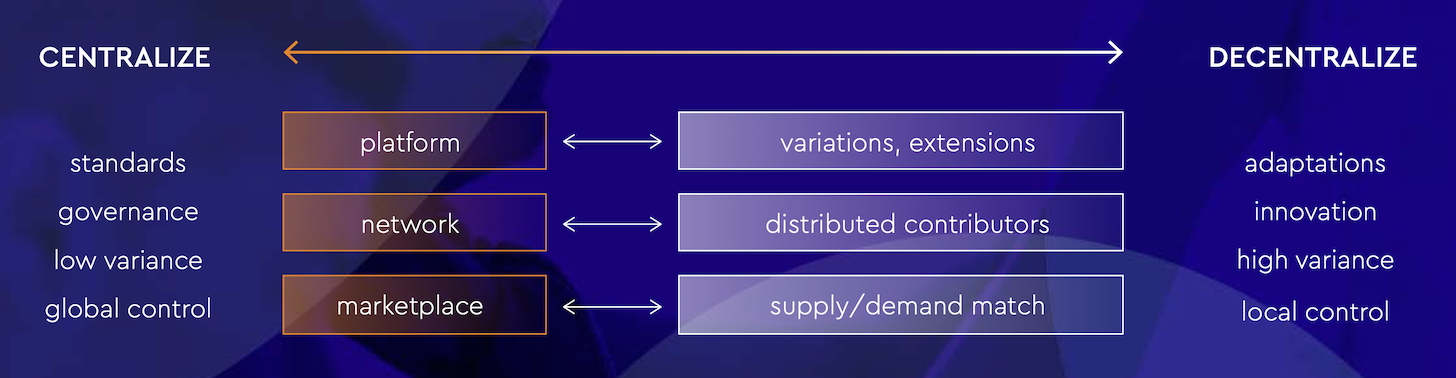
Three concrete moves:
- List the three ecosystems your revenue depends on (one CRM or data platform, one cloud or storefront, one AI engine) and name an owner for each relationship.
- Put your next renewals through the marketplace route and see how much committed-spend credit you can apply — this is where budgets hide.
- Expose one product surface as a machine-readable connector. The Model Context Protocol is the clearest signal that this is now standard plumbing rather than an experiment: Anthropic introduced it as an open standard in November 2024, OpenAI adopted MCP in March 2025, and in December 2025 Anthropic donated the protocol to the Linux Foundation's Agentic AI Foundation, co-founded with Block and OpenAI.
How do you live with 15,384 martech tools without drowning?
Audit before you buy: in a market that keeps adding tools, the highest-return action is usually deletion. Gartner's 2025 Marketing Technology Survey found martech utilization has dropped to 49%, which turns the report's abstract app-explosion warning into a spreadsheet line.
The numbers the report itself leans on: the 2020 martech landscape held 8,000 solutions when Martech 2030 was written, and most observers treated that as “peak martech.” Here we are in 2025 with nearly twice as many — 15,384 commercial solutions on the map. Why no consolidation? It consolidates constantly through competition and M&A, but software has effectively no barriers to entry, a reality AI has dialled up to 11, so new products arrive faster than old ones leave. Ironically, consolidation of hyperscaler cloud infrastructure and major app platforms triggered thousands of specialist apps built on those foundations: the vertical-market, regional, ecosystem and service-provider tools plus the endless startup tide that form the landscape's famously long tail.
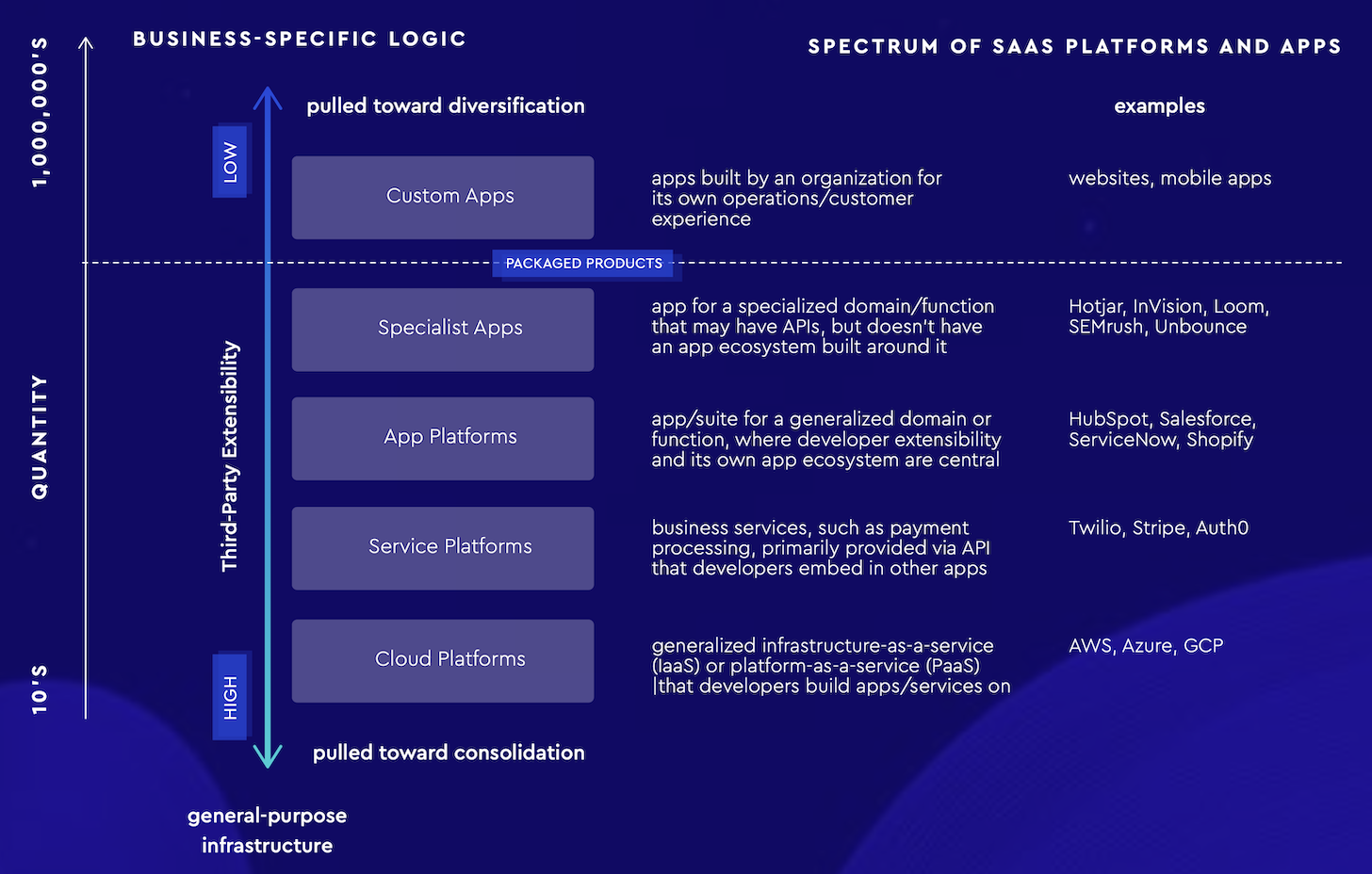
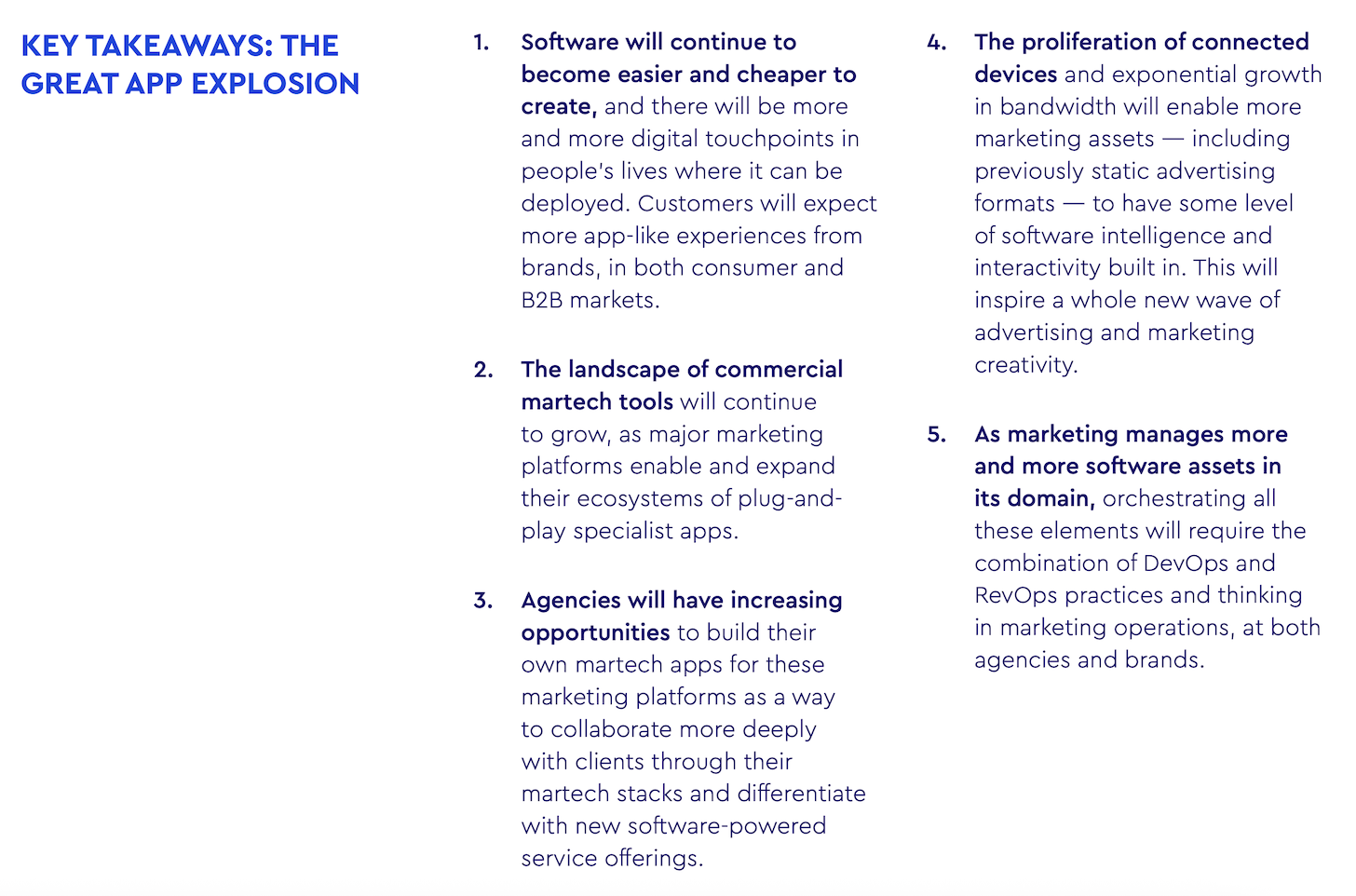
The original forecast went further: not thousands of apps, but Billions — the vast majority custom-built by organizations for their own operations and customer experiences. The commercial long tail keeps growing, but it is being dwarfed by a “hypertail” of custom martech. Readers wanting the underlying data can follow the report's own pointers to the State of Martech 2025 and Martech for 2026 studies, released last spring and this past December. Five predictions nested inside this trend are materializing, among them service-as-software (takeaway #3) and the rise of intelligent, interactive marketing assets (takeaway #4). AI has delivered the explosion; the hypertail already exists.
Stack-audit routine, run quarterly:
- Pull twelve months of invoices and one login-activity export per tool.
- Flag anything with seats below half-utilization or no login in sixty days.
- Draw overlap pairs — two tools answering one job — and pick a survivor.
- Label each tool: keep, absorb into a platform, retire, or replace with a prompt-built workflow.
- Publish the renewal calendar with one owner per line, and re-run the test next quarter.
Why is Trend #4, Big Ops, the mess you are meant to fix?
Because the diagnosis is right and the tooling is late: operations, not insight, is where budgets will go. Expect this to be the hardest trend to solve and the most durable source of new product claims.
The forecast said the 2020’s would be a decade of Big Ops — the same instinct that once organized Big Data, turned toward taming the scale and complexity of hundreds to thousands of parallel apps, agents and automations running across a company's data. The report called the problem correctly: the chaos produced by uncoordinated citizen creators colliding with the app explosion. That earned it a solid B/B+. Technical and organizational solutions are still emerging, and almost every major martech platform is chasing the same opportunity right now under the labels “orchestration” and “decisioning.” This is the platform battle for the rest of this decade, so grab popcorn.
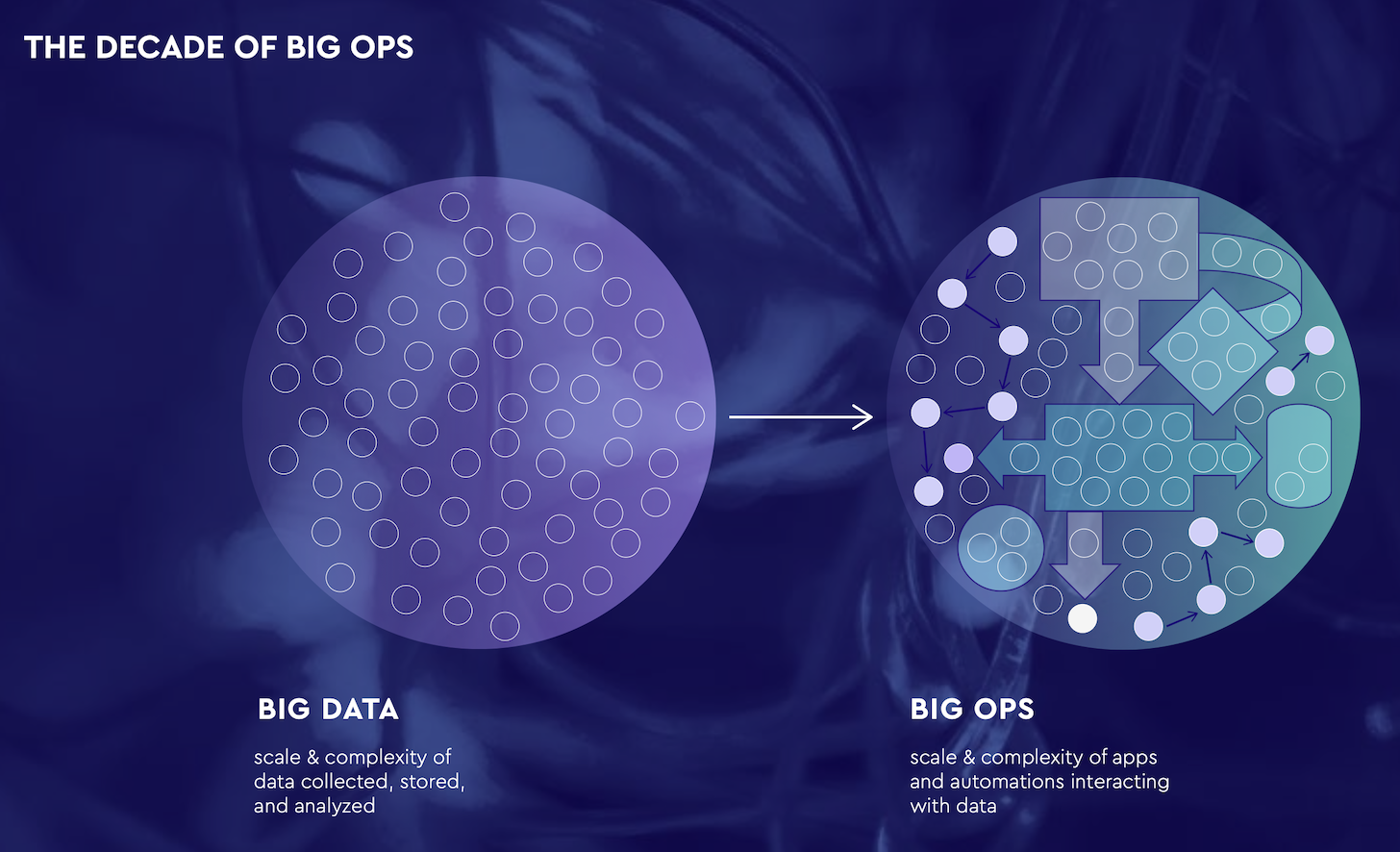
Data is the critical asset here, but its value unlocks only through distillation and activation — described in the report as data intelligence and data reflexes. The best line in the whole document is the metaphor: data is not the new oil, it is the new oil paint, and Big Ops is how pigments on a palette become finished canvases.
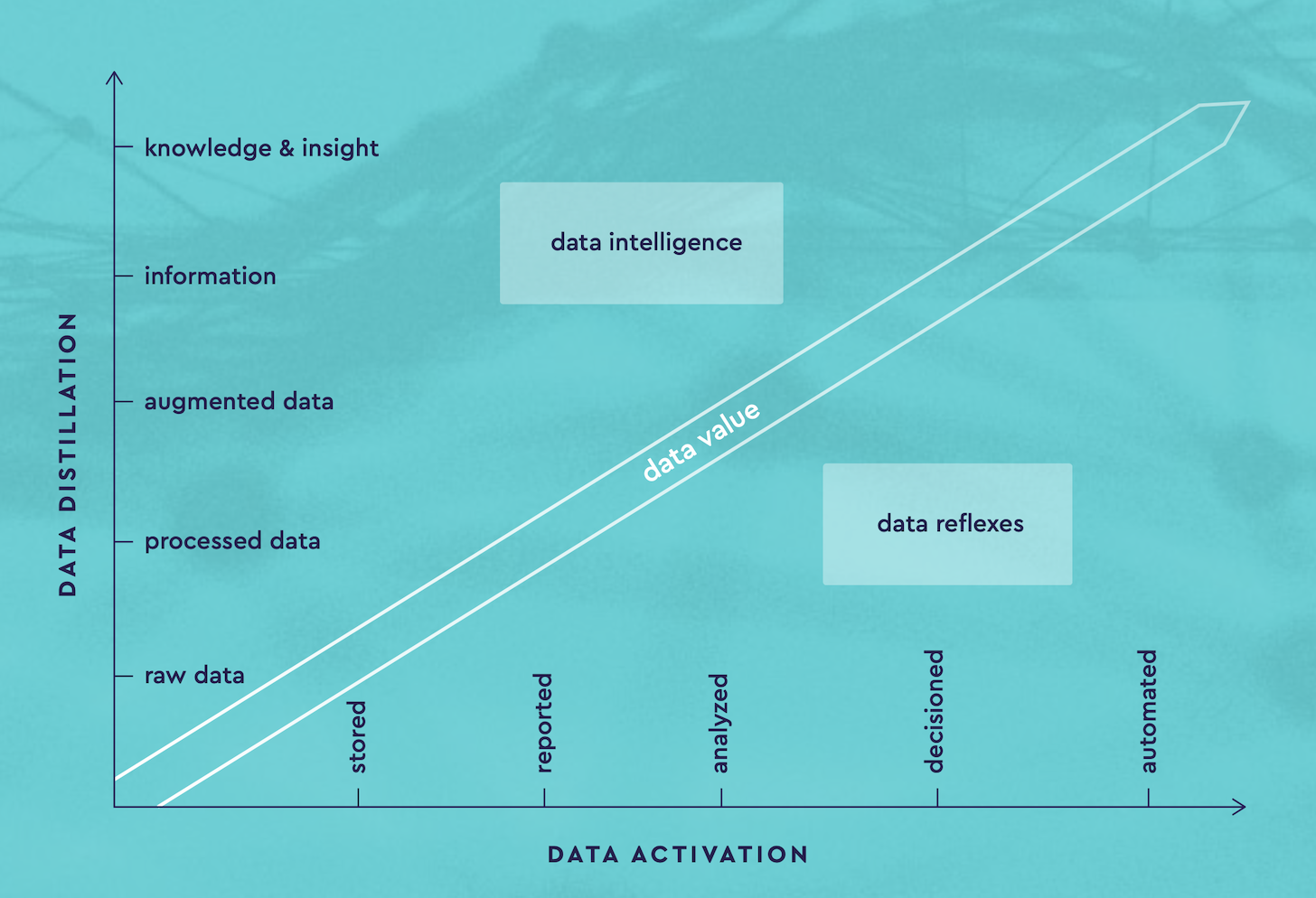
It is precisely the entanglement of Big Data and Big Ops that puts Databricks and Snowflake, plus the hyperscalers AWS, Google and Microsoft, in the running for these Orchestration Wars. Around them sits a frenzy of coopetition: public martechs such as Adobe, Braze, HubSpot, Salesforce and Zeta; evolving CDPs such as Hightouch, Tealium, Syncari, Treasure Data and Twilio; agent and automation platforms such as CrewAI, n8n, Make, Workato and Zapier; next-generation startups such as GrowthLoop and iCustomer; and the AI giants Anthropic and OpenAI. More popcorn required.
A minimum viable operations layer, before any new purchase:
- A registry: one list of every app, agent and automation, with owner, data touched and last review.
- Risk tiers: public content, internal workflow, and anything touching customer data or money get different gates.
- A path from sandbox to production, so nobody builds in the dark.
- Quarterly access reviews and a documented kill switch for abandoned assets.
- One shared metric — time from idea to live, and defects found in production — so “orchestration” stays accountable.
How do you prepare for AI buyers, AEO and agentic commerce?
Publish machine-readable truth about what you sell, then measure what assistants actually say about it. That one loop covers most of Trend #5's near-term to-do list.
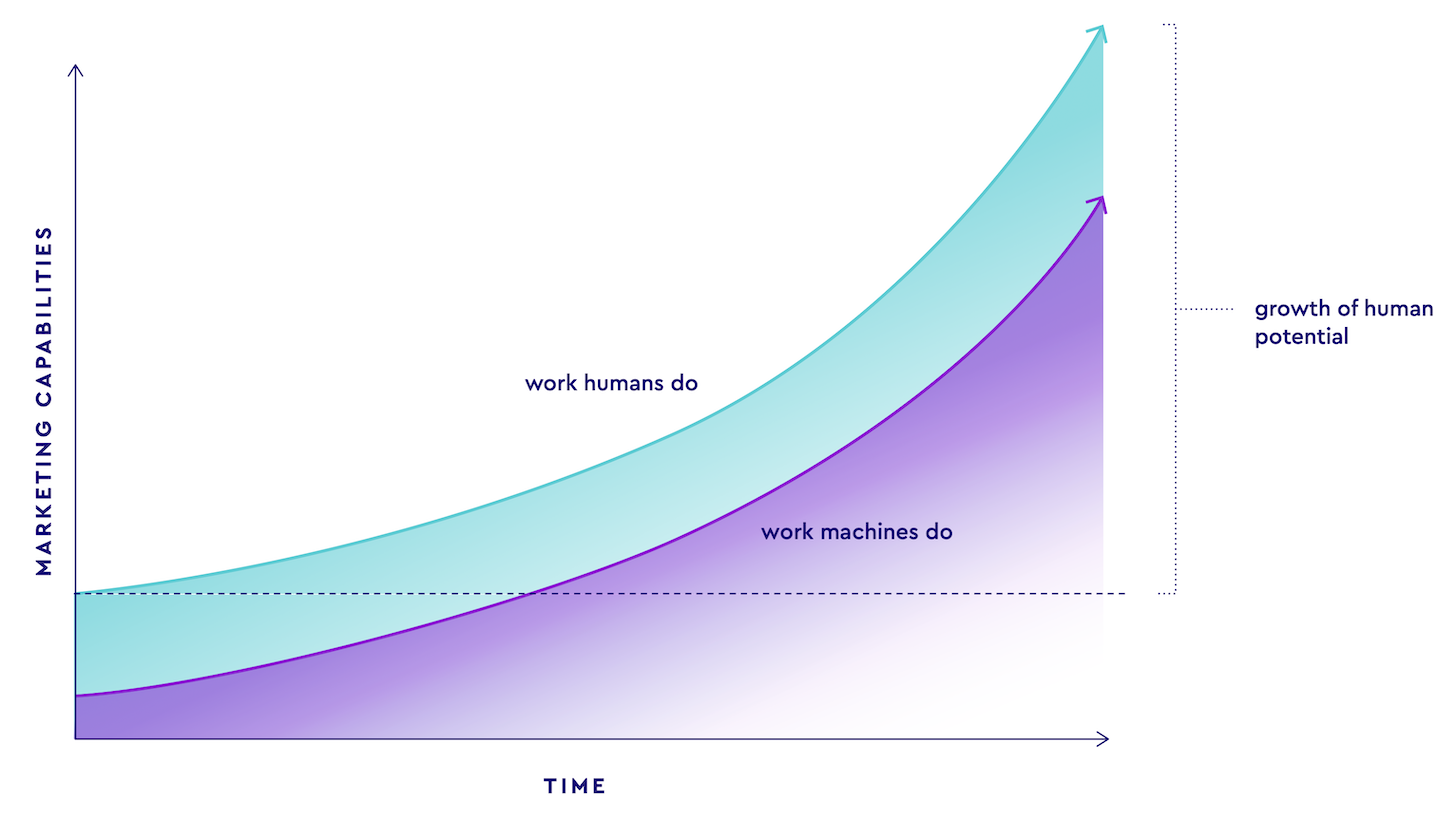
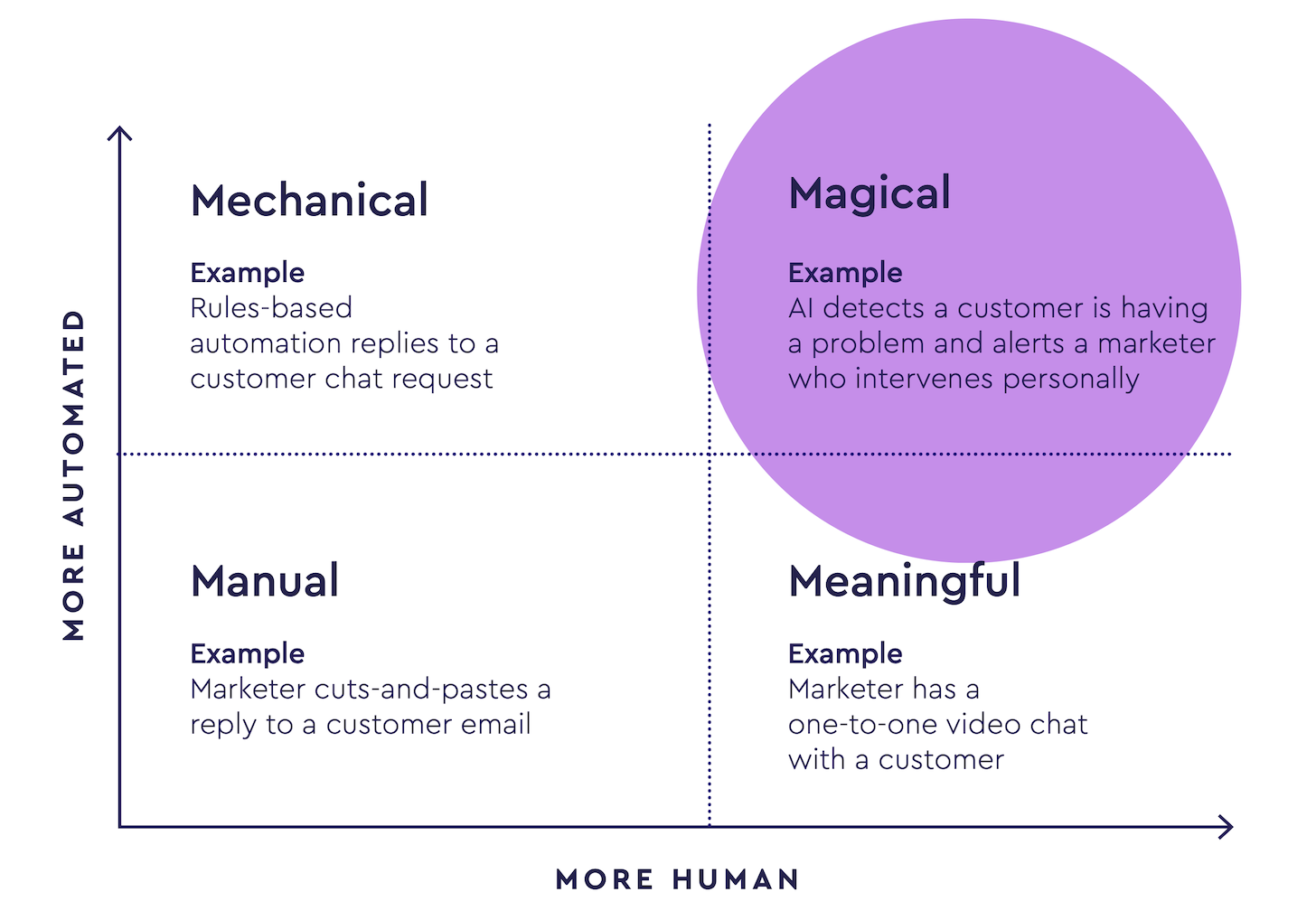
Make this prediction today and the reply is “no duh.” Five years ago the claim — “Greater automation and AI assistance will give marketers more time and new tools to focus on customers, creativity & innovation.” — was prescient, and the graph the report sketched is close to how events played out. Automation and human engagement are not mutually exclusive; synthesized properly, they produce experiences that feel magical rather than mechanical.
In 2025 buyer-side AI emerged as a genuine market force through Agents of Customers, another outcome the authors had anticipated. The 2020 idea of a shift from SEO to BBO (Buyer Bot Optimization) has resurfaced as the move from SEO to AEO (AI Engine Optimization), and what was forecast as Bot Commerce now goes by Agentic Commerce. The labels are cosmetically different; the underlying concepts crossed from theory into reality, which is how this trend collected its A+’s.
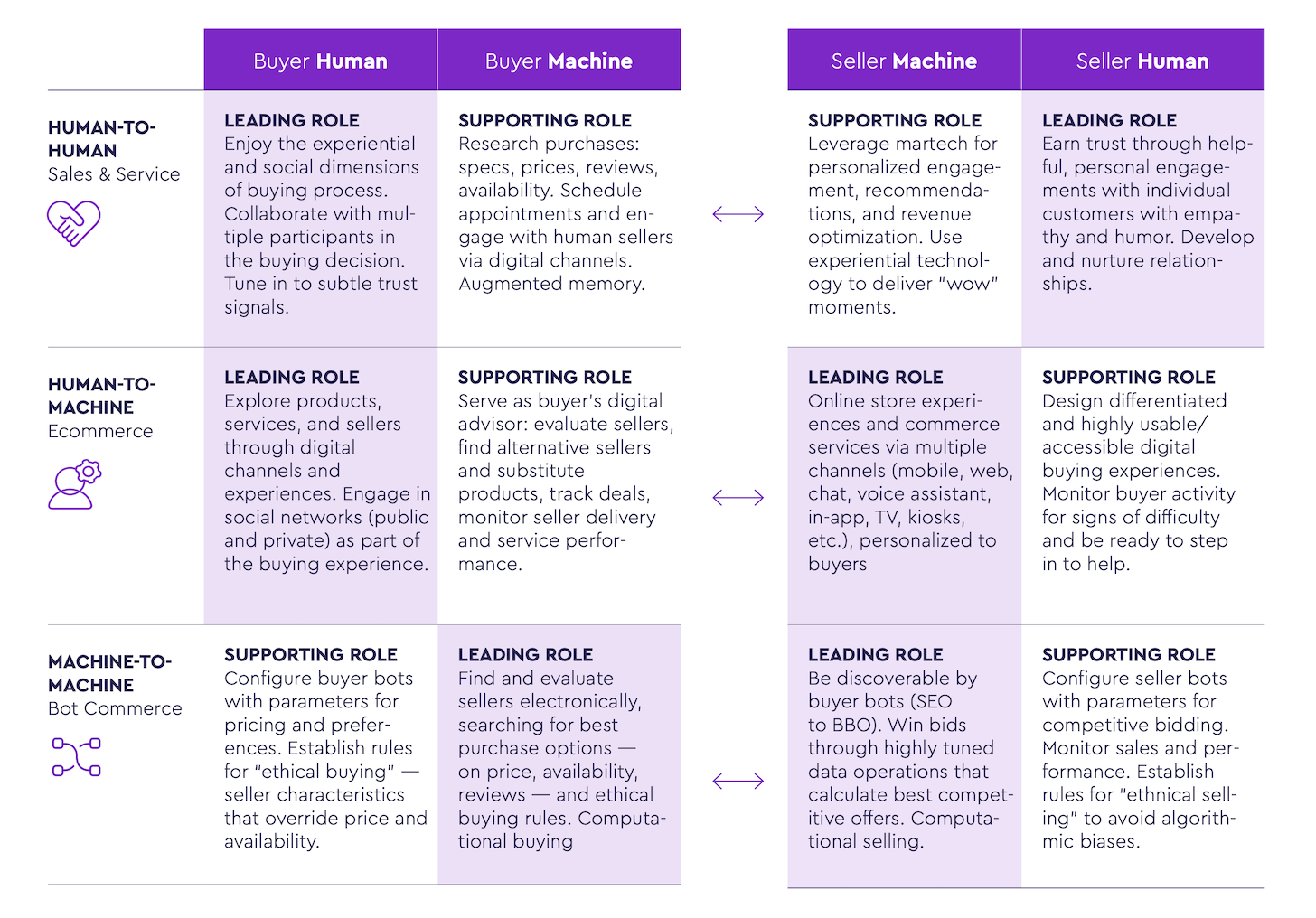
Consumer behaviour has caught up with the vocabulary. eMarketer reported in January 2026 that 38% of consumers already use AI while shopping and 80% expect to use it more, mostly to compare options and get decision support. McKinsey fielded its Agentic Commerce Consumer Survey in June 2026, polling roughly 21,000 consumers across 11 markets — evidence that retailers are being pushed to answer an old question in a new format: who represents the customer when the customer is a model?
AEO starter plan:
- Write down the ten questions a first-time buyer asks about your category.
- Give each question one authoritative answer page: dated facts, numbers, sources, no marketing adjectives.
- Publish structured product truth — specifications, prices, availability, return and privacy policies.
- Run a fixed set of prompts against the major assistants monthly and log how each one describes you.
- Track visits that arrive from AI surfaces and their conversion quality, separately from classic search.
- Do not gut your SEO foundations: answer engines cite pages that are crawlable, current and clearly attributable.
Which assumptions about this scorecard are wrong?
- “Martech peaked years ago.” It was declared peak martech at 8,000 solutions and reached 15,384 commercial solutions — entry barriers, not appetite, keep it growing.
- “An A+ grade means everyone has adopted it.” Harmonizing humans & machines scored highest while ecosystem selling stalled at A-/B+; being right early and being normal are different things.
- “Big Ops is a product you can buy.” The report's own B/B+ reflects that the gap is organizational — registry, owners, gates — before it is technical.
- “AEO replaces SEO.” The report's earlier term BBO rebranded rather than displaced search; treat it as an extension of the same crawlable content.
- “No-code makes engineering obsolete.” The earliest wins were deliberately basic use cases — the low-end foothold Clay Christensen described, not the core system.
- “Market-size numbers are settled.” Published valuations for this category differ by several hundred billion dollars depending on definition, so use them for direction, not for decisions.
What should you actually do in the next 90 days?
| Window | Actions | Owner | Proof it worked |
|---|---|---|---|
| Days 1–30 | Run the stack audit; template one recurring request; register every citizen-built asset | Marketing ops | Utilization baseline plus one live template |
| Days 31–60 | Move one renewal through a cloud marketplace; publish ten buyer questions with structured answers | Finance + content lead | Credits applied; answer pages live |
| Days 61–90 | Adopt the operations registry and access reviews; log how assistants describe you; retire one overlapping tool | IT + marketing jointly | Registry signed off; first retirement executed |
FAQ: quick answers for everyday tech readers
What is Martech 2030, exactly?
A free research paper published five years ago by Jason Baldwin and Scott Brinker. It named five major trends for The Decade of the Augmented Marketer, and its mid-decade re-grading is what this guide turns into practical steps.
Who assigned the grades?
The authors asked ChatGPT, Claude and Gemini to score their own forecasts at the start of 2026; the friendliest results landed on “harmonizing humans & machines.” The report is explicit that readers, not models, are the real judges.
Which trend is furthest behind, and why?
Big Ops, graded B/B+. The problem was predicted accurately, but both technical and organizational answers are still forming, which is why orchestration and decisioning dominate vendor roadmaps now.
Do I need this if my team is small?
More than ever. Small teams benefit directly from the no-code and marketplace effects, and they carry the least slack when unattended tools or AI-generated assets go wrong.
When is the next check-up?
Amara’s Law is the authors' own caveat: we overestimate a technology's short-term impact and underestimate its long-term effect. The plan is to reopen this paper in 2030 for final grades.
Bottom line: nothing here is slowing down
These five trends are unfinished, yet the distance covered in a few years is striking, and the pace is accelerating rather than settling. For better and worse, nobody should expect 2026 to be the year the queue gets shorter — the practical response is to build the operating habits that survive whatever ships next, and to let the next formal review happen in 2030.
Have your own grade card? MyTechDailyNews wants to hear which of these matches your day — tips and corrections go to hello@techdaily.com.
Sources and further reading
- MarketsandMarkets, “MarTech Market worth $296.88 billion by 2030” (press release, March 2025) — marketsandmarkets.com
- Gartner, “How to Support and Govern Low-Code Applications” (April 2025) — gartner.com
- Gartner Marketing Technology topic page, citing the 2025 Marketing Technology Survey utilization figure — gartner.com
- Anthropic, “Donating the Model Context Protocol and establishing the Agentic AI Foundation” (December 2025) — anthropic.com
- eMarketer, “How agentic AI will reshape shopping in 2026” (January 2026) — emarketer.com
- McKinsey & Company, “Who wins when AI does the shopping? New evidence on agentic commerce” — mckinsey.com