
Li Liang, Qin Shuo and Hu Xijin: A Side-by-Side Guide to the "ByteDance Time" Fight
For readers trying to understand the "ByteDance Time" quarrel, the most useful lens is comparison: which claims rest on the data range, which are moral judgments, and which are procedural consequences. The dispute involves Qin Shuo, Li Liang and Hu Xijin, and has moved from public commentary to litigation. Recently, Li Liang, vice-president of Douyin Group, responded again on Nov. 4 after earlier remarks by Hu Xijin described Li Liang's style as “quite unbecoming of a large company.” The legal phase began on Nov. 2, when Qin Shuo said he had commissioned lawyers to sue Li Liang over reputation rights; Li Liang answered the same day that he “will respond actively”.
The core comparison: data narrative versus methodology challenge
At the center is a report from Nomura Securities about the China internet market, using data tied to Japan. Qin Shuo used the statistics to support the idea that the industry has entered a "ByteDance Time." Li Liang did not deny every number in isolation; instead, he challenged whether the data can carry that broad conclusion. He said the statistics covered mobile Top50 App time allocation, but excluded long-tail applications and PC internet usage. In a comparison-style read, that is the difference between a narrow dashboard and a full picture of national internet behavior.
Public reporting adds more precision to the point. Some accounts cite a QuestMobile-based measure referenced by Nomura Securities showing ByteDance-linked apps at 41.8% and Tencent-linked apps at 28.6% within a mobile Top50 App time share, a gap of 13.2 percentage points. Those figures are useful, but they still describe a defined ranking universe, not every minute spent across phones, computers, browsers, mini-programs and offline-connected services.
| Comparison axis | Qin Shuo's position | Li Liang's counterposition | What a general reader should take away |
|---|---|---|---|
| Data scope | Nomura Securities statistics support a shift in internet influence. | The data are limited to mobile Top50 App time and do not cover the whole internet. | A metric can be real but still too narrow to define a generation. |
| Competition framing | The label "ByteDance Time" suggests changed dominance. | It reframes Tencent from decades of monopoly pain and presses ByteDance into a possible monopoly narrative. | Language is itself a competitive weapon. |
| Commercial independence | Li Liang's attack should not decide the analysis. | Li Liang claims Qin Shuo has multiple companies and paid publishing activities. | Need evidence before accepting motive-based claims. |
| Legal risk | Reputation harm deserves a court answer. | Public litigation is a way to clarify boundaries in industry debate. | Courts judge statements and harm, not macroeconomic narratives. |
Why the eight-year-old WeChat and Douyin dispute still matters
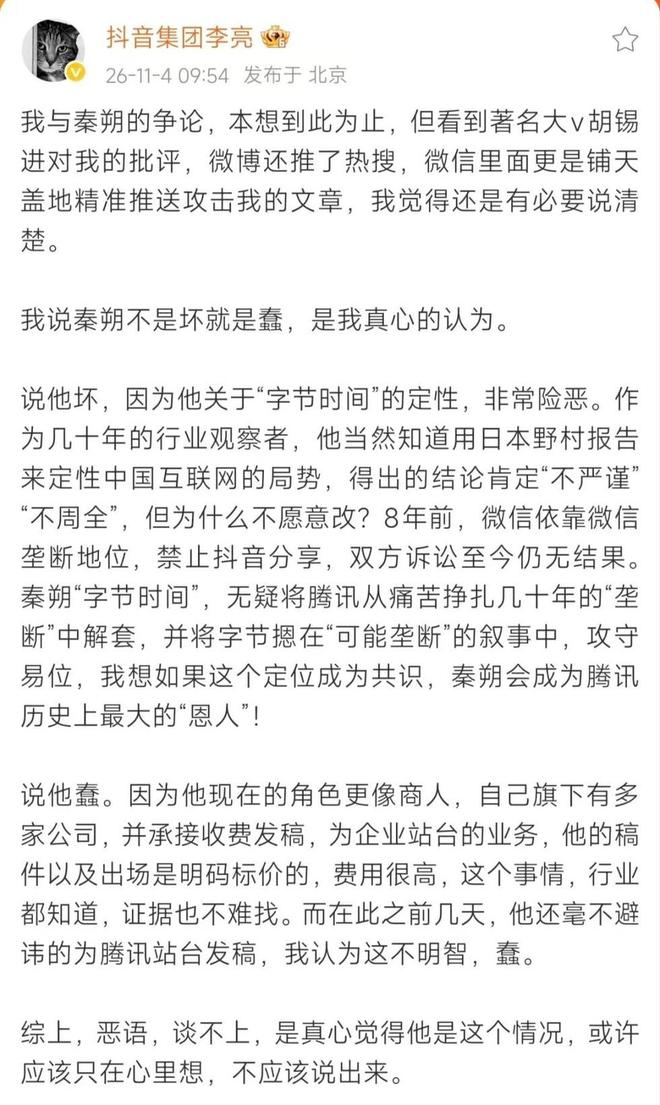
Li Liang's argument becomes sharper when viewed as a sequence. He translated his position into a long public passage that preserved the key facts readers need: “As an industry observer for decades, he naturally knows that using the Japan-based Nomura report to characterize the situation of China's internet will produce a conclusion that is 'not rigorous' and 'not comprehensive,' but why is he unwilling to change it? Eight years ago, WeChat relied on WeChat's monopoly position to block sharing of Douyin, and the two sides' lawsuits still have no result today. Qin Shuo's 'ByteDance Time' clearly releases Tencent from the 'monopoly' label that has caused painful struggles for decades, while pressing ByteDance into a narrative of 'possible monopoly.' Offense and defense are reversed. If this positioning becomes consensus, I think Qin Shuo will become Tencent's greatest 'benefactor' in history.”
That passage is not a neutral data note. It ties a current media argument to older platform conflicts. In the WeChat and Douyin dispute, the practical question was whether a social super-app could restrict external sharing. Eight years ago, that fight shaped user flows, marketing budgets and public-sector communication. If a "ByteDance Time" narrative becomes consensus, Li Liang's warning implies that a court of public opinion may reverse historical positions without a verdict.
Li Liang also attacked Qin Shuo's incentives, writing: “He has multiple companies under his own banner and undertakes paid publishing services to speak for enterprises; his articles and appearances have clearly priced fees, which are high. This thing is known in the industry, and evidence is not hard to find.” This is the second comparison layer. One side argues that the data should change the narrative; the other side argues that the narrator may have interests. A careful reader should test both claims against evidence.
A decision framework for non-experts
Because the case is public, general readers may feel pressure to choose a camp. A comparison approach is safer: decide what kind of claim each statement is, then decide what proof would be needed.
- Classify the claim: Is it a statistic, an interpretation, an accusation of motive, or a legal allegation?
- Check coverage: Does the source include long-tail apps, PC usage, overseas use, enterprise software, browsers and mini-programs?
- Check benchmarks: Is a percentage compared with total internet time, top apps only, revenue, ad budgets or regulatory thresholds?
- Check incentives: Does the person have a business relationship, paid content role or competitive position?
- Check remedies: Is the dispute being handled by data critique, public apology, deletion, platform moderation or court proceedings?
For ordinary users, the practical effect is smaller than the headlines suggest. This is not a policy ruling about Tencent, ByteDance, Douyin or WeChat. It is a public argument among influential people, now with a reputation-rights case. The user-facing lesson is to treat rankings as evidence, not verdicts.
FAQ
What exactly was sued?
Qin Shuo's November 2 statement focused on alleged reputation-right infringement by Li Liang. Public reporting from Jiefang Daily says materials were submitted to a court in Shanghai, and the dispute is described as a reputation-rights case. The claim is about whether certain statements damaged Qin Shuo's reputation, not whether "ByteDance Time" is correct as an economic theory.
Does the lawsuit decide the data question?
It should not. A court may evaluate whether statements were false, insulting or damaging, and whether evidence supports them. It does not have to resolve whether Nomura Securities' mobile Top50 App coverage can define China's internet. If Li Liang says the conclusion is not rigorous, that remains a methodological argument unless a court finds it was used to harm reputation through false or improper expression.
Why did Hu Xijin matter?
Hu Xijin's criticism added a public-perception layer: he said Li Liang's tone was “quite unbecoming of a large company.” Li Liang then said he had planned to let the argument end, but that trending attacks and WeChat-spread critiques pushed him to explain himself. This turns a platform dispute into a test of how large companies and commentators should behave in public.
Is 41.8% a monopoly figure?
Not automatically. The number reported for ByteDance-linked apps in mobile Top50 App time share is below one-half, a level often discussed in market-dominance analysis. But legal or antitrust conclusions require defined markets, competitor behavior, barriers to entry, revenue, user switching and other facts. A single time-share metric is not enough.
Common mistakes in reading this fight
- Assuming all public statements are equally factual. Data citations, accusations and emotional language have different evidentiary burdens.
- Treating mobile Top50 App data as the whole internet. The same report may be accurate within its sample but misleading when scaled up.
- Conflating criticism with proof. Calling an analyst paid does not by itself prove bias unless supported by verifiable evidence.
- Waiting for the lawsuit to settle every claim. Courts resolve legal injury, not broad narratives about competition.
Action advice for readers and professionals
For general tech readers
- Use primary statements, not secondhand summaries, when judging tone.
- Note the scope of any percentage before treating it as a market truth.
- Avoid repeating allegations about motive until the legal record or source documents are available.
For marketing, operations and policy readers
- When citing rankings, state whether they cover mobile only, PC only, app time, revenue or user reach.
- When publishing competitive commentary, separate fact, inference and insult. Public litigation increases the value of careful wording.
- Track platform communication history: restrictions, sharing paths and user behavior can shift narratives without changing underlying usage.
For media and brand teams
- Build a simple checklist: source, date, denominator, exclusions, conflicts of interest and legal risk.
- Use comparison language rather than absolutist framing. A statement such as "within this dataset" protects accuracy.
- Prepare correction paths. If a claim becomes contested, explain the scope instead of adding rhetorical force.
The lasting value of this dispute is not that Tencent, ByteDance, Douyin, WeChat or Nomura Securities can be judged instantly. It is the reminder that public influence now operates on several fronts at once: data, reputation, commercial motive and legal exposure. A side-by-side reading helps readers decide what to trust, what to wait for and what should never be repeated without evidence.