
MyTechDailyNews General: Lens Technology's Profit Reset, Zhou Qunfei's Rich List Moment, and Its AI Server Cabinet Pivot
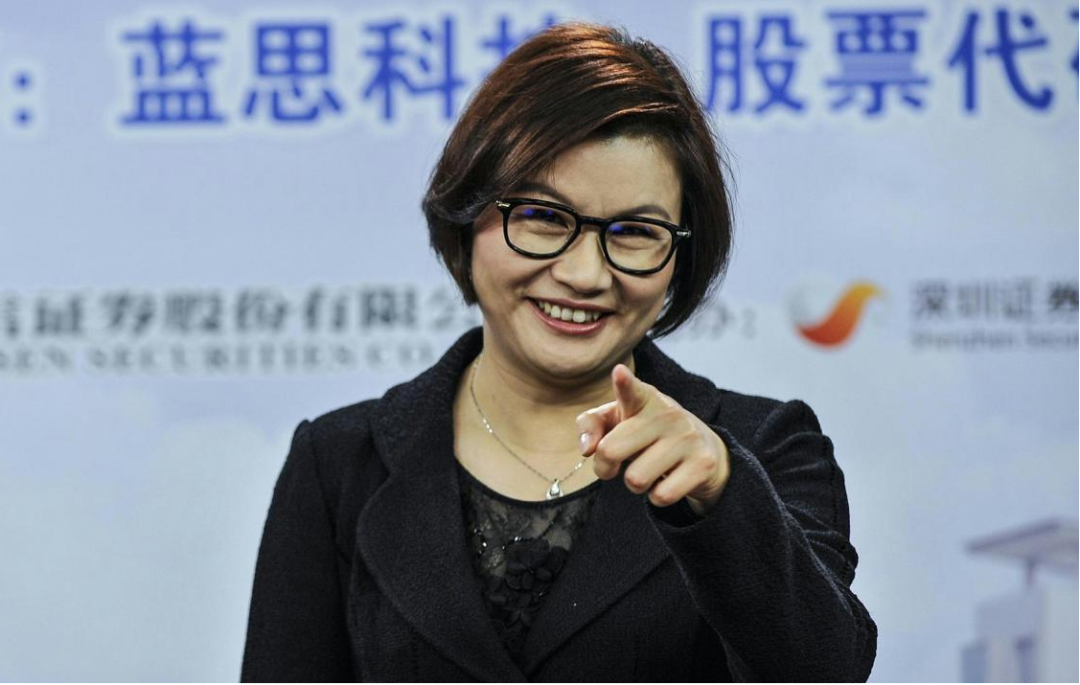
Two days before the wealth list was released, the 2026 third-quarter report of Lens Technology, the Apple-supply-chain leader led by Zhou Qunfei, was disclosed to the public. The numbers were stark: revenue for the first three quarters of this year was 479.02 units of 100 million yuan, down 10.74%, while net profit attributable to the parent fell 50.06% to 14.2 units of 100 million yuan compared with the same period last year. At the same time, the company announced a USD 25 million cash purchase of 59.78% of PMG, equal to 1.72 units of 100 million yuan, to move deeper into AI compute hardware.
What the 2026 third-quarter filing actually shows
Lens Technology disclosed its 2026 third-quarter report on Oct 25. For the entire first three quarters of this year, also called Jan-Sep 2026, revenue was 479.02 units of 100 million yuan and net profit attributable to the parent was 14.2 units of 100 million yuan. The profit decline of 50.06% meant about 5 in 10, or roughly half, was erased.
The slowdown was not limited to one quarter. Revenue had been falling since the fourth quarter of last year, namely Q4 2025. From Q4 2025 through Q3 of this year, quarterly revenue was 207.47, 141.4, 147.27 and 190.35 units of 100 million yuan, with year-on-year growth rates of -12.34%, -17.13%, -7.36% and -8.05% respectively.
The profit line was even starker. In Q4 2025, single-quarter net profit attributable to the parent was 11.75 units of 100 million yuan, down 6.23%. In Q1 of this year, namely Q1 2026, the company turned from profit to loss, with a single-quarter loss of 1.5 units of 100 million yuan. In Q2 of this year, it returned to profit, reporting 7.26 units of 100 million yuan, up 1.77% year-on-year. In Q3 of this year, profit slid again, falling 50.42% to 8.43 units of 100 million yuan from 17 units of 100 million yuan a year earlier, meaning it was halved.
| Period | Net profit attributable to parent (100 million yuan) | Year-on-year change |
|---|---|---|
| Q4 2025 (last year's fourth quarter) | 11.75 | -6.23% |
| Q1 2026 | -1.5 (loss) | from profit to loss |
| Q2 2026 | 7.26 | +1.77% |
| Q3 2026 (this year's third quarter) | 8.43 | -50.42% |
Cost data for the entire first three quarters show mixed movement. Selling expenses were 3.74 units of 100 million yuan, down 11.19%; management expenses were 22.79 units of 100 million yuan, up 8.35%; research and development expenses were 24.35 units of 100 million yuan, down 0.2%. In the same period, finance expenses jumped 1068.19% to 7.16 units of 100 million yuan, mainly because exchange net losses increased during the reporting period.
Non-recurring items also helped. During the first three quarters, non-recurring gains and losses were 4.22 units of 100 million yuan, about 30% of parent net profit. After excluding them, the decline in profit indicators widened, with a year-on-year drop of 63.07%.
By the end of the third quarter, total assets were about 911.65 units of 100 million yuan, total liabilities were 379.79 units of 100 million yuan, and the asset-liability ratio was about 41.66%, up 6.19 percentage points from the same period last year. On Oct 27, Lens Technology closed at 26.58 yuan per share, with a market value of about 1403 units of 100 million yuan.
Zhou Qunfei's rise and the Apple engine that slowed
According to Tianyancha, Lens Technology Co., Ltd. listed on the Shenzhen Stock Exchange ChiNext board in 2015, and its legal representative is Zhou Qunfei. On Oct 27, the Hurun Research Institute released the 2026 Hurun Rich List. Zhou Qunfei, with wealth close to 1300 units of 100 million yuan, became China's richest woman, and her husband Zheng Junlong also entered the list.
Before the headline, Zhou's path included a factory-worker background: due to family hardship, she left school in middle school and worked at Aoya Optical Glass Products Factory; her performance made her favored by managers. In 1993, aged 23, she left Aoya Optical and began a family-workshop style business. A friend's chance brought her into phone glass. In 2003, she founded Lens Technology, focusing on research, production and sales of protective window glass for phones. In 2006, Lens partnered with Apple to create the glass full screen of the first iPhone; the next year, it passed Apple Inc.'s supplier certification and joined the Apple supply chain.
With that Apple relationship, revenue took off, and the smartphone and computer business became the long-term growth engine. Tonghuashun iFinD data shows that in 2023 the segment brought 449.01 units of 100 million yuan, with revenue share 82.4%; in 2024, revenue rose to 577.54 units of 100 million yuan, up 28.63%. In 2025, the business crossed 600 units of 100 million yuan, but growth slowed sharply to 5.94%. In the first half of this year, revenue was 223.82 units of 100 million yuan, about 17.67% lower than the same period last year, and revenue share was about 77.54%.
Lens Technology mostly attributed the decline to a storage-chip cycle disturbing terminal demand and lower assembly revenue. Its 2026 half-year report said that in the first half of 2026 the global storage-chip market showed a rare supply-demand gap, storage prices rose quickly, and supply-chain price increases were transmitted step by step to terminal selling prices. Multiple research institutions pointed to weak consumer-electronics signs; especially entry-level and mainstream consumer products are more price sensitive, and consumers' phone replacement cycles lengthened.
IDC's quarterly data showed global smartphone shipments fell 4.1% in Q1 and 6.7% in Q2 year-on-year; TrendForce repeatedly revised down its forecast for 2026 global notebook PC shipments.
Lens tried to respond by adjusting product and customer mix, opening new domestic well-known customers and adding action-camera high-end assembly work. It sought to raise high-value premium shipments to offset part of lower-value revenue decline. The gross margin of the smartphone and computer business rose 2.99 percentage points to 16.17%.
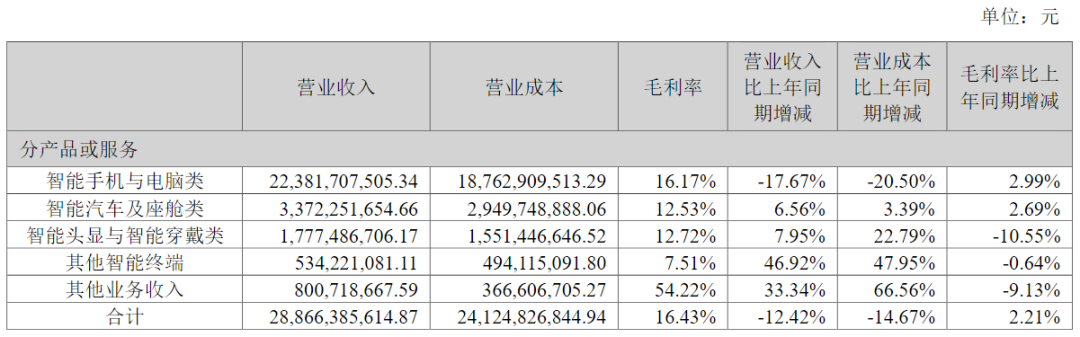
In the same first half, smart car and cockpit revenue was 33.72 units of 100 million yuan, up 6.56%; smart headsets and smart wearables about 17.77 units of 100 million yuan, up 7.95%; other smart terminal revenue 5.34 units of 100 million yuan, up 46.92%. The company said embodied intelligence business continued high growth as industry adoption accelerated, with shipments in the industry front row.
Lens Technology added that its robot dexterous hands, joint modules, other core components and complete-machine assembly were gradually entering a harvest phase. Batch delivery of related products contributed important incremental revenue for the other smart terminal business. However, other smart terminals represented only 1.85% of first-half revenue, far smaller than the smartphone and computer segment, so they could not yet fully reverse the overall decline.
Why an AI server cabinet company matters
Under performance pressure, the 2026 half-year report said Lens Technology is stabilizing its consumer-electronics base while developing AI edge-side hardware and AI compute hardware as new strategic tracks.
On Oct 16, Lens announced that it had signed share-purchase agreements with Lü Songsong, Peimeigao International Ltd. (PMG), Zhejiang Yuanshi, Lü Shaohua and other relevant parties. It planned to buy 59.78% of PMG for USD 25 million, about 1.72 units of 100 million yuan. The company said funds came from lawful own or raised funds; after closing, PMG would become a controlled subsidiary and enter the company's consolidated statements.
PMG's own financials were not impressive. From Jan to Apr 2026, revenue was about 1195.57 ten-thousand yuan and net profit about 70.45 ten-thousand yuan; as of Apr 30 of this year, net assets were about 1145.32 ten-thousand yuan, and debt ratio was 75.08%. This led some observers to suggest the real strategic target was PMG's held entity, Zhejiang Yuanshi, whose main business is AI server cabinets and related structural parts.
Related companies have completed expansion of AI server structural parts and high-efficiency liquid-cooling heat dissipation systems in Songshan Lake Park. They have passed factory audits by domestic and overseas major customers and obtained formal orders, while currently in a production ramp phase.
Zhejiang Yuanshi also has another key identity: it is one of Nvidia's RVL-certified server cabinet suppliers. Hunan Daily reported that in Nvidia's global AI compute ecosystem, RVL certification has a high threshold and long cycle; from certification to formal supply often takes years. As one of the few certified server cabinet suppliers, Zhejiang Yuanshi has supplied MGX racks and slides/rails and other core components for Nvidia GB200/GB300 systems, with multiple products reaching mass-production-ready status. It has also formally joined development work for the next-generation flagship server Vera Rubin, participating in key hardware development.
Analysts say this purchase could be a key step into the global AI compute hardware supply chain. The agreement says the seller will, after closing, negotiate honestly and amicably with Lens Technology, use each side's resources and advantages to co-develop Chinese and international customers, and jointly develop and market liquid-cooling products, OEM cooperation, forging technology, high-power VC vapor chamber plates for premium notebooks, and other new areas.
Lens had already been lining up this AI-compute ticket earlier. In Dec 2025, it signed an intent agreement with Lü Songsong on acquiring 100% of PMG. In Jun 2026, it injected 5000 ten-thousand yuan in cash into Zhejiang Yuanshi, gaining 14.28%. It said PMG's remaining 40.22% equity would be negotiated based on PMG's actual operations, audit and valuation, and confirmed by the parties in a later acquisition agreement.
In Jul 2026, Lens also joined hands with Intel. The companies will discuss and evaluate potential cooperation on TGV advanced packaging, including glass-substrate through-hole forming, high-precision laser processing, metallized through-hole deposition and multi-layer interconnect wiring, but not limited to these. TGV glass substrates have low loss, high-temperature resistance, anti-warpage and extremely high surface flatness, can perfectly fit the demanding packaging needs of AI compute chips, and are regarded by the market as an ideal material for next-generation advanced packaging.
Omdia data cited in the original report puts the 2026 global packaging glass substrate market at 186 units of 100 million USD, or USD 18.6 billion; by 2030, it may exceed 320 units, or USD 32 billion, with CAGR about 14.5%. Industry commentary treats 2026 as the first commercialization year for glass substrate.
Lens said the Intel tie-up could help build a long-term, stable, trust-based strategic partnership with Intel, using strengths in precision manufacturing, materials science and global supply-chain management to accelerate early mass application of related technologies and support its medium- and long-term strategic goals.
FAQ: Three questions general readers may have
Why did profit fall so much if revenue only fell 10.74%?
Because several pressure points overlapped: the core smartphone and computer segment declined, storage-chip prices and terminal demand created cost and replacement-cycle strain, and finance expenses rose sharply by 1068.19% to 7.16 units of 100 million yuan due to exchange net losses. The filing also notes that 4.22 units of 100 million yuan in non-recurring gains, about 30% of parent net profit, partially supported the reported result; excluding them, the decline was 63.07%.
Is PMG the real acquisition target?
PMG is the company being purchased, but the strategic interest appears centered on Zhejiang Yuanshi, the AI server cabinet and structural parts supplier connected to it. This is an interpretation in the original report, not a fact stated as definitive by the company.
Does the AI move mean consumer electronics is no longer important?
No. The report says Lens Technology is stabilizing consumer-electronics base while developing AI hardware. In the first half, smartphones and computers still accounted for about 77.54% of revenue, while other smart terminals were only 1.85%, so the new tracks are strategic but not yet large enough to replace the base.
Checklist: What to watch in Lens Technology's next update
- Whether smartphone and computer revenue stops falling after being down about 17.67% in H1.
- Whether gross margin gains of 2.99 percentage points to 16.17% remain.
- Whether smart car, headset/wearable and other smart terminal revenue keeps growing, especially from a 1.85% base.
- Whether PMG's remaining 40.22% is negotiated after audit and valuation.
- Whether Zhejiang Yuanshi's orders, production ramp and Nvidia-related products turn into disclosed financial impact.
- Whether Intel TGV cooperation moves from evaluation to application.
Common misconceptions to avoid
- Rich-list wealth proves current earnings are improving. The filing shows profit down 50.06% in the first three quarters.
- Any AI deal immediately fixes a manufacturing company. PMG's small revenue and profit, and Zhejiang Yuanshi's ramp stage, mean the effect is future-oriented.
- Apple supply-chain work is only iPhone glass. The business also includes computers, and Lens has expanded into action cameras, vehicles and embodied intelligence.
- RVL certification is the same as guaranteed large supply. Hunan Daily's background suggests certification is a gate with a long cycle before formal supply.
Action suggestions for general tech readers
If you follow consumer electronics companies as a reader, investor, product manager or market analyst, do not jump from headlines to conclusions. Start with the same numbers: revenue, parent net profit, segment revenue share, gross margin, finance expenses and non-recurring gains. Then ask whether the new AI-compute story has disclosed customers, orders, production ramp and legal closing steps. Based on Lens Technology's disclosures, the next checkpoints are the remaining 40.22% PMG negotiation, Zhejiang Yuanshi mass-production ramp, Intel TGV evaluation progress, and any 2026 filing showing whether smartphone/computer demand has stabilized.