
Kioxia's Monday Selloff Explained: What a Missed Forecast in the AI Memory Boom Means for Your Next Gadget
Scarcity of the chips behind your phone's storage, your laptop's drive and your console's SSD just became harder to read. When a supplier posts figures that look almost too good and its shares still get hammered on the first trading day afterwards, the market is not arguing about last quarter. It is arguing about the next one. That is the story coming out of Japan this week, and it reaches far beyond trader screens.
Start with the part nobody disputes: the results were enormous
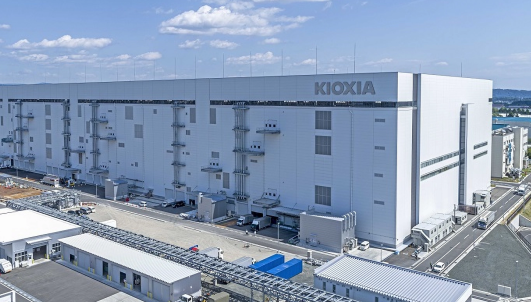
Only a few months ago, the AI-driven storage supercycle looked immune to doubt. In June this year, that wave had lifted Kioxia — the NAND flash specialist that grew out of Toshiba's memory business — to the position of Japan's most valuable listed company. The numbers published last Friday, covering the fiscal second quarter of 2026 (the quarter that ran to the end of September), made the boom plain in raw arithmetic: revenue of ¥2.48 trillion, up 453.20% year on year. Put another way, one quarter out-earned the whole of the previous fiscal year, which landed at about ¥2.34 trillion. Adjusted operating profit surged 2,181.10% year on year.
The trigger was the outlook, not the earnings report
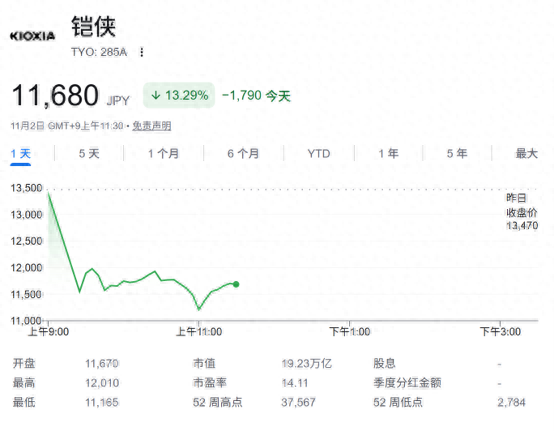
The selling started because management turned the camera forward instead of back. Kioxia guided last Friday to December quarter operating profit of ¥2 trillion — roughly US$12.7 billion — a step below the ¥2.35 trillion that analysts had collectively modelled. Measured against the ¥1.99 trillion the company booked in the September quarter, that forecast implies growth grinding almost to a halt after a stretch in which, across the past several quarters, operating profit had climbed on a steep upward slope.
| What to compare | The figure | Why investors read it as they did |
|---|---|---|
| Fiscal second quarter of 2026 revenue, quarter ended September | ¥2.48 trillion, +453.20% year on year | Bigger in one quarter than the full previous fiscal year (about ¥2.34 trillion) |
| Adjusted operating profit, same quarter | +2,181.10% year on year | Backward-looking; already priced in |
| December quarter operating profit guide | ¥2 trillion (about US$12.7 billion) | Short of the ¥2.35 trillion consensus |
| September quarter operating profit | ¥1.99 trillion | Makes the new guide look like near-zero sequential growth |
| NAND average selling price momentum | Second quarter of 2026: up about 70% quarter on quarter; third quarter: the gain shrank sharply to about 20% | Price speed, not price level, drives memory-share sentiment |
How the company explains a flat quarter
Kioxia's own diagnosis is a calendar problem rather than a demand problem, and it rests on two moving parts:
- Work pulled in. At customers' request, some orders scheduled for delivery in the current quarter were shifted earlier, into the September quarter — flattering one period and robbing the next.
- Work pushed out. Other orders slipped into the March quarter of the following year, because enterprise storage products now make up a larger share of the mix and those products need a longer production cycle.
- The demand claim. Chief Financial Officer Yoshihiko Kawamura told a conference call last week that orders from AI data center operators remain strong and that the company expects to be back on a fast growth track in the March quarter next year. He added that planned capacity for next year is completely sold out, more than half of the output earmarked for the year after next has already been allocated, and that some large customers have begun negotiating contracts covering 2029 and beyond.
Two signals that carry more weight than the headline beat
First is pricing velocity. In the second quarter of 2026, Kioxia's NAND average selling price rose about 70% quarter on quarter; in the third quarter, that increase shrank abruptly to about 20%. Memory stocks are typically valued on the slope of price change rather than the absolute level, so a slower climb gets read as a possible bend in the up-cycle.
Second is product mix. Kioxia's structural disadvantage, as investors see it, is focus: it sells NAND flash, while its South Korean competitors also ship DRAM — the other critical ingredient inside AI machines — and therefore hold stronger bargaining power when buyers negotiate across a whole platform rather than a single chip type.
The scare that faded, and the fragility underneath
On Monday morning, in the early session, Samsung Electronics slipped more than 3% and SK hynix dropped more than 1%, a reflex move across the memory trade. Both then reversed: as of press time, Samsung shares were up 0.44% and SK hynix shares were up 2.75%. The divergence told its own story — the worry was company-specific before it was industry-wide.
The other accelerant was structural. Among all companies listed on the Tokyo Stock Exchange, Kioxia has the highest concentration of leveraged long positions. When a negative catalyst lands, traders running on borrowed money can be forced to sell regardless of their view, which turns a reasonable repricing into a sharp one.
Why this belongs in a general tech feed, not just a markets one
Flash memory is one of the largest component line items in the hardware people actually buy. Industry analysis of the current shortage, including work by research house IDC, has warned that rising DRAM and NAND costs could push up smartphone and PC prices through 2026 and squeeze entry-level storage configurations. Kioxia is not a niche player in that supply chain: market tracker TrendForce ranked it third among NAND suppliers by revenue in early 2026, with about 13.9% share. If a large portion of that capacity is contractually reserved for AI data centers through 2029 and beyond, consumer-facing supply tightens even while demand for phones and laptops stays ordinary.
Three common misconceptions
- "A stock drop means the results were bad." Here the results were a blowout; the disappointment sat entirely in the forward guide.
- "Sold-out capacity means unlimited pricing power." Long-term allocations bring revenue visibility, but they usually lock in negotiated terms rather than allowing spot-price windfalls.
- "One flat quarter ends the AI build-out." Shipment timing, product mix and price momentum can all flatten a single quarter while the underlying trend continues.
Questions readers ask
Is this the end of the memory up-cycle?
Not established. Monday's move reflected a weaker guide and slower price gains, not a collapse in orders — the company still reports demand from AI data center operators as robust.
Why guide below what analysts expected?
Because guidance reflects shipping schedules, customer negotiations and product mix. When a company says orders moved between quarters, consensus models can briefly outrun reality.
Should I rush to buy an SSD or a new laptop?
Only if you need the device now. Memory pricing is a slow-moving cost pass-through; panic-buying storage rarely saves much and can lock you into an inflated retail price.
What should I watch next?
Three things: whether the March quarter actually re-accelerates as promised, the next reading on NAND average selling price momentum, and any further commentary from management that leans cautious rather than confident.
A practical checklist before your next device upgrade
- Compare storage tiers rather than headline model names — the gap between a smaller and a larger drive is where component costs show up first.
- Check whether a laptop or phone you are considering uses soldered storage; if it does, buy the capacity you will need in two years, not today.
- Treat a "record quarter" headline as history. Look for the forward guide and the direction of average selling prices.
- Note the mix: products sold into data centers compete for the same wafers as products sold into consumer devices.
- Ignore single-day price moves in the underlying stocks unless the reason is a change in guidance, capacity or pricing.
The useful takeaway from this week is not that a great quarter got punished. It is that in memory-heavy markets, the boring forward-looking lines in an earnings release — one forecast number and the speed of price change — decide the mood for everyone downstream, from traders in Tokyo to shoppers comparing laptops. The next few monthly readings will show whether this was a scheduling blip on the way to more growth or the first soft edge of a cycle that has run hot for a very long time.
Have a tech story you want decoded in plain language? The MyTechDailyNews General desk is listening — write to hello@techdaily.com. This report was prepared by Sarah Chen for Tech Daily.